
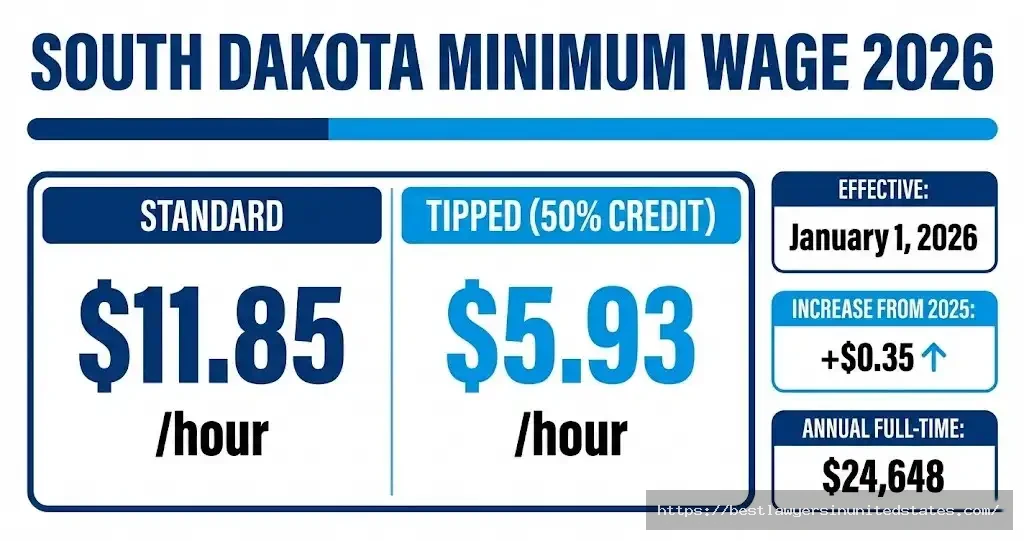
Quick Answer: South Dakota’s minimum wage will increase to $11.85 per hour on January 1, 2026. This represents a $0.35 increase from the 2025 rate of $11.50. The tipped minimum wage will be approximately $5.93 per hour, with employers allowed to claim a 50% tip credit as long as employees earn at least $11.85 per hour with tips included.
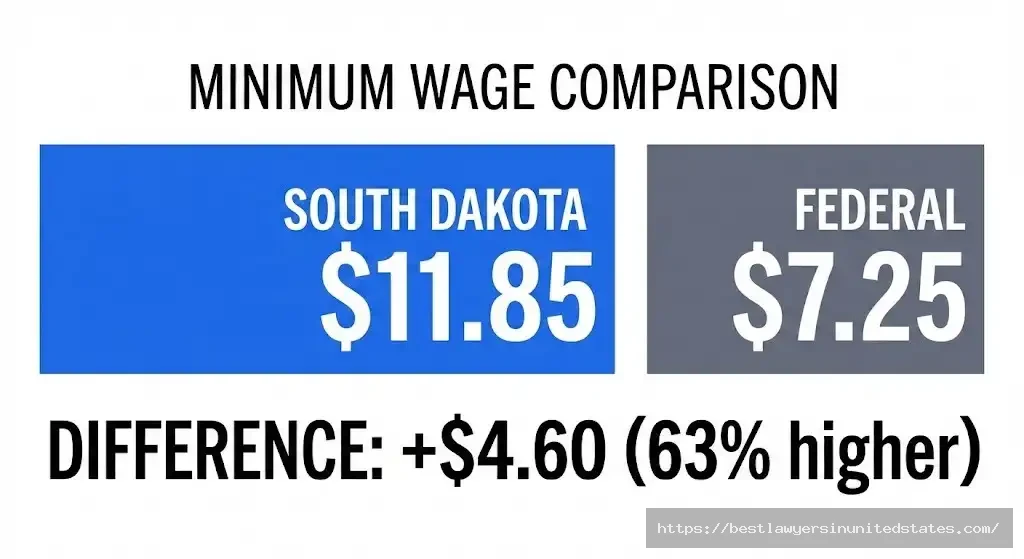
South Dakota uses an automatic cost-of-living adjustment system tied to the Consumer Price Index. This means the minimum wage increases annually without requiring new legislation. The state’s minimum wage currently sits $4.60 above the federal minimum wage of $7.25, which hasn’t increased since 2009.
Workers in South Dakota benefit from predictable wage growth, while employers can plan ahead knowing the October announcement timeline each year. The state also maintains no income tax, which helps offset living costs for minimum wage earners.
Calculate Your 2026 Earnings in South Dakota
Want to know exactly how much you’ll earn at South Dakota’s $11.85 minimum wage in 2026? Use our free calculator to estimate your weekly, monthly, and annual income based on your hours worked.
💰 Minimum Wage Earnings Calculator
Calculate your weekly, monthly, and annual earnings with overtime and tax estimates
📊 Your Earnings Breakdown
💰 Gross Earnings
Calculator features:
- Automatic South Dakota wage rates for 2026
- Weekly, monthly, and annual earnings projections
- Overtime calculations at time-and-a-half
- Tax withholding estimates
- Take-home pay breakdown
Full calculator with all features: Minimum Wage Calculator
Questions about your wages or need legal help?
Email: [email protected]
South Dakota Minimum Wage Rates for 2026
Standard Minimum Wage
South Dakota's standard minimum wage applies to most employees regardless of company size. The $11.85 hourly rate takes effect January 1, 2026, and covers full-time, part-time, and seasonal workers in nearly all industries.
The rate applies statewide with no city or county overrides. Unlike states such as California or New York, South Dakota maintains a single uniform minimum wage across all municipalities.
| Effective Date | Minimum Wage | Increase from Prior Year | Annual Earnings (Full-Time) |
|---|---|---|---|
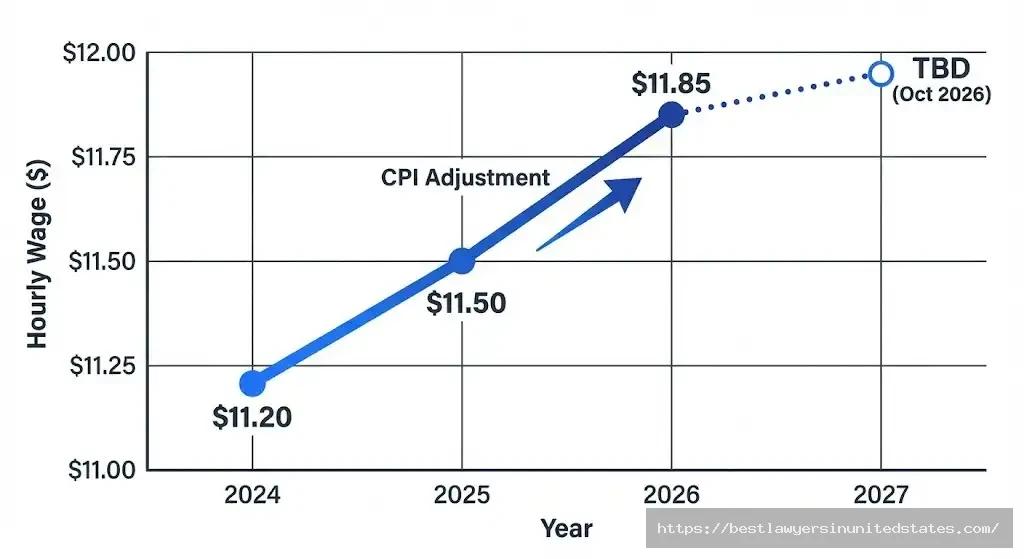
| January 1, 2024 | $11.20 | $0.30 | $23,296 |
| January 1, 2025 | $11.50 | $0.30 | $23,920 |
| January 1, 2026 | $11.85 | $0.35 | $24,648 |
| January 1, 2027 | TBD (Oct 2026) | Varies by CPI | TBD |
Tipped Employee Minimum Wage
South Dakota allows employers to pay tipped employees a reduced minimum wage using a tip credit system. The tipped minimum wage for 2026 will be approximately $5.93 per hour, which represents 50% of the standard minimum wage.
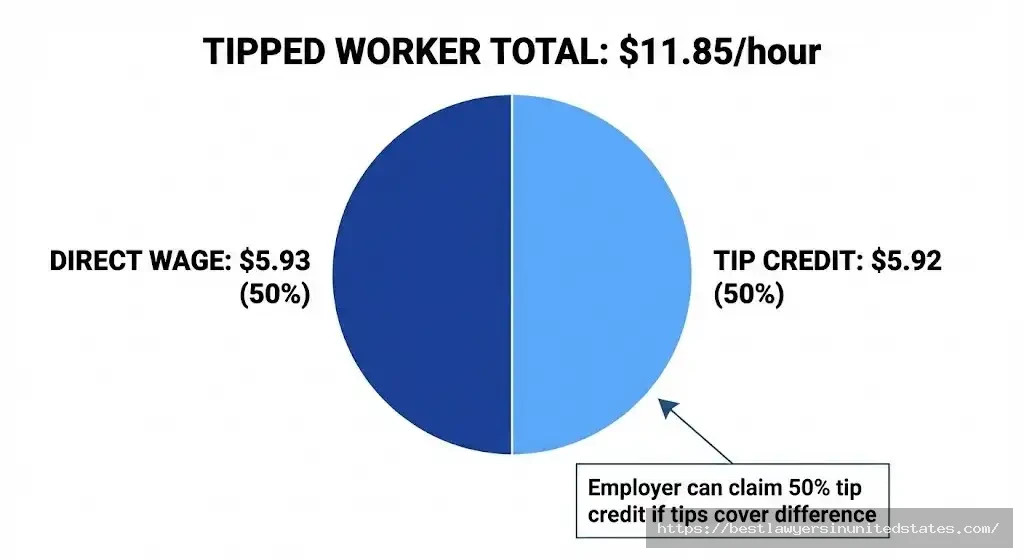
Employers can claim this tip credit only if employees earn enough in tips to reach the full $11.85 minimum wage. If tips fall short, employers must make up the difference.
Key tipped wage rules:
- Employee must earn at least $11.85/hour total (wages + tips)
- Employer pays direct wage of $5.93/hour minimum
- Tip credit cannot exceed $5.92/hour
- 80/20 rule applies to tipped duties
Example calculation:
- Server works 8-hour shift
- Receives $5.93/hour base wage = $47.44
- Earns $50 in tips during shift
- Total = $97.44 for 8 hours
- Hourly rate = $12.18 (above $11.85 minimum)
- ✅ Employer complies with law
Training Wage (Opportunity Wage)
South Dakota follows the federal training wage provision. Employers can pay workers under age 20 a training wage of $4.25 per hour for their first 90 consecutive calendar days of employment.
After 90 days or when the employee turns 20 (whichever comes first), the employer must pay the full minimum wage. This provision helps businesses train entry-level workers while managing costs.
Training wage restrictions:
- Only for workers under age 20
- Maximum 90 consecutive calendar days
- Cannot displace existing workers
- Must pay full wage after 90 days or age 20
How South Dakota Calculates Annual Wage Increases
The Initiated Measure 18 System
South Dakota voters approved Initiated Measure 18 in 2014, which established automatic annual minimum wage adjustments. The system ties wage increases to the Consumer Price Index for Urban Wage Earners and Clerical Workers (CPI-W) published by the U.S. Bureau of Labor Statistics.
Each October, the South Dakota Department of Labor and Regulation calculates the new minimum wage using the prior 12-month CPI-W change. This ensures wages keep pace with inflation without requiring legislative action each year.
The formula provides predictable increases for workers and planning certainty for employers. South Dakota joins states like Montana and Ohio in using automatic inflation-based adjustments.
2026 Calculation Methodology
The $11.85 rate for 2026 comes from applying the August 2024 to August 2025 CPI-W increase to the 2025 minimum wage of $11.50. The Department of Labor announced this figure in October 2025, as required by South Dakota Codified Laws § 60-11-3.1.
Calculation timeline:
- August 2025: Bureau of Labor Statistics releases CPI-W data
- October 2025: SD Department of Labor calculates new wage
- October 2025: Official announcement made to employers
- January 1, 2026: New rate takes effect
Historical Adjustment Patterns
South Dakota's minimum wage has increased every year since 2015, when the CPI adjustment system began. The increases have ranged from $0.15 to $0.50 annually, depending on inflation rates.
| Year | Minimum Wage | Dollar Increase | Percentage Increase |
|---|---|---|---|
| 2015 | $8.50 | $0.50 (initial) | 6.3% |
| 2018 | $8.85 | $0.15 | 1.7% |
| 2021 | $9.45 | $0.30 | 3.3% |
| 2024 | $11.20 | $0.30 | 2.8% |
| 2025 | $11.50 | $0.30 | 2.7% |
| 2026 | $11.85 | $0.35 | 3.0% |
The system has delivered consistent wage growth that outpaces the stagnant federal minimum wage, which has remained at $7.25 since 2009.
Tipped Employee Rules and 80/20 Compliance
Understanding South Dakota's Tip Credit
South Dakota allows employers to claim a tip credit equal to 50% of the minimum wage. This means employers can pay tipped employees $5.93 per hour in direct wages as long as tips bring total compensation to at least $11.85 per hour.
The tip credit shifts some wage costs to customers through tipping. However, employers retain full responsibility for ensuring employees earn the minimum wage. If tips fall short during any pay period, employers must make up the difference.
This differs significantly from states like California and Minnesota, which prohibit tip credits entirely and require full minimum wage payment regardless of tips.
The 80/20 Rule Explained
The 80/20 rule limits how much time tipped employees can spend on non-tipped duties. If an employee spends more than 20% of their work time on tasks that don't generate tips, the employer cannot claim the tip credit for those hours.
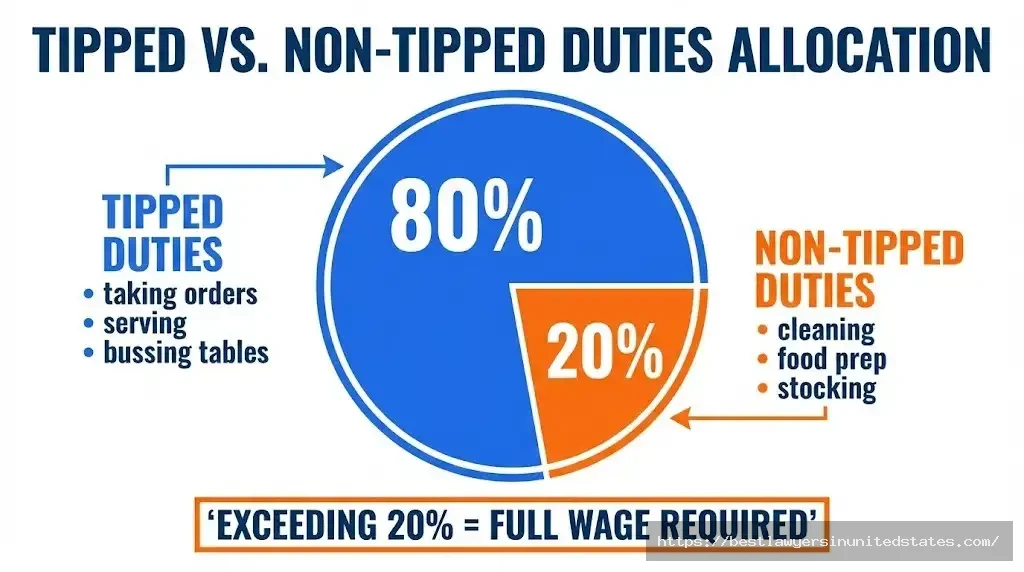
Tipped duties (tip credit allowed):
- Taking customer orders
- Serving food and beverages
- Bussing tables in dining area
- Greeting and seating customers
Non-tipped duties (full wage required if over 20%):
- Cleaning restrooms
- Mopping floors
- Food preparation in kitchen
- Stocking supplies
Example scenario:
- Server works 8-hour shift
- Spends 6.5 hours on tipped duties (81%)
- Spends 1.5 hours on non-tipped duties (19%)
- ✅ Employer can claim tip credit for all hours
If non-tipped duties exceed 20%, the employer must pay the full $11.85 minimum wage for those hours.
Common Tip Credit Violations
Many employers misunderstand or misapply tip credit rules, leading to wage violations. Workers experiencing these issues should document their hours carefully and may need to explore legal options for workplace disputes.
Frequent violations:
- Requiring excessive non-tipped duties
- Keeping portion of employee tips
- Including managers in tip pools
- Failing to track tip income properly
Workers who believe their employer violated tip credit rules can file complaints with the South Dakota Department of Labor and Regulation or pursue claims under federal law.
South Dakota Minimum Wage Exemptions
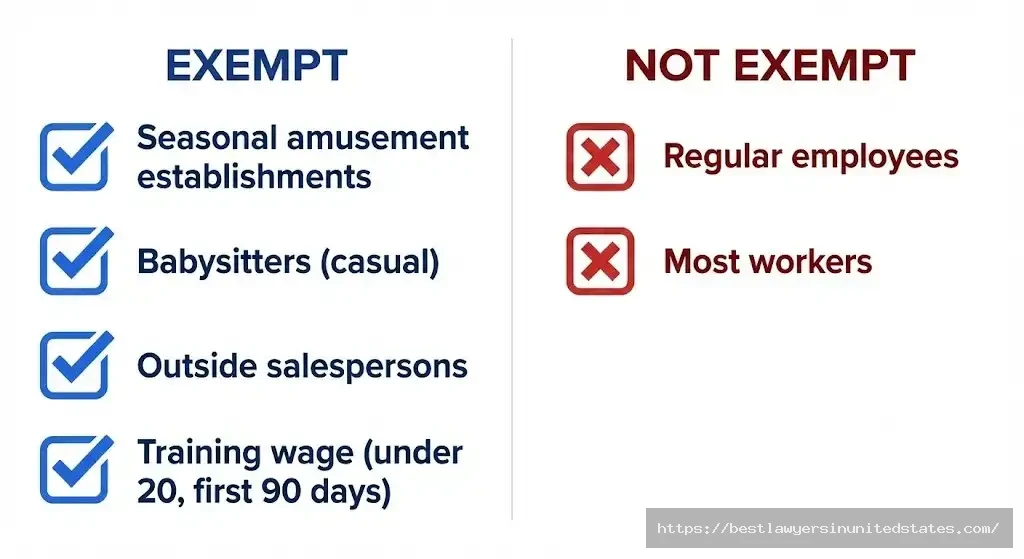
Who Is Exempt from Minimum Wage?
South Dakota law provides specific exemptions from minimum wage requirements. These exemptions apply to certain worker categories and employment situations where the standard wage rules don't fit.
Employers must carefully review exemption criteria, as misclassifying employees can result in significant penalties. When uncertain, consult the South Dakota Department of Labor and Regulation or seek guidance through legal options for workplace disputes.
Seasonal and Recreational Establishments
Employers operating seasonal amusement or recreational establishments qualify for minimum wage exemptions under specific conditions. These typically include summer camps, ski resorts, amusement parks, and similar businesses that operate only part of the year.
To qualify for exemption:
- Business must operate no more than 7 months per year
- Gross receipts for the 7-month period must not exceed one-third of annual gross receipts for prior year
- Establishment must be primarily recreational or amusement-focused
This exemption recognizes the seasonal nature of certain industries in South Dakota, where short operating seasons make standard wage requirements challenging.
Babysitters and Casual Employment
Individuals employed as babysitters on a casual basis are exempt from minimum wage requirements. This exemption covers irregular, infrequent childcare provided in the employer's home.
The exemption does not apply to professional childcare workers, daycare employees, or nannies in regular employment arrangements. Regular, scheduled childcare work requires minimum wage payment.
Outside Salespersons
Outside salespersons who work primarily away from the employer's place of business are exempt from minimum wage laws. These workers typically earn commission-based compensation rather than hourly wages.
To qualify as an outside salesperson:
- Primary duties involve making sales or obtaining orders
- Work performed away from employer's business location
- Customarily and regularly engaged away from place of business
Training Wage Details
As noted earlier, employers can pay workers under age 20 a training wage of $4.25 per hour for 90 days. This federal provision aims to encourage hiring of young workers with limited experience.
Training wage requirements:
- Worker must be under age 20
- Limited to first 90 consecutive calendar days
- Wage increases to $11.85 after 90 days or 20th birthday
- Cannot displace existing workers to hire training wage workers
Agricultural Worker Considerations
Many agricultural workers in South Dakota fall under federal H-2A visa programs, which set their own minimum wage rates. The H-2A minimum wage for 2026 typically exceeds South Dakota's state minimum wage.
Employers hiring H-2A workers must pay the higher of:
- State minimum wage ($11.85)
- H-2A adverse effect wage rate (set federally, often $15-17/hour)
- Prevailing wage for the occupation and area
Overtime Pay Rules in South Dakota
Federal FLSA Overtime Standards
South Dakota follows federal Fair Labor Standards Act (FLSA) overtime requirements. Employers must pay non-exempt employees one and one-half times their regular hourly rate for all hours worked over 40 in a workweek.
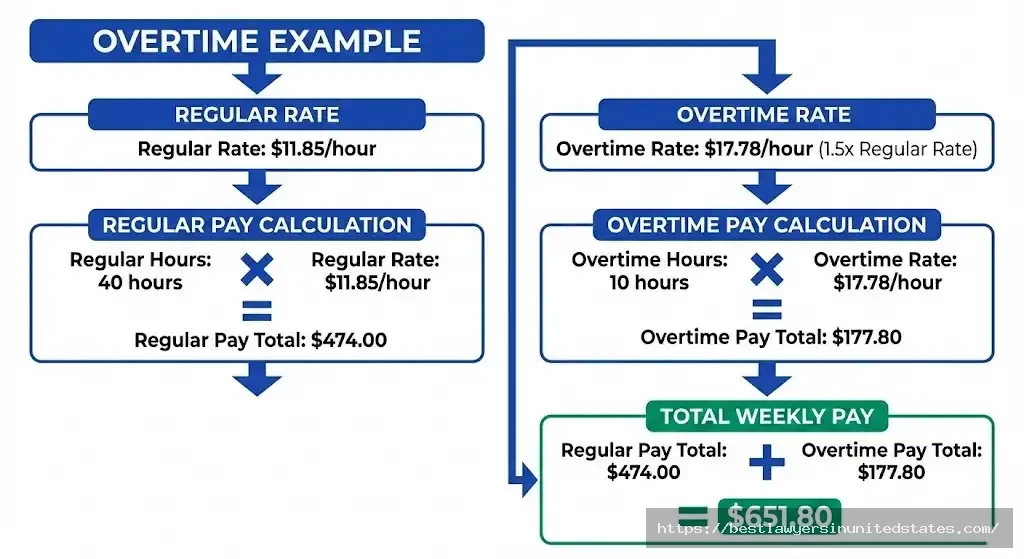
The state does not have additional daily overtime requirements like California, which mandates overtime after 8 hours in a single day. South Dakota workers earn overtime only when exceeding 40 hours per week.
Basic overtime calculation:
- Regular wage: $11.85/hour
- Overtime rate: $17.78/hour (1.5 × $11.85)
- Hours 1-40: Paid at regular rate
- Hours 41+: Paid at overtime rate
Calculate Your Overtime Pay in South Dakota
Working more than 40 hours per week? Calculate your overtime earnings based on South Dakota's overtime laws. This calculator accounts for the state's weekly overtime threshold and provides accurate pay estimates.
⏰ Overtime Pay Calculator
Calculate your overtime earnings based on your state's specific labor laws
📍 Select Your State
💰 Your Hourly Wage
📊 Calculation Method
📅 Weekly Hours
💵 Your Weekly Overtime Pay
📊 Earnings Breakdown
📅 Pay Period Estimates
⚖️ State vs Federal Comparison
Calculator features:
- South Dakota-specific overtime rules
- Weekly overtime calculations
- Pay period breakdowns
- Comparison with regular earnings
- Multiple pay period options
Full overtime calculator: Overtime Pay Calculator
Questions about your wages or need legal help?
Email: [email protected]
Overtime for Tipped Employees
Calculating overtime for tipped employees requires additional steps. The overtime rate applies to the full minimum wage ($11.85), not just the tipped minimum wage ($5.93).
Tipped employee overtime example:
- Regular hours (1-40): $5.93 direct wage + tips
- Overtime hours (41+): $11.85 × 1.5 = $17.78 per hour
- Employer can claim tip credit on overtime hours if tips sufficient
- If tip credit claimed: Employee receives $8.89 direct wage + tips on overtime hours
Many employers incorrectly calculate tipped employee overtime, resulting in underpayment. Workers can use the overtime pay calculator to verify their employer's calculations.
Exempt vs. Non-Exempt Employees
Not all employees qualify for overtime pay. The FLSA establishes exemptions for certain executive, administrative, professional, and outside sales employees who meet specific criteria.
To qualify for exemption, employees must meet both:
- Salary basis test: Paid at least $844 per week ($43,888 annually) as of 2024
- Duties test: Primary duties involve executive, administrative, or professional work
Common exempt positions include:
- Company executives and managers
- Licensed professionals (doctors, lawyers, teachers)
- Outside sales representatives
- Certain computer professionals
Simply paying a salary doesn't create an exemption. The employee's actual job duties must match exemption criteria. Misclassifying non-exempt workers as exempt violates wage laws and can trigger significant penalties.
Employer Compliance Requirements in South Dakota
Mandatory Minimum Wage Poster
South Dakota law requires all employers to display the official minimum wage poster in a conspicuous location where employees can easily see it. The South Dakota Department of Labor and Regulation provides this poster free of charge.
Employers must update the poster annually when the minimum wage changes. The 2026 poster should be displayed no later than January 1, 2026, showing the $11.85 rate.
Posting requirements:
- Display in common area accessible to all employees
- Must be clearly visible and legible
- Update annually with new wage rate
- Available in English and other languages as needed
Where to obtain the poster:
- Download from SD Department of Labor website
- Request physical copy from department offices
- Include in employee handbooks or break rooms
Failure to display the required poster can result in penalties during labor inspections.
Recordkeeping Requirements
The Fair Labor Standards Act and South Dakota law require employers to maintain accurate payroll records for at least three years. These records must document hours worked, wages paid, and other employment details.
Required records for each employee:
- Full name and Social Security number
- Address and birth date (if under 19)
- Time and day when workweek begins
- Hours worked each day and total hours each workweek
- Basis of wage payment (hourly, weekly, commission)
- Regular hourly rate
- Total daily or weekly straight-time earnings
- Total overtime earnings for the workweek
- All additions to or deductions from wages
- Total wages paid each pay period
- Date of payment and pay period covered
Employers should retain these records for the full three-year period. During wage disputes, proper recordkeeping provides critical evidence of compliance.
Wage Payment Law Requirements
South Dakota Codified Laws § 60-11-10 establishes specific requirements for wage payments. Employers must pay employees at least monthly on regularly scheduled paydays, with no more than 15 days between the end of the pay period and payday.
Key wage payment rules:
- Minimum payment frequency: Monthly
- Maximum delay: 15 days after pay period ends
- Must establish regular payday schedule
- Advance notice required for payday changes
Final Pay Requirements
South Dakota law distinguishes between termination and resignation when determining final pay timing:
When employee is terminated:
- Final pay due at time of termination or next regular payday
- Employer should process final pay immediately when possible
When employee resigns:
- Final pay due on next regular payday
- Earlier payment optional but not required
Employers who fail to provide final pay on time may face penalties and employee lawsuits. Workers experiencing final pay issues should document the termination date and expected payment schedule.
| Separation Type | Final Pay Due | Penalties for Late Payment |
|---|---|---|
| Termination | At termination or next payday | Waiting time penalties possible |
| Resignation | Next regular payday | Waiting time penalties possible |
| Mutual agreement | Next regular payday | Waiting time penalties possible |
What If You're Not Being Paid Properly?
Recognizing Wage Theft in South Dakota
Wage theft occurs when employers fail to pay workers the full wages they've earned. This illegal practice costs workers billions of dollars annually nationwide and affects workers across all industries.
Common wage theft violations in South Dakota:
- Paying below minimum wage ($11.85 in 2026)
- Refusing to pay overtime after 40 hours
- Misclassifying employees as exempt
- Keeping employee tips or forcing illegal tip pools
- Requiring off-the-clock work
- Making illegal deductions from paychecks
- Failing to pay final wages on time
Workers who suspect wage theft should document everything: pay stubs, time sheets, work schedules, and any communications about pay. This evidence becomes critical when filing complaints or pursuing legal action.
Calculate Your Wage Theft Recovery in South Dakota
Think your employer owes you money? Use our wage theft calculator to estimate how much you could recover, including unpaid wages, penalties, and interest under South Dakota law.
Wage Theft Recovery Calculator
Estimate how much you can recover in unpaid wages, penalties, and damages based on your state's laws
💵 Estimated Total Recovery
💰 Unpaid Wages
⚖️ Penalties & Damages
📋 Total Summary
Calculator features:
- Multiple violation types (unpaid wages, overtime, tips)
- South Dakota-specific penalties and damages
- Filing deadline tracker
- Total recovery estimate
- Next steps guidance
Full wage theft calculator: Wage Theft Calculator
Need help with unpaid wages?
Email: [email protected]
Workers can also consult a wage garnishment lawyer for guidance on recovering unpaid wages and protecting future earnings.
How to File a Wage Complaint
Workers have two options for filing wage complaints: state or federal agencies. Each has different processes and timelines.
South Dakota Department of Labor and Regulation:
- Contact the Division of Labor and Management
- Complete wage claim form
- Provide supporting documentation
- Department investigates complaint
- Department attempts resolution or refers to legal action
U.S. Department of Labor Wage and Hour Division:
- File complaint online, by phone, or in person
- Provide employment details and evidence
- DOL investigates employer
- DOL may assess back wages and penalties
- Workers can pursue private lawsuit if needed
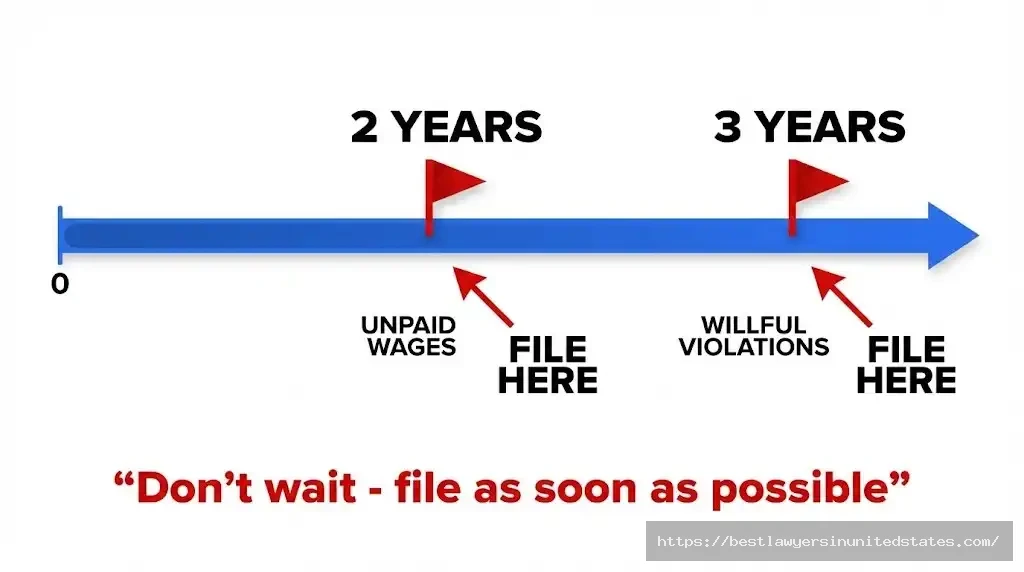
Filing deadlines:
- State claims: 2 years from violation (3 years if willful)
- Federal FLSA claims: 2 years (3 years if willful)
- Document violations immediately to preserve claims
Wage Theft Recovery Options
Workers who successfully prove wage violations can recover several types of compensation:
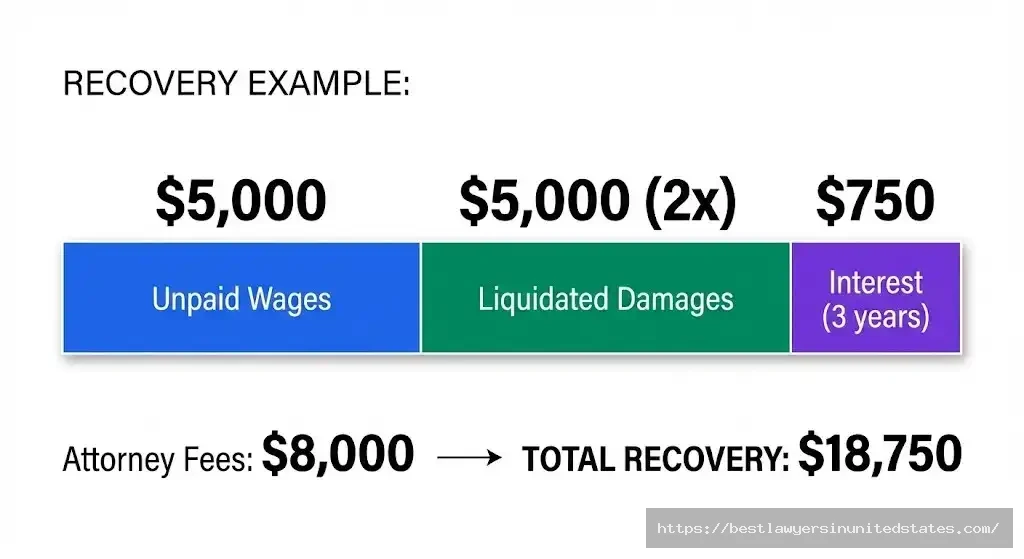
Available damages:
- Back pay: Full amount of unpaid wages owed
- Liquidated damages: Equal to back pay amount (double recovery)
- Interest: On unpaid wages from due date
- Attorney fees: If you hire lawyer to pursue claim
- Court costs: Filing fees and litigation expenses
Example recovery calculation:
- Unpaid overtime: $5,000
- Liquidated damages: $5,000
- Interest (3 years): $750
- Attorney fees: $8,000
- Total recovery: $18,750
The wage theft calculator helps workers estimate potential recovery amounts before filing claims. This information helps workers decide whether to pursue complaints and what remedies to seek.
Legal Resources and Free Assistance
Several organizations provide free help to workers dealing with wage issues:
South Dakota resources:
- SD Department of Labor and Regulation: (605) 773-3101
- Division of Labor and Management offices in Pierre and Sioux Falls
- Legal aid organizations for low-income workers
Federal resources:
- U.S. Department of Labor Wage and Hour Division: 1-866-487-9243
- Online complaint filing at dol.gov
- Free wage and hour compliance assistance
Workers can also consult with employment attorneys who often provide free initial consultations. Many wage theft cases are handled on contingency, meaning lawyers only get paid if they recover money for the worker.
South Dakota vs. Neighboring States
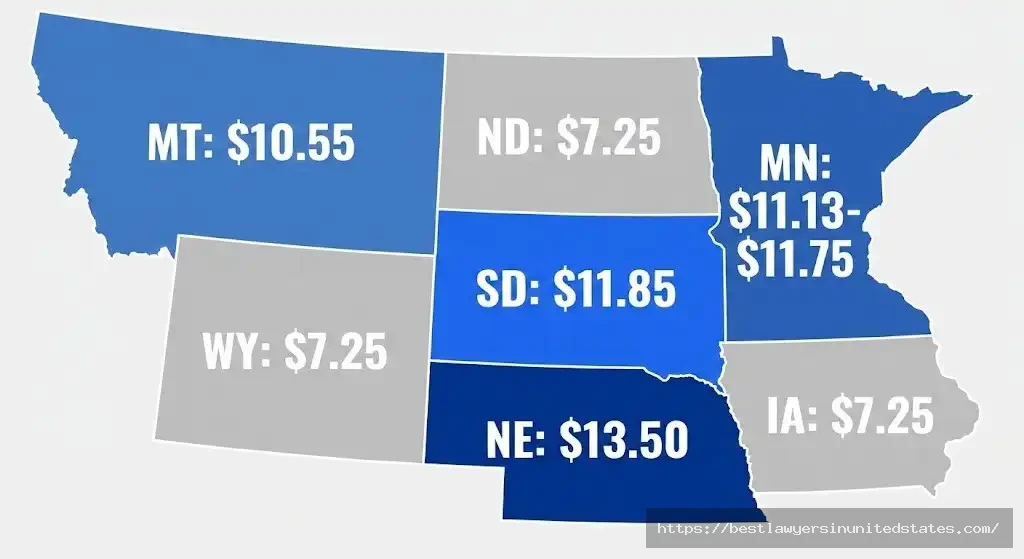
Regional Wage Comparison
South Dakota's minimum wage positions the state in the middle of its regional neighbors. The $11.85 rate for 2026 exceeds some neighboring states while falling below others.
| State | 2026 Minimum Wage | Difference from SD | Tipped Wage | Adjustment Method |
|---|---|---|---|---|
| South Dakota | $11.85 | Baseline | $5.93 | Annual CPI |
| North Dakota | $7.25 | -$4.60 | $4.86 | Follows federal |
| Minnesota | $11.13-$11.75 | -$0.10 to -$0.72 | $11.13-$11.75 | Annual inflation |
| Nebraska | $13.50 | +$1.65 | $2.13 | Scheduled increases |
| Iowa | $7.25 | -$4.60 | $4.35 | Follows federal |
| Montana | $10.55 | -$1.30 | $10.55 | Annual CPI |
| Wyoming | $7.25 | -$4.60 | $2.13 | Follows federal |
Nebraska offers the highest minimum wage in the region at $13.50, while North Dakota, Iowa, and Wyoming stick with the federal $7.25 rate.
Cost of Living Context
South Dakota's no-income-tax policy partially offsets its moderate minimum wage. While a worker in Minnesota might earn slightly more per hour, they also pay state income tax that South Dakota workers avoid.
Tax advantage example:
- SD worker earning $11.85/hour (full-time): $24,648 annual
- No state income tax: $24,648 take-home (before federal)
- MN worker earning $11.75/hour (full-time): $24,440 annual
- MN state income tax (~5.35%): $23,133 take-home
- SD advantage: $1,515 more annually
This tax structure makes South Dakota competitive for workers despite having a lower minimum wage than some neighbors. Housing costs in South Dakota cities also tend to run below regional averages.
Worker Migration Trends
Minimum wage differences create economic pressures that influence where people choose to work. Border communities near Nebraska may see workers commute for higher wages, while lower costs and no income tax attract workers from states like Minnesota.
Economic research shows minimum wage variations affect:
- Where workers seek employment
- Where businesses choose to locate
- Regional competition for labor
- Cross-border commuting patterns
Understanding these regional differences helps workers make informed decisions about employment opportunities across state lines.
Living Wage vs. Minimum Wage in South Dakota
What Is a Living Wage?
A living wage represents the income needed to cover basic expenses without government assistance or hardship. Unlike minimum wage, which sets a legal floor for hourly pay, living wage calculations account for actual cost of living in specific areas.
The MIT Living Wage Calculator estimates living wages for different family configurations and geographic areas. These calculations include housing, food, transportation, healthcare, childcare, and other essential expenses.
2026 estimated living wages in South Dakota:
| Family Type | Living Wage (Hourly) | Annual Income Needed | Gap from Minimum Wage |
|---|---|---|---|
| Single adult | $14.25 | $29,640 | +$2.40 above minimum |
| Single adult + 1 child | $29.50 | $61,360 | +$17.65 above minimum |
| 2 adults (1 working) | $19.75 | $41,080 | +$7.90 above minimum |
| 2 adults (both working) | $11.25 each | $46,800 combined | -$0.60 below minimum |
| 2 adults + 2 children (both working) | $18.50 each | $76,960 combined | +$6.65 above minimum |
These figures show minimum wage workers without dependents can approach a living wage, while families face significant gaps between minimum wage earnings and living wage requirements.
The Gap: Minimum vs. Living Wage
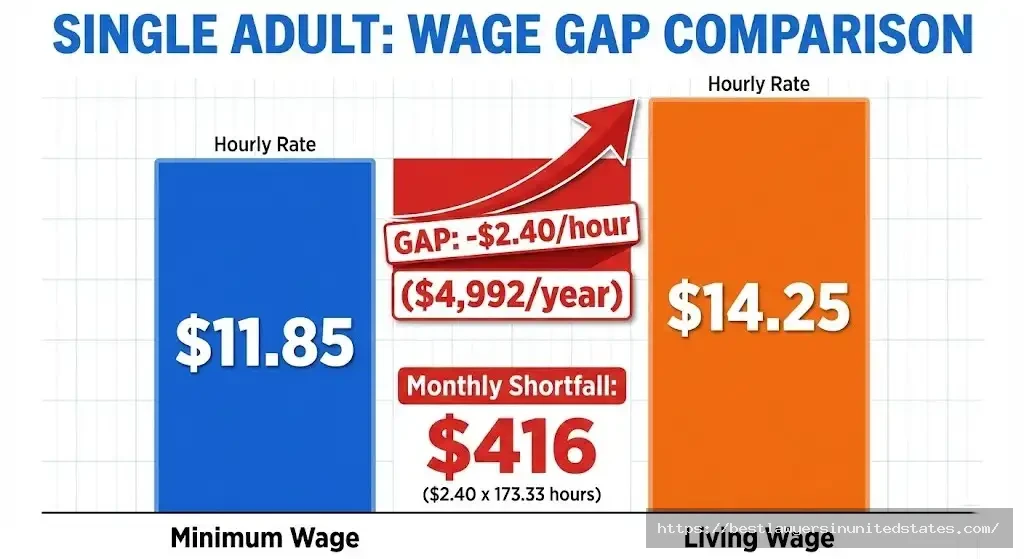
Single workers in South Dakota earning minimum wage fall approximately $2.40 per hour short of a true living wage. This gap widens dramatically for workers supporting families.
Monthly budget impact (single adult):
- Minimum wage earnings: $2,054/month (full-time)
- Living wage requirement: $2,470/month
- Shortfall: $416/month or $4,992/year
Many minimum wage workers bridge this gap through:
- Government assistance programs (SNAP, Medicaid)
- Second jobs or overtime hours
- Shared housing arrangements
- Additional household income sources
City-Specific Living Wage Data
Living costs vary significantly between South Dakota's urban and rural areas. Sioux Falls and Rapid City have higher housing costs that increase living wage requirements compared to smaller communities.
Estimated living wages by area (single adult, 2026):
| Area | Living Wage | Housing Cost (Monthly) | Difference from Minimum |
|---|---|---|---|
| Sioux Falls | $15.50 | $950 | +$3.65 |
| Rapid City | $14.75 | $875 | +$2.90 |
| Aberdeen | $13.25 | $675 | +$1.40 |
| Rural areas | $12.50 | $550 | +$0.65 |
Workers in larger cities face greater challenges living on minimum wage due to higher housing and transportation costs. Rural workers have lower expenses but also fewer high-wage job opportunities.
Industry Wage Benchmarks
Minimum wage represents the floor, but many South Dakota industries pay above this level. Understanding industry averages helps workers assess job opportunities.
Average hourly wages by industry (South Dakota, 2026 estimates):
| Industry | Average Wage | Entry-Level Wage | Above Minimum? |
|---|---|---|---|
| Healthcare support | $16.25 | $13.50 | ✅ Yes |
| Retail sales | $13.75 | $11.85 | ✅ Meets minimum |
| Food service | $12.50 | $11.85 | ✅ Meets minimum |
| Manufacturing | $19.50 | $15.25 | ✅ Yes |
| Hospitality | $13.25 | $11.85 | ✅ Meets minimum |
| Construction | $21.75 | $16.50 | ✅ Yes |
Most industries pay above minimum wage for experienced workers, though entry-level positions often start at or near the minimum. Workers can increase earnings through experience, skills training, and industry certifications.
Youth Employment and Minimum Wage
Do 14-Year-Olds Earn Minimum Wage in South Dakota?
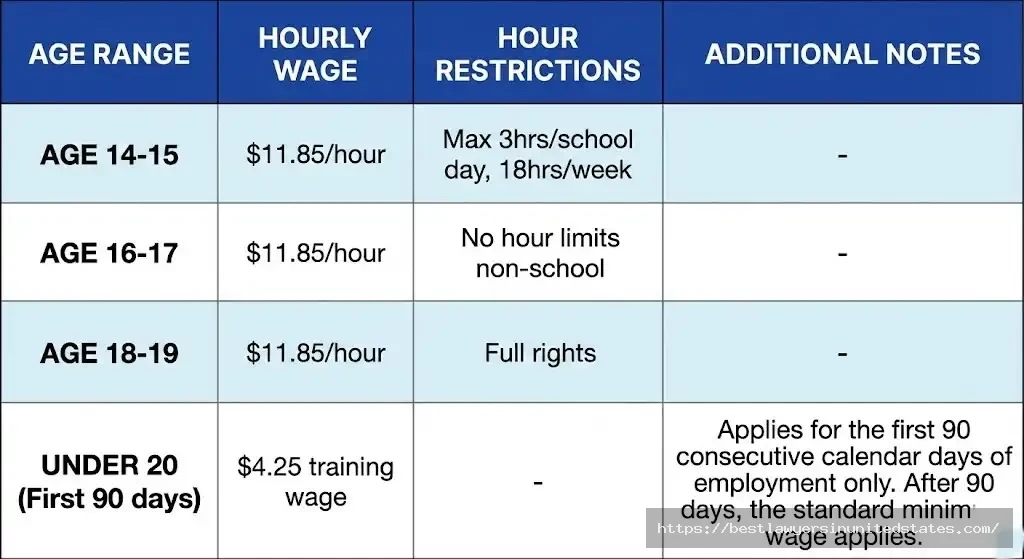
Yes, workers age 14 and older must receive the full South Dakota minimum wage of $11.85 per hour in 2026. The state does not have a separate youth minimum wage for workers 14 and older.
The only wage reduction applies to workers under age 20 during their first 90 days of employment, who can be paid the federal training wage of $4.25 per hour.
Age-based wage rules:
- Age 14-17: Full minimum wage ($11.85)
- Age 18-19: Full minimum wage ($11.85)
- Under 20 (first 90 days only): Training wage ($4.25)
- Age 20+: Full minimum wage ($11.85)
This contrasts with some states that establish lower minimum wages for teenage workers. South Dakota provides equal pay protection regardless of age, except for the narrow training wage exception.
Work Hour Restrictions by Age
While South Dakota pays young workers full minimum wage, federal and state laws limit when and how long minors can work. These restrictions protect young workers from excessive hours that interfere with education and development.
Workers age 14-15:
- Maximum 3 hours per school day
- Maximum 18 hours per school week
- Maximum 8 hours per non-school day
- Maximum 40 hours per non-school week
- No work before 7 AM or after 7 PM (9 PM June-Labor Day)
Workers age 16-17:
- No hour restrictions during non-school weeks
- Limited to reasonable hours during school weeks
- No work in hazardous occupations
- State law defers largely to federal standards
These restrictions apply regardless of the hourly wage paid. Employers who violate youth work hour rules face penalties from both state and federal agencies.
Work Permit Requirements
South Dakota requires work permits (employment certificates) for workers under age 16. Employers must obtain and keep these permits on file before allowing minors to begin work.
Work permit process:
- Minor obtains Certificate of Age from school
- Employer completes Employment Certificate
- School official or notary verifies information
- Employer keeps original certificate on file
- Permit remains valid as long as employment continues
Workers age 16 and older do not need work permits in South Dakota, though employers must verify age for workers who appear under 18.
Frequently Asked Questions
What is the minimum wage in South Dakota in 2026?
Quick Answer: South Dakota's minimum wage is $11.85 per hour effective January 1, 2026, which is $4.60 higher than the federal minimum wage of $7.25.
This rate applies to most employees statewide. Tipped workers can be paid $5.93 per hour in direct wages if tips bring total compensation to at least $11.85 per hour.
Does South Dakota follow federal minimum wage?
Quick Answer: No, South Dakota's minimum wage ($11.85 in 2026) is significantly higher than the federal minimum wage ($7.25). When state and federal minimums differ, employers must pay the higher rate.
South Dakota established its own minimum wage through Initiated Measure 18 in 2014 and increases it annually based on inflation. The state wage has exceeded federal minimum wage since 2015.
What is the tipped minimum wage in South Dakota?
Quick Answer: The tipped minimum wage in South Dakota is $5.93 per hour in 2026, which represents 50% of the standard minimum wage. Employees must earn at least $11.85 total with tips included.
Employers can claim this tip credit only if employees receive enough tips to reach the full minimum wage. If tips fall short, employers must pay the difference.
Are there exemptions to South Dakota's minimum wage?
Quick Answer: Yes, exemptions include seasonal recreational establishments, babysitters, outside salespersons, and certain agricultural workers. The training wage ($4.25) applies to workers under 20 for their first 90 days.
These exemptions are narrowly defined. Most workers, including teenagers age 14 and older, must receive the full minimum wage of $11.85 per hour.
How does South Dakota calculate annual wage increases?
Quick Answer: South Dakota uses the Consumer Price Index (CPI-W) to calculate automatic annual minimum wage increases. The Department of Labor announces the new rate each October, effective the following January 1.
This system, established by voter initiative in 2014, ensures wages keep pace with inflation without requiring legislative action each year. Increases typically range from $0.15 to $0.50 annually.
What is the minimum wage for 14-year-olds in South Dakota?
Quick Answer: Workers age 14 and older earn the full South Dakota minimum wage of $11.85 per hour in 2026. The state does not have a reduced youth minimum wage for teenagers.
The only exception is the training wage ($4.25 per hour) for workers under age 20 during their first 90 days of employment. After 90 days or age 20, full minimum wage applies.
Is South Dakota a final pay state?
Quick Answer: Yes, South Dakota requires employers to pay final wages at termination or by the next regular payday. For resignations, final pay is due on the next scheduled payday.
Employers who fail to provide final pay on time may face penalties under South Dakota Codified Laws § 60-11-10. Workers should document termination dates and follow up if payment is delayed.
What is the 80/20 rule for tipped employees?
Quick Answer: The 80/20 rule limits tipped employees' non-tipped work to 20% of their time. If employees spend more than 20% of hours on tasks that don't generate tips, employers must pay full minimum wage for those hours.
This rule prevents employers from exploiting the tip credit by assigning extensive non-tipped duties like cleaning or food prep while paying the lower tipped minimum wage.
How do I report wage theft in South Dakota?
Quick Answer: File a complaint with the South Dakota Department of Labor and Regulation at (605) 773-3101 or with the U.S. Department of Labor Wage and Hour Division at 1-866-487-9243.
Workers have 2-3 years to file wage claims depending on violation type. Document all evidence including pay stubs, time records, and communications about wages before filing.
What states have a $15 minimum wage?
Quick Answer: As of 2026, states with $15+ minimum wage include California ($16.50), Connecticut ($16.35), Massachusetts ($15.00), New York ($15.00+), and Washington ($16.66).
South Dakota's $11.85 minimum wage falls below these states but exceeds the federal rate and wages in neighboring states like North Dakota and Iowa ($7.25).
How do I calculate my earnings at South Dakota minimum wage?
Quick Answer: Use our minimum wage calculator to instantly calculate weekly, monthly, and annual earnings at $11.85 per hour based on your work schedule.
The calculator accounts for overtime, tax withholding, and provides take-home pay estimates. It's free and requires no personal information to use.
How much overtime pay am I entitled to in South Dakota?
Quick Answer: South Dakota requires overtime pay at 1.5 times regular wages for hours over 40 per week. Use our overtime calculator to calculate exact overtime earnings.
At minimum wage, overtime rate is $17.78 per hour ($11.85 × 1.5). The calculator handles complex scenarios including tipped wages and varying pay rates.
How do I calculate wage theft recovery in South Dakota?
Quick Answer: Our wage theft calculator estimates potential recovery including back pay, liquidated damages, and interest based on South Dakota law.
The calculator accounts for different violation types and provides total recovery estimates along with filing deadlines and next steps for pursuing claims.
Resources and Official Sources
South Dakota Government Agencies
South Dakota Department of Labor and Regulation
- Website: dlr.sd.gov
- Phone: (605) 773-3101
- Address: 123 W. Missouri Ave, Pierre, SD 57501
Division of Labor and Management
- Handles wage complaints and enforcement
- Provides compliance assistance
- Distributes required workplace posters
Sioux Falls Office
- 811 E. 10th Street, Sioux Falls, SD 57103
- Phone: (605) 367-5300
Federal Resources
U.S. Department of Labor Wage and Hour Division
- Website: dol.gov/agencies/whd
- Helpline: 1-866-487-9243
- Online complaint filing available
- Free compliance assistance
Fair Labor Standards Act (FLSA)
- Federal minimum wage and overtime law
- Applies when federal standards exceed state law
- Covers most private and public sector workers
Legal Assistance
South Dakota State Bar
- Lawyer referral service
- Free legal resources
- Consumer information on employment law
Legal Services Organizations
- East River Legal Services (Sioux Falls area)
- Dakota Plains Legal Services (Western SD)
- Free help for low-income workers
Workers dealing with wage issues may also benefit from consulting resources about South Dakota DUI laws or divorce costs in South Dakota if facing multiple legal challenges.
Statute References
Key South Dakota Laws:
- SDCL § 60-11-3: Minimum wage requirements
- SDCL § 60-11-3.1: Annual adjustment procedure
- SDCL § 60-11-10: Wage payment law
- SDCL § 60-11-11: Employer recordkeeping requirements
Federal Laws:
- Fair Labor Standards Act, 29 U.S.C. § 201 et seq.
- Portal-to-Portal Act, 29 U.S.C. § 251 et seq.
- Equal Pay Act, 29 U.S.C. § 206(d)
Additional Tools and Calculators
Workers and employers can access free calculators to understand wage obligations:
- Minimum Wage Calculator: Calculate earnings at South Dakota's minimum wage
- Overtime Pay Calculator: Determine overtime compensation
- Wage Theft Calculator: Estimate potential recovery from wage violations
These tools help workers verify proper payment and assist employers with compliance.
Last Updated: December 2025
Next Minimum Wage Increase: January 1, 2027 (rate to be announced October 2026)
For questions about South Dakota wage laws or to report violations:
Email: [email protected]
SD Department of Labor: (605) 773-3101
Federal DOL Helpline: 1-866-487-9243
