
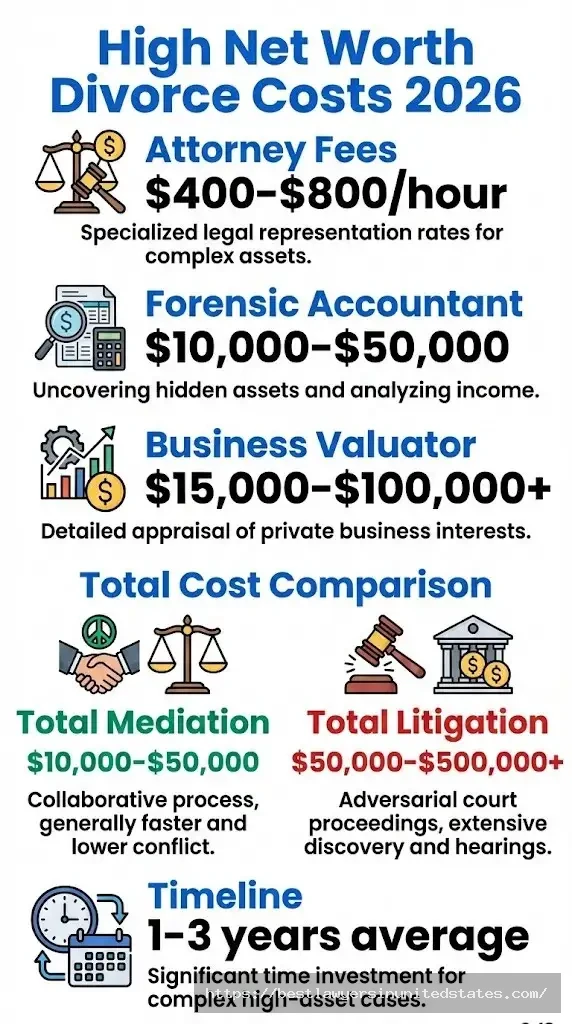
High net worth divorces involve couples with substantial wealth, typically $3 million or more in assets. These cases are far more complex than standard divorces due to intricate asset portfolios, business interests, tax implications, and privacy concerns. The average high net worth divorce takes 1-3 years to complete and costs $50,000 to $500,000+ in legal fees and expert costs.
When Jeff Bezos and MacKenzie Scott divorced in 2019, their $38 billion settlement became the largest in history. Bill and Melinda Gates’ 2021 divorce involved over $130 billion in assets. While most high net worth divorces don’t reach these levels, they share common challenges: hidden assets, business valuation disputes, complex tax planning, and lengthy negotiations.
This guide explains how high asset divorces differ from standard cases, what assets are typically involved, and how to protect your interests. You’ll learn about forensic accounting, business valuation, spousal support calculations, and common mistakes that cost wealthy couples millions.
What is a High Net Worth Divorce?
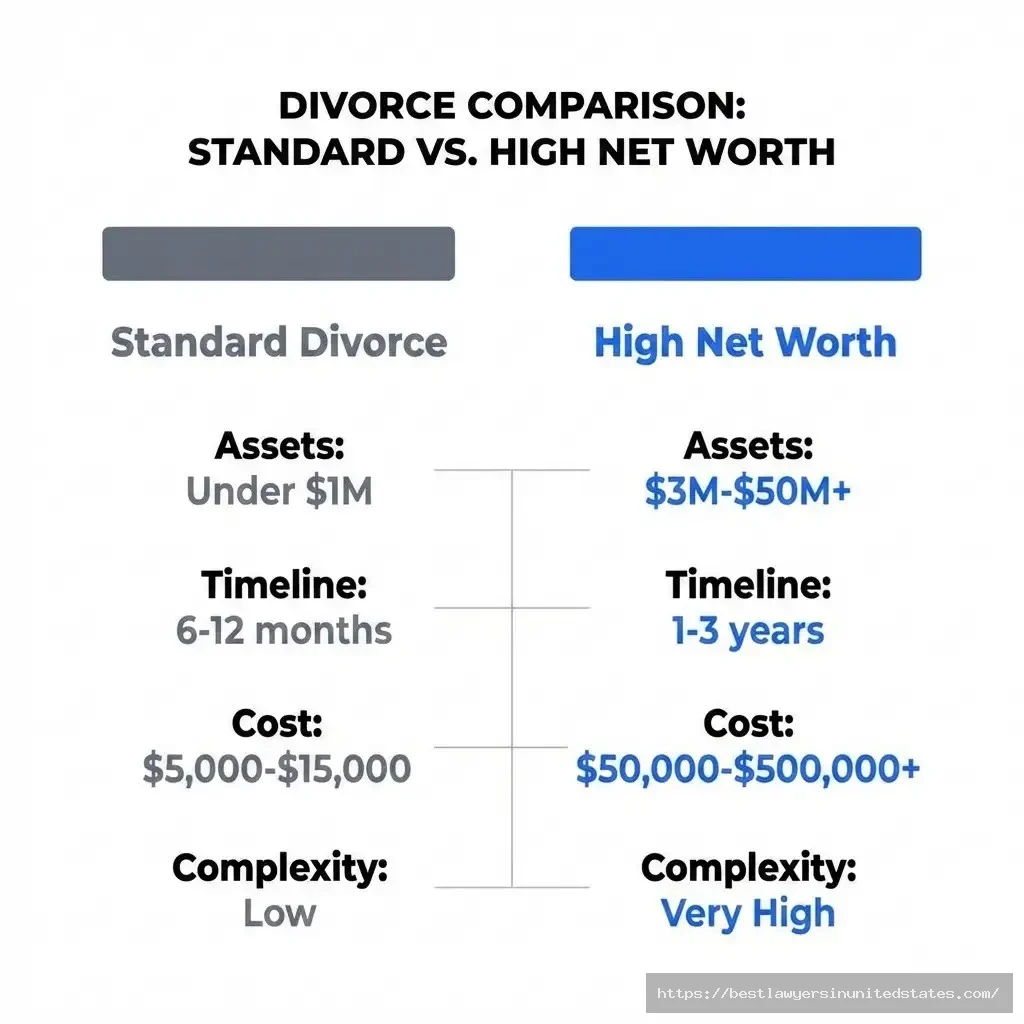
A high net worth divorce traditionally involved couples with at least $1 million in assets. That threshold has shifted dramatically due to inflation, rising home values, and larger retirement accounts. Today, most experts define high net worth divorce as cases involving $3 million to $5 million or more in total assets.
Ultra high net worth divorces involve $30 million or more in assets. These cases often include multiple businesses, international holdings, complex trust structures, and substantial real estate portfolios. The complexity increases exponentially with the asset total.
The median home price in the United States exceeded $400,000 in 2024. Many middle-income households now have retirement accounts with six-figure balances. This means crossing the $1 million threshold no longer indicates exceptional wealth or complex finances.
Why the Definition Changed
Assets that push couples over $1 million:
- Primary residence valued at $500,000 to $800,000
- Two retirement accounts totaling $300,000 to $500,000
- Modest investment portfolio of $200,000
- Vehicles and personal property worth $50,000
True high net worth indicators:
- Multiple real estate properties
- Business ownership or partnership interests
- Investment portfolios exceeding $1 million
- Executive compensation packages
- Trust funds or inherited wealth
- International assets or offshore accounts
How High Net Worth Divorces Differ from Standard Divorces
High net worth divorces take longer, cost more, and require specialized expertise. While a standard divorce might settle in 6-12 months for $5,000 to $15,000, high asset cases often extend 1-3 years and cost $50,000 to $500,000 or more.
Complexity of Assets
Standard divorces typically involve a house, two cars, retirement accounts, and bank accounts. High net worth cases include businesses, investment portfolios, real estate holdings, luxury assets, intellectual property, and cryptocurrency. Each asset type requires different valuation methods and expert analysis.
Business interests present unique challenges. A closely-held company needs professional valuation to determine its worth. Future earning potential, goodwill, and market conditions all factor into the calculation. Multiple experts may disagree on the final value by millions of dollars.
International assets add jurisdictional complexity. Properties in different countries follow different laws. Foreign bank accounts require special disclosure rules. Tax treaties between nations affect how assets transfer.
Extended Timelines
Standard divorce timeline:
- Filing to finalization: 6-12 months
- Discovery period: 2-3 months
- Settlement negotiations: 1-2 months
- Court proceedings: 1-3 hearings
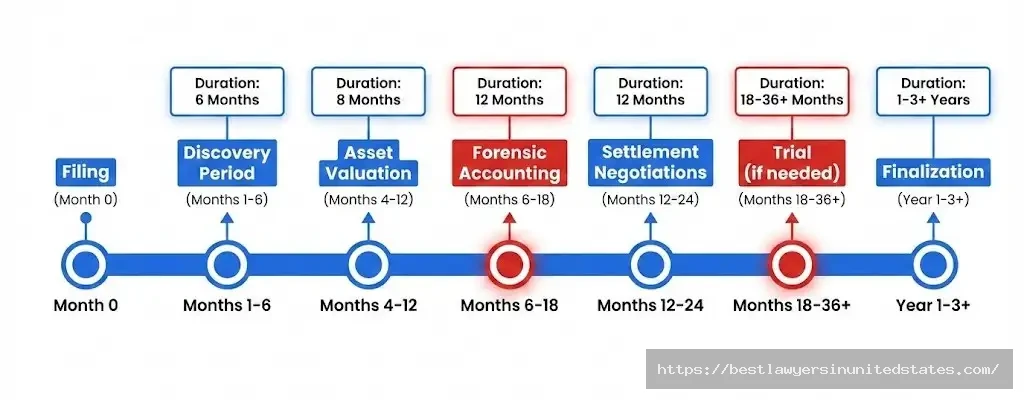
High net worth divorce timeline:
- Filing to finalization: 1-3 years (some exceed 5 years)
- Discovery period: 6-18 months
- Asset valuation: 4-12 months
- Settlement negotiations: 6-24 months
- Court proceedings: Multiple hearings over months or years
The extended timeline results from complex asset discovery, multiple expert valuations, tax planning considerations, and high-stakes negotiations. Each additional month costs thousands in attorney fees and expert costs.
Higher Legal and Expert Costs
Understanding divorce attorney fees becomes even more important in high asset cases. Standard divorce attorneys charge $200 to $350 per hour. High net worth divorce specialists command $400 to $800 per hour or more in major cities.
Expert costs in high net worth divorce:
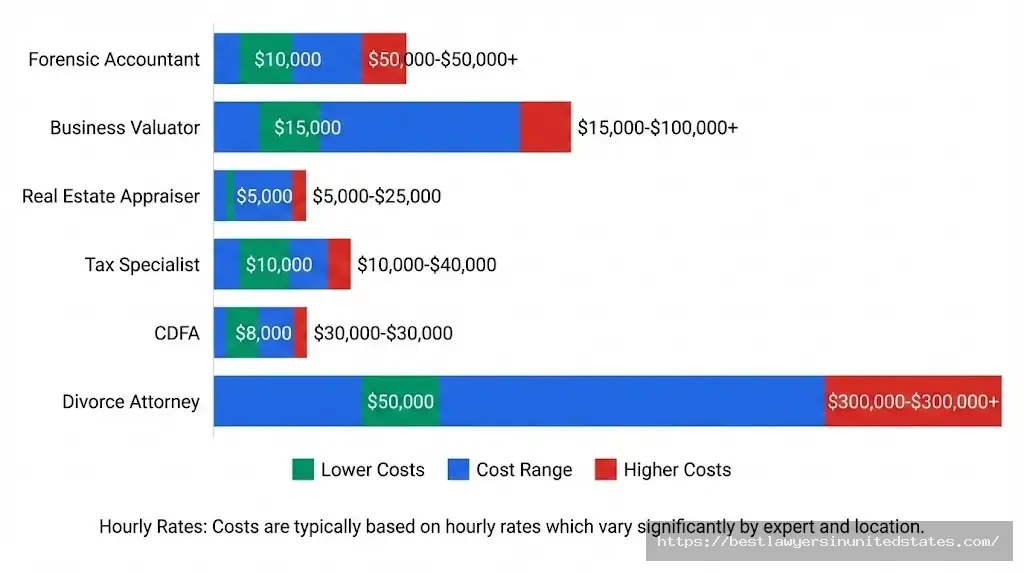
| Expert Type | Hourly Rate | Typical Total Cost |
|---|---|---|
| Forensic Accountant | $300-$600/hour | $10,000-$50,000+ |
| Business Valuator | $350-$700/hour | $15,000-$100,000+ |
| Real Estate Appraiser | $200-$500/hour | $5,000-$25,000 |
| Tax Specialist | $300-$600/hour | $10,000-$40,000 |
| CDFA (Financial Analyst) | $250-$500/hour | $8,000-$30,000 |
Privacy and Public Interest Concerns
High net worth individuals often include business leaders, executives, entrepreneurs, and public figures. Their divorces attract media attention that can damage business relationships, affect stock prices, and harm personal reputations.
Protecting sensitive financial information requires strategic legal work. Attorneys file motions to seal court records, negotiate confidentiality agreements, and pursue mediated divorce to avoid public proceedings. Private mediation keeps negotiations confidential and out of court records.
Tax and Estate Planning Implications
Property division in divorce creates significant tax consequences for wealthy couples. Selling appreciated assets triggers capital gains tax. Transferring retirement accounts requires Qualified Domestic Relations Orders (QDROs) to avoid penalties. Estate plans need complete revision after divorce.
Common Assets in High Net Worth Divorces
Wealthy couples accumulate diverse asset portfolios that require specialized valuation and division strategies. Each asset type presents unique challenges during divorce proceedings.

Business Interests and Professional Practices
Closely-held businesses, professional practices, and partnership interests often represent the largest asset in high net worth divorces. A successful business owner might have millions tied up in their company, making it impossible to simply divide 50-50.
Business valuation challenges:
- Determining fair market value vs. liquidation value
- Separating personal goodwill from business goodwill
- Assessing impact of divorce on future earnings
- Accounting for minority interest discounts
- Projecting growth and future value
Professional practices (medical, legal, dental) present additional complexity. Much of their value stems from the owner’s personal skill and reputation. Courts must determine whether that value is marital property subject to division.
Investment Portfolios and Stock Options
High net worth couples typically maintain substantial investment accounts with complex holdings. These may include:
Investment assets requiring valuation:
- Publicly traded stocks and bonds
- Mutual funds and index funds
- Hedge fund investments
- Private equity holdings
- Venture capital investments
- Stock options (vested and unvested)
- Restricted stock units (RSUs)
- Employee stock purchase plans
Executive compensation packages complicate matters further. Unvested stock options granted during marriage may be marital property. Courts must determine what portion belongs to each spouse based on when options vest and when they were granted.
Real Estate Holdings (Domestic and International)
Real estate portfolios in high net worth divorces often include:
| Property Type | Valuation Method | Common Issues |
|---|---|---|
| Primary Residence | Professional appraisal | Emotional attachment, who stays |
| Vacation Homes | Comparative market analysis | Seasonal use, rental income |
| Investment Properties | Income approach | Rental agreements, management |
| Commercial Real Estate | Income capitalization | Leases, operating expenses |
| International Properties | Foreign appraisers | Currency exchange, foreign laws |
| Undeveloped Land | Comparable sales | Development potential, zoning |
International real estate introduces jurisdictional questions. Which country’s laws apply? How do currency fluctuations affect value? Can foreign court orders be enforced domestically?
Luxury Assets and Collectibles
Fine art, antiques, jewelry, classic cars, yachts, and aircraft require expert appraisal. These assets can only be reliably valued at point of sale, creating disputes about current worth.
Luxury asset valuation challenges:
- Art and collectibles appreciate unpredictably
- Insurance values often exceed market value
- Authentication questions affect worth
- Market demand fluctuates significantly
- Emotional attachment complicates negotiations
Cryptocurrency and Digital Assets
Cryptocurrency holdings have become common in high net worth divorces. Bitcoin, Ethereum, and other digital assets present unique challenges. Values fluctuate wildly. Accounts can be hidden easily. Technical knowledge is required to trace transactions.
Digital assets to disclose:
- Cryptocurrency wallets and exchange accounts
- NFTs (non-fungible tokens)
- Digital collectibles
- Online business assets
- Domain name portfolios
- Social media accounts with monetization
Intellectual Property and Royalties
Patents, trademarks, copyrights, and royalty streams constitute valuable marital property. A patent granted during marriage may generate income for decades. Royalties from books, music, or inventions continue long after divorce.
Valuing intellectual property requires specialized expertise. Future earning potential is uncertain. Market conditions change. Licensing agreements may limit transferability.
Trusts and Estate Holdings
Family trusts, irrevocable trusts, and generation-skipping trusts complicate high net worth divorces. Trust assets may not be marital property if established before marriage or funded with inheritance. However, commingling trust funds with marital accounts can change their status.
Third parties may have legal claims to trust assets. Family members might contest division of generational wealth. Trust documents often include divorce clauses that protect assets from division.
The Role of Forensic Accountants and Hidden Assets
Forensic accountants play a critical role in high net worth divorces by uncovering financial information that one spouse may attempt to conceal. When millions of dollars are at stake, the temptation to hide assets increases dramatically.
Why Hidden Assets Are Common
High net worth individuals have more opportunities and sophisticated methods to conceal wealth. They may have complex business structures, multiple accounts, and international holdings that make asset tracing difficult. Some spouses control all financial decisions during marriage, leaving the other spouse unaware of the full extent of their wealth.
Financial infidelity often precedes actual divorce. A spouse planning to file may spend months or years moving assets, underreporting income, or transferring property to third parties.
Where Assets Are Typically Concealed
Common hiding places for assets:
| Location | Method | How Forensic Accountants Find It |
|---|---|---|
| Offshore Accounts | Foreign banks in tax havens | Subpoena bank records, trace wire transfers |
| Shell Corporations | Create fake business entities | Review corporate filings, analyze transactions |
| Cryptocurrency | Digital wallets, multiple exchanges | Blockchain analysis, exchange records |
| Business Accounts | Underreport revenue, inflate expenses | Analyze tax returns, bank statements |
| Family Members | Transfer to parents, siblings, friends | Trace unusual gifts, loans, transfers |
| Cash Businesses | Skim unreported cash income | Compare lifestyle to reported income |
| Delayed Bonuses | Request employer defer compensation | Examine employment contracts, compensation records |
| Antiques/Collectibles | Purchase high-value items | Review credit card statements, storage units |
How Forensic Accountants Uncover Hidden Wealth
Forensic accountants use multiple investigative techniques to locate concealed assets:
Investigation methods:
- Analyze tax returns for 3-7 years
- Review all bank statements and credit card records
- Trace wire transfers and large withdrawals
- Examine business financial statements
- Compare reported income to lifestyle
- Investigate business expense accounts
- Subpoena employment records
- Review property records and deeds
- Analyze investment account statements
- Track cryptocurrency transactions
Lifestyle analysis compares reported income to actual spending. If a spouse claims $200,000 annual income but maintains a lifestyle requiring $500,000, the forensic accountant investigates the discrepancy.
Legal Consequences of Hiding Assets
Courts take asset concealment seriously. Spouses caught hiding assets face severe penalties:
Penalties for hiding assets:
- Award the hidden asset entirely to the other spouse
- Require payment of other spouse’s attorney fees
- Impose monetary sanctions and fines
- Hold spouse in contempt of court
- In extreme cases, criminal charges for fraud or perjury
The discovery process requires full financial disclosure under oath. Lying about assets constitutes perjury. Falsifying financial documents is fraud. Both carry criminal penalties beyond civil divorce consequences.
Business Valuation in High Net Worth Divorce
Business ownership complicates divorce more than almost any other asset. Unlike a bank account that shows exact value, a business requires complex analysis to determine its worth. Disagreements over valuation can cost millions and extend divorce proceedings for years.
Why Business Valuation Is Complex
A successful business represents years of effort, customer relationships, and future earning potential. The owner may have built it from nothing. Their expertise and reputation drive its success. Determining how much of that value is marital property subject to division requires sophisticated analysis.
Factors affecting business value:
- Current and projected revenue
- Profit margins and expenses
- Industry conditions and competition
- Customer contracts and relationships
- Intellectual property and proprietary methods
- Equipment and physical assets
- Employee talent and key personnel
- Market demand for similar businesses
Valuation Methods
Business appraisers use three primary approaches to value companies:
| Valuation Method | How It Works | Best Used For |
|---|---|---|
| Income Approach | Projects future earnings, calculates present value | Service businesses, professional practices |
| Market Approach | Compares to similar business sales | Businesses with comparable sales data |
| Asset-Based Approach | Values all assets minus liabilities | Asset-heavy businesses, real estate companies |
Most appraisers use multiple methods and reconcile the results. A professional practice might be valued using both income and market approaches to arrive at a reasonable range.
Goodwill Valuation Disputes
Goodwill represents the intangible value of a business beyond its physical assets. Two types of goodwill exist, and courts treat them differently:
Personal vs. Enterprise Goodwill:
- Personal goodwill: Value tied to the owner’s skill, reputation, relationships. May not be marital property in some states.
- Enterprise goodwill: Value from business name, location, systems, customer base. Usually marital property.
A plastic surgeon’s practice derives much value from their personal skill and reputation. If they retired, patients likely wouldn’t stay. That’s personal goodwill. But the practice’s location, equipment, and staff systems have value even if the owner leaves. That’s enterprise goodwill.
Spouses often dispute how much goodwill is personal versus enterprise. The distinction can change a business valuation by millions of dollars.
Protecting Business Operations During Divorce
Business owners face unique challenges during divorce. They must continue operating the business while navigating divorce proceedings. Disruption can harm revenue, employee morale, and customer relationships.
Strategies to protect your business:
- Keep divorce proceedings confidential
- Avoid involving employees in disputes
- Maintain normal business operations
- Consider buying out spouse’s interest
- Structure payments over time if needed
- Work with business succession planners
- Update business agreements and documents
Some business owners negotiate to keep 100% of the business while giving their spouse other assets of equivalent value. This avoids forcing a business sale or creating ongoing co-ownership after divorce.
Spousal Support and Child Support for High Earners
Standard support calculations don’t apply when incomes exceed certain thresholds. Courts use discretion to determine appropriate alimony and child support amounts for wealthy families.
How Alimony Differs in High Net Worth Cases
Most states use formulas to calculate spousal support for middle-income couples. These formulas typically apply only up to a certain income level, often $250,000 to $500,000 combined. Above that threshold, courts have broad discretion.
Factors courts consider for high net worth alimony:
- Marital standard of living
- Length of marriage
- Age and health of each spouse
- Earning capacity and career sacrifices
- Education and training needed
- Contributions to the marriage
- Assets each spouse receives
The marital standard of living matters significantly in wealthy divorces. If a couple regularly vacationed internationally, dined at expensive restaurants, and maintained multiple homes, courts try to allow both spouses to continue a similar lifestyle.
Calculate your potential alimony obligations with our alimony calculator. This tool estimates support based on income difference, marriage duration, and standard of living factors.
Alimony Calculator
Estimate spousal support payments based on your state’s guidelines. Get monthly payment amounts, duration estimates, and total alimony calculations.
Enter Your Information
Provide details about income, marriage, and circumstances
Estimated Monthly Alimony Payment
📍 State Alimony Guidelines
Information about this state’s alimony approach will appear here.
📊 Calculation Breakdown
| Component | Value |
|---|
Questions about alimony or need legal help? Email: [email protected]
Child Support Above Guideline Amounts
State child support guidelines cap at certain income levels. California's guideline applies to combined incomes up to $30,000 per month. New York's caps at $163,000 combined annual income. Above these thresholds, courts use discretion.
Extraordinary expenses in high net worth families:
| Expense Category | Annual Cost Range | Notes |
|---|---|---|
| Private School | $15,000-$60,000+ per child | Tuition, fees, uniforms |
| Tutoring | $5,000-$25,000 | Academic support, test prep |
| Extracurriculars | $10,000-$50,000+ | Sports, music, arts, camps |
| Travel | $10,000-$100,000+ | Family vacations, visits |
| Healthcare | $5,000-$30,000 | Insurance, dental, vision, therapy |
| Technology | $2,000-$10,000 | Computers, phones, devices |
| College Savings | $10,000-$50,000+ | 529 plans, education funds |
Our child support calculator helps estimate support obligations based on income, custody arrangements, and extraordinary expenses.
Child Support Calculator
Calculate child support estimates based on your state's guidelines. Get accurate payment amounts using income shares model calculations.
Enter Your Information
Provide income, custody, and children details
Estimated Monthly Child Support
📍 State Child Support Guidelines
Information about this state's child support calculation method will appear here.
📊 Calculation Breakdown
| Component | Value |
|---|
Questions about child support? Email: [email protected]
Maintaining the Marital Standard of Living
Courts recognize that divorce inevitably changes lifestyles. Running two households costs more than one. However, in high net worth cases, both spouses should maintain a reasonably comparable standard to their married life.
This doesn't mean identical lifestyles. The higher-earning spouse may maintain more luxury. But the lower-earning spouse shouldn't face drastic lifestyle reduction while the other lives extravagantly.
Lifestyle factors courts examine:
- Housing size and location
- Vehicle types and quantity
- Vacation frequency and destinations
- Dining and entertainment spending
- Clothing and personal care budgets
- Club memberships and recreational activities
Financial experts analyze spending patterns during marriage. They review credit card statements, bank records, and receipts to establish the couple's actual lifestyle. This evidence supports spousal support arguments.
Tax Implications and Estate Planning
High net worth divorces create substantial tax consequences that can cost hundreds of thousands or millions if not properly planned. Every asset division decision affects future tax liability.
Capital Gains on Asset Sales
Selling appreciated assets to create an equitable split triggers capital gains tax. A couple might own stock purchased for $500,000 now worth $2 million. Selling generates $1.5 million in gains subject to federal and state capital gains tax.
Tax rates on capital gains (2026):
- Short-term gains (held under 1 year): Ordinary income tax rates up to 37%
- Long-term gains (held over 1 year): 0%, 15%, or 20% based on income
- Additional 3.8% Net Investment Income Tax for high earners
- State capital gains tax varies by state (0% to 13.3%)
Property transfers between spouses during divorce are generally tax-free under Section 1041 of the tax code. However, this only defers tax liability. The spouse who receives the asset inherits the original cost basis and pays capital gains tax when they eventually sell.
QDRO Requirements for Retirement Accounts
Qualified Domestic Relations Orders (QDROs) allow retirement account division without triggering early withdrawal penalties. A QDRO must be properly drafted and approved by the plan administrator.
Retirement accounts requiring QDROs:
- 401(k) plans
- 403(b) plans
- Pension plans
- Other employer-sponsored retirement plans
IRAs don't require QDROs but need specific divorce decree language to transfer tax-free. Mistakes in drafting can trigger immediate taxation and 10% early withdrawal penalties.
Estate Tax Considerations
High net worth individuals must consider estate tax implications of divorce settlements. The 2026 federal estate tax exemption is $13.99 million per person ($27.98 million for married couples). This exemption is scheduled to drop to approximately $7 million in 2026 unless Congress acts.
Divorce changes estate planning strategies. Couples who previously used portability to combine exemptions lose that benefit. Asset division might push one spouse above the exemption threshold while leaving the other well below it.
Updating Beneficiaries and Trusts Post-Divorce
After divorce, update beneficiary designations on:
Accounts requiring beneficiary updates:
- Life insurance policies
- Retirement accounts (401k, IRA, pension)
- Transfer-on-death (TOD) accounts
- Payable-on-death (POD) bank accounts
- Annuities
- Health savings accounts
Trusts created during marriage need review and possible revision. Some may need dissolution. Others require new trustees or beneficiaries. Failing to update trust documents can result in your ex-spouse controlling assets meant for children or other heirs.
Prenuptial and Postnuptial Agreements
Prenuptial and postnuptial agreements are common among high net worth couples. These contracts can simplify divorce or create additional litigation if challenged.
How They Affect High Net Worth Divorces
A well-drafted prenuptial agreement defines separate and marital property, establishes spousal support terms, and outlines asset division procedures. This eliminates many disputes that make high net worth divorces expensive and lengthy.
What prenups typically address:
- Classification of assets as separate or marital property
- Division of assets acquired during marriage
- Spousal support amount and duration
- Protection of business interests
- Treatment of inheritance and gifts
- Handling of debts and liabilities
Postnuptial agreements are created after marriage but serve similar purposes. Couples might execute postnups when one spouse receives an inheritance, starts a business, or when significant wealth changes occur.
Challenging Agreement Validity
Prenuptial agreements aren't automatically enforceable. Courts may set them aside if:
Grounds for challenging prenuptial agreements:
| Challenge Basis | What It Means | Example |
|---|---|---|
| Lack of Disclosure | One spouse hid assets or debts | Failed to disclose $5M investment account |
| Duress or Coercion | Forced to sign under pressure | Presented agreement day before wedding |
| Unconscionability | Terms are grossly unfair | Spouse receives nothing despite 20-year marriage |
| No Independent Counsel | Both spouses used same attorney | Lawyer represented both parties |
| Fraud or Misrepresentation | Lied about financial situation | Claimed business worthless when valued at $10M |
| Invalid Execution | Not properly signed or witnessed | Missing required notarization |
Many states require both spouses to have independent attorneys review prenuptial agreements. Without separate representation, courts may find the agreement invalid.
When Courts May Set Aside Agreements
Even valid prenuptial agreements can be modified or rejected in some circumstances. Courts have broad discretion to ensure fairness, especially after long marriages or when circumstances change dramatically.
Situations where courts modify prenups:
- Agreement was signed decades ago, before significant wealth accumulation
- Terms leave one spouse destitute while the other lives lavishly
- Caring for disabled children creates needs not contemplated in agreement
- Agreement waives all spousal support, violating state public policy
- Business value increased 1000% due to both spouses' efforts
Courts balance contractual freedom with fairness. An agreement that seemed reasonable when signed might be unconscionable 25 years later after one spouse sacrificed their career to raise children.
Choosing the Right Legal Team
High net worth divorces require specialized legal expertise. The wrong attorney can cost you millions in poor negotiation, missed tax strategies, or inadequate asset protection.
Qualities of a High Net Worth Divorce Attorney
Not all divorce attorneys handle complex financial cases. You need someone with specific experience in high asset divorces, business valuation, tax planning, and sophisticated negotiation.
Must-have qualifications:
- Experience with cases involving $5M+ in assets
- Knowledge of complex asset valuation methods
- Understanding of tax implications and strategies
- Network of expert witnesses (forensic accountants, business valuators)
- Trial experience in high-stakes cases
- Reputation among judges and opposing counsel
- Ability to maintain confidentiality and privacy
Ask potential attorneys about their largest case, how they handle business valuations, and their experience with international assets. Compare divorce attorney fees and fee structures carefully.
Additional Experts You May Need
Your attorney coordinates a team of specialists:
Expert team members:
| Expert | Role | When You Need Them |
|---|---|---|
| Forensic Accountant | Find hidden assets, analyze finances | Suspected asset concealment, complex finances |
| Business Valuator | Determine company worth | Business ownership, professional practice |
| Real Estate Appraiser | Value properties | Multiple properties, commercial real estate |
| Tax Specialist | Minimize tax liability | High-value asset sales, complex tax issues |
| CDFA | Financial planning | Long-term financial impact analysis |
| Estate Planner | Update trusts and wills | Existing trusts, estate tax concerns |
| Actuary | Value pensions | Defined benefit pension plans |
Each expert charges $200 to $700+ per hour. Total expert costs in complex cases can reach $50,000 to $200,000. However, proper expertise often saves far more than it costs.
Questions to Ask Potential Attorneys
Interview multiple attorneys before hiring. High stakes justify taking time to find the right fit.
Critical questions to ask:
- How many high net worth divorces have you handled?
- What's the largest asset value you've dealt with?
- Do you have experience with business valuations?
- How do you approach settlement negotiations?
- Will you handle my case personally or delegate to associates?
- What experts do you typically work with?
- How do you communicate with clients?
- What's your strategy for my specific situation?
Pay attention to how attorneys answer. Do they listen carefully? Do they explain concepts clearly? Do they seem genuinely interested in your goals?
Understanding Fee Structures
High net worth divorce attorneys use various billing methods:
Fee structure options:
- Hourly billing: $400-$800+ per hour, most common
- Retainer: Upfront deposit of $15,000-$50,000+, drawn against hourly work
- Flat fee: Fixed amount for specific services (rare in complex cases)
- Hybrid: Combination of retainer plus hourly above certain amount
Request detailed billing statements monthly. Track hours spent and tasks completed. Question any charges that seem excessive or unclear.
Mediation vs. Litigation for High Net Worth Divorce
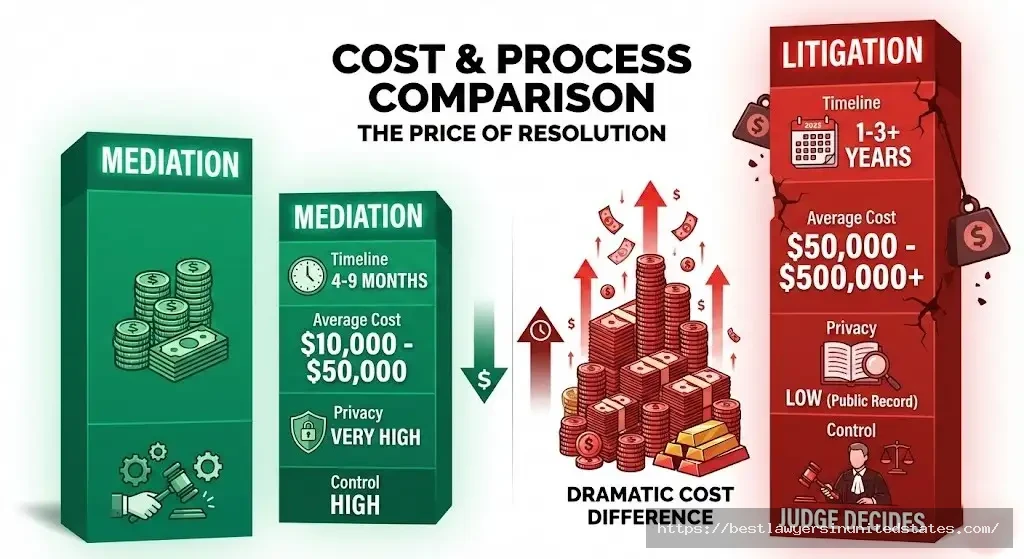
High net worth couples have more incentive to avoid litigation than middle-income spouses. Public court proceedings expose financial details, business strategies, and personal matters. Private mediation offers confidentiality and control.
Benefits of Private Mediation
Mediated divorce allows couples to negotiate settlement terms privately with a neutral mediator. No public court hearings. No court records detailing your finances. No media access to proceedings.
Mediation advantages for wealthy couples:
- Complete confidentiality of financial details
- Control over settlement terms instead of judge's decision
- Faster resolution than litigation (months vs. years)
- Lower total costs despite high hourly mediator rates
- Preserves business relationships and reputation
- Flexible creative solutions unavailable in court
- Less adversarial process reduces emotional toll
Successful mediation requires both spouses to negotiate in good faith. Full financial disclosure is still mandatory. But negotiations occur in private conference rooms, not public courtrooms.
When Litigation Is Necessary
Sometimes mediation fails. One spouse refuses to negotiate fairly. Hidden assets are suspected. Domestic violence or financial abuse occurred. These situations require litigation.
Indicators you may need to litigate:
- Spouse won't disclose assets fully
- Evidence of hidden accounts or income
- Spouse makes unreasonable demands
- History of financial control or abuse
- Spouse trying to harm your business
- Prenuptial agreement dispute
- Complex third-party claims to assets
Choosing between contested divorce and uncontested divorce significantly impacts cost and timeline. Contested cases involving litigation can cost $100,000 to $500,000+ and take years.
Collaborative Divorce Option
Collaborative divorce offers a middle ground between mediation and litigation. Both spouses hire collaborative divorce attorneys who commit to settling without going to court.
The process uses interest-based negotiation with team members including:
- Collaborative attorneys for each spouse
- Neutral financial specialist
- Mental health professionals
- Child specialists if needed
If collaborative divorce fails, both attorneys must withdraw. This gives everyone strong motivation to reach settlement.
Cost Comparison
| Divorce Method | Timeline | Average Cost | Privacy Level |
|---|---|---|---|
| DIY Uncontested | 3-6 months | $2,000-$5,000 | High |
| Mediation | 4-9 months | $10,000-$50,000 | Very High |
| Collaborative | 6-12 months | $30,000-$100,000 | High |
| Litigation | 1-3+ years | $50,000-$500,000+ | Low (public record) |
For context on standard divorce costs, see our guide on how much does a divorce cost. High net worth cases typically cost 3-10 times more than these averages.
11 Common Mistakes in High Net Worth Divorce
Wealthy spouses often make costly errors during divorce. These mistakes can cost hundreds of thousands or millions in lost assets, excess taxes, and prolonged proceedings.
Mistake 1: Failing to Gather Financial Documentation
The error: Not collecting complete financial records before filing or before your spouse knows divorce is coming.
Once divorce seems imminent, documents may disappear. Bank statements go missing. Business records become incomplete. Your spouse's attorney instructs them to stop providing information voluntarily.
What to gather:
- Tax returns for past 5-7 years
- Bank statements for all accounts (3+ years)
- Investment account statements
- Business financial statements and tax returns
- Real estate deeds and mortgage documents
- Credit card statements
- Retirement account statements
- Insurance policies
- Trust documents
- Estate planning documents
Make copies of everything before filing. Store copies securely outside your home. Consider photographing documents if needed.
Mistake 2: Hiding Assets
The error: Attempting to conceal assets, underreport income, or transfer property to hide it from division.
This always backfires. Forensic accountants will find hidden assets. When they do, courts penalize the hiding spouse severely. You may lose the entire concealed asset, pay your spouse's attorney fees, face contempt charges, or even criminal prosecution.
The discovery process requires sworn financial disclosure. Lying under oath is perjury. Falsifying documents is fraud. Both carry criminal penalties beyond civil divorce consequences.
Mistake 3: Not Hiring Specialized Counsel
The error: Hiring a general practice attorney or family lawyer without high net worth divorce experience.
Your brother-in-law who does real estate closings cannot handle a $10 million divorce. Your friend's divorce lawyer who handles $50,000 cases lacks the expertise for complex asset valuation, tax planning, and sophisticated negotiation.
Pay more for an experienced high net worth divorce attorney. The cost difference is tiny compared to the value they protect. An inexperienced attorney might miss tax strategies, accept poor business valuations, or negotiate unfavorably.
Mistake 4: Emotional Decision-Making
The error: Making divorce decisions based on anger, hurt, or revenge rather than financial logic.
Wealthy spouses sometimes spend $200,000 litigating over a $50,000 asset because of emotional attachment or spite. They reject reasonable settlement offers to punish their spouse, then end up with less after trial.
Example: A husband spent $150,000 in attorney fees fighting over $75,000 in artwork. The wife originally offered 50/50 division. After trial, the judge awarded wife 60% plus attorney fees.
Stay focused on financial outcomes. Use a therapist to process emotions. Let your attorney handle strategy based on logic and law.
Mistake 5: Overlooking Tax Consequences
The error: Agreeing to asset division without calculating tax implications.
Two assets with identical market values may have vastly different after-tax values. Taking a $1 million investment account with $700,000 in unrealized gains means owing capital gains tax when you sell. Taking a $1 million bank account has no tax consequences.
Tax considerations to evaluate:
- Capital gains tax on appreciated assets
- Tax basis of assets received
- Income tax on retirement account withdrawals
- Estate tax implications
- Property tax reassessment after transfer
Work with a tax specialist before finalizing any settlement. Calculate the after-tax value of proposed divisions.
Mistake 6: Forgetting to Update Estate Plans
The error: Not updating wills, trusts, beneficiaries, and powers of attorney after separation.
If you die during divorce proceedings before finalizing, your spouse may inherit under your current will. Life insurance policies still name them as beneficiary. Retirement accounts transfer to them.
Some states automatically revoke spouse provisions upon divorce. Others don't. Don't assume. Update everything immediately after separation:
Documents to update:
- Will and living trust
- Healthcare power of attorney
- Financial power of attorney
- Life insurance beneficiaries
- Retirement account beneficiaries
- TOD/POD account designations
- Guardian designations for minor children
Mistake 7: Making Assumptions About Inheritances
The error: Assuming inherited assets remain separate property automatically.
Inheritance is typically separate property if kept separate. But commingling makes it marital property subject to division. Depositing inheritance money into joint accounts comingles it. Using inheritance to buy marital assets transmutes it.
Example: Wife inherited $500,000. She deposited it in a joint account, used it for household expenses, and bought a vacation home titled jointly. All $500,000 became marital property.
Keep inherited assets completely separate. Maintain separate accounts. Never commingle with marital funds. Get clear written agreements if you choose to share inheritance.
Mistake 8: Power Imbalances in Negotiations
The error: Allowing financial control dynamics from marriage to continue during divorce.
One spouse often controlled finances during marriage. They know where accounts are, what businesses are worth, and how money flows. The other spouse has little financial knowledge.
This imbalance can lead to unfair settlements. The financially savvy spouse proposes complex divisions the other doesn't fully understand. Assets get valued incorrectly. Support amounts seem reasonable but aren't.
Protect yourself from power imbalances:
- Hire your own forensic accountant
- Get independent business valuations
- Work with a Certified Divorce Financial Analyst
- Don't sign anything you don't fully understand
- Take time to review all proposals thoroughly
- Demand complete explanations of all terms
Mistake 9: Ignoring Privacy Protection
The error: Not taking steps to keep divorce proceedings confidential.
Public court proceedings mean anyone can access your financial records. Media may report on your divorce. Business competitors learn about company finances. Employees discover owner's personal problems.
Request protective orders sealing sensitive financial documents. Pursue mediation or collaborative divorce instead of litigation. File motions to close courtroom during testimony. Negotiate confidentiality agreements.
Mistake 10: Not Planning for Post-Divorce Finances
The error: Accepting a settlement without understanding how you'll maintain your lifestyle long-term.
Receiving $3 million sounds like financial security. But if you need $200,000 annually to maintain your lifestyle, that money lasts 15 years. What happens after? Can you return to work? What's your earning capacity?
Work with a financial advisor to project post-divorce cash flow:
- What income will you have?
- What are your expected expenses?
- How long will assets last?
- Should you work or update skills?
- How should you invest settlement funds?
- What's your retirement plan?
Mistake 11: Choosing the Wrong Attorney
The error: Hiring the most aggressive "pit bull" attorney instead of the most skilled negotiator.
Aggressive attorneys escalate conflict. They see every issue as a battle. They file motions constantly. They refuse reasonable compromises. This approach costs a fortune and often produces worse results than strategic negotiation.
The best high net worth divorce attorneys are intelligent, strategic, and excellent negotiators. They know when to push hard and when to compromise. They protect your interests without unnecessary warfare.
Privacy Protection Strategies
Wealthy individuals and public figures face unique privacy challenges during divorce. Strategic legal work can minimize exposure.
Sealed Court Records
Courts may seal divorce records if you can demonstrate legitimate privacy concerns. Business trade secrets, proprietary financial information, and safety risks support sealing motions.
Arguments for sealing records:
- Protection of business confidential information
- Security concerns for high-profile individuals
- Protecting children from publicity
- Preventing identity theft or fraud
- Trade secrets or proprietary methods
- Sensitive medical or mental health information
Not all judges grant sealing motions. You must show compelling reasons beyond general preference for privacy.
Confidentiality Agreements
Negotiate confidentiality clauses in your settlement agreement. These prohibit both spouses from discussing financial details or settlement terms with anyone except attorneys, accountants, and financial advisors.
What confidentiality agreements cover:
- Asset values and division details
- Income information
- Business financial data
- Terms of support payments
- Reasons for divorce
- Conduct during marriage
Violations of confidentiality agreements can result in financial penalties, contempt charges, or modification of support terms.
Private Mediation Benefits
Mediation keeps negotiations completely private. No court hearings. No public docket. No media access. Discussions occur in conference rooms with only the spouses, attorneys, and mediator present.
Even the existence of mediation remains private unless you choose to disclose it. The mediator cannot be compelled to testify about what occurred in sessions. This protection allows open, honest negotiation.
Managing Media Attention
If media interest is likely, work with public relations professionals alongside your attorney. Coordinate messaging. Decide what, if anything, to say publicly. Control the narrative rather than letting others speculate.
Media management strategies:
- Issue brief joint statement about privacy
- Decline all media interview requests
- Monitor what's being reported
- Correct false information strategically
- Use social media carefully or not at all
- Brief employees/colleagues on appropriate responses
Never discuss divorce details on social media. Anything posted can be discovered and used in court proceedings.
Post-Divorce Action Items
Finalizing your divorce decree isn't the end of the process. Critical administrative and financial tasks remain.
Update All Legal Documents
Review and revise every legal document naming your former spouse:
Legal documents requiring updates:
- Will and testament
- Revocable living trust
- Irrevocable trusts (if possible)
- Healthcare power of attorney
- Financial power of attorney
- Healthcare directives/living will
- Guardianship designations
- Business succession plans
- Partnership agreements
- Operating agreements
Schedule meetings with your estate planning attorney within 30 days of divorce finalization. Some documents automatically revoke spouse provisions. Others don't. Verify everything.
Change Beneficiary Designations
Update beneficiaries on all accounts and policies:
Accounts to update immediately:
| Account Type | Action Required | Deadline |
|---|---|---|
| Life Insurance | Change beneficiaries | Within 30 days |
| 401(k)/403(b) | Update beneficiary forms | Within 60 days |
| IRA/Roth IRA | File new beneficiary designation | Within 60 days |
| Pension Plans | Complete beneficiary forms | Within 90 days |
| Annuities | Submit beneficiary changes | Within 30 days |
| HSA/FSA | Update beneficiary | Within 60 days |
| TOD Accounts | File new TOD designation | Immediately |
| POD Accounts | Update POD beneficiary | Immediately |
Failing to update beneficiaries can result in your ex-spouse inheriting assets meant for your children or new partner.
Close Joint Accounts
Close all joint bank accounts, credit cards, and other financial accounts:
Accounts to close:
- Joint checking accounts
- Joint savings accounts
- Joint credit cards
- Joint investment accounts (non-retirement)
- Joint lines of credit
- Joint store credit cards
- Authorized user credit card access
Pay off and close joint credit cards if possible. If balances remain, remove your ex-spouse as authorized user. Monitor credit reports to verify all joint accounts are properly closed.
Refinance Debts
If your divorce decree awards you the house but both names remain on the mortgage, refinance in your name only. The divorce decree doesn't release your ex-spouse from the mortgage in the lender's view. If you default, lenders can pursue both of you.
Debts to refinance or close:
- Mortgage on primary residence
- Home equity loans
- Car loans in both names
- Joint personal loans
- Joint business lines of credit
Complete refinancing within 6-12 months while divorce terms are fresh and you have settlement funds available.
Work with Financial Advisor
Engage a financial advisor to manage your post-divorce assets and plan for your financial future:
Financial planning priorities:
- Develop investment strategy for settlement funds
- Create new budget based on support received/paid
- Plan for retirement with updated asset levels
- Consider tax-efficient investment allocation
- Establish emergency fund (6-12 months expenses)
- Update insurance coverage (life, disability, health)
- Plan for children's education expenses
- Assess whether to return to work or update skills
State-Specific Considerations
Divorce laws vary significantly by state. Where you file affects property division, spousal support, and procedural requirements.
Community Property vs. Equitable Distribution States
Nine states follow community property rules. The remaining 41 use equitable distribution.
Community property states:
- Arizona
- California
- Idaho
- Louisiana
- Nevada
- New Mexico
- Texas
- Washington
- Wisconsin
Community property states generally divide marital assets 50/50 regardless of who earned more or whose name is on the account. Everything acquired during marriage belongs equally to both spouses.
Equitable distribution states divide property fairly but not necessarily equally. Courts consider factors like:
- Each spouse's income and earning capacity
- Length of marriage
- Age and health
- Contributions to marital assets
- Standard of living during marriage
- Economic circumstances of each spouse
Residency Requirements
Every state requires minimum residency before filing for divorce:
Common residency requirements:
| State Type | Residency Period | Example States |
|---|---|---|
| No requirement | 0 days | Alaska, South Dakota, Washington |
| Short requirement | 60-90 days | Idaho, Nevada |
| 6 months | 180 days | California, Delaware, Hawaii |
| 1 year | 365 days | Connecticut, Iowa, Nebraska |
Some states allow filing after shorter periods if you married in that state or the marriage broke down there. High net worth couples sometimes establish residency in favorable states before filing.
Spousal Support Formulas
Some states use formulas to calculate spousal support. Others give judges complete discretion.
States with spousal support formulas:
- California (guideline applies to income under $250,000/year combined)
- Colorado (formula for maintenance amount and duration)
- Illinois (formula based on income percentage)
- New York (guideline for income up to $203,000)
- Pennsylvania (formula suggestions available)
Above formula thresholds, courts use discretion based on marital standard of living and statutory factors.
How State Laws Affect High Net Worth Cases
State laws significantly impact high asset divorce outcomes:
State-specific impacts:
- Community property states may award equal division of multi-million dollar businesses
- Equitable distribution states might award 70/30 split based on contributions
- Some states allow permanent alimony, others cap duration
- Certain states consider marital fault in property division
- Tax treatment of alimony varies by state
- Business valuation methods accepted differ by jurisdiction
Consult with a local high net worth divorce attorney to understand how your state's laws apply to your specific situation.
Frequently Asked Questions
What qualifies as a high net worth divorce?
Quick Answer: High net worth divorce typically involves couples with $3 million to $5 million or more in total assets.
The traditional $1 million threshold is outdated. Many middle-income couples exceed that amount with a house, retirement accounts, and modest investments. True high net worth cases involve complex asset portfolios, business interests, and sophisticated financial planning needs.
How long does a high net worth divorce take?
Quick Answer: High net worth divorces typically take 1-3 years to complete, with some complex cases exceeding 5 years.
Standard divorces finalize in 6-12 months. High asset cases require extended time for asset discovery, business valuations, forensic accounting, tax planning, and complex negotiations. Each additional asset type adds months to the timeline.
How much does a high net worth divorce cost?
Quick Answer: High net worth divorces cost $50,000 to $500,000+ in legal fees and expert costs.
Use our divorce cost calculator to estimate your specific costs based on asset complexity and whether your case is contested.
Divorce Cost Calculator
Get an estimated cost for your divorce based on your specific situation
Your Estimated Divorce Cost
Cost Breakdown
📧 Get a Personalized Consultation
Have questions about your specific situation? Contact our legal experts for guidance tailored to your needs.
Contact Us via EmailQuestions about divorce costs? Email: [email protected]
Total costs depend on asset complexity, cooperation level, attorney hourly rates ($400-$800/hour), expert fees ($200-$700/hour), and whether mediation or litigation is used.
Can I hide assets during a high net worth divorce?
Quick Answer: No. Hiding assets is illegal and results in severe penalties including losing the asset entirely, paying opponent's attorney fees, contempt charges, and possible criminal prosecution.
Forensic accountants will find hidden assets. The discovery process requires sworn disclosure of all assets. Lying under oath is perjury. The consequences far exceed any benefit.
Do I need a forensic accountant?
Quick Answer: Yes, if you suspect hidden assets, don't know your spouse's complete financial picture, or have complex business interests and investments.
Forensic accountants cost $10,000 to $50,000+ but often discover assets worth far more. They analyze tax returns, trace transfers, examine business records, and testify as expert witnesses.
How are businesses valued in divorce?
Quick Answer: Business valuators use income approach, market approach, and asset-based approach to determine company worth, typically costing $15,000 to $100,000+.
Valuation considers future earnings, industry conditions, assets, goodwill (personal vs. enterprise), and market comparables. Expect disputes between competing valuations from each spouse's expert.
What happens to stock options and RSUs in divorce?
Quick Answer: Stock options and RSUs granted during marriage are typically marital property subject to division, even if unvested.
Courts determine what portion was earned during marriage versus before or after. Vesting schedules, grant dates, and service periods all factor into division calculations.
How is alimony calculated for high earners?
Quick Answer: Standard formulas don't apply above certain income thresholds (typically $250,000-$500,000). Courts use discretion based on marital lifestyle and statutory factors.
Calculate potential alimony with our alimony calculator. Courts consider marriage length, income disparity, standard of living, age, health, and earning capacity.
Will my prenuptial agreement hold up in court?
Quick Answer: Prenuptial agreements are generally enforceable unless signed under duress, without full disclosure, without independent counsel, or terms are unconscionable.
Courts examine whether both parties had independent attorneys, fully disclosed assets, had adequate time to review, and whether terms are grossly unfair given current circumstances.
Should I choose mediation or litigation?
Quick Answer: Mediation offers privacy, control, and lower costs ($10,000-$50,000) versus litigation ($50,000-$500,000+), but requires both spouses to negotiate in good faith.
Litigate if your spouse won't disclose assets, makes unreasonable demands, or you suspect financial abuse. Otherwise, mediation or collaborative divorce provides better outcomes for less money.
How can I protect my privacy during divorce?
Quick Answer: Request sealed court records, pursue mediation instead of litigation, negotiate confidentiality agreements, and work with PR professionals if needed.
Public court proceedings expose financial details. Private mediation keeps everything confidential. Courts may seal records if you show legitimate business or safety concerns.
What tax implications should I consider?
Quick Answer: Asset transfers during divorce are tax-free, but you inherit the tax basis. Selling appreciated assets triggers capital gains tax. Retirement accounts need QDROs to avoid penalties.
Work with tax specialists before finalizing settlement. Calculate after-tax value of proposed divisions. Consider capital gains tax, estate tax, and retirement account withdrawal taxes.
How is cryptocurrency handled in divorce?
Quick Answer: Cryptocurrency is treated as marital property subject to division. Both spouses must disclose all crypto holdings, wallets, and exchange accounts.
Crypto values fluctuate significantly. Determine valuation date in settlement agreement. Forensic accountants can trace blockchain transactions to find hidden wallets.
What if my spouse owns a business?
Quick Answer: The business gets professionally valued ($15,000-$100,000+). You may receive a cash buyout, percentage of business, or other assets of equivalent value.
Most business owners prefer keeping 100% ownership and giving the spouse other assets. This avoids forced sale or ongoing co-ownership after divorce.
Do I need to update my estate plan after divorce?
Quick Answer: Yes. Update your will, trusts, powers of attorney, and all beneficiary designations within 30-60 days of divorce finalization.
Failing to update can result in your ex-spouse inheriting assets, making medical decisions, or controlling trusts meant for your children.
Conclusion
High net worth divorces involve complex financial issues far beyond standard dissolution cases. The stakes are higher, timelines are longer, and costs are substantially greater. Protecting your interests requires specialized legal counsel, expert financial analysis, and strategic planning.
Work with experienced high net worth divorce attorneys who understand business valuation, tax implications, and sophisticated negotiation. Engage forensic accountants if asset concealment is suspected. Consider mediation to maintain privacy and control over settlement terms.
Avoid common mistakes like hiding assets, making emotional decisions, or accepting settlements without understanding tax consequences. Update all legal documents and beneficiaries after finalization. Plan for your post-divorce financial future with professional advisors.
With proper expertise and strategic planning, you can achieve a fair settlement that protects your assets and positions you for financial success after divorce.
Need help with your high net worth divorce? Email: [email protected]