
Alimony is money one spouse pays to the other after divorce to help maintain their standard of living. Also called spousal support or spousal maintenance, alimony can last months, years, or even permanently depending on marriage length and each spouse’s financial situation. The Tax Cuts and Jobs Act of 2017 changed everything about alimony taxes for divorces finalized after December 31, 2018.
This guide explains how alimony works, who qualifies, how payments are calculated, and what the 2019 tax law changes mean for your divorce settlement.
What Is Alimony? Definition & Legal Meaning
Alimony is court-ordered financial support paid by one ex-spouse to the other after divorce. The purpose is to help the lower-earning spouse maintain a similar lifestyle to what they had during marriage. Courts award alimony based on financial need and ability to pay.
Alimony goes by different names in different states. Some states call it spousal support, spousal maintenance, or maintenance. These terms all mean the same thing: money paid from one ex-spouse to another.
Alimony is NOT the same as child support or property division. Child support pays for children’s needs like food, housing, and education. Property division splits marital assets like homes, cars, and retirement accounts. Alimony specifically helps the lower-earning spouse meet their living expenses.
Who Can Receive Alimony?
Either spouse can receive alimony regardless of gender. Courts look at who earns less and who needs financial help. A growing number of men receive alimony payments today.
Same-sex spouses have the same alimony rights as opposite-sex couples. The 2015 Supreme Court case Obergefell v. Hodges guaranteed marriage equality, including spousal support rights.
How Alimony Works: The Basics
Courts can order alimony or spouses can agree to it during their divorce. When couples agree, they include the alimony terms in their marital settlement agreement. If they disagree, a judge decides whether alimony is appropriate and sets the amount.
Payment Methods and Frequency
Most alimony payments happen monthly through direct deposit or check. Some states allow lump-sum payments instead of monthly installments. The divorce decree or settlement agreement specifies the payment schedule.
Courts can order wage garnishment to ensure payments happen on time. This means the money comes directly from the paying spouse’s paycheck before they receive it.
When Courts Award Alimony
Judges award alimony when one spouse needs financial help and the other can afford to pay. Not every divorce includes alimony. Courts consider marriage length, income difference, and each person’s ability to support themselves.
Short marriages under 3-5 years rarely result in alimony awards. Long marriages over 10 years are more likely to include spousal support, especially if one spouse sacrificed career opportunities to support the household or the other spouse’s career.
Types of Alimony: Which One Applies to You?
Five main types of alimony exist in the United States. Each serves a different purpose and lasts different lengths of time. Understanding these types helps you know what to expect in your divorce process.
Temporary Alimony (Pendente Lite)
Temporary alimony provides support during the divorce proceedings before the final decree. It helps the lower-earning spouse pay bills while the case moves through court. This type of alimony ends when the divorce finalizes.
Courts often award temporary alimony in contested divorces that take many months to resolve. The amount may be higher or lower than the permanent alimony amount set in the final decree.
Permanent Alimony
Permanent alimony continues until death or remarriage of the recipient spouse. This type was common for long marriages but many states are phasing it out. Florida eliminated permanent alimony in 2023, and Massachusetts reformed its laws in 2012.
Courts typically reserve permanent alimony for marriages lasting 20+ years where one spouse has little earning potential due to age, disability, or decades out of the workforce.
Rehabilitative Alimony
Rehabilitative alimony is the most common type today. It provides temporary support while the recipient spouse gains job skills, education, or work experience to become self-supporting. This type usually lasts 2-5 years.
For example, a spouse who stayed home for 15 years might receive rehabilitative alimony while completing a nursing degree or building their career. Payments end when they can support themselves or after the time period specified in the decree.
Reimbursement Alimony
Reimbursement alimony compensates a spouse who supported the other’s education or career advancement. If you paid for your spouse’s medical school or law degree, you might receive this type of support.
Courts calculate reimbursement alimony based on what the supporting spouse contributed financially. This type is less common than rehabilitative alimony.
Lump-Sum Alimony
Lump-sum alimony pays the entire support amount in one payment instead of monthly installments. This type offers finality and avoids ongoing payment obligations. The recipient gets all the money upfront.
Tax treatment for lump-sum alimony differs from monthly payments. It may be structured as property division rather than traditional spousal support, which has different tax implications.
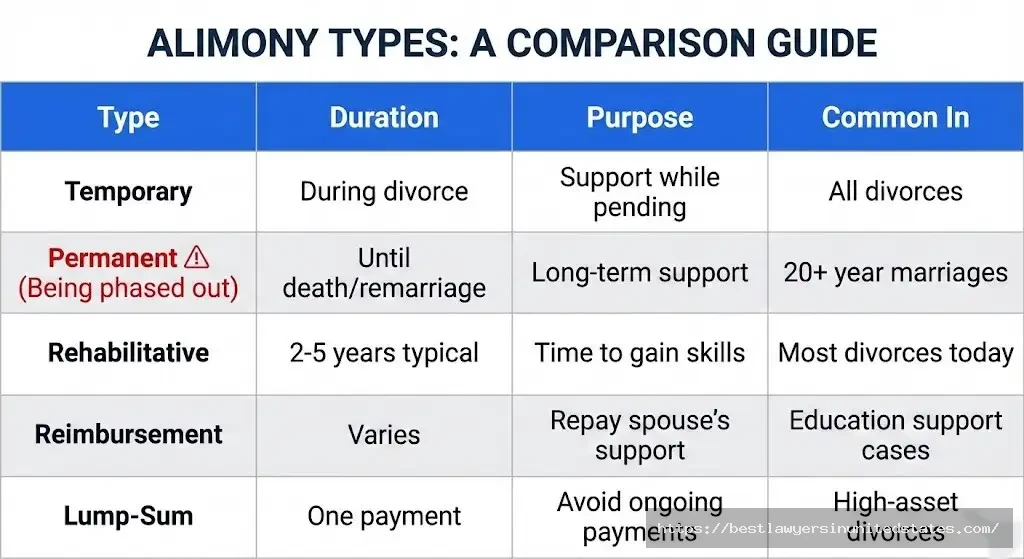
Alimony Type Comparison
| Type | Duration | Purpose | Common In |
|---|---|---|---|
| Temporary | During divorce | Support while case pending | All divorces |
| Permanent | Until death/remarriage | Long-term support | 20+ year marriages |
| Rehabilitative | 2-5 years typical | Time to gain job skills | Most divorces today |
| Reimbursement | Varies | Repay spouse’s support | Educational support cases |
| Lump-Sum | One payment | Avoid ongoing payments | High-asset divorces |
Who Qualifies for Alimony? Eligibility Factors
Either spouse can request alimony during divorce proceedings. You cannot request alimony after your divorce is final, so you must ask for it during the case.

Courts consider multiple factors when deciding whether to award alimony. No single factor determines eligibility. Judges weigh all circumstances together.
Key Factors Courts Consider
Length of marriage matters most for alimony decisions. Longer marriages are much more likely to result in spousal support awards. Many states use formulas based partly on marriage duration.
Income disparity between spouses is the second most important factor. Courts look at the difference between what each person earns. A spouse earning $150,000 while the other earns $30,000 creates a strong case for alimony.
Standard of living during marriage helps courts determine appropriate payment amounts. Judges try to help both spouses maintain a similar lifestyle to what they had while married.
Age and health affect earning potential and ability to work. Older spouses or those with disabilities may receive longer-term support. A 58-year-old who hasn’t worked in 25 years will likely receive more generous alimony than a healthy 32-year-old.
Earning capacity and employability examine each spouse’s ability to earn income. Courts consider education level, job skills, work history, and current job market conditions. They may calculate “imputed income” if someone could earn more but chooses not to work.
Contributions to marriage include both financial and non-financial support. Staying home to raise children or supporting a spouse’s career advancement are valuable contributions. So is paying for a spouse’s education or helping build a family business.
Custody of children can affect alimony awards. The parent with primary custody may receive more support since childcare responsibilities limit work opportunities.
Property division influences alimony decisions. If one spouse receives most marital assets, they may get less alimony or none at all.
Fault in divorce matters in some states but not others. In fault-based divorces, adultery or abuse may reduce or eliminate alimony for the at-fault spouse.
What Disqualifies You From Alimony?
Several factors can prevent alimony awards:
✅ Short marriage under 3 years rarely results in alimony ✅ Similar incomes between spouses eliminates the need for support
✅ Refused to work or improve job skills despite ability ✅ Prenuptial agreement waiving alimony rights ✅ Marital misconduct in fault states may disqualify you
How Is Alimony Calculated? Payment Amounts Explained
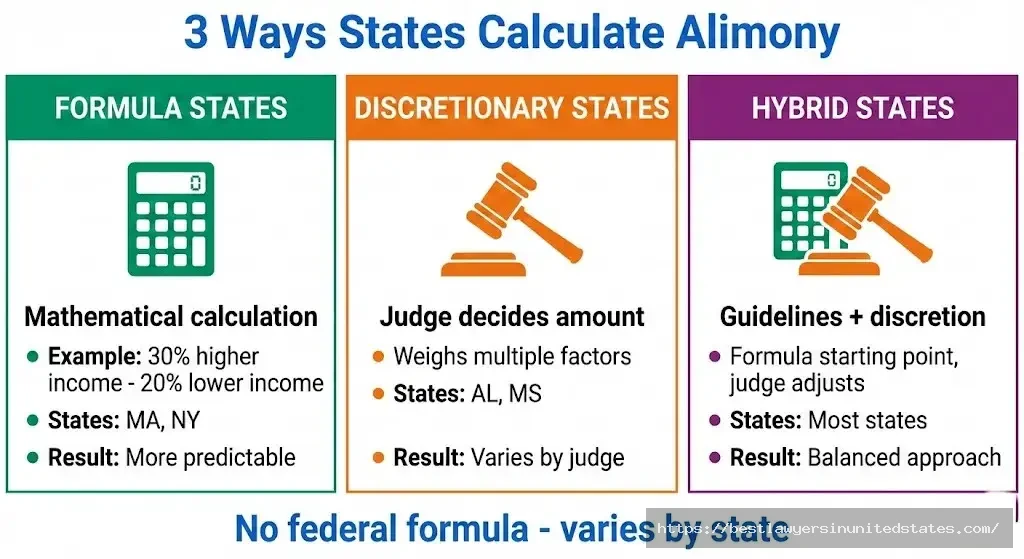
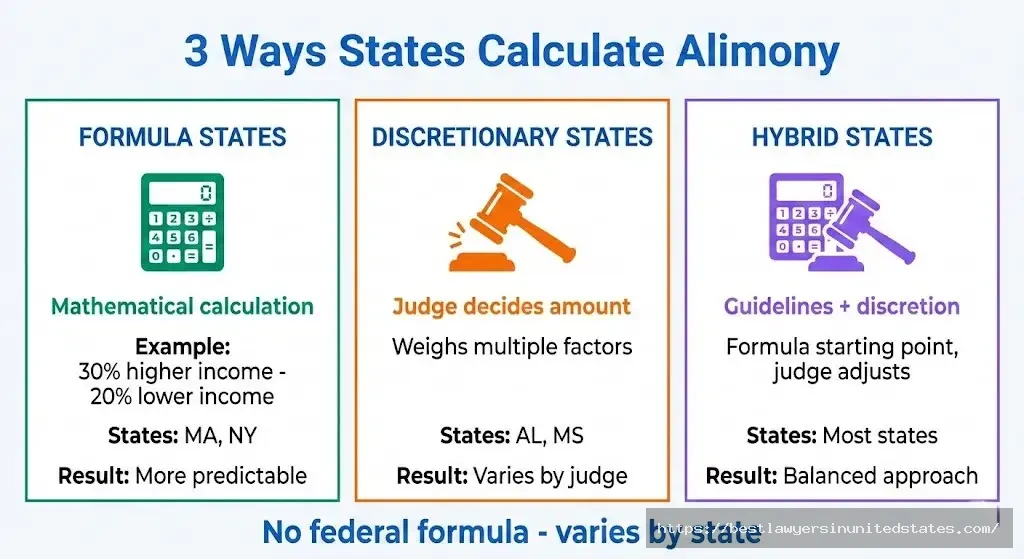
No federal formula exists for calculating alimony. Each state handles calculations differently. This creates huge variations in alimony amounts depending on where you live.
Three Main Calculation Approaches
Formula states use mathematical calculations to determine alimony. For example, some states calculate 30% of the higher earner’s income minus 20% of the lower earner’s income. These formulas provide consistency but judges can still adjust amounts based on individual circumstances.
Discretionary states give judges full freedom to set alimony amounts based on the factors listed above. Two similar cases might result in different awards depending on the judge.
Hybrid approach states provide guidelines but allow judicial discretion. Judges start with a formula then adjust up or down based on specific case details.
Estimate Your Alimony Payments
Calculate Your Alimony
Wondering about potential spousal support? Our calculator estimates alimony payments based on income difference, marriage length, and state guidelines.
Alimony Calculator
Estimate spousal support payments based on your state’s guidelines. Get monthly payment amounts, duration estimates, and total alimony calculations.
Enter Your Information
Provide details about income, marriage, and circumstances
Estimated Monthly Alimony Payment
📍 State Alimony Guidelines
Information about this state’s alimony approach will appear here.
📊 Calculation Breakdown
| Component | Value |
|---|
Calculator features: ✅ State-specific alimony formulas
✅ Duration estimates based on marriage length ✅ Income-based calculations ✅ Modification factor considerations
Questions about your divorce or need legal help? Find Divorce Lawyers - Free Consultation Email: [email protected]
Average Alimony Payment Amounts
National averages range from $800 to $2,000 per month for alimony payments. However, this varies dramatically based on income level and geographic location.
Income-Based Alimony Examples:
$50,000/year household:
Spouse A earns $40,000, Spouse B earns $10,000. Alimony might be $300-$700/month for 5 years in a 10-year marriage.
$100,000/year household:
Spouse A earns $85,000, Spouse B earns $15,000. Alimony might be $1,200-$2,000/month for 7 years in a 15-year marriage.
$200,000/year household:
Spouse A earns $180,000, Spouse B earns $20,000. Alimony might be $3,000-$5,000/month for 10 years in a 20-year marriage.
These are rough estimates only. Actual amounts depend on state laws, specific circumstances, and judicial discretion. Use the divorce cost calculator to estimate your total divorce expenses including potential alimony.
How Long Does Alimony Last? Duration Rules
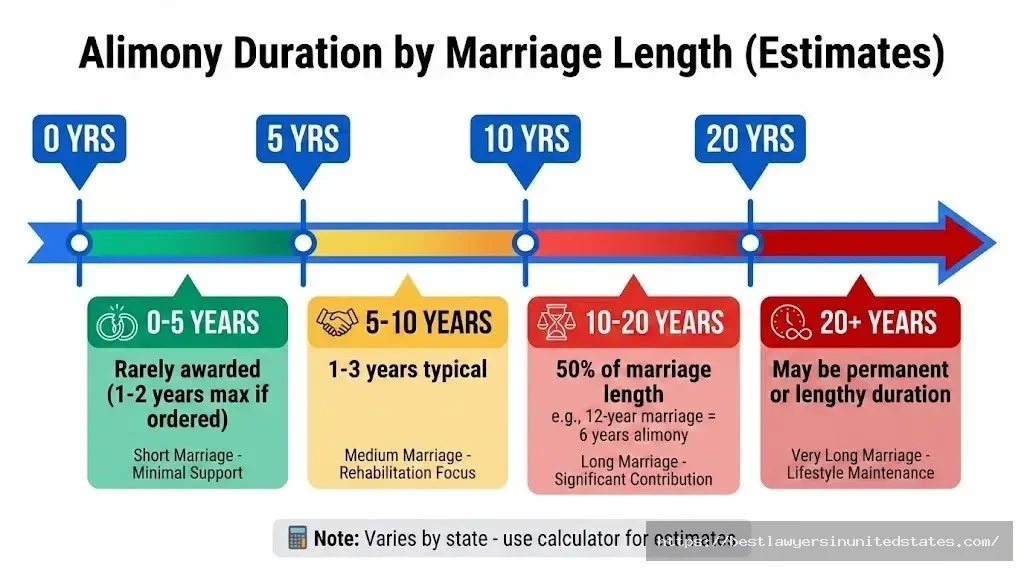
Alimony duration varies based primarily on marriage length. Most states follow general guidelines but judges have flexibility to adjust timeframes.
General Duration Guidelines by Marriage Length
Marriages 0-5 years:
Alimony rarely awarded. If ordered, typically lasts 1-2 years maximum.
Marriages 5-10 years:
Alimony typically lasts 1-3 years, usually shorter than the marriage.
Marriages 10-20 years:
Alimony often lasts 50% of the marriage length. A 12-year marriage might result in 6 years of support.
Marriages 20+ years:
May be permanent or last many years. Some states cap duration even for long marriages, while others allow indefinite support.
When Alimony Automatically Ends
Several events terminate alimony obligations automatically:
✅ Death of either spouse ends alimony immediately in all states ✅ Remarriage of recipient automatically terminates support in most states
✅ Court-ordered end date specified in the divorce decree ✅ Recipient becomes self-supporting if decree includes this provision ✅ Cohabitation in romantic relationships ends alimony in many states
Important: The paying spouse cannot just stop payments when these events occur. They must file a court motion to officially terminate the alimony order. Stopping payments without court approval can result in contempt charges.
Calculating Your Divorce Timeline
Understand how the divorce waiting period affects your total case timeline, including when alimony starts and stops. The divorce waiting period varies by state from zero days to six months.
Alimony and Taxes: What You Need to Know
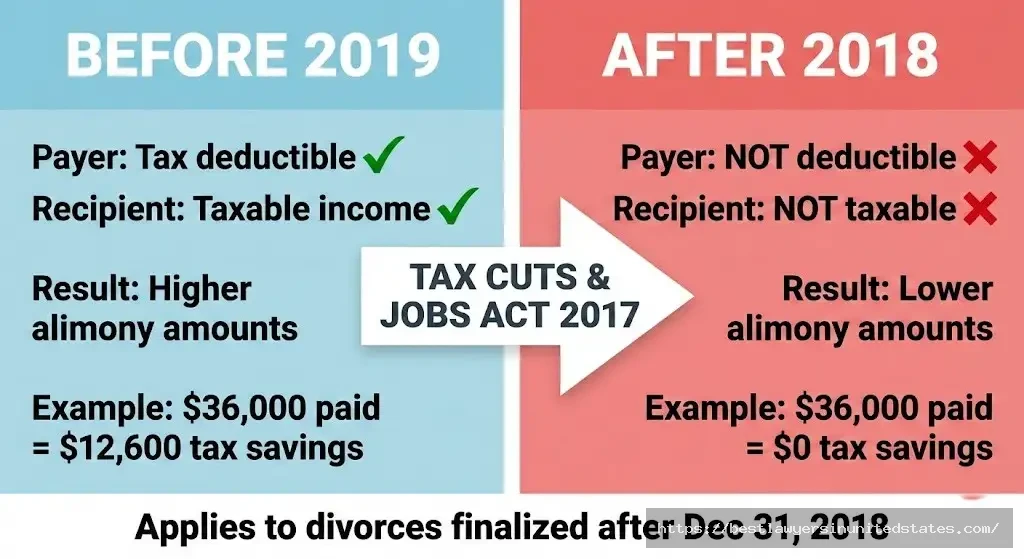
The Tax Cuts and Jobs Act of 2017 created the biggest change to alimony in decades. Understanding these tax rules is critical for negotiating fair alimony amounts.
The 2019 Tax Law Change (CRITICAL)
For divorces BEFORE January 1, 2019: ✅ Paying spouse deducts alimony from taxable income ✅ Receiving spouse reports alimony as taxable income
✅ This created incentive for higher alimony amounts ✅ Old rule still applies if not modified after 2018
For divorces AFTER December 31, 2018: ✅ Paying spouse CANNOT deduct alimony ✅ Receiving spouse does NOT report as income ✅ Reduced incentive to pay alimony ✅ Average alimony amounts decreased nationwide
This change affects divorce negotiations significantly. Pre-2019, a high-earning spouse in the 35% tax bracket got 35 cents back for every dollar paid in alimony. That tax benefit no longer exists.
How This Affects Divorce Negotiations
Before 2019 tax change:
Spouse A earns $200,000 (35% tax bracket)
Pays $3,000/month alimony = $36,000/year
Tax deduction saves $12,600/year
Net cost: $23,400/year
After 2019 tax change:
Spouse A earns $200,000 (35% tax bracket)
Pays $3,000/month alimony = $36,000/year
NO tax deduction
Net cost: $36,000/year
The paying spouse now pays 50% more in after-tax dollars. This is why average alimony amounts dropped after the law changed.
For receiving spouses:
Before 2019, recipients paid income tax on alimony received. Now they keep 100% tax-free. A recipient in the 22% tax bracket now keeps an extra 22% of every alimony dollar.
IRS Reporting Requirements
For pre-2019 divorces, paying spouses report alimony on Form 1040 Schedule 1 and must include the recipient's Social Security number. Receiving spouses report it as income.
For post-2018 divorces, no reporting is required since alimony is neither deductible nor taxable.
See IRS Publication 504 for detailed rules on divorced or separated individuals.
Alimony vs Other Divorce Costs
Alimony represents ongoing costs separate from one-time divorce expenses. Understanding how these differ helps you plan financially.
Cost Comparison Table
| Cost Type | Timing | Amount | Purpose |
|---|---|---|---|
| Alimony | Monthly ongoing | $800-$2,000/month average | Spousal support |
| Child Support | Monthly ongoing | Varies by income/children | Children's needs |
| Property Division | One-time | 50% of assets typically | Split marital property |
| Attorney Fees | Upfront/hourly | $3,000-$20,000+ | Legal representation |
| Filing Fees | One-time | $200-$450 | Court costs |
| Mediation | Hourly | $100-$300/hour | Negotiate settlement |
Understanding the Differences
Alimony supports the ex-spouse's living expenses and lifestyle maintenance. It's based on need and ability to pay.
Child support pays for children's specific needs like food, housing, clothing, healthcare, and education. It's calculated using state formulas based on both parents' incomes and custody arrangements.
Property division splits assets acquired during marriage. In community property states, assets split 50/50. In equitable distribution states, courts divide fairly but not necessarily equally.
Attorney fees represent upfront divorce costs. You pay these whether or not alimony is ordered. See how much a divorce costs for complete breakdowns.
Most divorces involve multiple cost types. A contested divorce with children might include attorney fees, filing fees, alimony, and child support.
State Alimony Laws: Where You Live Matters
Alimony laws vary dramatically by state. Where you file for divorce affects whether you receive alimony, how much, and for how long.
States With Different Alimony Approaches
Most states allow alimony but apply different rules and formulas. Some states recently reformed their alimony laws while others maintain traditional permanent alimony for long marriages.
Formula-based states like Massachusetts and New York provide specific calculations for determining alimony amounts and duration. This creates more predictability.
Discretionary states like Alabama and Mississippi give judges full control over alimony decisions without formulas. Similar cases may result in different awards.
States With Limited Alimony
Texas offers spousal maintenance only in specific situations: ✅ Marriage lasted 10+ years
✅ Recipient spouse lacks earning ability ✅ Domestic violence occurred ✅ Disabled child requires care
Texas alimony is limited to $5,000/month or 20% of paying spouse's gross income, whichever is less. Duration maxes out at 5 years for marriages under 20 years.
North Carolina provides limited post-separation support and alimony only when one spouse is dependent on the other. Fault matters significantly in North Carolina alimony decisions.
Recent State Alimony Reforms
Florida (2023): Eliminated permanent alimony entirely. Now offers bridge-the-gap, rehabilitative, and durational alimony only. Durational alimony cannot exceed the marriage length.
Massachusetts (2012): Comprehensive reform limited alimony duration based on marriage length. Generally caps alimony at 50% of marriage length for marriages under 20 years.
New Jersey (2014): Eliminated permanent alimony term and replaced it with "open durational alimony" for marriages over 20 years.
State Comparison Table
| State | Alimony Type | Typical Duration | Formula? |
|---|---|---|---|
| California | All types | 50% marriage length | Yes |
| Texas | Limited | 5 years max | No |
| Florida | No permanent | Up to marriage length | No |
| New York | All types | Varies widely | Yes |
| Massachusetts | Reformed | Capped by marriage | Yes |
Check your state's specific laws before negotiating alimony. Consider consulting the divorce laws by state guide for detailed information on your location.
Alimony and Prenuptial Agreements
Prenuptial agreements can waive or limit alimony rights before marriage. These agreements must follow specific legal requirements to be valid.
How Prenups Affect Alimony
Prenuptial agreements commonly include alimony provisions such as:
✅ Complete waiver of alimony rights
✅ Cap on alimony amount
✅ Limit on alimony duration ✅ Specific formula for calculating payments ✅ Conditions triggering alimony (length of marriage, fault)
Courts generally enforce valid prenup alimony provisions. However, judges can reject unfair agreements, especially if circumstances changed dramatically since signing.
Key Provisions to Include
Effective prenup alimony clauses specify:
Payment amount: Set specific dollar amounts or formulas based on income and marriage length.
Duration limits: Cap how long alimony lasts regardless of marriage length.
Triggering events: Define what circumstances lead to alimony payments.
Escalation clauses: Increase payments for longer marriages or if certain milestones occur.
Fault exceptions: State whether adultery or abuse affects alimony provisions.
When Courts Invalidate Prenups
Judges can throw out prenuptial agreements if:
✅ One spouse signed under duress or pressure
✅ Agreement was unconscionable (extremely unfair) ✅ Full financial disclosure wasn't provided ✅ No independent legal counsel for both parties ✅ Spouse would become public burden without support
Make sure both parties have separate attorneys review prenups. Sign them at least 30 days before the wedding to avoid duress claims.
Modifying Alimony After Divorce
Alimony orders can change after divorce if circumstances change significantly. Neither spouse can unilaterally change payments. Courts must approve all modifications.
Grounds for Modification
Courts consider modification requests when a material and substantial change in circumstances occurs that wasn't anticipated in the original divorce decree.
Valid reasons for modification:
✅ Job loss or income reduction: Involuntary unemployment or significant pay cuts may reduce payments.
✅ Disability or health issues: New medical conditions affecting earning ability support modifications.
✅ Retirement: Reaching retirement age is grounds for reduction or termination in most states.
✅ Recipient's increased income: If the receiving spouse gets a high-paying job, payments may decrease.
✅ Cost of living changes: Significant inflation or deflation may justify adjustments.
✅ Cohabitation: Recipient living with new romantic partner often reduces or eliminates alimony.
Invalid reasons for modification:
❌ Simply wanting to pay less
❌ Voluntarily quitting a job ❌ Starting expensive new hobbies ❌ New spouse wants the money for themselves
How to Request Modification
File a motion with the court that issued your original divorce decree. You must provide evidence proving the material change in circumstances.
The process typically involves:
- File motion: Submit modification request to family court
- Serve ex-spouse: Deliver papers officially notifying them
- Provide evidence: Show financial documents, medical records, etc.
- Attend hearing: Present your case to the judge
- Receive order: Judge grants, denies, or partially approves modification
Critical rule: Never stop paying alimony without a court order. Stopping payments can result in contempt charges, wage garnishment, property liens, or even jail time.
Continue making payments at the original amount until the judge officially modifies the order. You can request retroactive modification back to your filing date.
Enforcing Alimony Payments
When an ex-spouse stops paying alimony, you have legal remedies available. Courts take alimony violations seriously.
What to Do When Payments Stop
First, try contacting your ex-spouse directly. Sometimes technical issues like bank errors cause missed payments. Document all communication attempts.
If direct contact fails, file a motion for contempt with the court. This legal action forces your ex-spouse to appear before a judge and explain why they stopped paying.
Enforcement Mechanisms
Courts have multiple tools to enforce alimony orders:
Wage garnishment: The most common enforcement method. Court orders the employer to withhold alimony directly from paychecks before the paying spouse receives their wages.
Property liens: Courts can place liens on real estate, vehicles, or other property. The paying spouse cannot sell these assets without first paying overdue alimony.
Bank account levies: Judges can order banks to freeze accounts and withdraw past-due amounts directly.
License suspension: Many states can suspend driver's licenses, professional licenses, or business licenses for non-payment.
Contempt of court: Judges can fine the non-paying spouse or order jail time for willful violation of court orders.
Credit reporting: Unpaid alimony appears on credit reports and damages credit scores.
What Happens to Unpaid Alimony
Overdue alimony becomes a judgment that accrues interest. You don't lose the right to collect missed payments. Courts can order payment of all past-due amounts plus interest.
Most states don't allow bankruptcy to discharge alimony debts. Even if your ex-spouse declares bankruptcy, they still owe alimony.
Keep detailed records of missed payments including dates and amounts. This documentation proves your case when seeking enforcement. The divorce decree serves as your legal proof of the payment obligation.
Alimony and Remarriage
Remarriage affects alimony obligations significantly. However, the specific rules vary by state and depend on what your divorce decree says.
Automatic Termination Rules
In most states, alimony automatically ends when the recipient spouse remarries. The paying spouse no longer has an obligation to support someone whose new spouse should provide support.
However, "automatic" doesn't mean you can simply stop paying. The paying spouse must still file a motion with the court to officially terminate the obligation. Just stopping payments risks contempt charges.
Some states require the paying spouse to file for termination rather than ending payments automatically. Always check your state's specific rules and your divorce decree language.
Dating vs Cohabitation vs Remarriage
Dating doesn't affect alimony. The recipient can date freely without risking support payments.
Cohabitation in a romantic relationship may terminate alimony in many states. This means living together full-time with a romantic partner, not just dating or occasional sleepovers.
The paying spouse must prove cohabitation exists. Evidence includes: ✅ Shared residence address ✅ Joint bills or lease agreements
✅ Shared finances or bank accounts ✅ Public statements about the relationship ✅ Length and stability of arrangement
Remarriage legally ends alimony in most states. Some divorce decrees include provisions allowing alimony to continue even after remarriage, but this is rare.
Cohabitation Rules by State
Not all states consider cohabitation grounds for termination. Some states require proof that cohabitation reduces the recipient's financial need.
States with cohabitation provisions typically require:
✅ Romantic relationship, not just roommates
✅ Regular residence sharing (not occasional visits) ✅ Financial interdependence or support ✅ Duration of at least several months
The burden of proof falls on the paying spouse. Simply showing someone else lives there isn't enough. You must prove it's a romantic relationship functioning like marriage.
Time limits apply: Some states require filing cohabitation motions within one year of discovering the situation. Missing this deadline may prevent termination.
Men and Alimony: Statistics and Trends
Alimony is gender-neutral by law. Either spouse can receive support based on financial need, not gender. Despite this, misconceptions persist that only women receive alimony.
Current Statistics on Men Receiving Alimony
Approximately 3-5% of alimony recipients are men, though this percentage is rising. The exact number is difficult to track since many states don't collect gender-specific alimony data.
Between 2000 and 2020, the percentage of men receiving alimony roughly doubled. This trend reflects:
✅ More women earning higher salaries
✅ More men serving as stay-at-home parents ✅ Better awareness of gender-neutral laws ✅ Reduced stigma around men requesting support
Why Fewer Men Receive Alimony
Several factors explain why men represent a small percentage of alimony recipients:
Income disparity: On average, men still earn more than women. Fewer marriages exist where the wife significantly out-earns the husband.
Social stigma: Many men feel embarrassed requesting alimony. Cultural expectations that men should be primary earners discourage some from seeking support they legally deserve.
Career sacrifices: Historically, women more often sacrificed careers for family responsibilities. This gap is closing as more men stay home with children or support spouses' careers.
Underreporting: Some couples privately agree to financial support without court orders, making it impossible to track.
Challenges Men Face Requesting Alimony
Despite gender-neutral laws, some men report bias in family courts. Judges raised with traditional gender roles may unconsciously favor women seeking alimony while questioning men's requests.
Men may face:
✅ Attorney discouragement from requesting alimony
✅ Spouse's refusal to acknowledge the request seriously ✅ Personal embarrassment or loss of masculine identity ✅ Family and friend judgment ✅ Lower alimony awards than women in similar situations
However, men who persist often succeed. Courts must apply laws equally regardless of gender. Document your financial need, career sacrifices, and your spouse's ability to pay just as a woman would.
Alimony in Mediation and Collaborative Divorce
Couples can negotiate alimony terms themselves through mediation or collaborative divorce rather than having a judge decide. This often results in more creative and mutually satisfactory solutions.
Benefits of Negotiated Alimony
Greater flexibility: You're not bound by state formulas or judicial decisions. Couples can create payment structures that work for their unique situations.
Creative solutions: Might include stepped-down payments, lump sums, or payments tied to specific events like children finishing college.
Faster resolution: Mediation typically takes weeks or months compared to years for contested litigation.
Lower costs: Divorce mediation costs $3,000-$8,000 on average versus $15,000-$30,000+ for contested litigation.
Reduced conflict: Cooperative negotiation preserves relationships better than courtroom battles.
More control: You decide terms rather than leaving it to a judge who doesn't know your family.
Alternative Alimony Structures
Mediated agreements can include provisions courts wouldn't order:
Stepped-down payments: Start higher then decrease over time as recipient builds career skills.
Education funding: Pay for recipient's college or job training instead of cash alimony.
Extended health insurance: Continue coverage instead of or in addition to payments.
Retirement account transfers: Trade alimony for larger retirement asset division.
Life insurance requirements: Maintain policy to protect alimony if paying spouse dies.
Lump-sum options: One payment eliminates ongoing obligations.
Balloon payment at end: Lower monthly payments with larger final payment.
When Mediation Works Best for Alimony
Mediation succeeds when:
✅ Both spouses can communicate respectfully
✅ No domestic violence history exists ✅ Financial disclosure happens honestly
✅ Both genuinely want fair outcomes ✅ Power imbalance isn't extreme
Collaborative divorce takes this further by having attorneys committed to settlement present during negotiations. If collaboration fails and litigation starts, both attorneys must withdraw and clients hire new counsel.
For couples pursuing uncontested divorce, agreeing on alimony terms beforehand significantly speeds the process and reduces costs.
Common Alimony Mistakes to Avoid
Many people make critical errors when dealing with alimony that cost them thousands of dollars or cause legal problems. Avoid these common mistakes.
Not Requesting Alimony Before Divorce Is Final
Biggest mistake: You must request alimony during your divorce proceedings. Once your divorce is final, you cannot go back and request alimony later.
Even if you think you don't need alimony now, request it anyway. You can always waive it later. But you cannot add it after the divorce decree is signed.
Agreeing to Unfair Terms Without Legal Counsel
Don't sign alimony agreements without consulting an attorney who represents only you. Your spouse's lawyer doesn't protect your interests.
Many people agree to inadequate alimony amounts or too-short duration to "just get it over with." These decisions cause financial hardship for years.
Stopping Payments Without Court Modification
Never stop paying alimony without a court order even if: ✅ Your ex-spouse remarries
✅ They cohabitate with someone new ✅ You lose your job ✅ They now earn more than you
File a modification motion first. Stopping payments without court approval results in contempt charges, interest on overdue amounts, wage garnishment, or jail.
Not Documenting Changed Circumstances
If seeking modification, keep detailed records proving the change: ✅ Termination letter from employer
✅ Medical records showing disability ✅ Evidence of ex-spouse's cohabitation
✅ Pay stubs showing reduced income ✅ Retirement account statements
Without documentation, courts deny modification requests.
Failing to Enforce When Payments Stop
Don't assume your ex-spouse will eventually catch up on missed payments. File contempt motions quickly. Delay makes enforcement harder and you lose money every month.
Verbal Agreements Instead of Court Orders
Never rely on verbal promises about alimony. Get everything in writing and approved by the court. Verbal agreements are unenforceable.
Ignoring Tax Implications
Understand whether your divorce falls under pre-2019 or post-2018 tax rules. This dramatically affects after-tax costs. Factor taxes into negotiation strategies.
Not Updating Court on Address Changes
Keep the court informed of your current address. Missing court notices about modification requests can result in default judgments against you.
Learn more about navigating the complete divorce process steps to avoid these and other mistakes.
Alimony FAQs
Why does a man have to pay alimony?
Quick Answer: Alimony is gender-neutral. The higher-earning spouse pays regardless of gender based on income disparity and financial need.
Courts don't care whether the paying spouse is male or female. They look at who earns more and who needs financial support. If a wife out-earns her husband significantly, she may pay him alimony.
What qualifies a spouse for alimony in the USA?
Quick Answer: Financial need plus the other spouse's ability to pay are the main qualifications. Marriage length, income disparity, and standard of living during marriage also matter.
No guaranteed qualification exists. Judges weigh multiple factors including age, health, earning capacity, contributions to marriage, and property division. Each case is different.
Does wife get alimony if she cheated?
Quick Answer: It depends on the state. Some states consider adultery when awarding alimony, while others follow no-fault rules that ignore marital misconduct.
In fault-based states like North Carolina, adultery can reduce or eliminate alimony for the unfaithful spouse. In no-fault states like California, adultery doesn't affect alimony determinations. Check your state's specific laws.
How much is alimony typically?
Quick Answer: Average alimony ranges from $800 to $2,000 per month nationally but varies widely based on income, marriage length, and state.
High-income earners may pay $5,000+ monthly. Low-income households might have no alimony or $300-$500 monthly. Use the alimony calculator for estimates based on your situation.
Can you avoid paying alimony?
Quick Answer: Prenuptial agreements, short marriages, and similar spousal incomes can prevent alimony. You cannot evade court-ordered alimony without legal consequences.
Legitimate ways to avoid alimony include signing a valid prenup waiving it, keeping marriage under 3-5 years, or ensuring both spouses maintain career earning ability. Illegally evading court-ordered alimony leads to wage garnishment, contempt charges, and possible jail time.
What happens if I don't pay alimony?
Quick Answer: Consequences include contempt of court, wage garnishment, property liens, license suspension, credit damage, and possible jail time.
Courts enforce alimony aggressively. Your ex-spouse files a contempt motion. The judge can order immediate payment of past-due amounts plus interest. Continued refusal results in wage garnishment or incarceration.
How long do you have to be married to get alimony?
Quick Answer: Most states require at least 3-5 years of marriage for alimony awards. Longer marriages receive longer or potentially permanent support.
Short marriages under 3 years rarely result in alimony unless special circumstances exist like one spouse supporting the other through medical school. Marriages over 10 years are much more likely to include spousal support.
Is alimony forever?
Quick Answer: No. Most alimony has end dates. Permanent alimony exists for very long marriages in some states but is becoming less common.
Alimony typically ends when the recipient remarries, either spouse dies, the court-ordered duration expires, or the recipient becomes self-supporting. Only very long marriages (20+ years) might result in permanent support, and many states have eliminated permanent alimony entirely.
Can alimony be changed after divorce?
Quick Answer: Yes. Either spouse can request modification if material and substantial changes in circumstances occur. Courts must approve all changes.
Valid reasons include job loss, disability, retirement, or the recipient's increased income. File a modification motion with evidence proving the change. Never stop paying without court approval.
Do I have to pay alimony if my ex lives with someone?
Quick Answer: Possibly. Many states allow alimony termination for cohabitation but you must prove it's a romantic relationship and get court approval first.
Don't just stop paying. File a motion to terminate based on cohabitation. Provide evidence like shared addresses, joint finances, and relationship duration. The court decides whether cohabitation justifies ending payments.
Is alimony taxable in 2026?
Quick Answer: For divorces finalized after December 31, 2018, alimony is not taxable to recipients and not deductible for payers.
Pre-2019 divorces follow old tax rules where alimony is taxable income for recipients and deductible for payers unless modified after 2018. Check when your divorce was finalized to determine which tax treatment applies.
How is alimony different from child support?
Quick Answer: Alimony supports the ex-spouse's living expenses. Child support pays for children's specific needs like food, housing, and education.
Child support calculations use state formulas based on both parents' incomes. Alimony considers financial need and ability to pay. Both can be ordered in the same divorce. Calculate potential child support payments separately from alimony.
Can I get alimony in a short marriage?
Quick Answer: Rarely. Marriages under 3-5 years typically don't result in alimony unless special circumstances exist.
Exceptions include one spouse supporting the other through advanced education or significant career sacrifices made during the short marriage. Most judges reserve alimony for marriages lasting at least 5 years.
What if we both work?
Quick Answer: Both spouses working doesn't automatically eliminate alimony. Courts look at income difference, not just whether both people have jobs.
If one spouse earns $150,000 while the other earns $35,000, alimony might still be appropriate despite both working. The significant income disparity and ability to maintain marital standard of living matter more than employment status.
Do prenups prevent alimony?
Quick Answer: Yes, if properly written and executed. Valid prenuptial agreements can waive or limit alimony rights.
Both parties must have independent legal counsel, provide full financial disclosure, sign voluntarily without duress, and create fair terms. Courts may reject unconscionable prenups that leave one spouse destitute.
Next Steps: Get Help with Alimony
Understanding alimony basics helps you prepare for divorce negotiations. However, every situation is unique. State laws vary dramatically and individual circumstances significantly affect outcomes.
When to Hire an Alimony Lawyer
Consider hiring an attorney if:
✅ Your marriage lasted 10+ years
✅ Significant income disparity exists ✅ You sacrificed career for family/spouse's career
✅ Your spouse earns substantially more ✅ You're being offered unfair alimony terms ✅ Your ex-spouse stopped paying ✅ You need to modify existing alimony ✅ Complex assets or businesses are involved
Many divorce attorneys offer free initial consultations. Use these meetings to understand your alimony rights and likely outcomes in your state.
Understand Your State's Specific Laws
Research your state's alimony statutes before negotiating. State laws determine:
✅ Whether alimony is likely in your situation
✅ How courts calculate payment amounts ✅ How long alimony typically lasts
✅ Whether fault affects alimony decisions ✅ Tax treatment for your divorce date ✅ Modification and termination rules
Review state-specific divorce cost information:
Or explore the comprehensive divorce laws by state guide.
Consider Divorce Alternatives
If you and your spouse can cooperate, consider alternatives to traditional litigation:
Mediation: Work with a neutral mediator to negotiate all divorce terms including alimony. Costs $3,000-$8,000 on average. Learn more: Divorce mediation costs
Collaborative divorce: Each spouse has an attorney but everyone commits to settling out of court. Learn more: Collaborative divorce costs
Uncontested divorce: Both spouses agree on all terms including alimony before filing. Learn more: Uncontested divorce
These alternatives typically cost less than contested court battles and allow more creative alimony solutions.
Get Professional Legal Help
Contact experienced family law attorneys in your area:
Find Divorce Lawyers - Free Consultation Email: [email protected]
An attorney can: ✅ Explain your state's specific alimony laws
✅ Evaluate your likelihood of receiving or paying alimony ✅ Calculate fair payment amounts and duration
✅ Negotiate favorable terms with your spouse ✅ Represent you in court if needed ✅ Ensure proper documentation and court filings ✅ Protect your financial interests
Don't navigate alimony alone. The financial impact lasts years or decades. Professional guidance ensures you understand your rights and obligations fully.