
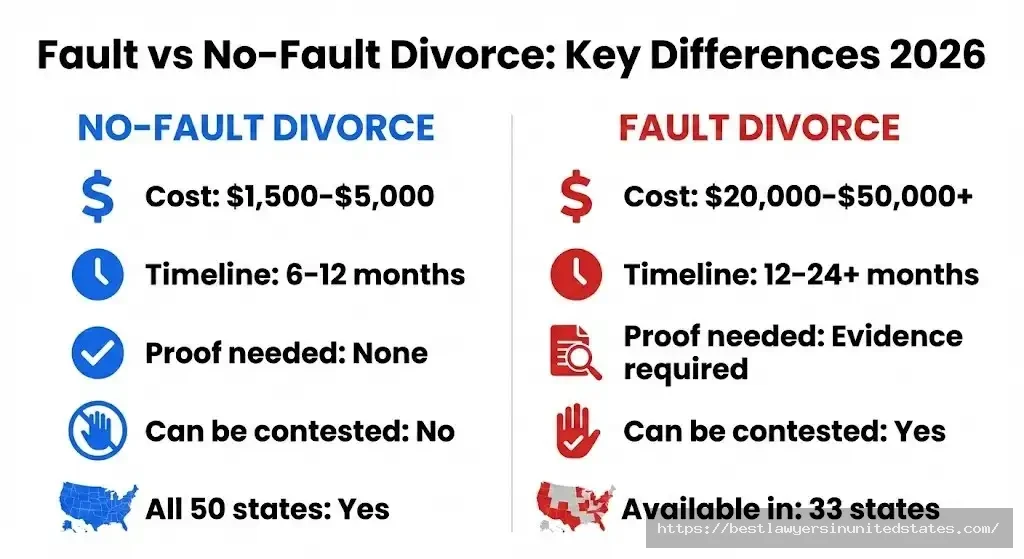
Fault divorce requires one spouse to prove the other’s wrongdoing caused the marriage to fail. This differs from no-fault divorce, where couples can split without blaming anyone. While all 50 states now allow no-fault divorce, 33 states still permit fault-based grounds.
Most people think some states are “fault states” while others are “no-fault states.” That’s not accurate. Every state in America allows no-fault divorce as of 2010, when New York became the last state to adopt it. The real distinction is whether states allow both options or only no-fault.
Understanding fault divorce matters because it affects your divorce strategy, costs, and timeline. Choosing between contested and uncontested divorce can save you thousands of dollars and months of stress. This guide explains when fault divorce makes sense and when it doesn’t.
Understanding Fault Divorce vs No-Fault Divorce
What Is Fault Divorce?
Fault divorce means one spouse blames the other for destroying the marriage. The filing spouse must prove specific misconduct happened. Courts call these reasons “matrimonial offenses” or “fault grounds.”
Common fault grounds include adultery, abuse, abandonment, and substance abuse. The spouse making the claim carries the burden of proof. They need evidence like witness testimony, photos, text messages, or financial records.
Grounds for divorce vary by state, but most recognize similar categories of marital misconduct.
What Is No-Fault Divorce?
No-fault divorce lets couples end their marriage without proving wrongdoing. One spouse simply states the marriage has “irretrievable differences” or has “irretrievably broken down.” These terms mean the relationship can’t be fixed.
The other spouse cannot contest a no-fault divorce. Even if they disagree, the court will grant the divorce. This is why no-fault divorce became the default option in every state.
Some states require couples to live apart for a set period before granting no-fault divorce. This separation period ranges from a few months to over a year depending on the state.
Key Differences: Fault vs No-Fault
| Feature | Fault Divorce | No-Fault Divorce |
|---|---|---|
| Proof Required | Must prove spouse’s misconduct | No proof needed |
| Can Be Contested | Yes, spouse can defend | No, cannot be stopped |
| Average Cost | $15,000-$30,000+ | $1,500-$5,000 |
| Timeline | 12-24+ months | 6-12 months |
| Evidence Needed | Witness testimony, documents, photos | Simple statement |
| Separation Period | Usually not required | Required in some states |
| Affects Property/Alimony | Yes, in some states | No, typically |
Quick comparison: Fault divorce costs 2-3 times more and takes twice as long as no-fault divorce. Most attorneys recommend no-fault unless you have a specific strategic reason to pursue fault.
The Truth About “Fault States” – Every State Explained
Debunking the “Fault State” Myth
Many people incorrectly say they live in a “fault state” or “no-fault state.” This misconception comes from outdated information. New York was the last state to allow no-fault divorce in 2010. Since then, every state permits couples to divorce without proving fault.
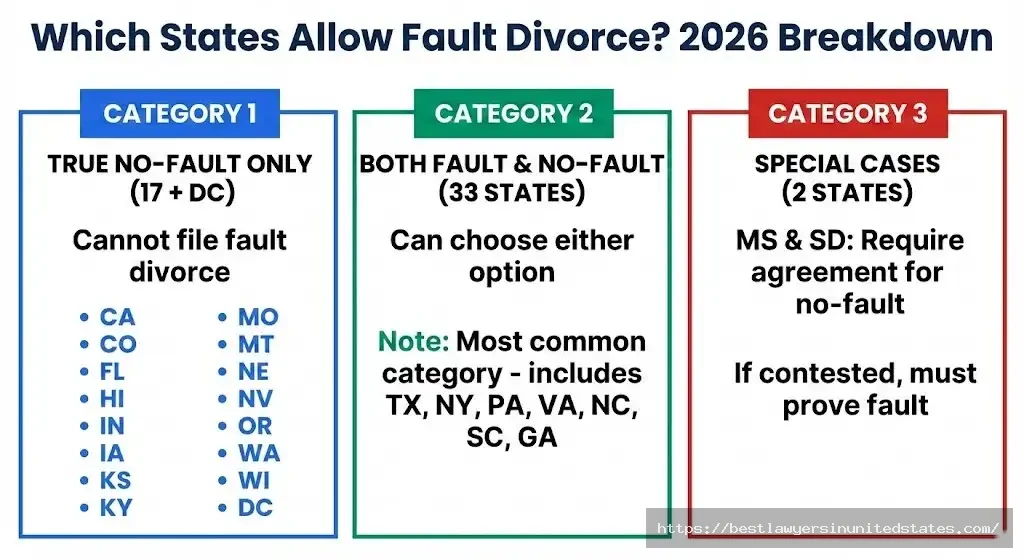
The real question isn’t whether your state allows no-fault divorce. It does. The question is whether your state also still allows fault-based grounds. Most states (33 of them) allow both options.
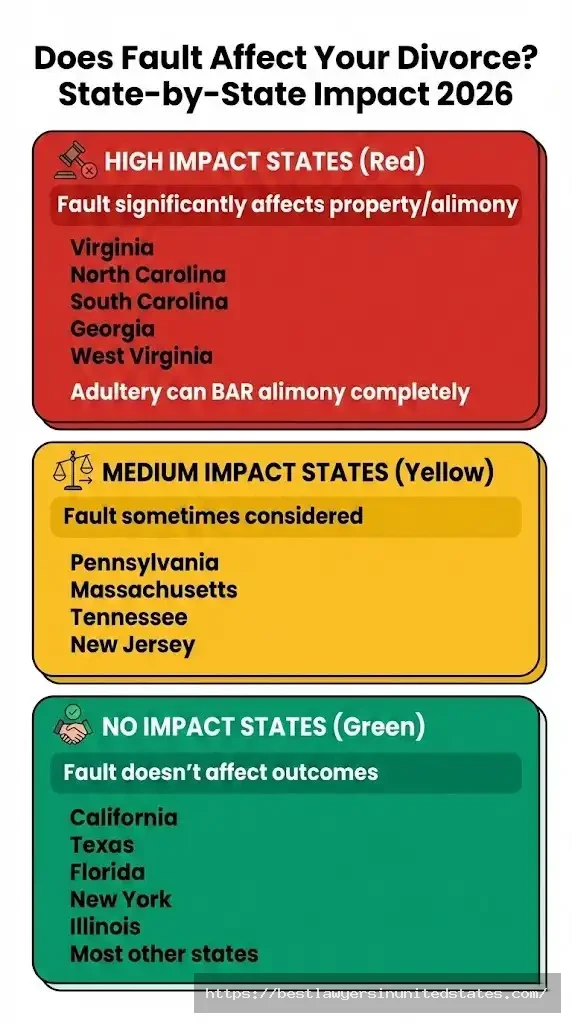
What people really mean by “fault state”: They mean states where fault can affect property division or alimony. Virginia, North Carolina, South Carolina, and a few others let judges consider marital misconduct when dividing assets or awarding spousal support.
State Categories for Divorce Grounds
All 50 states fall into three categories for divorce laws:
| Category | Number of States | What It Means |
|---|---|---|
| True No-Fault Only | 17 states + DC | Only allow no-fault grounds |
| Mixed (Both Options) | 33 states | Allow both fault and no-fault |
| Special Cases | 2 states (MS, SD) | Require agreement for no-fault |
True no-fault states (cannot file fault divorce): California, Colorado, Florida, Hawaii, Indiana, Iowa, Kansas, Kentucky, Michigan, Minnesota, Missouri, Montana, Nebraska, Nevada, Oregon, Washington, Wisconsin, and Washington DC.
States allowing both fault and no-fault (33 states): Alabama, Alaska, Arizona, Arkansas, Connecticut, Delaware, Georgia, Idaho, Illinois, Louisiana, Maine, Maryland, Massachusetts, Mississippi, New Hampshire, New Jersey, New Mexico, New York, North Carolina, North Dakota, Ohio, Oklahoma, Pennsylvania, Rhode Island, South Carolina, South Dakota, Tennessee, Texas, Utah, Vermont, Virginia, West Virginia, Wyoming.
Special cases: Mississippi and South Dakota require both spouses to agree for a no-fault divorce. If one spouse contests, you must prove fault grounds. This makes them unique among all states.
How Fault Affects Outcomes by State
Not all states treat fault the same way. Some states consider marital misconduct when dividing property or awarding alimony. Others ignore fault completely.
States where fault significantly affects outcomes:
| State | Property Division | Alimony | Notes |
|---|---|---|---|
| Virginia | Yes | Yes | Adultery can bar alimony |
| North Carolina | No | Yes | Adultery bars alimony completely |
| South Carolina | Yes | Yes | Fault affects both heavily |
| Georgia | Yes | Yes | Adultery can bar alimony |
| West Virginia | Yes | Yes | Strong fault consideration |
| Massachusetts | Yes | Sometimes | Fault affects property split |
States where fault rarely matters: California, Texas, Florida, New York, and most other states use no-fault property division. Judges split assets based on fairness, not who did what wrong.
Even in states that consider fault, the impact is limited. Most judges focus on financial factors like income, assets, and needs rather than moral judgments about the marriage.
Grounds for Fault Divorce: What Qualifies?
Adultery
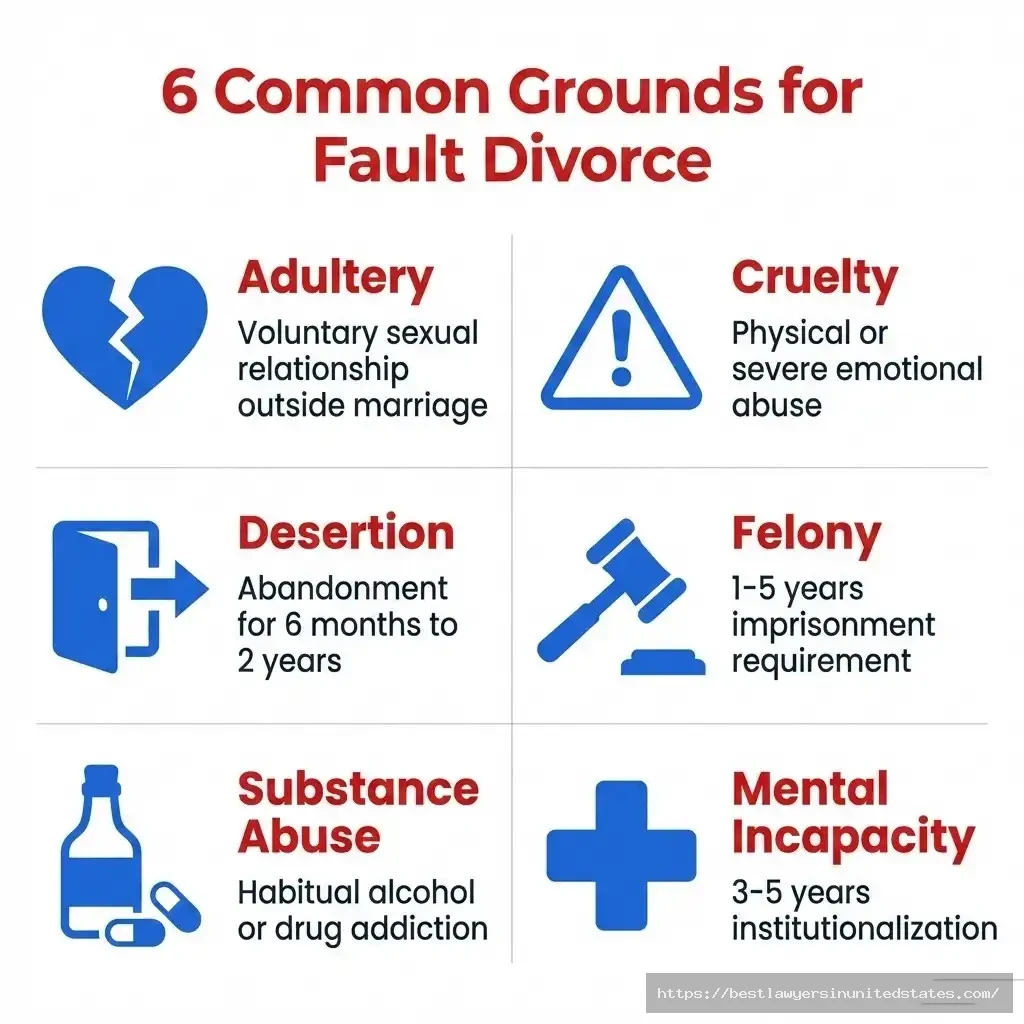
Adultery means one spouse had a voluntary sexual relationship outside the marriage. This is the most common fault ground filed in states that allow it. You need proof beyond suspicion or accusations.
Evidence courts accept:
- Photos or videos
- Text messages or emails
- Credit card statements showing hotel bills
- Witness testimony from someone who saw the affair
- Private investigator reports
Some states require corroboration, meaning you need more than just your own testimony. A second witness or document must support your claim.
States where adultery affects alimony: North Carolina, South Carolina, Georgia, and West Virginia bar the cheating spouse from receiving alimony. Other states may reduce alimony amounts but don’t eliminate them completely.
Cruelty (Physical or Mental)
Cruelty covers both physical abuse and severe emotional mistreatment. The conduct must be serious enough to make continuing the marriage impossible. One-time arguments or occasional harsh words don’t qualify.
Physical cruelty examples:
- Hitting, slapping, or other violence
- Threats of physical harm
- Destruction of property during rage
- Any domestic violence incidents
Mental/emotional cruelty examples:
- Constant verbal abuse or humiliation
- Extreme controlling behavior
- Refusing to speak for extended periods
- Public degradation or embarrassment
Documentation needed: Police reports, medical records, photos of injuries, witness statements from family or friends, therapist notes, or recordings (where legal).
If domestic violence is involved, get a protective order first. Your safety matters more than the divorce process. Courts take abuse claims seriously and may expedite proceedings.
Desertion/Abandonment
Desertion means one spouse left the marital home without consent and stayed away for a specific period. The time requirement varies by state, typically ranging from 6 months to 2 years.
What counts as desertion:
- Physical abandonment of home
- Refusal to have sexual relations (in some states)
- Kicking spouse out of the home
- Moving out without agreement or court order
What doesn’t count:
- Leaving due to abuse (justified departure)
- Mutual agreement to separate
- Work-related absences
- Temporary stays with family during conflict
The abandoning spouse must have intended to end the marriage. Leaving for work, visiting sick relatives, or brief separations during arguments don’t qualify.
Felony Conviction and Imprisonment
Many states allow divorce if a spouse is convicted of a felony and imprisoned. The minimum sentence requirement varies, usually between 1 to 5 years. Some states require the conviction happened during the marriage.
State variations:
- Texas: 1+ years imprisonment for felony
- Virginia: 1+ years for felony conviction
- Pennsylvania: 2+ years imprisonment
- Most states: 1-5 year minimum
You typically cannot use this ground if you testified against your spouse to get them convicted. Courts won’t reward someone who helped put their spouse in prison just to divorce them.
Substance Abuse
Habitual drunkenness or drug addiction qualifies as fault in many states. The substance abuse must be ongoing and serious. Occasional drinking or past drug use doesn’t meet the standard.
Proof required:
- DUI convictions
- Treatment program records
- Witness testimony about drinking/drug use
- Medical records showing addiction
- Employment records (fired for substance abuse)
- Financial records showing excessive alcohol/drug purchases
The addiction must have started after marriage or worsened significantly during marriage. Pre-existing known addiction that continues unchanged is harder to prove as grounds.
Other Fault Grounds
Mental incapacity or insanity: Some states allow divorce if a spouse has been confined to a mental institution for a set period (usually 3-5 years). The condition must be incurable or have a high probability of relapse.
Physical incapacity: Inability to have sexual relations can be grounds if the condition existed before marriage but was hidden. This rarely gets filed today.
Bigamy: Being married to two people at once automatically voids the second marriage. This isn’t really divorce but annulment.
State-specific grounds: Some states have unique fault grounds like “indignities” (Pennsylvania) or “voluntary drug addiction” (Delaware).
How to File for Fault Divorce: Step-by-Step Process
Step 1: Determine If You Meet Residency Requirements
Every state requires at least one spouse to live there for a set time before filing. This prevents forum shopping for favorable divorce laws.
Residency requirements by state type:
- No waiting period: Alaska, South Dakota, Washington (must be resident when filing)
- 6 weeks: Nevada (historically quick divorce destination)
- 3 months: Connecticut, Delaware, Wyoming
- 6 months: California, Wisconsin, New Jersey, Arizona, New Mexico, many others
- 1 year: New York, Rhode Island, Connecticut (for some grounds), many others
Check your specific state’s family code for exact requirements. Filing before you meet residency will get your case dismissed. Courts verify residency through driver’s licenses, utility bills, or lease agreements.
Step 2: Gather Evidence for Your Fault Claim
Fault divorce requires proof. Start collecting evidence before you file. The stronger your evidence, the better your chances of success.
Evidence checklist by fault ground:
For adultery: ✅ Photos or videos of spouse with affair partner ✅ Hotel or restaurant receipts ✅ Text messages, emails, or social media messages ✅ Credit card statements showing suspicious charges ✅ Witness statements from people who saw the affair ✅ Private investigator reports
For cruelty/abuse: ✅ Police reports from domestic violence calls ✅ Medical records showing injuries ✅ Photos of bruises or property damage ✅ Text messages with threats ✅ Witness statements from family or neighbors ✅ Restraining order documentation
For desertion: ✅ Lease or mortgage showing you stayed in home ✅ Utility bills in your name ✅ Text messages or emails about spouse leaving ✅ Witness statements about abandonment ✅ Timeline documenting how long spouse has been gone
For substance abuse: ✅ DUI arrest records ✅ Treatment facility records ✅ Photos or videos showing intoxication ✅ Witness testimony about addiction ✅ Financial records showing alcohol/drug purchases
Some states require corroboration. This means you need a second witness or piece of evidence beyond your own testimony. Check your state’s requirements before proceeding.
Step 3: File Divorce Complaint with Fault Grounds
Filing for divorce starts with completing a divorce petition or complaint. You’ll check boxes indicating which fault ground(s) you’re claiming.
Documents needed:
- Divorce petition/complaint form
- Summons
- Marriage certificate
- Financial disclosure forms
- Supporting affidavit explaining fault grounds
Where to file: County clerk’s office or family court in your county. File where you currently live or where you last lived together as a couple.
Filing fees by state (2026 rates):
| State | Filing Fee | Service Fee |
|---|---|---|
| California | $435-$450 | $40-$75 |
| Texas | $300-$350 | $50-$100 |
| New York | $335 | $30-$50 |
| Florida | $408 | $40 |
| Pennsylvania | $300-$350 | $50 |
Divorce filing fees vary by county within each state. Call your local clerk to confirm exact amounts.
After filing, you must serve the papers on your spouse. Most states require professional service by a sheriff or private process server. You cannot serve the papers yourself.
Step 4: Respond to Defenses (If Raised)
Your spouse can defend against fault divorce claims. They file an answer admitting or denying your allegations. They may also raise legal defenses that could defeat your fault claim.
Common defenses:
- Condonation (they forgave the misconduct)
- Connivance (you encouraged or set up the misconduct)
- Recrimination (you’re also at fault)
- Provocation (you provoked their actions)
- Collusion (you both agreed to fake the grounds)
If your spouse raises defenses, you’ll need to counter them with evidence. Many spouses facing strong evidence choose a different strategy: they simply file their own no-fault divorce petition.
Strategic reality: Your spouse can defeat any fault divorce by counter-filing for no-fault divorce. Courts must grant no-fault divorces, so fault defenses rarely prevent divorce altogether. They just make the process more expensive and contentious.
Step 5: Discovery and Evidence Exchange
Discovery is the formal process of gathering information for trial. Both sides can request documents, ask written questions (interrogatories), and take depositions (sworn testimony).
Discovery tools:
- Document requests: Financial records, phone bills, emails, texts
- Interrogatories: Written questions about the marriage, finances, misconduct
- Depositions: Oral testimony under oath with court reporter present
- Subpoenas: Force third parties (banks, employers) to provide documents
Discovery in fault divorce is more extensive than no-fault. You’re gathering evidence to prove misconduct, which requires more investigation. This adds significant cost to the process.
Average discovery costs: $5,000-$15,000 in attorney time alone. Add expert witnesses (private investigators, therapists, financial analysts) and costs climb higher.
Step 6: Pre-Trial Hearings
Most courts schedule pre-trial conferences to narrow issues and encourage settlement. You may need temporary orders for support, custody, or exclusive use of the home while the case proceeds.
The divorce process includes multiple court appearances. Each hearing costs money in attorney fees. Settling before trial saves substantial expense.
Mediation requirements: Many courts require mediation before allowing fault divorce trials. Mediators help couples settle without a judge deciding. Even in fault cases, most settle during mediation to avoid trial costs.
Step 7: Divorce Trial
If you can’t settle, your fault divorce goes to trial. You present evidence, call witnesses, and make legal arguments. Your spouse does the same. A judge decides whether you proved your fault grounds and how to divide property and award support.
Trial components:
- Opening statements
- Witness testimony (you, your spouse, other witnesses)
- Documentary evidence presentation
- Expert witness testimony (if needed)
- Closing arguments
- Judge’s ruling
Average trial time: 1-3 days for simple fault cases, up to several weeks for complex cases with substantial assets and multiple fault grounds.
Trial costs: $15,000-$50,000+ in attorney fees depending on complexity and length. Divorce attorney fees for trial work range from $300-$500+ per hour.
After trial, the judge issues a divorce decree. The divorce becomes final after any appeal period expires (usually 30 days). Understanding your divorce decree helps you know your rights and obligations.
Fault Divorce Defenses: How Spouses Fight Back
Condonation (Forgiveness)
Condonation means you knew about the misconduct and forgave it by resuming the marital relationship. Courts won’t let you use misconduct you already forgave as grounds for divorce.
How it works: If your spouse had an affair two years ago, you found out, but you stayed together and tried to work it out, you may have condoned the adultery. Resuming sexual relations or continuing to live together as a married couple typically shows forgiveness.
Example: Wife discovers husband’s affair in 2023. They go to marriage counseling and continue living together. In 2026, wife files for fault divorce based on the 2023 affair. Husband claims condonation defense. Court likely grants the defense because wife forgave and resumed the marriage.
Why it rarely succeeds: Courts look at whether you truly forgave or just tried to save the marriage. Brief attempts at reconciliation don’t always equal condonation. New evidence of continued affairs defeats the defense entirely.
Connivance (Setting Up Spouse)
Connivance means you helped create the situation that led to the fault. If you encouraged or enabled the misconduct, courts won’t let you use it as divorce grounds.
Classic example: Husband travels for work and tells wife to invite a male friend to stay at the house while he’s gone. He then uses this as evidence of adultery. Court would likely find connivance because he created the opportunity.
Modern example: Wife monitors husband’s phone, sees messages with coworkers, and actively encourages him to go drinking with a specific female colleague. She then hires a private investigator to catch them together. This could be connivance.
Why it rarely applies: Most spouses don’t intentionally set up their partners for affairs or misconduct. This defense is hard to prove and rarely attempted in modern divorce cases.
Recrimination (Both at Fault)
Recrimination claims both spouses committed marital misconduct. Under old divorce laws, if both were at fault, neither could get divorced. Courts now use “comparative rectitude” instead.
Comparative rectitude: The court grants divorce to whichever spouse is “less at fault.” If both spouses had affairs, the judge determines who was worse and grants them the divorce.
Why it doesn’t work anymore: Even if both spouses are equally at fault, courts will grant a divorce. The public policy strongly favors letting people end failed marriages. No state forces people to stay married because both behaved badly.
Modern application: Recrimination might affect property division or alimony rather than preventing divorce. A spouse who committed adultery may receive less property or support even if they also proved their spouse’s fault.
Provocation
Provocation means one spouse pushed the other to commit the fault. The misconduct happened as a response to the provoking spouse’s behavior.
Example: Husband subjects wife to years of verbal abuse and humiliation. Wife finally has an affair. Husband files for fault divorce based on adultery. Wife claims provocation: his abusive treatment provoked her affair.
Legal reality: Provocation is a weak defense. Courts generally hold adults responsible for their own choices. Having a bad spouse doesn’t justify adultery or other fault grounds.
When it might work: Desertion cases where one spouse forced the other to leave through abuse or cruelty. If you left because staying was dangerous, that’s justified desertion, not fault.
Collusion (Fabricating Grounds)
Collusion means both spouses agreed to fake fault grounds to speed up the divorce. This was more common when no-fault divorce didn’t exist. Couples would stage fake adultery or other misconduct to meet legal requirements.
Why it’s irrelevant now: Every state allows no-fault divorce. There’s no reason to fake fault grounds. If you want a quick divorce, file no-fault. Collusion claims rarely arise in modern cases.
Why Defenses Rarely Work
Bottom line: Fault divorce defenses almost never prevent divorce. Here’s why:
Your spouse can just file no-fault: Even if they successfully defend against your fault claims, they can immediately file their own no-fault petition. Courts must grant no-fault divorces. You can’t stop them.
Courts favor granting divorces: Strong public policy supports ending failed marriages. Judges won’t force people to stay married based on technicalities.
Defenses are expensive: Proving condonation, connivance, or recrimination requires evidence and attorney time. Most spouses realize fighting fault grounds costs more than any benefit they gain.
Better strategy: Negotiate a better settlement rather than fight on fault grounds. Use the money you’d spend on defenses to hire a good attorney who can get you favorable property division or support terms.
How Fault Affects Divorce Outcomes
Impact on Property Division
Most states divide property based on fairness (equitable distribution) or equally (community property). Fault rarely matters in property division, but some states make exceptions.
Community property states (equal 50/50 split): California, Texas, Arizona, Nevada, New Mexico, Idaho, Washington, Wisconsin, Louisiana. These states split marital assets equally regardless of fault. Adultery, abuse, or abandonment don’t affect property division.
Equitable distribution states (fair but not necessarily equal): The remaining 41 states divide property based on various factors. Some consider fault when dividing assets.
States where fault significantly affects property:
| State | How Fault Affects Property |
|---|---|
| Virginia | Courts can consider fault when dividing property |
| South Carolina | Fault is a major factor in property division |
| North Carolina | Marital misconduct can affect distribution |
| West Virginia | Fault influences property split |
| Rhode Island | Courts may consider fault |
| Mississippi | Fault affects property division |
Dissipation of assets: Even in no-fault states, wasting marital money on an affair can affect property division. If your spouse spent $50,000 on their affair partner (gifts, trips, rent), courts may award you more property to compensate.
Example: Husband has affair and spends $30,000 on girlfriend (jewelry, vacations, apartment rent). Wife proves this dissipation. Even in a no-fault state, the court might give wife an extra $30,000 from marital assets or reduce husband’s share.
Impact on Spousal Support/Alimony
Fault has more impact on alimony than property division. Several states bar or reduce alimony based on marital misconduct, particularly adultery.
States that bar alimony for adultery:
- North Carolina: Cheating spouse cannot receive alimony (absolute bar)
- South Carolina: Adultery is a complete bar to alimony
- Georgia: Adultery prevents alimony unless caused by desertion
- West Virginia: Adultery bars alimony
States that reduce alimony for fault:
- Virginia: Fault affects amount and duration
- Pennsylvania: Marital misconduct is a factor
- Tennessee: Courts consider fault in alimony decisions
- New Jersey: Fault can reduce or eliminate alimony
- Alabama: Fault influences alimony awards
Most states ignore fault for alimony: California, Texas, Florida, New York, and most others determine alimony based purely on financial factors:
- Length of marriage
- Income disparity between spouses
- Standard of living during marriage
- Age and health of both spouses
- Ability to become self-supporting
Strategic consideration: If you live in a state where adultery bars alimony, and your spouse had an affair, fault divorce could save you substantial money. Use our alimony calculator to estimate potential savings.
Calculate Alimony Based on Your State’s Laws
Wondering about spousal support? Our calculator estimates alimony payments based on your state’s guidelines, income difference, marriage length, and other factors.
Alimony Calculator
Estimate spousal support payments based on your state’s guidelines. Get monthly payment amounts, duration estimates, and total alimony calculations.
Enter Your Information
Provide details about income, marriage, and circumstances
Estimated Monthly Alimony Payment
📍 State Alimony Guidelines
Information about this state’s alimony approach will appear here.
📊 Calculation Breakdown
| Component | Value |
|---|
Questions about your divorce or need legal help? Email: [email protected]
Impact on Child Custody (Rare)
Courts decide custody based on the child's best interests. Marital misconduct between spouses rarely affects custody unless it impacts parenting ability.
When fault affects custody:
- Abuse or domestic violence: Any abuse of spouse or children heavily influences custody decisions
- Substance abuse: Active addiction affects ability to parent safely
- Mental health issues: Untreated severe mental illness may limit custody
- Neglect: Abandoning children along with spouse affects custody
When fault doesn't affect custody:
- Adultery: Having an affair doesn't make you a bad parent
- Financial misconduct: Spending marital money poorly doesn't affect parenting
- General marital conflict: Arguments and incompatibility between spouses
Best interests factors courts actually consider: ✅ Child's relationship with each parent ✅ Each parent's ability to meet child's needs ✅ Stability of each home environment ✅ Child's adjustment to school and community ✅ Mental and physical health of all parties ✅ Child's preference (if old enough)
Example: Father had affair during marriage. Mother files fault divorce based on adultery. Father was still an involved, loving parent who attended school events, helped with homework, and maintained strong relationship with children. Courts will likely grant joint custody despite the affair.
Use our child support calculator to estimate support payments based on your state's guidelines and custody arrangement.
Calculate Child Support in Your State
Have children? Our calculator estimates child support payments based on your state's child support guidelines and custody arrangements.
Child Support Calculator
Calculate child support estimates based on your state's guidelines. Get accurate payment amounts using income shares model calculations.
Enter Your Information
Provide income, custody, and children details
Estimated Monthly Child Support
📍 State Child Support Guidelines
Information about this state's child support calculation method will appear here.
📊 Calculation Breakdown
| Component | Value |
|---|
Questions about your divorce or need legal help? Email: [email protected]
Impact on Attorney Fees
Some states allow courts to award attorney fees to the "innocent" spouse in fault divorces. The at-fault spouse pays their own fees plus the other spouse's legal costs.
States that may award attorney fees based on fault:
- Virginia
- South Carolina
- Pennsylvania (in some cases)
- North Carolina
- West Virginia
How it works: If wife proves husband's adultery or cruelty, the court may order husband to pay wife's attorney fees. This compensates her for the cost of proving his fault.
Financial impact: Attorney fees in fault divorce often exceed $15,000-$30,000. Having your spouse pay these fees provides substantial financial relief.
Reality check: Even if the court awards fees, collecting them can be difficult. If your spouse lacks funds, winning a fee award doesn't guarantee payment.
Fault Divorce Cost: What to Expect
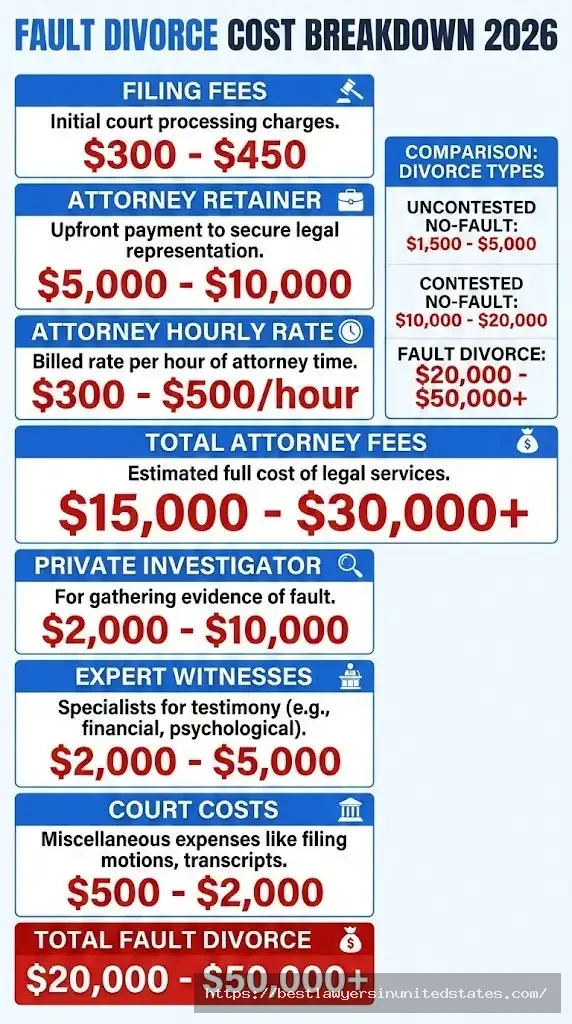
Average Fault Divorce Costs
Fault divorce costs significantly more than no-fault divorce. You're paying for investigation, evidence gathering, and trial preparation that no-fault cases don't require.
National average fault divorce costs (2026):
| Cost Component | Amount |
|---|---|
| Filing fees | $300-$450 |
| Attorney retainer | $5,000-$10,000 |
| Attorney hourly rate | $300-$500/hour |
| Total attorney fees | $15,000-$30,000+ |
| Private investigator | $2,000-$10,000 |
| Expert witnesses | $2,000-$5,000 |
| Court costs | $500-$2,000 |
| Total fault divorce | $20,000-$50,000+ |
Comparison to no-fault divorce:
| Divorce Type | Average Total Cost |
|---|---|
| Uncontested no-fault | $1,500-$5,000 |
| Contested no-fault | $10,000-$20,000 |
| Fault divorce | $20,000-$50,000+ |
Why fault costs more: You need extensive discovery, multiple court hearings, witness testimony, and possibly trial. How much a divorce costs depends heavily on whether you pursue fault grounds.
Why Fault Divorce Costs More
Longer timeline means more attorney hours: Fault divorce takes 12-24+ months versus 6-12 months for no-fault. Your attorney bills hourly for all that extra time.
Evidence gathering expenses:
- Private investigators: $75-$150/hour
- Forensic accountants: $300-$500/hour
- Mental health experts: $200-$400/hour
- Depositions: $500-$2,000 each
More court appearances: Every hearing, conference, and motion costs attorney time. Fault cases have more hearings than no-fault cases.
Trial preparation: If you can't settle, trial preparation alone costs $10,000-$20,000 in attorney time. Trial itself adds another $10,000-$30,000.
Your spouse fights back: Contested fault cases involve both sides hiring experts and conducting extensive discovery. When both spouses have attorneys fighting aggressively, costs escalate quickly.
Calculate Your Divorce Costs
Planning a divorce? Use our free calculator to estimate your total costs based on your state's filing fees, typical attorney rates, and whether your divorce is contested or uncontested.
Divorce Cost Calculator
Get an estimated cost for your divorce based on your specific situation
Your Estimated Divorce Cost
Cost Breakdown
📧 Get a Personalized Consultation
Have questions about your specific situation? Contact our legal experts for guidance tailored to your needs.
Contact Us via EmailQuestions about your divorce or need legal help? Email: [email protected]
States with Highest/Lowest Fault Divorce Costs
Filing fees and attorney rates vary significantly by state. Here's what fault divorce typically costs in major states:
| State | Average Fault Divorce Cost | Filing Fee |
|---|---|---|
| California | $25,000-$50,000 | $435-$450 |
| New York | $30,000-$60,000 | $335 |
| Massachusetts | $25,000-$45,000 | $215 |
| Texas | $20,000-$40,000 | $300-$350 |
| Florida | $20,000-$35,000 | $408 |
| Pennsylvania | $18,000-$35,000 | $300-$350 |
| Virginia | $18,000-$35,000 | $86-$110 |
| Georgia | $15,000-$30,000 | $200-$220 |
| North Carolina | $15,000-$30,000 | $225 |
Lowest cost states: Arkansas, Mississippi, Wyoming, Montana, Idaho typically have lower attorney rates ($200-$300/hour) making fault divorce somewhat more affordable.
Highest cost states: New York, Massachusetts, California, Connecticut have attorney rates of $400-$600/hour, driving up total costs.
Explore state-specific divorce costs:
Fault Divorce Timeline: How Long Does It Take?
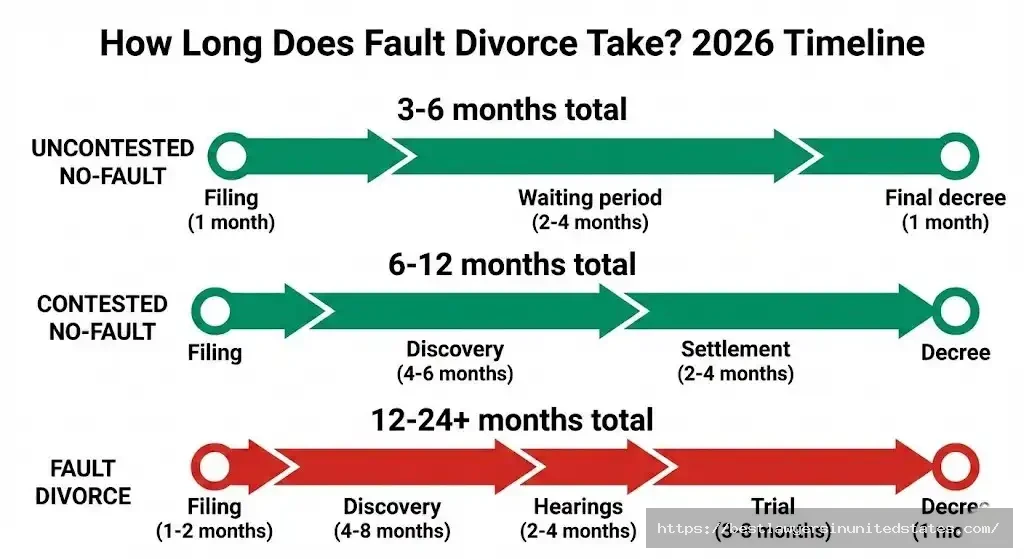
Average Timeline Comparison
Fault divorce takes substantially longer than no-fault divorce. The evidence gathering, discovery, and potential trial all add months to the process.
Typical divorce timelines (2026):
| Divorce Type | Average Timeline |
|---|---|
| Uncontested no-fault | 3-6 months |
| Contested no-fault | 6-12 months |
| Contested no-fault with separation | 12-18 months |
| Fault divorce (settled) | 12-18 months |
| Fault divorce (trial) | 18-24+ months |
Breakdown of fault divorce timeline:
- Filing and service: 1-2 months
- Discovery period: 4-8 months
- Motions and hearings: 2-4 months
- Settlement negotiations: 2-6 months
- Trial (if no settlement): 3-8 months
- Final decree: 1 month
Factors That Affect Timeline
Complexity of evidence: Simple adultery with clear proof (affair partner testimony, hotel receipts) resolves faster than complex financial dissipation requiring forensic accounting.
Defense strategies: If your spouse fights the fault grounds with multiple defenses, the case takes longer. Each motion and hearing adds weeks or months.
Court backlog: Family courts in major cities have significant backlogs. Getting a trial date can take 12-18 months in busy jurisdictions. Smaller counties move faster.
Settlement negotiations: Most fault cases settle before trial. If you and your spouse can negotiate a resolution, you save 6-12 months compared to going to trial.
Attorney schedules: Busy attorneys and judges mean scheduling conflicts. Finding dates when everyone is available adds time to the process.
Can Fault Divorce Be Faster Than No-Fault?
In a few situations, fault divorce actually moves faster than no-fault. This happens in states with long separation requirements for no-fault divorce.
States where fault can be faster:
| State | No-Fault Separation Required | Fault Grounds Available |
|---|---|---|
| North Carolina | 1 year separation | Yes (adultery, abandonment, etc.) |
| South Carolina | 1 year separation | Yes (adultery, cruelty, desertion) |
| Virginia | 6 months-1 year separation | Yes (adultery, cruelty, desertion) |
| Maryland | 1-2 years separation | Yes (adultery, cruelty, desertion) |
Example: In North Carolina, you must live separately for one full year before filing no-fault divorce. If you have evidence of adultery, you can file fault divorce immediately and potentially finish in 8-12 months. This beats the 12-month separation plus 3-6 months for no-fault processing.
Strategic consideration: Even in these states, the cost difference often outweighs the time savings. Paying $25,000 for a fault divorce that takes 12 months versus waiting 15 months for a $5,000 no-fault divorce may not make financial sense.
Understanding how long divorce takes helps you plan financially and emotionally for the process.
When Should You Choose Fault Divorce?
Strategic Advantages of Fault Divorce
States where fault affects property or alimony: If you live in Virginia, North Carolina, South Carolina, West Virginia, or Georgia, and your spouse committed adultery, fault divorce could save you substantial money in alimony. This is the primary strategic reason to pursue fault.
Avoiding separation requirements: In states requiring 12-month separation for no-fault, fault grounds let you file immediately. This matters when you need to end the marriage quickly for financial or safety reasons.
Emotional vindication: Some people need public acknowledgment of their spouse's wrongdoing. Court recognition of adultery or abuse provides closure some people value.
Negotiation leverage: Sometimes merely filing fault divorce creates negotiation pressure. Your spouse may offer better settlement terms to avoid a public trial about their affair or other misconduct.
When fault makes sense: ✅ Spouse's adultery in state where it bars alimony ✅ Need immediate filing in state with long separation requirement ✅ Spouse wasted significant marital assets on affair or addiction ✅ Documented abuse where fault affects property division ✅ Spouse's fault is so clear they'll settle quickly to avoid trial
Major Disadvantages of Fault Divorce
Significantly higher costs: You'll spend $20,000-$50,000+ versus $1,500-$5,000 for uncontested no-fault. The cost difference rarely justifies the benefits except in extreme cases.
Longer timeline: 18-24 months versus 6-12 months means prolonged stress and continued legal entanglement with your spouse.
Emotional toll: Reliving marital trauma through discovery, depositions, and trial takes a heavy psychological price. Many people report that fault divorce damaged their mental health.
Public trial record: Divorce trials are public. Your spouse's affair, your arguments, and intimate details become court records anyone can access. Most people prefer privacy.
Defenses and counter-filing: Your spouse can raise defenses or simply file their own no-fault petition. Courts must grant no-fault divorce, so fighting fault grounds often proves pointless.
Impact on children: Contentious fault divorce increases conflict between parents. This harms children. Courts disfavor parents who pursue vindictive litigation rather than protecting kids.
When fault is a mistake: ❌ You just want revenge or to hurt your spouse ❌ The financial benefit is minimal ❌ You have limited funds for legal fees ❌ Your evidence is weak or circumstantial ❌ You want to maintain co-parenting relationship ❌ Your state doesn't consider fault for property or support
Decision Framework: Fault or No-Fault?
Ask yourself these questions before choosing fault divorce:
Financial analysis:
- Will fault affect property division or alimony in my state?
- How much could I save in alimony if I prove fault?
- Can I afford $20,000-$50,000 in legal fees?
- Is the potential savings worth the legal cost?
Evidence assessment:
- Do I have strong evidence of fault (photos, witnesses, documents)?
- Can I prove fault without spending years in discovery?
- Will my spouse seriously contest the fault grounds?
- Do I need expert witnesses or investigators?
Personal factors:
- Can I handle 18-24 months of contentious litigation?
- Is public disclosure of marital problems acceptable to me?
- Do I have children whose interests should come first?
- Is this about money or revenge?
Strategic alternatives:
- Can I get a favorable settlement without proving fault?
- Would mediation or collaborative divorce work better?
- Can I wait out separation requirement for no-fault?
- Is uncontested divorce possible with negotiation?
General recommendation: Choose no-fault unless you have clear financial advantage in a state where fault matters AND strong evidence that won't be contested. For most people, no-fault divorce is faster, cheaper, and less stressful.
Understanding different types of divorce helps you make the best choice for your situation.
Frequently Asked Questions About Fault Divorce
What states still have fault divorce?
Quick Answer: 33 states allow both fault and no-fault divorce grounds. However, all 50 states allow no-fault divorce as of 2010.
States allowing both fault and no-fault include Alabama, Alaska, Arizona, Arkansas, Connecticut, Delaware, Georgia, Idaho, Louisiana, Maine, Maryland, Massachusetts, Mississippi, New Hampshire, New Jersey, New Mexico, New York, North Carolina, North Dakota, Ohio, Oklahoma, Pennsylvania, Rhode Island, South Carolina, South Dakota, Tennessee, Texas, Utah, Vermont, Virginia, West Virginia, and Wyoming.
True no-fault-only states (cannot file fault) are California, Colorado, Florida, Hawaii, Indiana, Iowa, Kansas, Kentucky, Michigan, Minnesota, Missouri, Montana, Nebraska, Nevada, Oregon, Washington, Wisconsin, and Washington DC.
Is fault divorce more expensive than no-fault?
Quick Answer: Yes, fault divorce typically costs 2-3 times more than no-fault divorce. Average fault divorce costs range from $20,000-$50,000+ versus $1,500-$5,000 for uncontested no-fault.
The higher cost comes from extensive discovery, witness testimony, expert fees, multiple hearings, and potential trial. Attorney fees alone often exceed $15,000-$30,000 in fault cases. Private investigators, forensic accountants, and trial preparation add thousands more.
Can I get more money in a fault divorce?
Quick Answer: It depends on your state. Some states allow courts to consider fault when dividing property or awarding alimony, while most ignore fault completely.
States where fault significantly affects outcomes include Virginia, North Carolina, South Carolina, Georgia, and West Virginia. North Carolina and South Carolina completely bar alimony for spouses who committed adultery. Most states (California, Texas, Florida, New York) divide property and award support based purely on financial factors regardless of fault.
How do you prove fault in a divorce?
Quick Answer: You need concrete evidence like photos, witness testimony, documents, or records. The specific evidence required depends on which fault ground you're claiming.
For adultery: hotel receipts, text messages, photos, witness statements, private investigator reports. For cruelty: police reports, medical records, photos of injuries, witness statements. For desertion: timeline documentation, witnesses, proof you stayed in marital home. For substance abuse: DUI records, treatment records, witness testimony.
Some states require corroboration, meaning you need more than just your own testimony. A second witness or piece of evidence must support your claim.
Can my spouse prevent a fault divorce?
Quick Answer: Not permanently. Your spouse can raise defenses against fault grounds, but they cannot stop you from getting divorced.
Your spouse can defend by claiming condonation (you forgave the fault), connivance (you set them up), recrimination (you're also at fault), or provocation (you caused the fault). Even if these defenses succeed, your spouse can simply file their own no-fault divorce petition. Courts must grant no-fault divorces, so fighting fault grounds rarely prevents divorce long-term.
Which states bar alimony for adultery?
Quick Answer: North Carolina, South Carolina, Georgia, and West Virginia completely bar alimony for spouses who committed adultery.
North Carolina has the strictest rule with an absolute bar on alimony for the spouse who committed adultery. South Carolina also prohibits alimony entirely for adulterous spouses. Georgia bars alimony for adultery unless the other spouse's desertion caused it. West Virginia considers adultery a complete bar to receiving spousal support.
Other states may reduce alimony amounts for fault but don't eliminate it completely.
Does fault affect child custody?
Quick Answer: Generally no, unless the fault directly impacts parenting ability or child safety.
Courts decide custody based on the child's best interests. Marital misconduct between spouses (like adultery) doesn't make someone a bad parent. However, fault grounds involving abuse, severe substance abuse, or neglect do affect custody because they impact the child's safety and wellbeing.
A spouse who was abusive toward the other spouse, especially with domestic violence, will face serious custody limitations. Active drug or alcohol addiction also limits custody. Simple adultery or financial misconduct typically has no effect on custody decisions.
How long does a fault divorce take?
Quick Answer: 12-24+ months typically, compared to 6-12 months for no-fault divorce.
Fault divorce takes longer because of extensive discovery, evidence gathering, multiple hearings, and potential trial. If you settle before trial, expect 12-18 months. If the case goes to trial, plan for 18-24 months or longer. Court backlogs in busy jurisdictions can extend timelines even further.
In states with long separation requirements for no-fault, fault divorce can sometimes be faster by avoiding the waiting period.
What is the most common fault ground?
Quick Answer: Adultery is the most commonly filed fault ground, followed by cruelty and desertion.
Adultery is relatively easy to prove with modern technology (text messages, social media, GPS data) and has the most significant legal consequences in states that bar alimony for cheating spouses. Cruelty (including domestic violence and emotional abuse) is the second most common. Desertion or abandonment ranks third.
Substance abuse, imprisonment, and mental incapacity are filed less frequently because they're harder to prove or occur less often.
Can I change from fault to no-fault divorce?
Quick Answer: Yes, you can amend your petition to change from fault grounds to no-fault grounds at any time before the final decree.
Many people file fault divorce for strategic reasons but later switch to no-fault to settle the case. This happens when the cost and stress of proving fault exceeds any benefit. You simply file an amended petition with the court removing the fault allegations and stating no-fault grounds instead.
Switching to no-fault often helps settlement negotiations because it reduces conflict and shows willingness to compromise.
What's the difference between fault divorce and contested divorce?
Quick Answer: Fault divorce means grounds for ending the marriage (adultery, cruelty, etc.). Contested divorce means spouses disagree on settlement terms. They're different concepts.
You can have fault divorce that's uncontested (both agree on property, support, custody despite fault grounds). You can have no-fault divorce that's contested (spouses fight over money and custody). You can have fault divorce that's also contested. Or you can have no-fault uncontested divorce.
Fault refers to WHY the marriage ended. Contested refers to WHETHER spouses agree on the settlement terms. Understanding contested vs uncontested helps you plan your strategy.
Do I need a lawyer for a fault divorce?
Quick Answer: Yes, you strongly need an attorney for fault divorce due to complex evidence requirements, trial procedures, and legal defenses.
Fault divorce involves proving allegations, conducting discovery, examining witnesses, and potentially going to trial. These are complex legal procedures that require professional representation. Self-representation in fault divorce almost always results in poor outcomes.
Even if you can't afford a full-service attorney, consider limited scope representation (unbundled services) where a lawyer helps with specific parts of your case. Divorce attorney fees vary, and many offer payment plans.
Can my spouse file for fault divorce if I file no-fault?
Quick Answer: Yes, your spouse can file their own petition claiming fault grounds even if you filed first with no-fault grounds.
Filing first doesn't lock in the type of divorce. Your spouse can file a counter-petition or answer asserting fault grounds. The court will consider both petitions. This is called "cross-complaints" or "counter-petitions."
This often happens strategically when one spouse wants to avoid fault accusations by filing no-fault first, but the other spouse insists on proving misconduct.
Does adultery affect divorce outcomes?
Quick Answer: It depends entirely on your state. In North Carolina, South Carolina, Georgia, and West Virginia, adultery bars alimony. In most other states, adultery has no legal effect.
States that consider adultery for alimony or property: Virginia, North Carolina, South Carolina, Georgia, West Virginia, Rhode Island, Connecticut (sometimes), New Jersey (sometimes).
States that ignore adultery completely: California, Texas, Florida, New York, Illinois, Washington, and most others. These states base divorce outcomes purely on financial factors regardless of who cheated.
Adultery rarely affects child custody unless the affair exposed children to inappropriate situations or people.
How much does it cost to prove adultery in divorce?
Quick Answer: $5,000-$20,000+ depending on evidence availability. Private investigators charge $2,000-$10,000, and attorney fees for discovery and trial add $10,000-$30,000.
If you have clear evidence (text messages, emails, witness statements), costs stay lower around $5,000-$10,000. If you need extensive investigation, surveillance, and expert testimony, costs reach $15,000-$20,000+.
Many people discover the cost of proving adultery exceeds any financial benefit unless they live in states where adultery bars alimony completely.
Conclusion
Fault divorce still exists in 33 states but is rarely used in 2026. All 50 states allow no-fault divorce, making fault grounds unnecessary for most people. The higher cost ($20,000-$50,000+), longer timeline (18-24 months), and emotional stress outweigh the benefits except in specific situations.
Consider fault divorce only if you live in a state where fault significantly affects alimony or property division AND you have strong evidence of misconduct. North Carolina, South Carolina, Virginia, and Georgia are the primary states where fault matters financially. Even in these states, carefully weigh the cost of proving fault against the potential savings.
For most people, no-fault divorce is faster, cheaper, and less contentious. Focus on negotiating a fair settlement rather than proving who was at fault. Your time and money are better spent on mediation or collaborative divorce than on contentious fault litigation.
Use our calculators to estimate costs and make informed decisions:
- Divorce cost calculator for total expense estimates
- Alimony calculator for spousal support projections
- Child support calculator for custody-based support
Need legal help with your divorce? Contact experienced family law attorneys in your state for a consultation. Email: [email protected]