
Hawaii’s minimum wage increases to $16.00 per hour on January 1, 2026. This is $1.50 higher than the current 2025 rate of $14.50 and $8.75 above the federal minimum wage of $7.25.
However, Hawaii faces a unique challenge. The state has one of the highest costs of living in the nation, yet its minimum wage ranks only in the middle among U.S. states. This creates a significant gap between what workers earn and what they need to live comfortably.
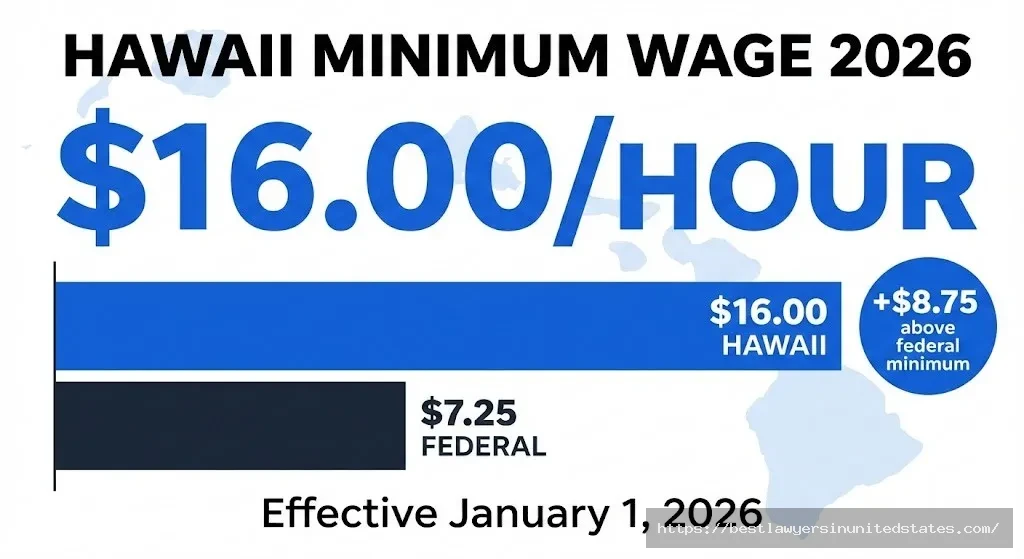
This guide covers everything you need to know about Hawaii’s minimum wage laws for 2026, including wage rates, overtime rules, tipped employee protections, and how to file a wage complaint if your employer violates these laws.
Calculate Your Earnings in Hawaii
Want to know exactly how much you’ll earn at Hawaii’s $16.00 minimum wage? Use our free calculator to estimate your weekly, monthly, and annual income based on your hours worked.
💰 Minimum Wage Earnings Calculator
Calculate your weekly, monthly, and annual earnings with overtime and tax estimates
📊 Your Earnings Breakdown
💰 Gross Earnings
Calculator features:
- Automatic Hawaii wage rates for 2026
- Weekly, monthly, and annual earnings
- Overtime calculations
- Tax withholding estimates
- Take-home pay breakdown
Full calculator with all features: https://bestlawyersinunitedstates.com/minimum-wage-calculator/
Questions about your wages or need legal help?
Email: [email protected]
What Is Hawaii's Minimum Wage in 2026?
Hawaii's minimum wage is $16.00 per hour starting January 1, 2026. This applies to all workers across the state, regardless of employer size or industry.
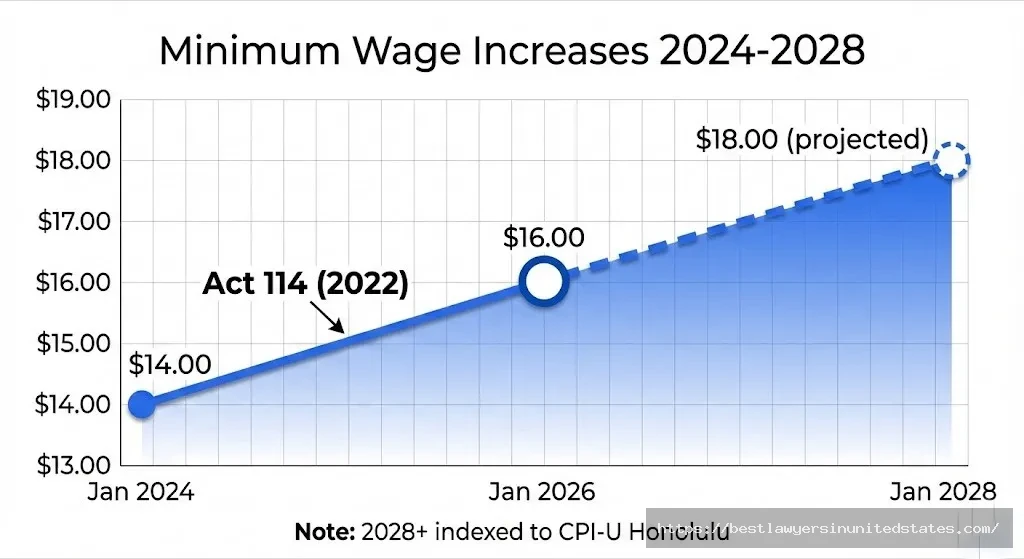
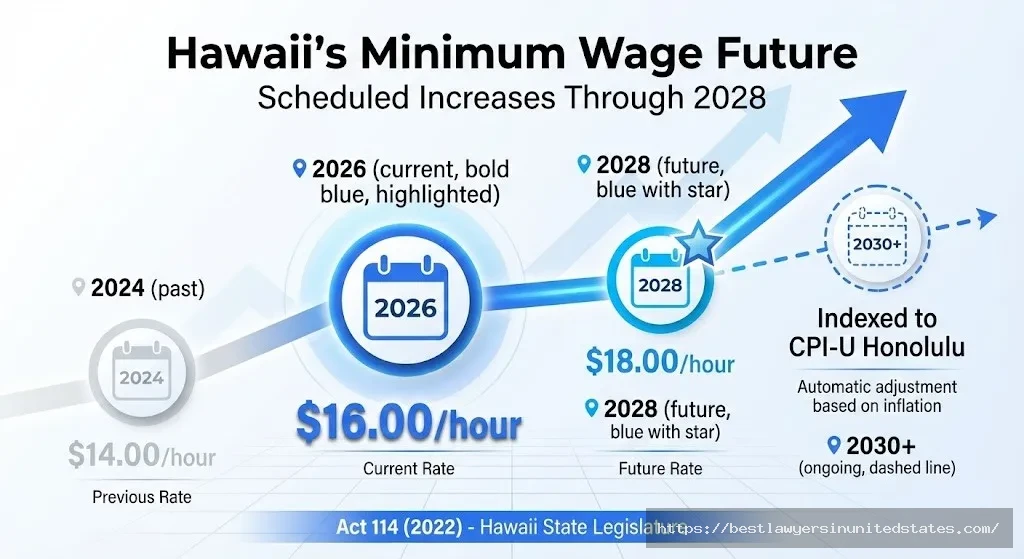
The state legislature passed Act 114 in 2022, which scheduled incremental minimum wage increases through 2028. The 2026 increase brings Hawaii's wage closer to a livable standard, though it still falls short of what economists consider necessary for the state's high cost of living.
Hawaii Minimum Wage Timeline
| Effective Date | Minimum Wage | Change from Previous | Annual Salary (Full-Time) |
|---|---|---|---|
| Jan 1, 2024 | $14.00/hour | +$2.00 | $29,120 |
| Jan 1, 2026 | $16.00/hour | +$2.00 | $33,280 |
| Jan 1, 2028 | $18.00/hour | +$2.00 | $37,440 |
Key detail: After 2028, Hawaii's minimum wage will increase annually based on the Consumer Price Index for Urban Consumers (CPI-U) for Honolulu, meaning wages will adjust with inflation.
How Hawaii Compares to Other States
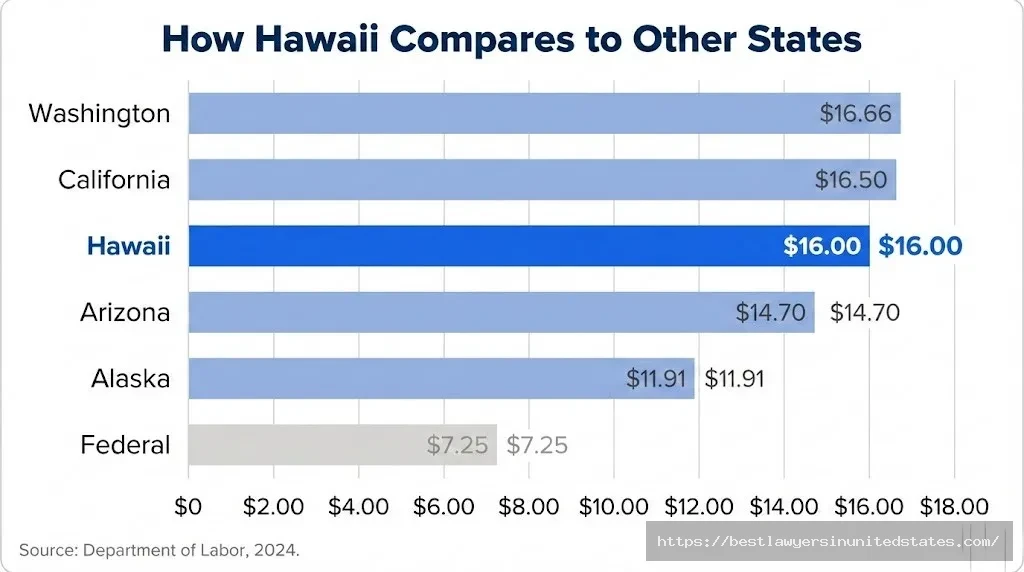
Hawaii's $16.00 minimum wage in 2026 places it among the higher-wage states, but not at the top. California's minimum wage is $16.50, while Washington state leads the nation at $16.66.
| State | 2026 Minimum Wage | Difference from Hawaii |
|---|---|---|
| Hawaii | $16.00/hour | Baseline |
| California | $16.50/hour | +$0.50 |
| Washington | $16.66/hour | +$0.66 |
| Alaska | $11.91/hour | -$4.09 |
| Arizona | $14.70/hour | -$1.30 |
| Federal | $7.25/hour | -$8.75 |
Important note: Unlike Arkansas or Georgia, which follow the federal minimum wage, Hawaii has consistently maintained wages well above the federal floor.
Why Is Hawaii's Minimum Wage "So Low" for Its Cost of Living?
Hawaii's minimum wage sits at $16.00 in 2026, but the state has the second-highest cost of living in the United States. This creates a painful reality for minimum wage workers who struggle to afford basic necessities like housing, food, and transportation.
The Cost of Living Gap
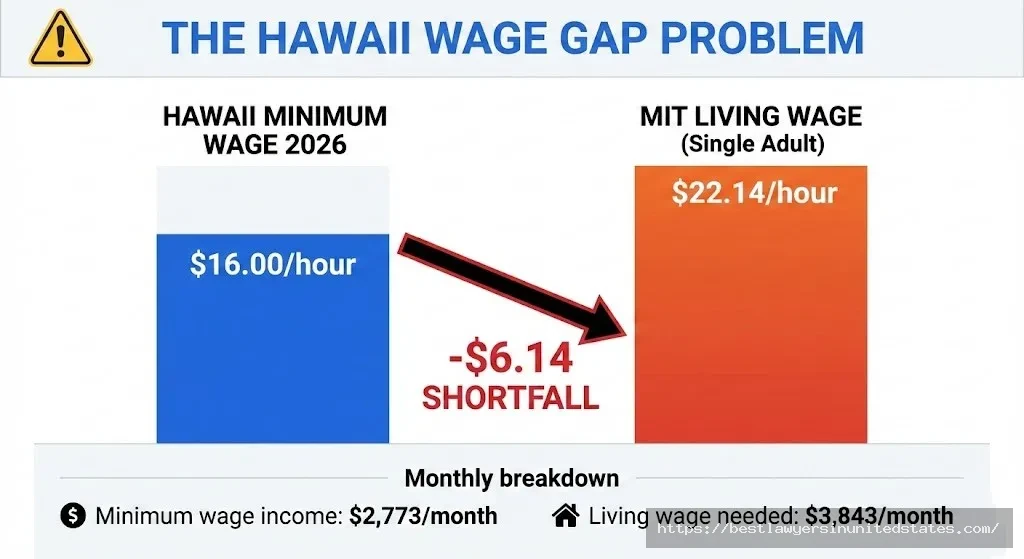
According to MIT's Living Wage Calculator, a single adult in Hawaii needs approximately $22.14 per hour to cover basic expenses in Honolulu. The 2026 minimum wage of $16.00 falls $6.14 short of this baseline.
| Household Type | Required Living Wage | Hawaii Minimum Wage 2026 | Shortfall |
|---|---|---|---|
| 1 Adult | $22.14/hour | $16.00/hour | -$6.14 |
| 1 Adult + 1 Child | $39.42/hour | $16.00/hour | -$23.42 |
| 2 Adults (both working) | $18.07/hour each | $16.00/hour each | -$2.07 |
| 2 Adults + 2 Children (both working) | $24.89/hour each | $16.00/hour each | -$8.89 |
Why the Wage Hasn't Kept Pace
Several factors contribute to Hawaii's wage-cost gap:
Political resistance from business groups: Hawaii's economy relies heavily on tourism and small businesses. Industry groups have historically opposed rapid wage increases, arguing they would hurt employment and force businesses to close.
Legislative process: Minimum wage increases require action from Hawaii's state legislature. Unlike states such as Colorado that automatically adjust wages annually for inflation, Hawaii only recently adopted inflation indexing starting in 2028.
Geographic isolation: Hawaii's remote location increases the cost of imported goods. About 90% of the state's food and consumer products arrive by ship, making everything more expensive even as wages remain relatively stagnant.
What This Means for Workers
A full-time worker earning Hawaii's minimum wage in 2026 takes home approximately $2,773 per month after taxes. The average rent for a one-bedroom apartment in Honolulu is $1,800, leaving just $973 for all other expenses including food, utilities, transportation, and healthcare.
This gap forces many minimum wage workers to take on multiple jobs, share housing with roommates or family, or rely on government assistance programs to make ends meet.
Can You Actually Live on Hawaii's Minimum Wage?
Living on Hawaii's minimum wage requires extreme budgeting and often means sacrificing savings, healthcare, or other basic needs. Most minimum wage workers in Hawaii rely on roommates, family support, or multiple jobs to survive.
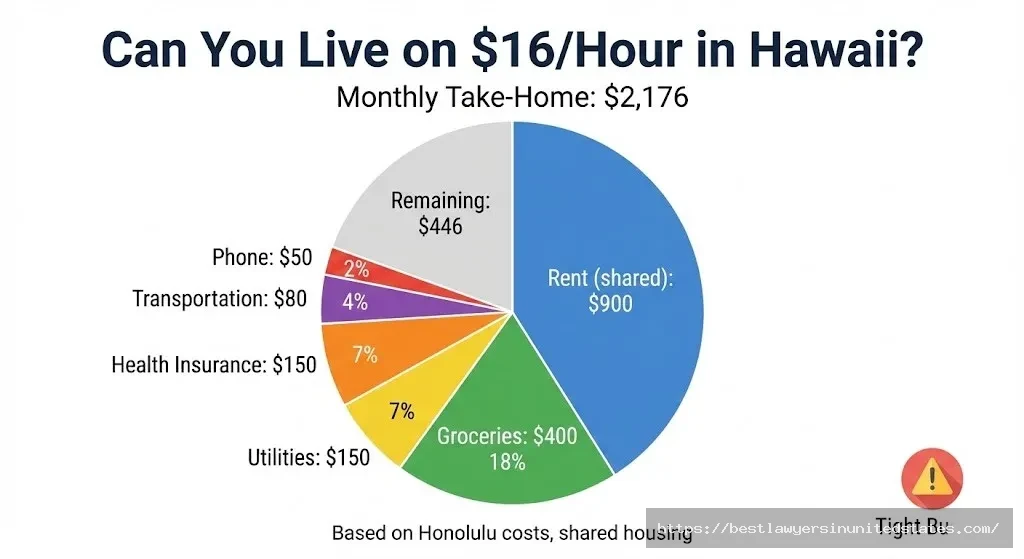
Monthly Budget Reality Check (2026)
Here's what a realistic monthly budget looks like for a full-time minimum wage worker in Honolulu:
Gross Monthly Income: $16.00/hour × 160 hours = $2,560
After taxes (estimated 15%): $2,176 take-home
| Expense Category | Average Monthly Cost | Percentage of Income |
|---|---|---|
| Rent (1-bedroom, shared) | $900 (half of $1,800) | 41% |
| Utilities (electric, water, internet) | $150 | 7% |
| Groceries | $400 | 18% |
| Transportation (bus pass) | $80 | 4% |
| Health insurance | $150 | 7% |
| Phone | $50 | 2% |
| Total Basic Expenses | $1,730 | 80% |
| Remaining | $446 | 20% |
What's missing from this budget:
- Emergency savings
- Car payments or maintenance
- Entertainment or dining out
- Clothing
- Medical co-pays
- Dental or vision care
How People Actually Survive
Most minimum wage workers in Hawaii use one or more of these strategies:
Multiple jobs: Many workers hold two or three part-time jobs to increase their income above minimum wage earnings.
Shared housing: Splitting a two or three-bedroom apartment with roommates cuts housing costs significantly. Some workers live with extended family to reduce expenses.
Living in less expensive areas: Workers commute from more affordable neighborhoods like Waipahu, Ewa Beach, or Kaneohe rather than living in downtown Honolulu.
Government assistance: Many full-time minimum wage workers qualify for SNAP (food stamps), Medicaid, or housing assistance programs.
Comparison to Other High-Cost States
Unlike California, where minimum wage workers in San Francisco earn $18.07 per hour, or Seattle where workers earn $19.97, Hawaii's minimum wage doesn't fully account for the state's extreme cost of living.
Hawaii Tipped Minimum Wage: A Major Advantage for Service Workers
Hawaii does not allow tip credits. Tipped employees must receive the full minimum wage of $16.00 per hour in 2026, plus any tips they earn.
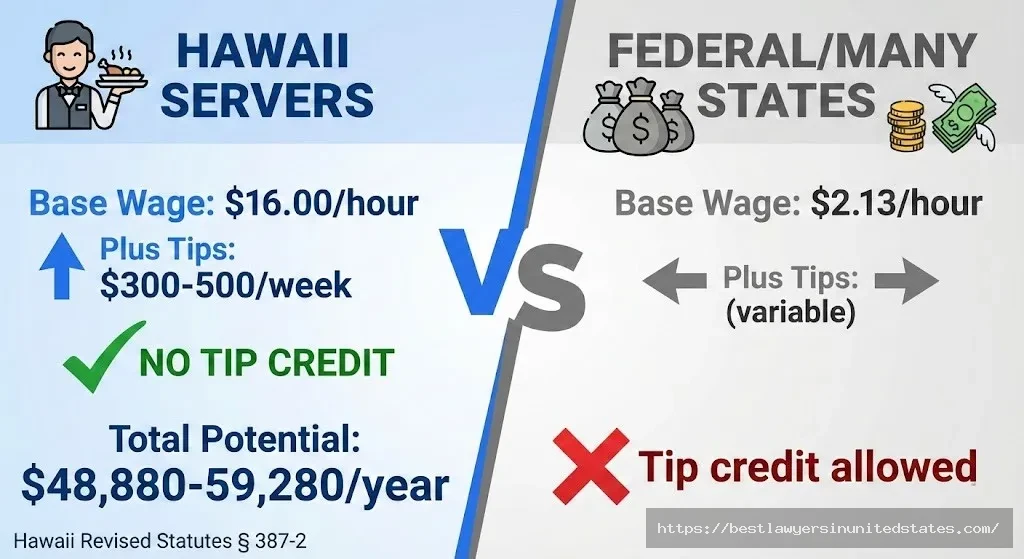
This makes Hawaii one of the best states in the nation for servers, bartenders, and other tipped workers.
What Is a Tip Credit?
A tip credit allows employers to pay tipped workers less than minimum wage, with the assumption that tips will make up the difference. The federal tip credit lets employers pay as little as $2.13 per hour if tips bring total earnings to at least $7.25.
Hawaii prohibits this practice entirely. Under Hawaii Revised Statutes § 387-2, all employees must receive at least the full minimum wage, regardless of tips.
Hawaii vs. Other States for Tipped Workers
| State | Allows Tip Credit? | Tipped Minimum Wage | Regular Minimum Wage |
|---|---|---|---|
| Hawaii | No | $16.00/hour | $16.00/hour |
| California | No | $16.50/hour | $16.50/hour |
| Florida | Yes | $8.98/hour | $13.00/hour |
| Texas | Yes | $2.13/hour | $7.25/hour |
| Connecticut | Yes | $6.38/hour | $15.69/hour |
Potential Earnings for Tipped Workers
A server working 40 hours per week at Hawaii's minimum wage earns:
Base wage: $16.00/hour × 40 hours = $640/week
Average tips: $300-500/week (depends on restaurant)
Total weekly earnings: $940-1,140
Annual income: $48,880-59,280
This significantly exceeds what the same server would earn in states that allow tip credits.
Tip Pooling Rules in Hawaii
Hawaii law allows tip pooling among employees who customarily receive tips, including servers, bartenders, bussers, and hosts. However, managers and supervisors cannot participate in tip pools or take any portion of employee tips.
Important: Employers who violate Hawaii's tipping laws face penalties including back pay, damages, and potential civil liability under HRS § 388-10.
Hawaii Overtime Laws and Regulations
Hawaii requires employers to pay overtime at 1.5 times the regular rate for hours worked beyond 40 in a single workweek. This follows federal Fair Labor Standards Act (FLSA) guidelines.
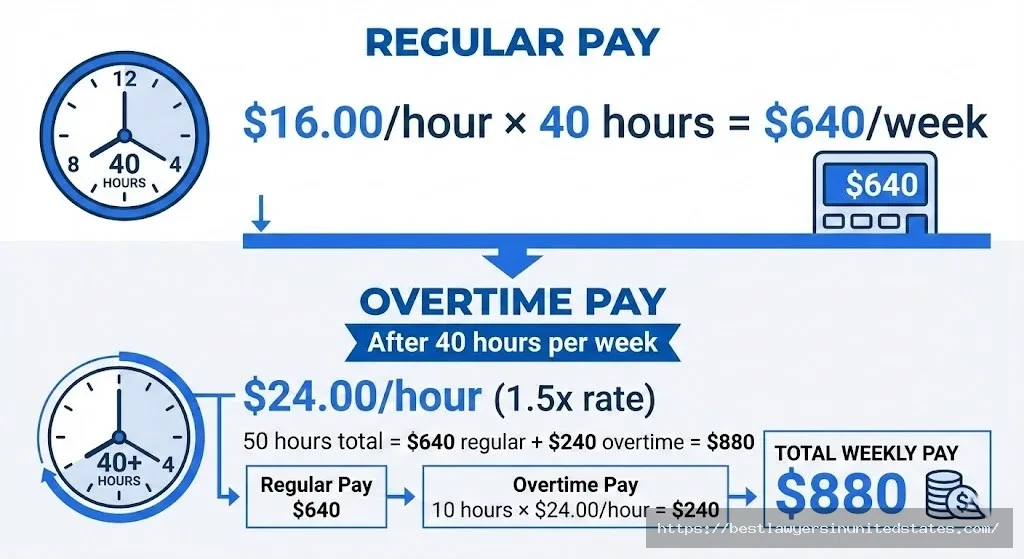
How Overtime Works in Hawaii
Standard overtime rate: If you earn $16.00 per hour, your overtime rate is $24.00 per hour.
When overtime applies: Any hours worked over 40 in a seven-day workweek.
Who qualifies: Non-exempt employees are entitled to overtime. Exempt employees (salaried workers in executive, administrative, or professional roles earning above the threshold) do not receive overtime pay.
Calculate Your Overtime Pay
Working more than 40 hours per week? Calculate your overtime earnings based on Hawaii's overtime laws.
⏰ Overtime Pay Calculator
Calculate your overtime earnings based on your state's specific labor laws
📍 Select Your State
💰 Your Hourly Wage
📊 Calculation Method
📅 Weekly Hours
💵 Your Weekly Overtime Pay
📊 Earnings Breakdown
📅 Pay Period Estimates
⚖️ State vs Federal Comparison
Calculator features:
- Hawaii-specific overtime rules
- Weekly overtime calculations
- Pay period breakdowns
- Comparison with federal law
Full overtime calculator: https://bestlawyersinunitedstates.com/overtime-pay-calculator/
Questions about your wages or need legal help?
Email: [email protected]
Who Is Exempt from Overtime?
Hawaii follows federal exemption rules under the FLSA. Employees are exempt from overtime if they meet three tests:
Salary basis test: Paid a predetermined salary not subject to reduction based on quality or quantity of work.
Salary level test: Earn at least $844 per week ($43,888 annually) as of 2024. This threshold may increase in 2026.
Duties test: Perform executive, administrative, or professional duties as defined by the FLSA.
Common Overtime Violations
Employers sometimes violate overtime laws through:
Misclassifying employees as exempt: Calling someone a "manager" doesn't automatically make them exempt if they don't meet all three tests.
Off-the-clock work: Requiring employees to work before clocking in or after clocking out.
Incorrect calculation: Failing to include bonuses, commissions, or other compensation when calculating overtime rates.
If you believe your employer has violated Hawaii's overtime laws, you can file a complaint with the Hawaii Department of Labor and Industrial Relations or consult an employment attorney.
Who Is Exempt from Hawaii's Minimum Wage?
Most workers in Hawaii are covered by minimum wage laws, but certain categories of employees may be exempt under Hawaii Revised Statutes § 387-9 and federal law.
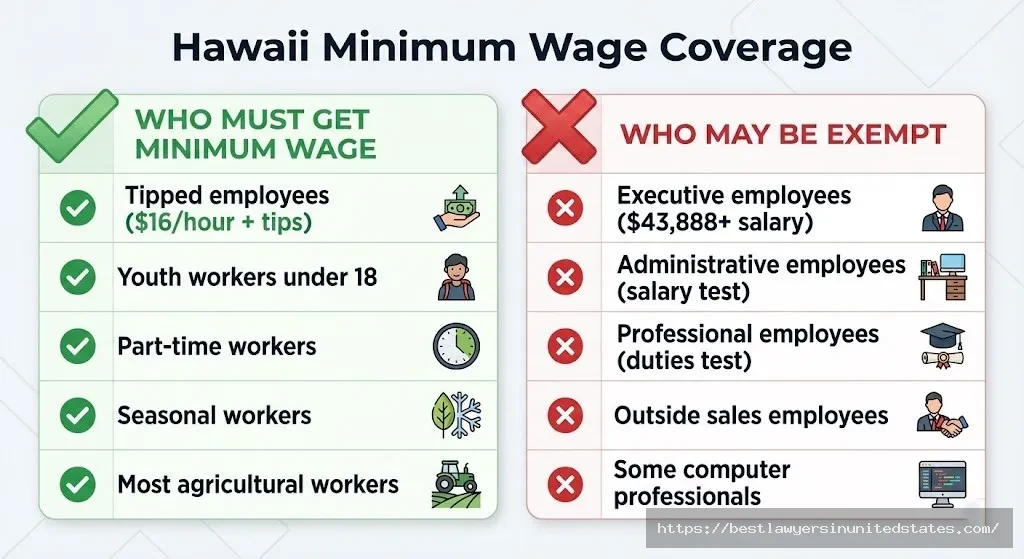
Common Exemptions
Executive, administrative, and professional employees: Must meet specific salary and duties tests. As of 2024, they must earn at least $43,888 annually.
Outside sales employees: Employees who primarily work outside the employer's place of business making sales.
Computer professionals: Certain IT employees earning above the threshold and performing specific duties.
Agricultural workers: Some agricultural employees may be exempt, though most are covered by Hawaii's minimum wage law.
Exemptions That Don't Apply in Hawaii
Youth minimum wage: Hawaii does not have a separate lower minimum wage for workers under 18. All employees, regardless of age, must receive at least $16.00 per hour in 2026.
Training wage: Unlike some states, Hawaii doesn't allow employers to pay a sub-minimum training wage to new employees.
Disability wage certificates: Hawaii follows federal rules that prohibit paying workers with disabilities less than minimum wage.
Independent Contractors vs. Employees
Independent contractors are not entitled to minimum wage or overtime. However, employers sometimes misclassify employees as independent contractors to avoid paying wages and benefits.
Hawaii uses the "ABC test" to determine worker classification:
A: The worker is free from control and direction in performing services.
B: The work performed is outside the usual course of the employer's business.
C: The worker is customarily engaged in an independently established trade, occupation, or business.
If a worker doesn't meet all three criteria, they're likely an employee entitled to minimum wage.
Hawaii Wage Theft: Your Rights and How to Fight Back
Wage theft occurs when employers fail to pay workers the full wages they've earned. This includes unpaid minimum wage, unpaid overtime, stolen tips, or illegal deductions.
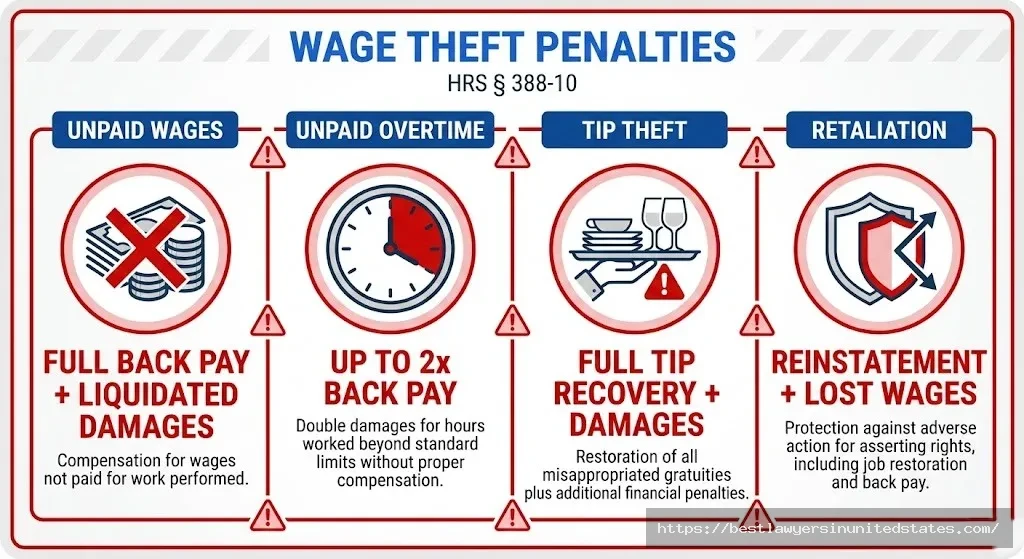
Hawaii law provides strong protections for workers and steep penalties for employers who violate wage and hour laws.
Common Types of Wage Theft
Paying below minimum wage: Some employers pay workers less than $16.00 per hour or claim exemptions that don't apply.
Unpaid overtime: Refusing to pay time-and-a-half for hours over 40 per week.
Off-the-clock work: Requiring employees to work before or after their scheduled shifts without pay.
Tip theft: Taking a portion of employee tips or requiring tip sharing with managers.
Illegal deductions: Making unauthorized deductions from paychecks that bring wages below minimum wage.
Misclassification: Treating employees as independent contractors to avoid paying minimum wage and overtime.
Calculate Your Potential Recovery
Think your employer owes you money? Use our wage theft calculator to estimate how much you could recover, including unpaid wages, penalties, and interest under Hawaii law.
Wage Theft Recovery Calculator
Estimate how much you can recover in unpaid wages, penalties, and damages based on your state's laws
💵 Estimated Total Recovery
💰 Unpaid Wages
⚖️ Penalties & Damages
📋 Total Summary
Calculator features:
- Multiple violation types (unpaid wages, overtime, tips)
- Hawaii-specific penalties and damages
- Filing deadline tracker
- Total recovery estimate
- Next steps guidance
Full wage theft calculator: https://bestlawyersinunitedstates.com/wage-theft-calculator/
Need help with unpaid wages? Contact Hawaii Department of Labor or consult with an employment attorney.
Email: [email protected]
Hawaii's Wage Theft Penalties
Hawaii imposes serious penalties on employers who violate wage laws under HRS § 388-10:
Back pay: Employers must pay all unpaid wages owed.
Liquidated damages: Workers can recover up to double the amount of unpaid wages.
Attorney fees: Employers may be required to pay the employee's legal costs.
Criminal penalties: Willful violations can result in misdemeanor charges.
How to File a Wage Claim in Hawaii
If your employer violates Hawaii's minimum wage or overtime laws, you have the right to file a wage complaint with the Hawaii Department of Labor and Industrial Relations.
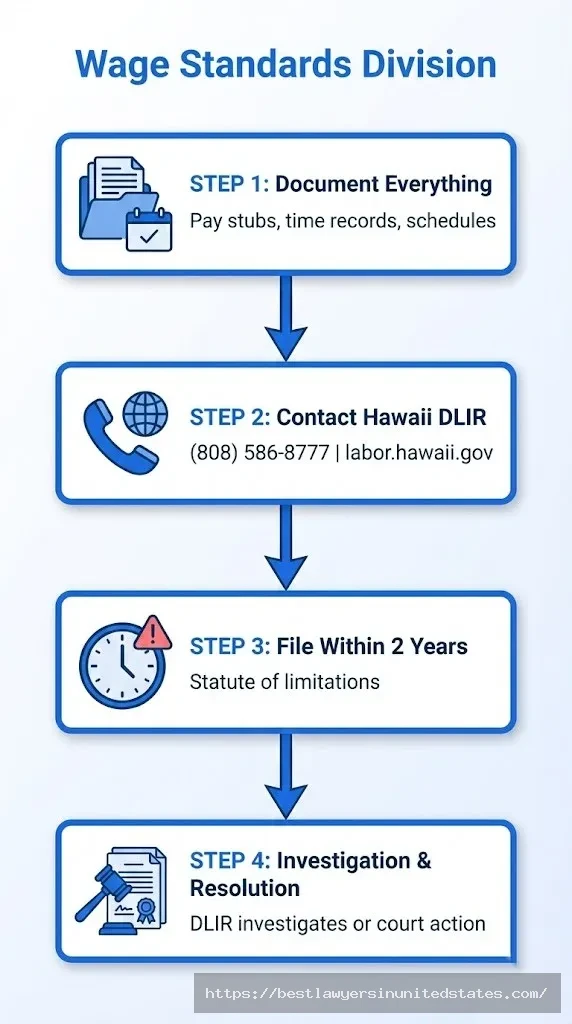
Step-by-Step Filing Process
1. Document everything: Gather pay stubs, time records, work schedules, and any written communications about your wages.
2. Contact the Wage Standards Division: File your complaint with the Hawaii DLIR Wage Standards Division within two years of the violation.
Hawaii Department of Labor and Industrial Relations Wage Standards Division 830 Punchbowl Street, Room 340 Honolulu, HI 96813 Phone: (808) 586-8777 Website: labor.hawaii.gov
3. Submit your complaint: You can file online, by mail, or in person at any DLIR office.
4. Investigation: The Wage Standards Division will investigate your claim and may attempt to mediate a resolution.
5. Enforcement: If mediation fails, DLIR can issue a wage order requiring the employer to pay, or you can file a lawsuit in court.
Statute of Limitations
You have two years from the date of the wage violation to file a complaint with DLIR or file a lawsuit. For willful violations, this extends to three years.
Retaliation Is Illegal
Hawaii law prohibits employers from retaliating against workers who file wage claims or cooperate with DLIR investigations. Retaliation includes firing, demotion, reduction in hours, or other adverse actions.
If you experience retaliation, you can file an additional complaint with DLIR.
Hawaii Break and Meal Period Laws
Hawaii does not require employers to provide rest breaks or meal periods to employees. However, if an employer chooses to provide breaks, certain rules apply under federal and state law.
Federal Break Rules Apply
While Hawaii has no state-mandated break requirements, the federal Fair Labor Standards Act (FLSA) requires that short breaks (5-20 minutes) must be paid. Meal periods of 30 minutes or longer can be unpaid if the employee is completely relieved of duties.
Common Employer Policies
Most Hawaii employers voluntarily provide:
15-minute rest breaks: Every 4 hours for employees working 8-hour shifts.
30-minute meal breaks: For employees working 6 or more hours.
These policies vary by employer and industry. Check your employee handbook or union contract for specific break policies.
California vs. Hawaii
Unlike California, which requires 10-minute paid breaks every 4 hours and 30-minute meal breaks for shifts over 5 hours, Hawaii leaves break policies to employer discretion.
Hawaii Minimum Wage for Specific Worker Categories
Hawaii's minimum wage laws apply to most workers, but some categories have special considerations under state law.
Agricultural Workers
Most agricultural workers in Hawaii are covered by minimum wage laws and must receive $16.00 per hour in 2026. However, small farms with limited annual sales may be exempt under federal law.
Seasonal Workers
Seasonal workers in Hawaii's tourism industry are entitled to full minimum wage. There are no special lower rates for seasonal employment.
Student Workers
Hawaii does not have a separate student minimum wage. Students working part-time or during school breaks must receive the full $16.00 minimum wage.
Trainees and Apprentices
Hawaii doesn't allow sub-minimum training wages. All trainees and apprentices must receive at least minimum wage unless they're in a formal Department of Labor-approved apprenticeship program.
Local Minimum Wages in Hawaii
Hawaii has a uniform statewide minimum wage with no local variations. Unlike states such as California where cities like San Francisco set higher local minimums, Hawaii's $16.00 wage applies equally across all counties.
Why No Local Ordinances?
Hawaii's state constitution centralizes labor law authority at the state level. Individual counties cannot set their own minimum wages higher than the state rate.
Cost of Living Differences by Island
While the minimum wage is the same statewide, cost of living varies significantly:
Oahu (Honolulu): Highest costs, average rent $1,800+ for one-bedroom
Maui: Second-highest costs, similar to Oahu in tourist areas
Hawaii (Big Island): More affordable, especially in Hilo and rural areas
Kauai: Moderate to high costs depending on location
Workers on the Big Island may find it slightly easier to live on minimum wage compared to Honolulu, though all areas remain expensive relative to the $16.00 wage.
Frequently Asked Questions
What is Hawaii's minimum wage in 2026?
Quick Answer: Hawaii's minimum wage is $16.00 per hour effective January 1, 2026, which is $8.75 higher than the federal minimum wage of $7.25.
This applies to all employees regardless of industry, employer size, or hours worked.
Do tipped employees get full minimum wage in Hawaii?
Quick Answer: Yes. Hawaii prohibits tip credits, so tipped employees must receive the full $16.00 per hour minimum wage plus any tips they earn.
This makes Hawaii one of the best states for servers, bartenders, and other tipped workers who earn significantly more than in states that allow tip credits like Florida where tipped minimum wage is only $8.98.
How do I calculate my earnings at Hawaii's minimum wage?
Quick Answer: Use our free minimum wage calculator to instantly calculate weekly, monthly, and annual earnings based on your hours worked.
The calculator includes overtime calculations and estimated tax withholdings to show your actual take-home pay.
When is overtime required in Hawaii?
Quick Answer: Hawaii requires overtime pay at 1.5 times your regular rate for hours worked over 40 in a single workweek.
At $16.00 per hour minimum wage, overtime rate is $24.00 per hour. Use our overtime calculator to estimate your total pay including overtime.
Can you live on minimum wage in Hawaii?
Quick Answer: It's extremely difficult. A full-time minimum wage worker earns about $2,176 monthly after taxes, while average rent in Honolulu is $1,800.
Most minimum wage workers rely on roommates, multiple jobs, or government assistance to cover basic expenses. MIT's Living Wage Calculator estimates a single adult needs $22.14 per hour to afford basic needs in Hawaii.
How do I file a wage complaint in Hawaii?
Quick Answer: Contact the Hawaii Department of Labor and Industrial Relations Wage Standards Division at (808) 586-8777 or visit labor.hawaii.gov to file online.
You have two years from the wage violation to file. Use our wage theft calculator to estimate potential recovery.
Are 15-minute breaks required by law in Hawaii?
Quick Answer: No. Hawaii does not mandate rest breaks or meal periods, though most employers voluntarily provide them.
If employers do provide breaks under 20 minutes, federal law requires they be paid.
Does Hawaii have a youth minimum wage?
Quick Answer: No. Hawaii does not have a separate lower minimum wage for workers under 18. All employees receive the full $16.00 minimum wage in 2026.
Who is exempt from Hawaii's minimum wage?
Quick Answer: Executive, administrative, and professional employees earning at least $43,888 annually and meeting specific duties tests are exempt.
Outside sales employees and some computer professionals may also be exempt. Most workers, including part-time, seasonal, and tipped employees, must receive minimum wage.
What happens if my employer doesn't pay minimum wage?
Quick Answer: You can file a complaint with Hawaii DLIR or sue in court. Employers must pay back wages plus up to double damages and attorney fees.
Hawaii law prohibits retaliation against workers who file wage complaints. Contact DLIR at (808) 586-8777 or email [email protected] for legal assistance.
Key Takeaways: Hawaii Minimum Wage 2026
Hawaii's minimum wage increases to $16.00 per hour on January 1, 2026, representing a significant step toward fair wages but still falling short of what workers need to afford the state's high cost of living.
Most important facts:
Wage rates: $16.00 for all workers, no tip credits, no youth wage
Overtime: Time-and-a-half for hours over 40 per week
Tipped workers: Receive full $16.00 plus tips, making Hawaii one of the best states for service workers
Cost of living gap: Minimum wage covers only about 72% of the estimated living wage for single adults in Hawaii
Worker protections: Strong wage theft penalties, two-year filing deadline, retaliation prohibited
Use our free calculators:
Get help: If you have questions about unpaid wages or need legal assistance, contact the Hawaii Department of Labor at (808) 586-8777 or email [email protected] for a free consultation with employment lawyers.
