
Texas workers face a unique wage situation in 2026. The state minimum wage remains $7.25 per hour, unchanged since 2009. This matches the federal minimum wage because Texas has no separate state minimum wage law.
This guide covers everything you need to know about Texas minimum wage laws in 2026. You’ll learn about current rates, tipped worker rules, overtime requirements, and what to do if you’re not paid properly. We’ll also show you exactly how much you can earn at different wage levels using our free calculators.
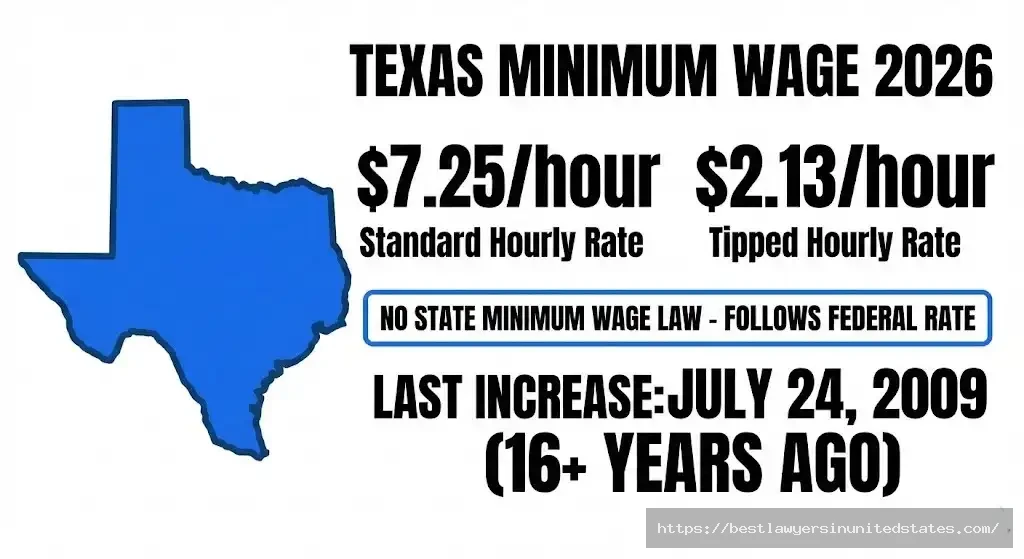
Key facts about Texas minimum wage in 2026:
- Regular minimum wage: $7.25/hour
- Tipped minimum wage: $2.13/hour
- No scheduled increases for 2027
- All Texas cities follow the same rate
Calculate Your Earnings in Texas
Want to know exactly how much you’ll earn at Texas’s $7.25 minimum wage? Use our free calculator to estimate your weekly, monthly, and annual income based on your hours worked.
💰 Minimum Wage Earnings Calculator
Calculate your weekly, monthly, and annual earnings with overtime and tax estimates
📊 Your Earnings Breakdown
💰 Gross Earnings
Calculator features:
- Automatic Texas wage rates for 2026
- Weekly, monthly, and annual earnings
- Overtime calculations
- Tax withholding estimates
- Take-home pay breakdown
Full calculator with all features: Calculate your minimum wage earnings
Questions about your wages or need legal help?
Email: [email protected]
What Is the Minimum Wage in Texas for 2026?
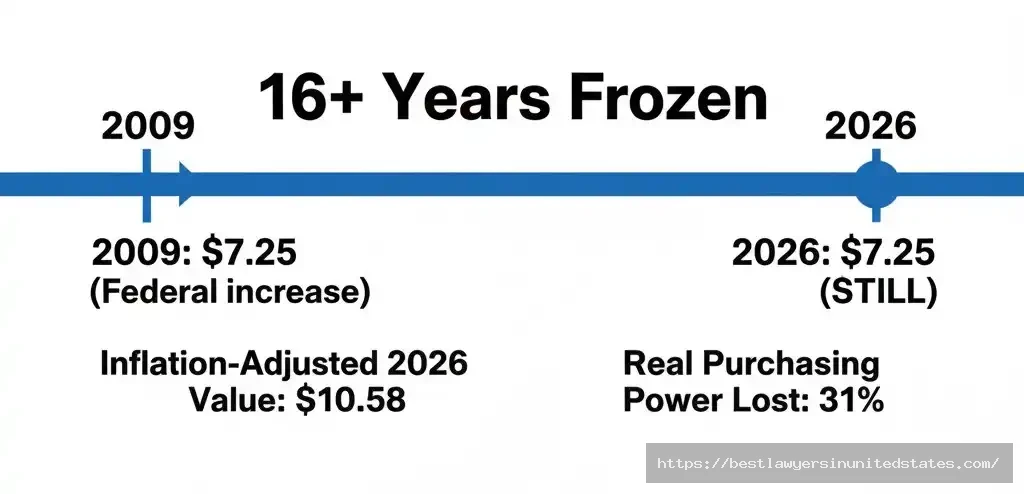
Texas minimum wage is $7.25 per hour in 2026. This rate has not changed since July 24, 2009, when the federal minimum wage last increased.
Texas does not have its own state minimum wage law. Instead, the state follows the federal minimum wage set by the Fair Labor Standards Act (FLSA). This means Texas workers earn the federal minimum of $7.25 per hour unless they fall under specific exemptions.
How Much Can You Earn at Minimum Wage?
Here's what $7.25 per hour translates to in actual earnings:
| Work Schedule | Earnings |
|---|---|
| Weekly (40 hours) | $290 |
| Monthly (173 hours avg) | $1,254 |
| Annual (2,080 hours) | $15,080 |
| After taxes (monthly) | ~$1,068 |
These numbers assume full-time work at 40 hours per week. Part-time workers earn proportionally less based on their hours.
Texas vs Federal Minimum Wage Comparison
| Jurisdiction | Minimum Wage | Tipped Wage | Last Increase |
|---|---|---|---|
| Texas | $7.25 | $2.13 | July 2009 |
| Federal | $7.25 | $2.13 | July 2009 |
| Difference | $0.00 | $0.00 | Same date |
Texas and federal rates are identical because Texas has no separate state law. Workers must follow whichever standard gives them the higher wage.
Why Does Texas Have No State Minimum Wage Law?
Texas Labor Code § 62.051 technically establishes a state minimum wage. However, this statute simply defers to the federal minimum wage under the FLSA. The Texas Workforce Commission (TWC) enforces federal wage standards for covered employees.
The state legislature has not passed a higher minimum wage despite repeated efforts. Texas follows a business-friendly approach that keeps labor costs aligned with the federal floor.
Will Texas Raise Minimum Wage to $15 in 2026 or 2027?
No. Texas has no plans to raise the minimum wage to $15 in 2026 or 2027.
The Texas legislature has consistently rejected minimum wage increases. The Republican-controlled state government opposes raising wages above the federal minimum. No bills to increase the minimum wage have passed since 2009.
Why Won't Texas Raise the Minimum Wage?
Several factors prevent Texas from raising its minimum wage:
Political opposition: The Republican majority in the Texas legislature opposes wage mandates. They argue that higher minimum wages hurt small businesses and reduce job creation.
Business climate priority: Texas markets itself as a low-cost state for businesses. Keeping the minimum wage at the federal floor attracts companies from states with higher labor costs.
State preemption laws: Texas law prevents cities from setting their own minimum wages. This blocks local efforts to raise wages in high-cost areas like Austin or Dallas.
Economic philosophy: State leaders believe the free market should determine wages. They oppose government intervention in private wage negotiations.
Failed Local Ordinances
Several Texas cities attempted to raise local minimum wages but faced legal challenges:
- Austin (2014): Proposed $11 minimum wage ordinance struck down by state law
- Dallas (2015): Similar ordinance blocked before implementation
- San Antonio (2013): Living wage proposal for city contractors rejected
Texas Government Code § 2252.904 prevents cities and counties from establishing minimum wages different from state or federal law. Only the state legislature can change the minimum wage.
When Was the Last Increase?
Texas minimum wage last increased on July 24, 2009. That's over 16 years without a raise. During this time, inflation has reduced the purchasing power of $7.25 by more than 30%.
Comparison: States with $15+ Minimum Wage
While Texas stays at $7.25, many states have moved to $15 or higher:
| State | 2026 Minimum Wage | vs Texas |
|---|---|---|
| California | $16.50 | +$9.25 |
| Washington | $16.66 | +$9.41 |
| New York | $16.50 | +$9.25 |
| Connecticut | $16.35 | +$9.10 |
| Massachusetts | $15.00 | +$7.75 |
These states demonstrate that higher minimum wages are economically viable. Texas workers earn significantly less than their counterparts in states with updated wage laws.
Texas Minimum Wage by City: Houston, Dallas, Austin, San Antonio
All Texas cities follow the same $7.25 per hour minimum wage in 2026. There are no local minimum wage ordinances in Texas.
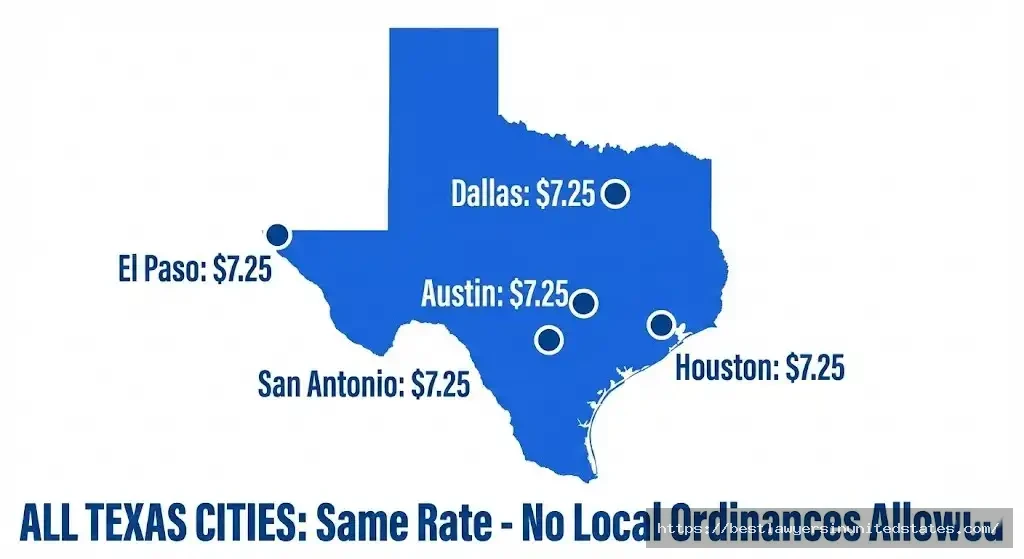
Many workers search for city-specific wages thinking Houston, Dallas, Austin, or San Antonio might have higher rates. This is not the case. State law prohibits cities from setting their own minimum wages.
City-by-City Cost of Living Context
While the minimum wage is identical across Texas, the cost of living varies dramatically by city:
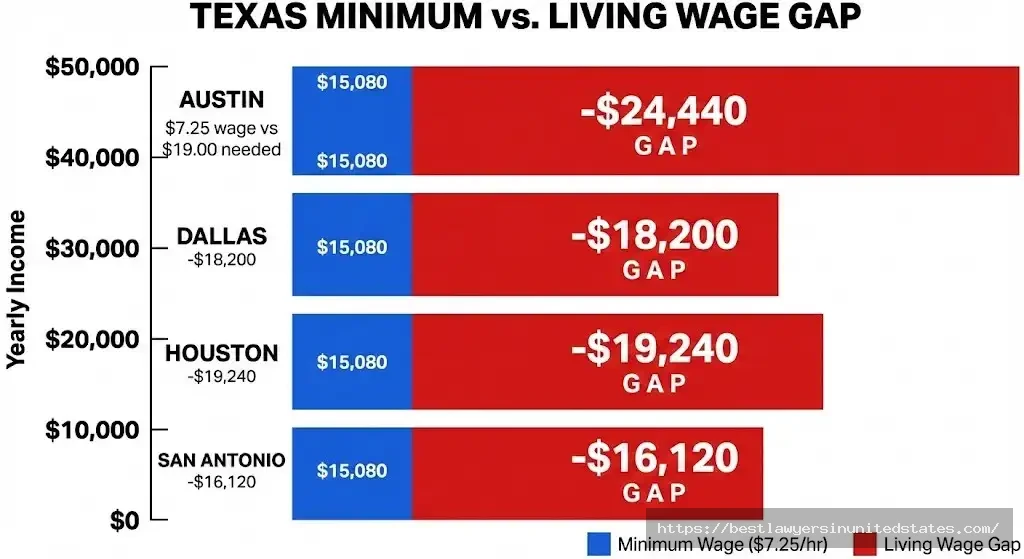
| City | Minimum Wage | Cost of Living Index | Living Wage Needed | Annual Gap |
|---|---|---|---|---|
| Austin | $7.25/hour | 119.3 | $19.00/hour | -$24,440/year |
| Dallas | $7.25/hour | 99.3 | $16.00/hour | -$18,200/year |
| Houston | $7.25/hour | 94.1 | $16.50/hour | -$19,240/year |
| San Antonio | $7.25/hour | 91.7 | $15.00/hour | -$16,120/year |
| El Paso | $7.25/hour | 85.6 | $14.50/hour | -$15,080/year |
The "Annual Gap" shows how much more a single adult needs to earn annually to afford basic living expenses in each city. Austin has the highest gap at nearly $25,000 per year.
Why Can't Cities Set Their Own Minimum Wages?
Texas state law preempts local wage ordinances. Texas Government Code § 2252.904 gives the state legislature sole authority to set minimum wages. Cities cannot pass ordinances that conflict with state law.
This differs from states like California, where cities such as San Francisco ($18.07) and Los Angeles ($17.28) have local minimum wages higher than the state rate.
Major City Employment Markets
Despite identical minimum wages, job markets differ significantly:
Austin: Tech industry jobs often pay $20-30/hour for entry-level positions. The city's high cost of living forces employers to pay above minimum wage.
Houston: Energy sector provides higher-paying opportunities. Most employers start at $12-15/hour due to competition for workers.
Dallas: Corporate headquarters offer competitive wages. Retail and service jobs typically pay $10-13/hour.
San Antonio: Military presence and tourism drive employment. Service industry wages range from $9-12/hour.
El Paso: Lower cost of living means more employers pay closer to minimum wage. Manufacturing jobs average $11-14/hour.
Tipped Minimum Wage in Texas: Servers, Waiters, and Bartenders
Texas allows employers to pay tipped employees $2.13 per hour in 2026. This is the federal tipped minimum wage, unchanged since 1991.
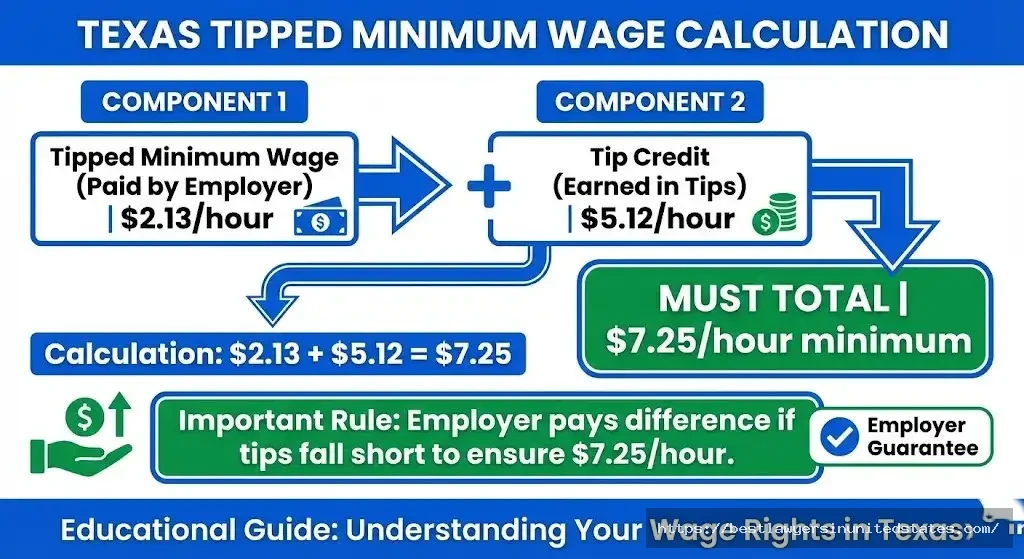
Employers can use a "tip credit" to pay less than the regular minimum wage. However, tipped employees must still earn at least $7.25 per hour when you combine their base wage plus tips.
How the Tip Credit Works
The tip credit system works like this:
- Regular minimum wage: $7.25/hour
- Tipped minimum wage: $2.13/hour
- Maximum tip credit: $5.12/hour
Example calculation:
- Employee works 8 hours
- Base pay: $2.13/hour × 8 = $17.04
- Tips received: $60
- Total earnings: $77.04
- Hourly rate: $77.04 ÷ 8 = $9.63/hour
This exceeds $7.25/hour, so the employer met the minimum wage requirement.
What If Tips Don't Reach Minimum Wage?
Employers must make up the difference if tips don't bring earnings to $7.25 per hour. This is calculated weekly, not daily.
Example of employer shortfall:
- Employee works 40 hours
- Base pay: $2.13/hour × 40 = $85.20
- Tips received: $180
- Total: $265.20
- Required minimum: $7.25 × 40 = $290
- Employer owes: $290 - $265.20 = $24.80
The employer must add $24.80 to the paycheck to meet minimum wage requirements under 29 U.S.C. § 203(m).
Common Tipped Occupations in Texas
| Job Type | Typical Base Wage | Average Tips | Effective Hourly Rate |
|---|---|---|---|
| Restaurant Server | $2.13 | $8-15/hour | $10-17/hour |
| Bartender | $2.13 | $10-20/hour | $12-22/hour |
| Delivery Driver | $2.13-5.00 | $5-12/hour | $8-17/hour |
| Barber/Stylist | $2.13-7.25 | $5-15/hour | $10-20/hour |
| Valet Attendant | $2.13 | $8-15/hour | $10-17/hour |
Rights of Tipped Employees
Texas tipped workers have specific protections under federal and state law:
You must receive at least $7.25/hour total. If your tips plus base wage don't reach this amount, your employer owes you the difference.
Tip pooling is legal but restricted. You can be required to share tips with other service staff (servers, bartenders, bussers). However, managers and owners cannot participate in tip pools under 29 U.S.C. § 203(m)(2)(A).
You keep 100% of your tips. Employers cannot keep any portion of your tips, even for credit card processing fees. This is illegal under federal law.
Tips must be reported. You must report all tips to your employer for tax purposes. Employers must report tip income to the IRS.
What If Your Employer Violates Tipped Wage Rules?
File a complaint with the Texas Workforce Commission (TWC) or the U.S. Department of Labor. You can recover:
- All unpaid wages
- Liquidated damages (double your unpaid wages)
- Attorney fees if you win
Workers facing legal options for workplace disputes should document all pay stubs, tip records, and work schedules.
Can You Live on Minimum Wage in Texas?
No. You cannot live comfortably on Texas minimum wage in 2026.
A full-time minimum wage worker earns $15,080 per year before taxes. After federal and state taxes, this drops to approximately $12,816 annually, or $1,068 per month.
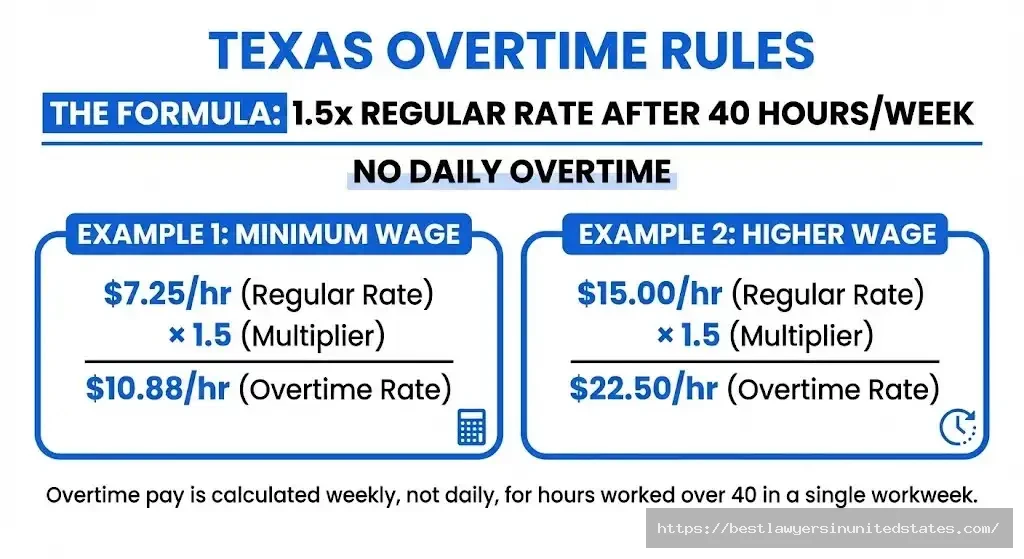
The average rent for a one-bedroom apartment in Texas exceeds $1,200 per month. This means rent alone costs more than the entire monthly take-home pay of a minimum wage worker.
Monthly Budget Breakdown
Here's what a minimum wage budget looks like in Texas:
| Expense Category | Monthly Cost | Annual Cost |
|---|---|---|
| Gross income (before taxes) | $1,254 | $15,080 |
| Federal taxes (estimated) | -$94 | -$1,128 |
| FICA taxes (7.65%) | -$96 | -$1,153 |
| Net income (take-home) | $1,064 | $12,799 |
| Rent (1BR apartment) | -$1,200 | -$14,400 |
| Remaining for ALL other expenses | -$136 | -$1,601 |
Before paying for food, transportation, utilities, phone, or healthcare, a minimum wage worker is already $136 in the hole each month.
Living Wage vs Minimum Wage by City
The MIT Living Wage Calculator shows how much you actually need to cover basic expenses:
| City | Minimum Wage Income | Living Wage Needed | Monthly Shortfall |
|---|---|---|---|
| Austin | $1,257/month | $3,173/month | -$1,916 |
| Dallas | $1,257/month | $2,773/month | -$1,516 |
| Houston | $1,257/month | $2,860/month | -$1,603 |
| San Antonio | $1,257/month | $2,600/month | -$1,343 |
| El Paso | $1,257/month | $2,417/month | -$1,160 |
Even in El Paso, Texas's most affordable major city, minimum wage workers fall $1,160 short each month.
What Basic Expenses Are Impossible to Cover?
Living on minimum wage means going without essentials:
Housing: Can't afford rent without roommates or assistance programs. Many minimum wage workers face homelessness or live in substandard housing.
Healthcare: No employer-provided insurance at minimum wage jobs. Can't afford private insurance premiums ($400-600/month). Emergency medical bills are financially catastrophic.
Transportation: Can't afford a reliable car ($300-500/month). Public transit is limited in most Texas cities. Many workers spend hours commuting on buses.
Food: Food budget of $200-250/month means skipping meals or using food banks. Fresh produce and healthy options are unaffordable.
Emergency savings: Zero ability to save money. One unexpected expense (car repair, medical bill) creates financial crisis.
How Do Minimum Wage Workers Survive?
Texas minimum wage workers typically combine multiple strategies:
- Work 60-80 hours per week at multiple jobs
- Live with family or multiple roommates
- Rely on government assistance (SNAP, Medicaid)
- Use food banks and charitable organizations
- Go without healthcare, insurance, or savings
- Accumulate debt through payday loans or credit cards
This is why understanding your rights under employment law matters. Many workers are owed more than minimum wage but don't know it.
What Do Employers Actually Pay in Texas?
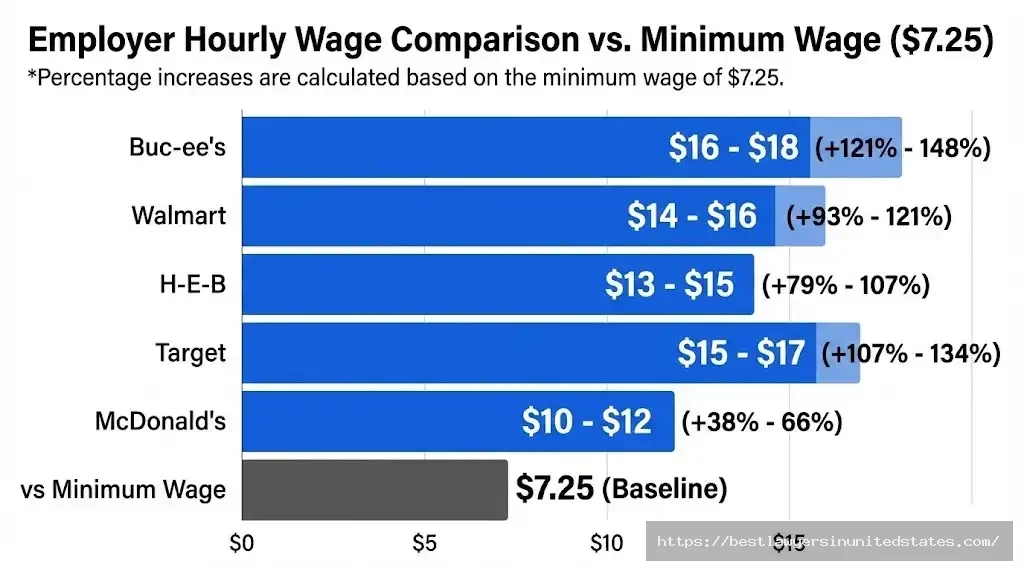
Most major employers in Texas pay well above the $7.25 minimum wage in 2026. Market competition and labor shortages force companies to offer higher starting wages.
Here's what major Texas employers actually pay:
| Employer | Texas Starting Wage | vs Minimum Wage | Increase % |
|---|---|---|---|
| Buc-ee's | $16-18/hour | +$8.75-10.75 | +121-148% |
| H-E-B | $13-15/hour | +$5.75-7.75 | +79-107% |
| Walmart | $14-16/hour | +$6.75-8.75 | +93-120% |
| Target | $15-17/hour | +$7.75-9.75 | +107-134% |
| Amazon | $15-17/hour | +$7.75-9.75 | +107-134% |
| Chick-fil-A | $13-15/hour | +$5.75-7.75 | +79-107% |
| Whataburger | $11-13/hour | +$3.75-5.75 | +52-79% |
| McDonald's | $10-12/hour | +$2.75-4.75 | +38-66% |
Why Do Employers Pay More Than Minimum Wage?
Labor market competition: Unemployment rates below 4% mean employers compete for workers. Higher wages attract better candidates.
Retention costs: Training new employees costs $3,000-5,000. Paying higher wages reduces turnover and saves money long-term.
Cost of living reality: Employers know workers can't survive on $7.25. Companies in expensive cities like Austin must pay more to attract any applicants.
National company policies: Large chains set wages nationally or regionally. They can't adjust to Texas's low minimum wage without damaging their brand.
Industries Still Paying Close to Minimum Wage
Some sectors still pay near minimum wage:
Small retail shops: Independent stores with thin margins often start at $8-9/hour.
Non-chain restaurants: Local diners and cafes may pay $7.25-8.50 for kitchen staff.
Agricultural work: Farm workers and ranch hands sometimes earn minimum wage during slow seasons.
Janitorial services: Cleaning companies frequently pay $8-10/hour.
Childcare: Daycare workers and preschool teachers often earn $8-11/hour despite high responsibility.
If you work in these industries and earn minimum wage, you may qualify for better-paying opportunities elsewhere. Use our minimum wage calculator to compare potential earnings.
Texas Minimum Wage Exemptions: Who Is Not Covered?
Several categories of workers are exempt from Texas minimum wage requirements. These exemptions come from both federal law (FLSA) and Texas Labor Code.
Executive, Administrative, and Professional Employees
The "white collar" exemption excludes salaried employees who meet specific criteria under 29 CFR § 541.
Requirements for exemption:
- Salary of at least $684 per week ($35,568 annually)
- Primary duties involve management, administration, or professional work
- Exercise discretion and independent judgment
Common exempt positions:
- Company executives and managers
- Administrative assistants with significant responsibilities
- Teachers and academic professionals
- Doctors, lawyers, and licensed professionals
- Computer professionals earning $27.63/hour or more
Key point: Just having a salary doesn't make you exempt. You must meet both the salary threshold AND the duties test. Many employers misclassify workers as exempt to avoid paying overtime.
Agricultural Workers
Texas has special exemptions for agricultural employees under Texas Labor Code § 62.003:
Exempt agricultural workers:
- Employees of small farms (fewer than 500 person-days of labor)
- Immediate family members working on family farms
- Piece-rate workers in hand-harvest operations
- Ranch hands on certain cattle operations
Not exempt:
- Large commercial farming operations
- Food processing plants
- Agricultural workers employed by non-farming businesses
Tipped Employees
As covered earlier, tipped workers can be paid $2.13/hour under the tip credit provision. This applies to:
- Restaurant servers and bartenders
- Delivery drivers who receive tips
- Barbers and beauticians
- Hotel and parking valets
Employers must still ensure total earnings (wages + tips) reach $7.25/hour.
Youth Minimum Wage
Workers under age 20 can be paid $4.25 per hour for their first 90 consecutive calendar days of employment under 29 U.S.C. § 206(g).
Important limits:
- Only for first 90 days
- Must be raised to $7.25 on day 91
- Cannot be used to displace regular employees
- Cannot fire a worker after 90 days to hire another youth worker
This provision is rarely used because most Texas employers already pay more than $7.25 to attract workers.
Other Common Exemptions
Independent contractors: Not covered by minimum wage laws, but many workers are misclassified as contractors when they should be employees.
Certain commissioned salespeople: Car salespeople and some retail workers paid entirely by commission may be exempt under specific conditions.
Newspaper delivery: Carriers who deliver newspapers to homes are typically exempt.
Casual babysitters: Babysitting in a private home on an irregular basis is exempt.
Federal employees: Follow different pay scales set by federal government.
What If You Think You're Misclassified?
Many employers incorrectly classify workers as exempt to avoid paying minimum wage or overtime. If you think you're misclassified:
- Document your actual job duties and hours
- Compare your situation to FLSA exemption requirements
- File a complaint with the Texas Workforce Commission
- Contact an employment attorney
Misclassification is one of the most common forms of wage theft in Texas.
Texas Overtime Laws: When Do You Get Time-and-a-Half?
Texas follows federal overtime law under the Fair Labor Standards Act. Non-exempt employees must receive 1.5 times their regular rate for hours worked over 40 in a workweek.
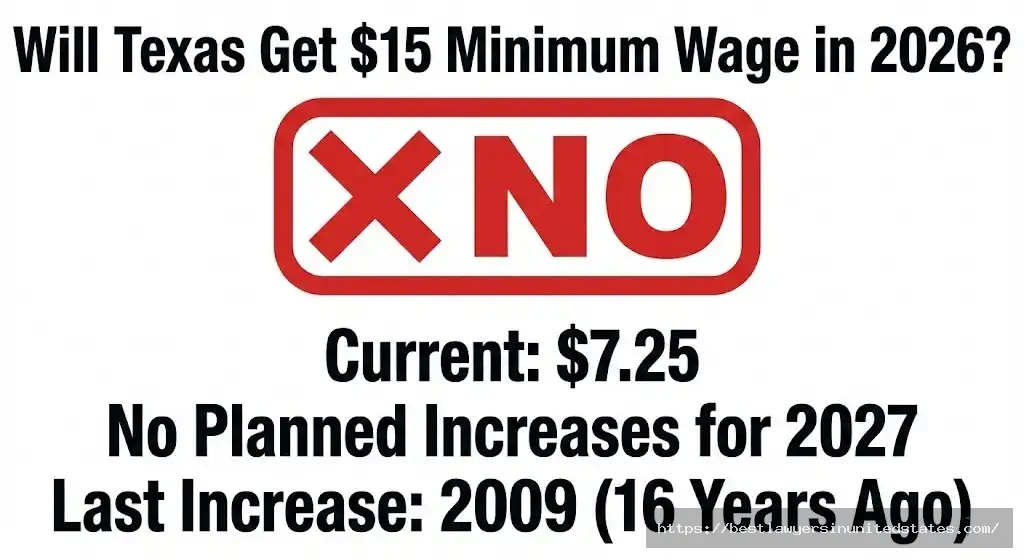
Texas has no daily overtime law. You only get overtime after working more than 40 hours in a seven-day workweek, regardless of how many hours you work in a single day.
How Texas Overtime Works
Basic overtime rate: 1.5 × your regular hourly rate
Overtime threshold: More than 40 hours in a workweek
Workweek definition: Any fixed seven consecutive 24-hour periods
Overtime Calculation Examples
| Regular Hourly Rate | Overtime Rate (1.5×) | Weekly Earnings (50 hours) |
|---|---|---|
| $7.25 (minimum wage) | $10.88 | $379.00 |
| $10.00 | $15.00 | $550.00 |
| $15.00 | $22.50 | $825.00 |
| $20.00 | $30.00 | $1,100.00 |
| $25.00 | $37.50 | $1,375.00 |
Calculation formula: (40 hours × regular rate) + (overtime hours × overtime rate)
Example: $15/hour worker who works 50 hours
- Regular pay: 40 hours × $15 = $600
- Overtime pay: 10 hours × $22.50 = $225
- Total weekly pay: $825
Calculate Your Overtime Pay in Texas
Working more than 40 hours per week? Calculate your overtime earnings based on Texas's overtime laws. This calculator accounts for Texas's specific overtime rules and helps you verify you're being paid correctly.
⏰ Overtime Pay Calculator
Calculate your overtime earnings based on your state's specific labor laws
📍 Select Your State
💰 Your Hourly Wage
📊 Calculation Method
📅 Weekly Hours
💵 Your Weekly Overtime Pay
📊 Earnings Breakdown
📅 Pay Period Estimates
⚖️ State vs Federal Comparison
Calculator features:
- Texas-specific overtime rules
- Weekly overtime calculations
- Pay period breakdowns
- Comparison with federal law
- Underpayment detection
Full overtime calculator: Calculate your overtime pay
Questions about your wages or need legal help?
Email: [email protected]
Who Is Eligible for Overtime?
Non-exempt employees must receive overtime:
- Hourly workers
- Salaried employees earning less than $684/week
- Salaried non-exempt workers (those who don't meet exemption tests)
Exempt employees do NOT receive overtime:
- Executive, administrative, professional employees earning $684+/week
- Outside salespeople
- Certain computer professionals
- Independent contractors
Common Overtime Violations in Texas
Many employers illegally avoid paying overtime through these tactics:
Off-the-clock work: Requiring employees to work before clocking in or after clocking out. All work time must be paid, including prep work and closing duties.
Misclassification as exempt: Giving someone a "manager" title and salary to avoid overtime, even though they don't meet the duties test.
Comp time instead of overtime pay: Private employers cannot offer comp time (time off) instead of overtime pay. Only government employers can do this.
Averaging hours across weeks: Paying straight time for one week with 50 hours and giving time off another week is illegal. Each workweek stands alone.
Illegal deductions: Deducting from overtime pay for uniforms, cash register shortages, or broken equipment.
If you're experiencing these violations, you may be owed significant back pay. Workers should document everything and consider filing a wage claim with the Texas Workforce Commission.
Texas Labor Laws: 7-Minute Rule, Breaks, and Other Rules
Texas has several labor law quirks that differ from other states. Understanding these rules helps you know when your employer is following the law versus when they're violating your rights.
The 7-Minute Rule (Time Rounding)
The 7-minute rule allows employers to round employee time punches to the nearest 15-minute increment under 29 CFR § 785.48(b).
How it works:
- Clock in at 7:53 AM → Rounded to 8:00 AM (7 minutes early = round up)
- Clock in at 8:07 AM → Rounded to 8:00 AM (7 minutes late = round down)
- Clock in at 8:08 AM → Rounded to 8:15 AM (8+ minutes late = round up)
Legal requirements:
- Must be applied consistently
- Cannot always favor the employer
- Must be neutral over time
- Cannot result in employee losing pay over pay periods
Example: If rounding always benefits your employer, that's wage theft. The system should balance out so you gain time some days and lose time other days.
Break Laws in Texas (or Lack Thereof)
Texas has NO law requiring breaks for adult employees. This surprises many workers, but it's true.
What this means:
- Employers don't have to provide lunch breaks
- Employers don't have to provide rest breaks
- You can work 8, 10, or 12 hours straight without a break
Two exceptions exist:
- Nursing mothers: Must be provided reasonable break time to express breast milk for one year after birth (federal law)
- Minors under 18: Some break requirements exist under child labor laws
If your employer provides breaks:
- Breaks under 20 minutes must be paid
- Meal breaks of 30+ minutes can be unpaid
- You must be completely relieved of duties during unpaid breaks
- If you answer phones or monitor equipment, the break must be paid
Many Texas employers provide breaks anyway to maintain productivity and employee satisfaction. However, it's not legally required.
The 4-Hour Rule Myth
There is NO 4-hour rule in Texas. This is a common misconception.
The myth: If you show up for your shift and your employer sends you home, they must pay you for 4 hours.
The reality: Texas has no "reporting pay" or "show-up pay" law. Your employer can send you home immediately without paying you anything if you haven't worked.
Exceptions:
- If you have an employment contract requiring reporting pay
- If company policy promises reporting pay
- If you actually worked any time, you must be paid for time worked
Final Paycheck Rules
When employment ends, Texas law requires payment on the next regular payday under Texas Payday Law (Texas Labor Code Chapter 61).
Resignation: Final paycheck due on next regular payday
Termination: Final paycheck due on next regular payday
Unlike some states: Texas has no "immediately upon termination" requirement. However, employers cannot withhold final paychecks as punishment.
Payday Frequency
Texas Labor Code § 61.011 requires employees to be paid at least twice monthly. Most common schedules:
- Weekly (every 7 days)
- Bi-weekly (every 14 days)
- Semi-monthly (twice per month, e.g., 1st and 15th)
Monthly pay periods are generally not allowed in Texas.
Wage Theft in Texas: Your Rights and Recovery Options
Wage theft costs Texas workers hundreds of millions of dollars annually. It happens when employers fail to pay legally owed wages, including minimum wage, overtime, tips, or final paychecks.
Common examples include unpaid overtime, off-the-clock work, tip theft, illegal deductions, and misclassification. Many workers don't realize they're victims of wage theft.
What Counts as Wage Theft?
Unpaid minimum wage: Paying less than $7.25/hour (or applicable tipped minimum wage)
Unpaid overtime: Not paying time-and-a-half for hours over 40 per week
Off-the-clock work: Requiring work before clocking in or after clocking out
Tip theft: Keeping employee tips or forcing tip pooling with managers
Illegal deductions: Deducting for uniforms, cash register shortages, or broken equipment (if it brings pay below minimum wage)
Final paycheck violations: Not paying final wages on the next regular payday
Misclassification: Calling employees independent contractors or exempt when they're not
Texas Payday Law Protections
The Texas Payday Law (Texas Labor Code Chapter 61) provides strong protections for workers. You can recover significant damages if your employer violates wage laws.
What you can recover:
- Full back pay: All wages owed to you
- Liquidated damages: Equal to the amount owed (essentially doubles your recovery)
- Attorney fees: If you hire a lawyer and win
- Court costs: Filing fees and legal expenses
No time limit: Texas Payday Law has no statute of limitations for filing claims. However, federal law limits recovery to 2-3 years, so don't wait too long.
Retaliation protection: It's illegal for employers to fire or punish you for filing a wage claim under Texas Labor Code § 61.051(c).
Calculate Your Wage Theft Recovery in Texas
Think your employer owes you money? Use our wage theft calculator to estimate how much you could recover, including unpaid wages, penalties, and interest under Texas law.
Wage Theft Recovery Calculator
Estimate how much you can recover in unpaid wages, penalties, and damages based on your state's laws
💵 Estimated Total Recovery
💰 Unpaid Wages
⚖️ Penalties & Damages
📋 Total Summary
Calculator features:
- Multiple violation types (unpaid wages, overtime, tips)
- Texas-specific penalties and damages
- Filing deadline tracker
- Total recovery estimate
- Next steps guidance
Full wage theft calculator: Calculate your wage theft recovery
Need help with unpaid wages? Contact employment lawyers for a free consultation.
Email: [email protected]
How to File a Wage Claim in Texas
You have three options for recovering unpaid wages:
Option 1: Texas Workforce Commission (TWC)
- File complaint online at TWC website
- TWC investigates your claim
- Free process, no lawyer required
- Can recover up to $20,000
- Takes 3-6 months typically
Option 2: Small Claims Court
- File suit for claims under $20,000
- No lawyer required (though recommended)
- Faster than TWC (usually 1-3 months)
- You present evidence directly to judge
- Court costs are $50-100
Option 3: District Court
- For claims over $20,000
- Lawyer highly recommended
- Can recover unlimited damages
- Takes 6-18 months
- More formal legal process
What Evidence Do You Need?
Strong documentation wins wage cases. Gather:
Pay stubs: Every pay stub from employment period
Time records: Clock-in sheets, time cards, digital time records
Work schedule: When you were scheduled vs. actually worked
Job duties: Written job description, actual tasks performed
Communication: Emails, texts, or notes about hours worked
Witness statements: Coworkers who can confirm your claims
Bank deposits: Proof of what you actually received
Take photos or make copies before quitting. Employers sometimes "lose" records after you file a claim.
What If Your Employer Retaliates?
Firing or punishing workers for filing wage claims is illegal under Texas Labor Code § 61.051(c). If your employer retaliates:
- File a separate retaliation claim with TWC
- You can recover additional damages
- Court may order reinstatement
- Additional attorney fees available
Document any retaliation immediately. Save emails, texts, or witness statements showing the adverse action occurred after filing your wage claim.
Many workers fear retaliation and don't report violations. However, Texas law specifically protects whistleblowers. Consider consulting with legal professionals before filing to understand your full rights.
Frequently Asked Questions About Texas Minimum Wage
Is Texas Minimum Wage Going Up in 2026 or 2027?
Quick Answer: No. Texas minimum wage remains $7.25/hour in 2026 with no scheduled increases for 2027.
Texas has not raised its minimum wage since 2009 and follows the federal minimum wage. The state legislature has no pending bills to increase the minimum wage. Unless federal law changes, expect $7.25 to continue indefinitely.
Why Is Texas Minimum Wage So Low?
Quick Answer: Texas has no state minimum wage law and follows the federal $7.25/hour rate set in 2009. The Republican-controlled legislature opposes raising wages above the federal floor.
Texas positions itself as a business-friendly state with low labor costs. State leaders argue that market forces should determine wages, not government mandates. This philosophy has kept minimum wage unchanged for 16+ years.
What Is Minimum Wage in Houston, Dallas, or Austin?
Quick Answer: All Texas cities follow the same $7.25/hour federal minimum wage. Cities cannot set higher local minimum wages due to state preemption laws.
Unlike states such as California, where cities can set their own rates, Texas law prevents cities from establishing local minimum wages. Houston, Dallas, Austin, San Antonio, and all other Texas cities must follow the $7.25 state/federal rate.
Can Tipped Employees Be Paid $2.13/Hour in Texas?
Quick Answer: Yes, but only if tips bring total compensation to at least $7.25/hour. Employers must make up any difference.
Texas allows the federal tip credit. Employers can pay tipped workers $2.13/hour as long as tips bring total earnings to at least $7.25/hour. If a worker doesn't earn enough in tips, the employer must add money to reach minimum wage.
How Much Is $7.25/Hour Annually?
Quick Answer: $15,080 per year (full-time, pre-tax) or approximately $12,800 after taxes ($1,068/month).
A full-time minimum wage worker (40 hours/week, 52 weeks/year) earns $15,080 before taxes. After federal taxes, FICA, and state taxes, take-home pay is approximately $1,068 per month.
What Is a Living Wage in Texas?
Quick Answer: Depends on city. Ranges from $15/hour (San Antonio) to $19/hour (Austin) for a single adult.
Living wage is the hourly rate needed to cover basic expenses like housing, food, transportation, and healthcare. Austin has the highest living wage requirement at $19/hour, while smaller cities like El Paso need about $14.50/hour. All are significantly higher than the $7.25 minimum wage.
Does Walmart Pay Minimum Wage in Texas?
Quick Answer: No. Walmart's starting wage in Texas is $14-16/hour, well above the $7.25 minimum.
Most major employers pay above minimum wage due to labor market competition. Walmart starts at $14-16/hour, Target at $15-17/hour, and H-E-B at $13-15/hour. Only small businesses and certain industries still pay close to minimum wage.
How Do I Calculate My Earnings at Texas Minimum Wage?
Quick Answer: Use our minimum wage calculator to calculate weekly, monthly, and annual earnings based on hours worked.
Our calculator automatically computes earnings at Texas's $7.25 minimum wage. Enter your weekly hours to see gross pay, tax withholding, and take-home pay. The calculator also computes overtime if you work more than 40 hours per week.
What Is the 7-Minute Rule in Texas?
Quick Answer: Employers can round time punches to the nearest 15 minutes. Minutes 1-7 round down, minutes 8-14 round up.
The 7-minute rule allows time rounding under federal regulations (29 CFR § 785.48). Rounding must be neutral over time and cannot consistently favor the employer. If you always lose time due to rounding, that's wage theft.
Are Breaks Required in Texas?
Quick Answer: No. Texas has no law requiring meal or rest breaks for adult employees.
Unlike many states, Texas doesn't require employers to provide breaks. You can work 8+ hours without a break. However, if your employer does provide breaks, breaks under 20 minutes must be paid.
How Do I Report Unpaid Wages in Texas?
Quick Answer: File a complaint with the Texas Workforce Commission online or contact an employment attorney.
You can file wage claims with the Texas Workforce Commission for free. Alternatively, file a lawsuit in small claims court (under $20,000) or district court (over $20,000). Texas Payday Law allows you to recover double the unpaid wages plus attorney fees.
How Much Overtime Pay Am I Entitled to in Texas?
Quick Answer: 1.5 times your regular hourly rate for all hours worked over 40 in a workweek. Use our overtime calculator to calculate your overtime pay.
Texas follows federal overtime law. Non-exempt employees receive time-and-a-half for hours over 40 per week. There's no daily overtime, so you only get overtime pay after exceeding 40 hours in a seven-day workweek.
How Do I Calculate Wage Theft Recovery in Texas?
Quick Answer: Use our wage theft calculator to estimate recovery including unpaid wages, liquidated damages, and attorney fees.
Texas Payday Law allows you to recover the full amount of unpaid wages plus an equal amount as liquidated damages (essentially doubles your recovery). You can also recover attorney fees if you hire a lawyer and win your case.
Texas Minimum Wage History: How We Got to $7.25
Texas minimum wage has remained frozen at $7.25 per hour since July 24, 2009. That's over 16 years without an increase.
Historical Minimum Wage Rates
| Effective Date | Minimum Wage | Adjusted for 2026 Inflation | Real Value Lost |
|---|---|---|---|
| July 24, 2009 | $7.25 | $10.58 | -$3.33 (-31%) |
| July 24, 2008 | $6.55 | $9.48 | N/A |
| July 24, 2007 | $5.85 | $8.61 | N/A |
| Sept 1, 1997 | $5.15 | $10.02 | N/A |
| April 1, 1991 | $4.25 | $9.72 | N/A |
| April 1, 1990 | $3.80 | $8.89 | N/A |
Key insight: The 2009 minimum wage of $7.25 would need to be $10.58 in 2026 to have the same purchasing power. Texas minimum wage workers have lost 31% of their buying power to inflation over 16 years.
Why Hasn't Texas Raised Minimum Wage Since 2009?
The last increase came from federal law, not Texas state action. The federal Fair Labor Standards Act raised the minimum wage to $7.25 on July 24, 2009, which automatically applied to Texas because the state has no separate minimum wage.
Since 2009, every effort to raise Texas's minimum wage has failed in the legislature. The Republican majority opposes wage increases, citing business competitiveness and free market principles.
Comparison to Other States
While Texas stayed at $7.25, other states increased their minimum wages:
| State | 2009 Rate | 2026 Rate | Total Increase |
|---|---|---|---|
| Texas | $7.25 | $7.25 | $0.00 (0%) |
| Arkansas | $7.25 | $11.00 | +$3.75 (+52%) |
| New Mexico | $7.25 | $12.00 | +$4.75 (+66%) |
| Florida | $7.25 | $13.00 | +$5.75 (+79%) |
| California | $8.00 | $16.50 | +$8.50 (+106%) |
Texas now has one of the lowest minimum wages in the nation, tied with 19 other states at the federal minimum.
Comparison to Border States and Neighbors
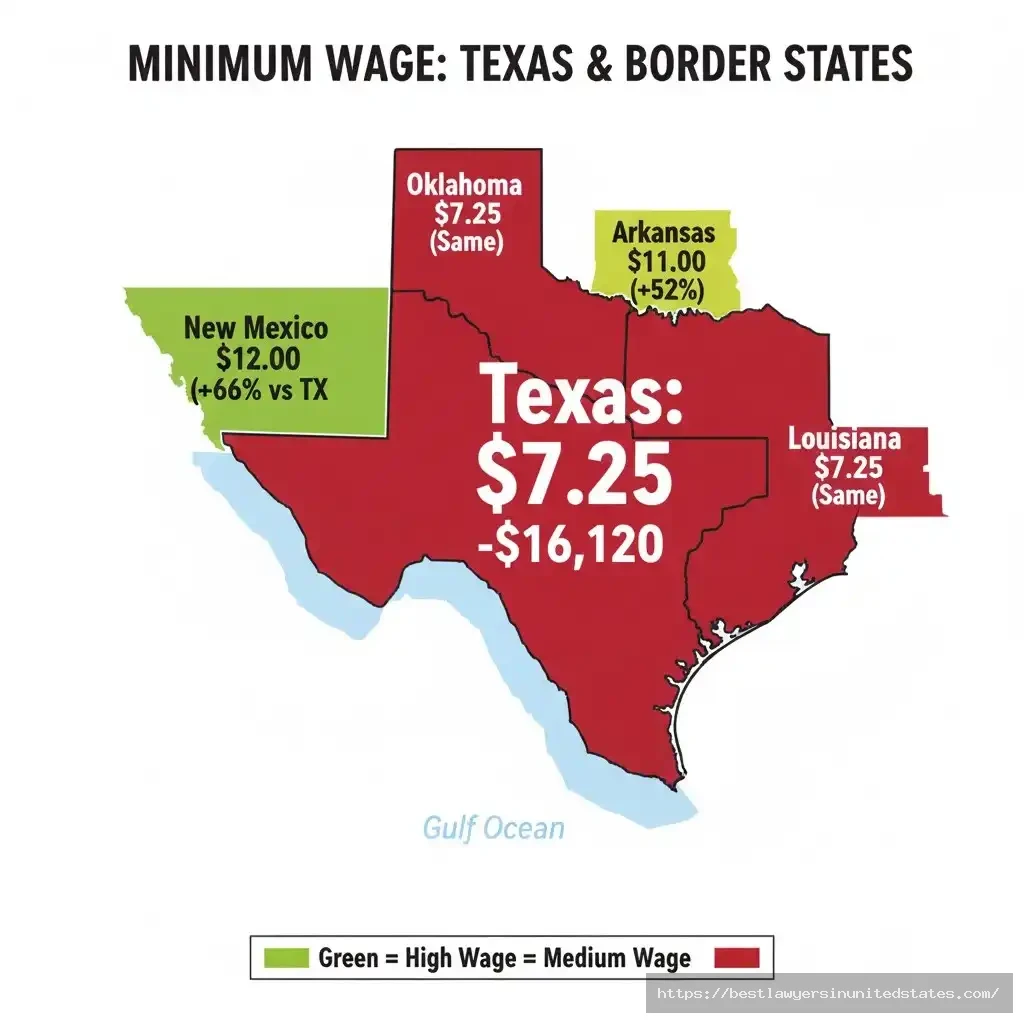
Texas's $7.25 minimum wage looks especially low when compared to neighboring states.
Border State Minimum Wages
| State | 2026 Minimum Wage | vs Texas | Distance % |
|---|---|---|---|
| New Mexico | $12.00 | +$4.75 | +66% higher |
| Louisiana | $7.25 | $0.00 | Same |
| Oklahoma | $7.25 | $0.00 | Same |
| Arkansas | $11.00 | +$3.75 | +52% higher |
New Mexico workers earn 66% more per hour than Texas workers at minimum wage. This creates economic incentives for Texas border residents to seek employment across state lines.
States with $15+ Minimum Wage in 2026
| State | Minimum Wage | vs Texas | Link |
|---|---|---|---|
| California | $16.50 | +$9.25 | +128% |
| Washington | $16.66 | +$9.41 | +130% |
| New York | $16.50 | +$9.25 | +128% |
| Connecticut | $16.35 | +$9.10 | +126% |
| Massachusetts | $15.00 | +$7.75 | +107% |
| Colorado | $14.81 | +$7.56 | +104% |
Workers in these states earn double or more what Texas minimum wage workers make. This wage gap drives migration patterns and economic competition between states.
Southern States Comparison
Even within the South, Texas lags behind progressive states:
| State | Minimum Wage | Region |
|---|---|---|
| Florida | $13.00 | South |
| Arkansas | $11.00 | South |
| Texas | $7.25 | South |
| Louisiana | $7.25 | South |
| Mississippi | $7.25 | South |
Florida's gradual path to $15/hour by 2026 demonstrates that southern states can raise wages without economic collapse.
Conclusion: What You Need to Know About Texas Minimum Wage in 2026
Texas minimum wage remains $7.25 per hour in 2026, unchanged since 2009. This rate applies to all workers except those in exempt categories like tipped employees ($2.13/hour) or certain white-collar positions.
The state has no plans to raise the minimum wage above the federal floor. Texas's Republican-controlled legislature opposes wage increases, citing business competitiveness and free market principles. All Texas cities follow the same rate due to state preemption laws that prevent local wage ordinances.
Key takeaways for workers:
- You cannot live comfortably on minimum wage in any Texas city
- Most major employers pay $12-18/hour due to market competition
- Tipped workers must earn at least $7.25/hour including tips
- Overtime is required after 40 hours per week at 1.5× your rate
- Texas has no required breaks for adult employees
- You can recover double unpaid wages under Texas Payday Law
What you can do:
- Use our free wage calculators to verify you're paid correctly
- Document all hours worked and compare to paychecks
- File wage claims if you're underpaid
- Seek higher-paying employers who pay above minimum wage
- Understand your rights under employment law
For employers:
- Verify all workers are classified correctly
- Ensure overtime calculations are accurate
- Maintain proper time and payroll records
- Understand tip credit requirements if employing tipped workers
- Comply with federal and state wage laws to avoid penalties
Texas workers deserve to know their rights and employers need to understand their obligations. While the minimum wage hasn't changed in 16 years, enforcement of existing laws remains strong. Workers who are underpaid can recover significant damages, and employers who violate wage laws face serious penalties.
Need help with wage issues? Contact the Texas Workforce Commission or consult with an employment attorney. Use our wage theft calculator to estimate potential recovery if you've been underpaid.
Email: [email protected]
