
Our free alimony calculator estimates spousal support payments for all 50 states plus Washington DC. Enter your income, marriage length, and state to get instant monthly payment amounts and duration estimates.
Alimony calculations vary dramatically by state. States like Illinois and Colorado use specific formulas. Others like California and Florida rely on judicial discretion and multiple factors. Our calculator applies the correct methodology for your location.
Understanding potential alimony helps you plan divorce costs and negotiate settlements. These estimates are educational tools. They don’t replace advice from a family law attorney.
Alimony Calculator
Estimate spousal support payments based on your state’s guidelines. Get monthly payment amounts, duration estimates, and total alimony calculations.
Enter Your Information
Provide details about income, marriage, and circumstances
Estimated Monthly Alimony Payment
📍 State Alimony Guidelines
Information about this state’s alimony approach will appear here.
📊 Calculation Breakdown
| Component | Value |
|---|
Calculator Features:
- State-specific alimony formulas for all 50 states
- Duration estimates based on marriage length
- Income-based calculations
- Adjustment factors for custody, health, age
- Instant results with payment breakdowns
Questions about alimony or need legal help? Email: [email protected]
How to Use the Alimony Calculator
The calculator requires basic financial and marriage information. You'll get an instant estimate based on your state's specific guidelines and formulas.
Required Information
You need to enter four key pieces of information. The calculator uses these to apply your state's alimony rules.
Essential inputs:
| Input Field | What to Enter | Why It Matters |
|---|---|---|
| Your State | Select from dropdown | Applies state-specific formulas and guidelines |
| Higher Earner Income | Annual gross income | Determines ability to pay |
| Lower Earner Income | Annual gross income | Establishes income disparity |
| Marriage Length | Years married | Affects duration and likelihood of alimony |
Optional Adjustment Factors
The calculator includes checkboxes for factors courts consider. These adjust your estimate up or down based on your specific situation.
Factors that increase alimony:
- Primary custody of children
- Health issues limiting employment
- Career sacrifices during marriage
- Supporting spouse's education or career
- Age over 55 years
Factors that decrease alimony:
- Marriage under 5 years
- Similar incomes between spouses
- Fault in causing divorce (some states)
Key takeaway: Select all factors that apply to your situation for the most accurate estimate.
Understanding Alimony Calculation Methods
Courts use different methods to calculate alimony depending on your state. Some states have specific formulas. Others give judges wide discretion based on multiple factors.
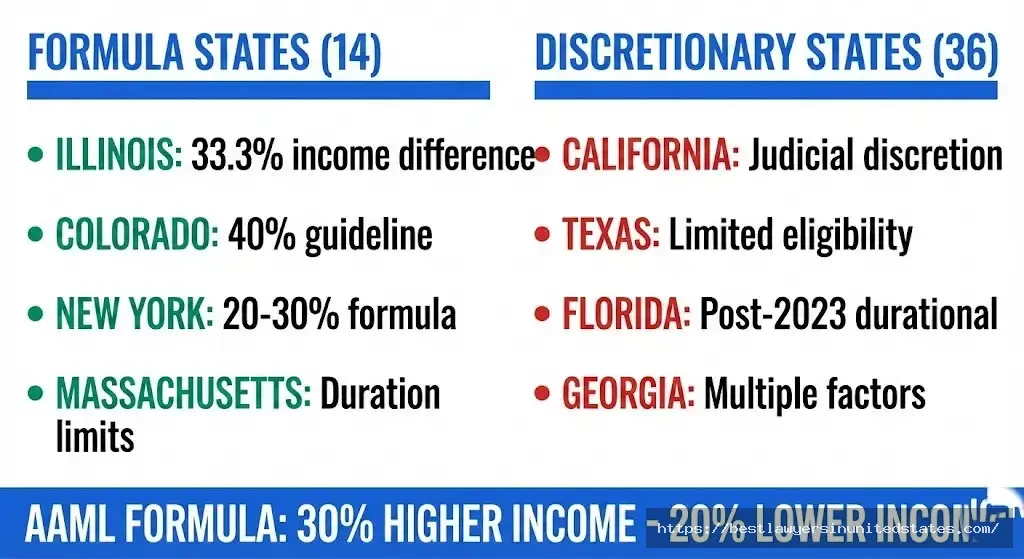
Formula-Based States
14 states use specific formulas to calculate alimony amounts. These formulas typically consider income difference and marriage length.
Formula states include:
- Illinois: 33.3% of income difference
- Colorado: 40% of combined income to lower earner
- New York: Income percentage based on combined income
- Massachusetts: Income-based with duration limits
- New Jersey: Various factors with income consideration
Quick Answer: Formula states provide more predictable alimony estimates than discretionary states.
Discretionary States
36 states use judicial discretion without specific formulas. Judges consider multiple factors to determine fair alimony amounts.
Common factors judges evaluate:
| Factor | How It Affects Alimony |
|---|---|
| Length of Marriage | Longer marriages = more likely, longer duration |
| Income Disparity | Greater difference = higher payments |
| Standard of Living | Courts try to maintain marital standard |
| Age and Health | Older/health issues = more likely |
| Child Custody | Primary custodian may receive more |
| Career Sacrifices | Leaving career for family = consideration |
| Education Support | Supporting spouse's career = reimbursement |
| Earning Capacity | Ability to become self-supporting |
AAML Formula Method
The American Academy of Matrimonial Lawyers developed a widely referenced guideline formula. Many attorneys use this as a starting point for negotiations.
AAML formula for monthly alimony: 30% of higher income minus 20% of lower income
Example calculation:
- Higher earner: $100,000/year ($8,333/month)
- Lower earner: $40,000/year ($3,333/month)
- Calculation: ($8,333 x 0.30) - ($3,333 x 0.20) = $2,500 - $667 = $1,833/month
Duration guideline: Many courts award alimony for one-third to one-half the marriage length.
State-Specific Alimony Rules
Alimony laws differ significantly across states. What you receive in California might be double what you'd get in Texas for the same situation.

Formula States Comparison
States with formulas provide more predictable results. Here's how major formula states calculate alimony:
| State | Formula Method | Duration Calculation | Special Rules |
|---|---|---|---|
| Illinois | 33.3% income difference | Up to marriage length | Caps at 40% of combined income |
| Colorado | 40% to lower earner | 31-50% of marriage length | Different for marriages under 3 years |
| New York | 20-30% income difference | Marriage-length dependent | Temporary vs post-divorce different |
| Massachusetts | Income-based | Shorter of marriage length or retirement | 2012 reform act limits |
High-Alimony States
Some states award higher alimony amounts and longer durations. These states favor supporting the lower-earning spouse.
States with typically higher alimony:
- California: Long duration, maintains marital standard
- New York: Generous formulas, extended duration
- New Jersey: Permanent alimony for long marriages
- Connecticut: Favors lifetime support
- Vermont: Extended duration awards
Average alimony in high-award states: $2,000 to $4,000 per month for middle-income divorces.
Low-Alimony States
Other states limit alimony awards or make them harder to obtain. These states favor economic independence.
States with typically lower alimony:
- Texas: Limited to 10 years maximum
- Tennessee: Caps duration at marriage length
- Mississippi: Rarely awarded, short duration
- Georgia: Limited in duration and amount
- Florida: 2023 reform eliminated permanent alimony
Average alimony in limited-award states: $800 to $1,500 per month for middle-income divorces.
Key difference: Where you file for divorce can dramatically affect your alimony outcome.
Tax Implications of Alimony
Federal tax treatment of alimony changed dramatically in 2019. Your divorce date determines whether alimony is taxable.
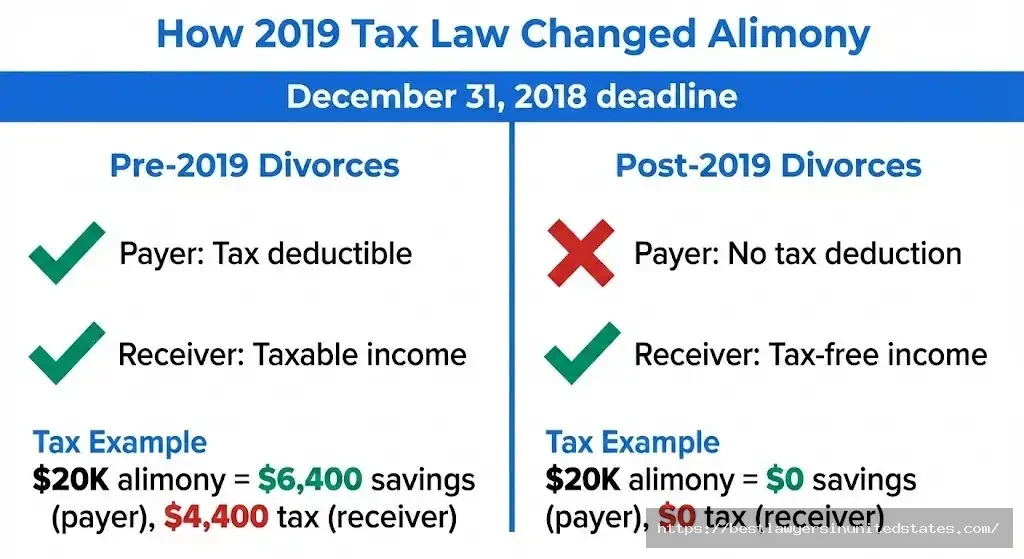
Pre-2019 Divorces (Old Tax Rules)
Divorces finalized before December 31, 2018 follow the old tax treatment. This applied for decades until the Tax Cuts and Jobs Act changed the rules.
Old tax rules:
- Paying spouse: Deducts alimony from taxable income
- Receiving spouse: Reports alimony as taxable income
- Tax benefit: Shifts income to lower tax bracket
Example of old rules:
- Payer in 32% bracket: $20,000 alimony = $6,400 tax savings
- Receiver in 22% bracket: $20,000 alimony = $4,400 tax owed
- Net tax benefit to couple: $2,000
Post-2019 Divorces (New Tax Rules)
Divorces finalized on or after January 1, 2019 follow new tax treatment. The Tax Cuts and Jobs Act eliminated the alimony deduction.
New tax rules:
- Paying spouse: No tax deduction for alimony
- Receiving spouse: Alimony is tax-free income
- Tax burden: Stays with higher-earning payer
Example of new rules:
- Payer in 32% bracket: $20,000 alimony = $0 tax benefit
- Receiver in 22% bracket: $20,000 alimony = $0 tax owed
- Net difference: Payer loses $6,400 in tax savings
Impact on Alimony Negotiations
The tax change affects how couples negotiate alimony. Payers lost their tax deduction. Receivers gained tax-free income.
Negotiation shifts after 2019:
- Lower alimony amounts (payer gets no tax break)
- More property division instead of alimony
- Lump-sum payments instead of monthly alimony
- Creative structuring to offset tax loss
Critical deadline: Divorce modifications made after 2019 to pre-2019 agreements maintain old tax rules unless both parties agree otherwise.
Alimony Duration and Modification
How long you pay or receive alimony depends on marriage length and state rules. Most alimony orders also include modification provisions.

Duration by Marriage Length
Marriage length is the single biggest factor determining alimony duration. Longer marriages typically receive longer alimony periods.
| Marriage Length | Typical Alimony Duration | States Using This Standard |
|---|---|---|
| Under 5 years | 6 months to 2 years | Most states, limited awards |
| 5 to 10 years | 2 to 5 years | Moderate duration |
| 10 to 20 years | 5 to 10 years | Substantial duration |
| 20+ years | 10 years to permanent | Long-term support common |
General guideline: Courts often award alimony for one-third to one-half the marriage length.
Types of Alimony by Duration
Different alimony types serve different purposes. The type affects both amount and duration.
Temporary alimony (pendente lite):
- Duration: During divorce proceedings only
- Purpose: Maintain status quo until final order
- Amount: Based on immediate need
Rehabilitative alimony:
- Duration: 2 to 5 years typically
- Purpose: Allow recipient to gain job skills or education
- Amount: Covers living expenses during training
- Most common type awarded
Durational alimony:
- Duration: Set time period, often half marriage length
- Purpose: Bridge gap after short to moderate marriage
- Amount: Maintains reasonable standard of living
- Florida's preferred post-2023 reform type
Permanent alimony:
- Duration: Until death, remarriage, or court modification
- Purpose: Long marriages where self-support unlikely
- Amount: Maintains marital standard of living
- Increasingly rare (Florida eliminated in 2023)
Reimbursement alimony:
- Duration: Variable, often shorter
- Purpose: Reimburse spouse who supported other's career/education
- Amount: Based on financial contribution
- Less common but growing
Modification Triggers
Alimony orders aren't always permanent. Substantial changes in circumstances can justify modifications.
Common modification reasons:
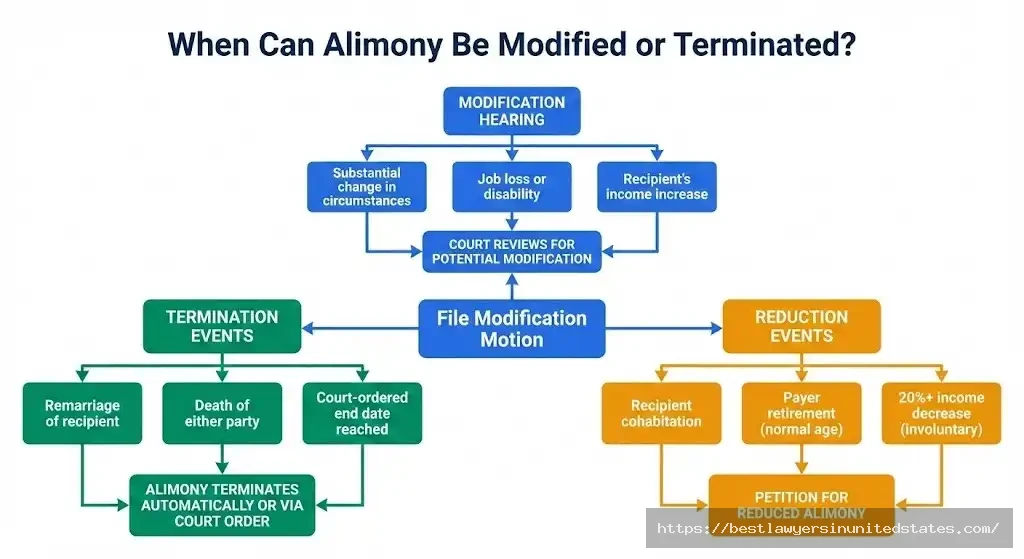
Job loss or reduced income:
- Must be involuntary and significant
- Courts impute income for intentional unemployment
- Usually requires 20%+ income change
Retirement:
- Reaching normal retirement age (65-67)
- May reduce or terminate alimony
- Must provide advance notice to recipient
Cohabitation:
- Recipient living with new romantic partner
- May reduce or terminate in most states
- Some states require financial support from new partner
Remarriage:
- Automatically terminates alimony in all states
- No court order needed
- Effective immediately upon remarriage
Stat: Approximately 25% of alimony orders get modified within 5 years of the original decree.
State Comparison: Alimony Calculation Examples
Real examples show how dramatically alimony varies by state. These calculations use the same scenario across different states.

Example Scenario
Marriage details:
- Higher earner: $120,000/year
- Lower earner: $40,000/year
- Marriage length: 15 years
- No children, both healthy
- Both age 45
Formula State Calculations
Illinois calculation:
- Formula: 33.3% of income difference
- Income difference: $80,000
- Monthly alimony: ($80,000 x 0.333) / 12 = $2,220/month
- Duration: Up to 15 years (100% of marriage length)
- Total obligation: $399,600
Colorado calculation:
- Guideline: 40% of combined income to lower earner
- Combined income: $160,000
- Target income: $64,000 for lower earner
- Monthly alimony: ($64,000 - $40,000) / 12 = $2,000/month
- Duration: 7.5 years (50% of marriage length)
- Total obligation: $180,000
New York calculation:
- Formula: 20% of higher minus 25% of lower
- Calculation: ($120,000 x 0.20) - ($40,000 x 0.25) = $14,000/year
- Monthly alimony: $1,167/month
- Duration: 7.5 to 11.25 years (guideline)
- Total obligation: $140,040 (10 years assumed)
Discretionary State Estimates
California estimate:
- Method: Judicial discretion, DissoMaster software common
- Typical range: 30-35% income difference
- Monthly alimony: $2,000-$2,500/month
- Duration: 7.5 years (half marriage length standard)
- Total obligation: $180,000-$225,000
Texas estimate:
- Method: Limited alimony, strict requirements
- Qualifies: Marriage over 10 years
- Monthly alimony: $1,500-$2,000/month (lower than most states)
- Duration: 5 years maximum for 10-20 year marriage
- Total obligation: $90,000-$120,000
Florida estimate (post-2023 reform):
- Method: Durational alimony only
- Monthly alimony: $1,800-$2,200/month
- Duration: 7.5 years maximum (50% of marriage length)
- Total obligation: $162,000-$198,000
- No permanent alimony available
State Comparison Table
| State | Monthly Amount | Duration | Total Paid | Calculation Method |
|---|---|---|---|---|
| Illinois | $2,220 | 15 years | $399,600 | Formula (33.3%) |
| Colorado | $2,000 | 7.5 years | $180,000 | Guideline (40%) |
| New York | $1,167 | 10 years | $140,040 | Formula (20%-25%) |
| California | $2,250 | 7.5 years | $202,500 | Discretionary |
| Texas | $1,750 | 5 years | $105,000 | Limited statute |
| Florida | $2,000 | 7.5 years | $180,000 | Durational only |
Key insight: The same scenario produces $105,000 to $399,600 in total alimony depending on the state.
How Alimony Affects Total Divorce Costs
Alimony negotiations impact overall divorce expenses. Disputes over spousal support drive up legal fees and court costs.
Uncontested Divorce with Agreed Alimony
When spouses agree on alimony terms, divorce costs stay low. You can often use mediation or a collaborative approach.
Typical costs for agreed alimony:
- Attorney fees: $2,000-$5,000 (drafting agreement)
- Mediation: $1,500-$3,000 (reaching agreement)
- Court filing fees: $300-$450 (varies by state)
- Total divorce cost: $3,800-$8,450
Contested Divorce with Alimony Dispute
Alimony fights significantly increase divorce costs. Attorney time, expert witnesses, and court hearings add up quickly.
Typical costs for contested alimony:
- Attorney fees: $15,000-$40,000 (litigation and discovery)
- Financial expert: $3,000-$8,000 (income analysis)
- Vocational expert: $2,000-$5,000 (earning capacity evaluation)
- Court costs: $1,000-$3,000 (multiple hearings)
- Total divorce cost: $21,000-$56,000
Key fact: Alimony disputes can triple or quadruple your total divorce costs compared to uncontested divorces.
Using the Calculator to Avoid Disputes
Running calculator estimates before negotiations helps set realistic expectations. Both spouses see what courts might award. This reduces unreasonable demands.
Calculator benefits for settlement:
- Establishes reasonable negotiation range
- Shows impact of different scenarios
- Demonstrates state law applications
- Reduces emotional arguments with data
- Speeds settlement discussions
Many couples reach alimony agreements after seeing calculator estimates. This saves $10,000-$30,000 in legal fees compared to litigation.
Alimony vs Child Support: Key Differences
Alimony and child support are separate financial obligations. Understanding the differences helps you calculate total divorce costs.
Fundamental Differences
| Aspect | Alimony | Child Support |
|---|---|---|
| Purpose | Support ex-spouse | Support children |
| Duration | Variable, often limited | Until child turns 18-21 |
| Tax Treatment (post-2019) | Tax-free to recipient | Not taxable/deductible |
| Modification | Possible with circumstances | Automatic reviews available |
| Termination | Remarriage, death, cohabitation | Child reaches majority |
| Calculation | Income-based or discretionary | Formula-based in all states |
Combined Obligations
Many divorcing parents pay both alimony and child support. The combination creates significant monthly obligations.
Example combined obligation:
- Alimony: $2,000/month
- Child support (2 kids): $1,500/month
- Total monthly: $3,500
- Annual obligation: $42,000
Some states reduce alimony when child support is also paid. Courts consider total ability to pay when setting both amounts.
Which Gets Priority?
Child support always takes priority over alimony. Courts must calculate child support first. Alimony gets determined from remaining income.
Calculation order:
- Calculate child support based on incomes
- Subtract child support from payer's income
- Calculate alimony from reduced income
- Set final amounts for both obligations
This protects children's financial needs. It may reduce alimony compared to childless divorce scenarios.
Recent State Law Changes (2023-2026)
Several states reformed alimony laws recently. These changes affect calculations and duration limits.
Florida's 2023 Alimony Reform
Florida eliminated permanent alimony effective July 1, 2023. The reform represents the biggest alimony change in recent years.
Major changes:
- No permanent alimony for any marriages
- Durational alimony now primary type
- Duration capped at 50% marriage length for marriages under 20 years
- Retirement presumption at normal retirement age
- Applies to new cases and modifications
Impact: Florida alimony awards dropped approximately 30-40% in total obligations compared to pre-reform.
Massachusetts Updates
Massachusetts continues implementing its 2012 alimony reform. Courts now apply stricter duration limits.
Current Massachusetts rules:
- Marriage 0-5 years: Maximum 50% of marriage length
- Marriage 5-10 years: Maximum 60% of marriage length
- Marriage 10-15 years: Maximum 70% of marriage length
- Marriage 15-20 years: Maximum 80% of marriage length
- Marriage 20+ years: Indefinite but reviewable
Retirement trigger: Alimony suspends or terminates when payer reaches full retirement age.
Illinois Maintenance Updates
Illinois modified its formula application in recent years. The state continues refining its income-based calculation.
Illinois 2026 guidelines:
- Formula applies to combined income under $500,000
- Caps total at 40% of combined incomes
- Duration increases with marriage length
- Clearer modification standards
Colorado Adjustments
Colorado updated its maintenance advisory guidelines. The guidelines aren't mandatory but heavily influence courts.
Colorado changes:
- Adjusted income thresholds for guideline application
- Clarified treatment of bonuses and variable income
- Modified duration multipliers for different marriage lengths
- Enhanced modification procedures
Key trend: Most states are limiting or eliminating permanent alimony in favor of durational or rehabilitative support.
Frequently Asked Questions
How is alimony calculated?
Quick Answer: Alimony is calculated using state-specific formulas or judicial discretion based on income difference, marriage length, and multiple factors.
Formula states like Illinois use income percentages. Other states give judges discretion to consider earning capacity, standard of living, health, age, and contributions to the marriage. Our calculator applies your state's specific methodology.
What is the average alimony payment?
Quick Answer: Average alimony payments range from $1,200 to $2,500 per month, varying significantly by state, income levels, and marriage length.
National data shows median alimony awards around $1,800 per month. High-income divorces see higher payments. States with formulas produce more consistent averages. Texas and similar limited-alimony states average below $1,500 monthly. California and New York average above $2,200 monthly.
How long does alimony last?
Quick Answer: Alimony typically lasts from one-third to one-half the marriage length, though duration varies dramatically by state law.
Short marriages (under 5 years) rarely receive alimony exceeding 2 years. Moderate marriages (10-15 years) often see 5-7 year durations. Long marriages (20+ years) may receive extended or indefinite alimony, though permanent alimony is becoming rare.
Is there a formula to calculate alimony?
Quick Answer: 14 states use specific formulas, while 36 states rely on judicial discretion without set formulas.
Formula states include Illinois (33.3% income difference), Colorado (40% guideline), New York (income percentage), and Massachusetts (duration-limited). The AAML suggests 30% of higher income minus 20% of lower income as a guideline, though it's not legally binding.
Can alimony be modified?
Quick Answer: Yes, alimony can be modified based on substantial changes in circumstances like job loss, retirement, remarriage, or cohabitation.
Most states allow modifications for involuntary income changes exceeding 15-20%. Retirement at normal age usually justifies reduction or termination. Remarriage automatically ends alimony. Cohabitation may reduce or end payments depending on state law.
Does remarriage end alimony?
Quick Answer: Yes, remarriage of the receiving spouse automatically terminates alimony in all 50 states.
Termination is immediate and requires no court order. The paying spouse simply stops payments after the remarriage date. Some states also reduce or terminate alimony if the receiving spouse cohabitates with a new partner without marriage.
How does the 2019 tax law affect alimony?
Quick Answer: Divorces finalized after December 31, 2018 make alimony non-deductible for payers and non-taxable for recipients.
Pre-2019 divorces still follow old rules where payers deduct alimony and recipients pay taxes. The change eliminates tax benefits for new divorces. This has reduced average alimony amounts since payers no longer receive tax deductions.
What factors increase alimony?
Quick Answer: Longer marriages, greater income disparity, recipient's health issues, career sacrifices, and older age increase alimony likelihood and amounts.
Courts award higher alimony when recipients have limited earning capacity due to age, health, or career interruptions. Supporting a spouse through school or sacrificing career advancement strengthens alimony claims. Primary custody of children may increase awards.
Which states have the highest alimony?
Quick Answer: California, New York, New Jersey, Connecticut, and Vermont typically award the highest alimony amounts and longest durations.
These states favor maintaining marital standard of living and award extended or permanent alimony for long marriages. High cost of living in these states also drives higher payment amounts. Average alimony exceeds $2,500 monthly in high-award states.
Which states have the lowest alimony?
Quick Answer: Texas, Tennessee, Mississippi, Georgia, and Florida (after 2023 reform) award the lowest alimony or strictly limit duration.
Texas caps alimony at 10 years maximum and requires specific qualifications. Florida eliminated permanent alimony in 2023. These states favor self-sufficiency over long-term support. Average awards stay below $1,500 monthly.
How much of my income will go to alimony?
Quick Answer: Alimony typically ranges from 15-40% of the income difference between spouses, with most awards falling around 25-30%.
Formula states specifically calculate percentages. Illinois uses 33.3% of income difference. Colorado targets 40% of combined income going to lower earner. Courts generally cap total alimony to prevent excessive hardship on paying spouse.
Can I avoid paying alimony?
Quick Answer: You can minimize or avoid alimony through prenuptial agreements, short marriages, similar incomes, or proving spouse has adequate earning capacity.
Marriages under 3-5 years rarely trigger alimony. When both spouses earn similar incomes, courts usually deny alimony. Prenuptial agreements that waive alimony are generally enforceable if properly executed. Proving fault in some states may reduce awards.
Does adultery affect alimony?
Quick Answer: In the 17 states that consider fault, adultery can reduce or eliminate alimony for the cheating spouse.
Fault-based states include North Carolina, South Carolina, Virginia, Georgia, and others. Adultery generally bars the cheating spouse from receiving alimony. It may also increase alimony awarded to the wronged spouse. No-fault states like California don't consider adultery in alimony decisions.
How does cohabitation affect alimony?
Quick Answer: Cohabitation with a new partner reduces or terminates alimony in most states, though requirements vary.
Some states automatically reduce alimony when recipients cohabitate. Others require proving financial support from the new partner. Florida, North Carolina, and Tennessee have strong cohabitation reduction statutes. Payers must typically file modification motions to stop payments.
Can I get alimony if I worked during marriage?
Quick Answer: Yes, working spouses can receive alimony if there's significant income disparity and the marriage meets minimum duration requirements.
Courts compare incomes, not employment status. A spouse earning $40,000 while the other earns $150,000 likely qualifies for alimony despite working. The focus is maintaining reasonable standard of living, not punishing the working spouse.
Next Steps After Using the Calculator
Calculator results give you a starting point. Professional legal advice ensures you understand your rights and options fully.
Review Your Results
Examine your calculator estimate carefully. The breakdown shows monthly payments, duration, and total obligation based on your state's laws.
Key numbers to note:
- Monthly payment amount
- Total years of payments
- Cumulative total obligation
- Adjustment factors applied
Compare results against your financial capacity. If paying, can your budget handle the estimated amount? If receiving, will it meet your living expenses?
Consult a Family Law Attorney
Calculator estimates don't replace legal advice. An experienced attorney reviews factors the calculator can't assess.
Attorney consultations cover:
- Your specific financial situation
- Unique marital circumstances
- Recent case law in your jurisdiction
- Negotiation strategies
- Tax planning opportunities
Most family law attorneys offer free initial consultations. Use your calculator results to have an informed discussion.
Find help: Search for experienced divorce attorneys in your area offering free consultations.
Consider Mediation
If your calculator estimate seems reasonable to both spouses, mediation can finalize terms. Divorce mediation costs far less than litigation.
Mediation benefits:
- Costs $1,500-$3,000 vs $15,000+ for litigation
- Faster resolution (weeks vs months)
- More control over final terms
- Less adversarial process
- Higher compliance rates
Bring your calculator results to mediation. They provide objective starting points for negotiations.
Calculate Total Divorce Costs
Alimony is one component of your total divorce expenses. Use our divorce cost calculator to estimate all costs.
Total divorce costs include:
- Court filing fees ($200-$450)
- Attorney fees ($3,000-$40,000)
- Mediation costs ($1,500-$3,000)
- Expert witness fees ($2,000-$8,000)
- Alimony obligations (calculated above)
Understanding total costs helps you budget for the divorce process.
Explore Settlement Options
Most divorces settle without trial. Knowing potential alimony helps both spouses negotiate fairly.
Settlement approaches:
- Lump-sum buyout instead of monthly payments
- Property trade-offs in exchange for lower alimony
- Structured settlements with decreasing payments
- Time-limited agreements with review provisions
Creative settlements often satisfy both spouses better than court orders. Your calculator estimate helps identify reasonable ranges.
Document Everything
Start gathering financial documentation now. Whether negotiating or litigating, you'll need comprehensive financial records.
Essential documents:
- Tax returns (last 3-5 years)
- Pay stubs and W-2s
- Bank statements
- Investment account statements
- Business financial records
- Expense documentation
- Property valuations
Complete documentation supports accurate alimony calculations. It also speeds the divorce process.
Plan Your Financial Future
Whether paying or receiving alimony, adjust your budget for post-divorce reality. Calculator results help you plan ahead.
Financial planning steps:
- Create post-divorce budget
- Adjust withholding for tax changes
- Review retirement savings capacity
- Consider life insurance requirements
- Update estate planning documents
- Plan for alimony termination date
Financial advisors can help structure your finances around alimony obligations or income.
Disclaimer: This calculator provides estimates for educational purposes only. Results don't constitute legal advice. Actual alimony awards depend on specific circumstances and judicial discretion. Consult a licensed family law attorney in your state for advice about your situation.
Last Updated: January 2026
Questions or need legal assistance? Email: [email protected]