
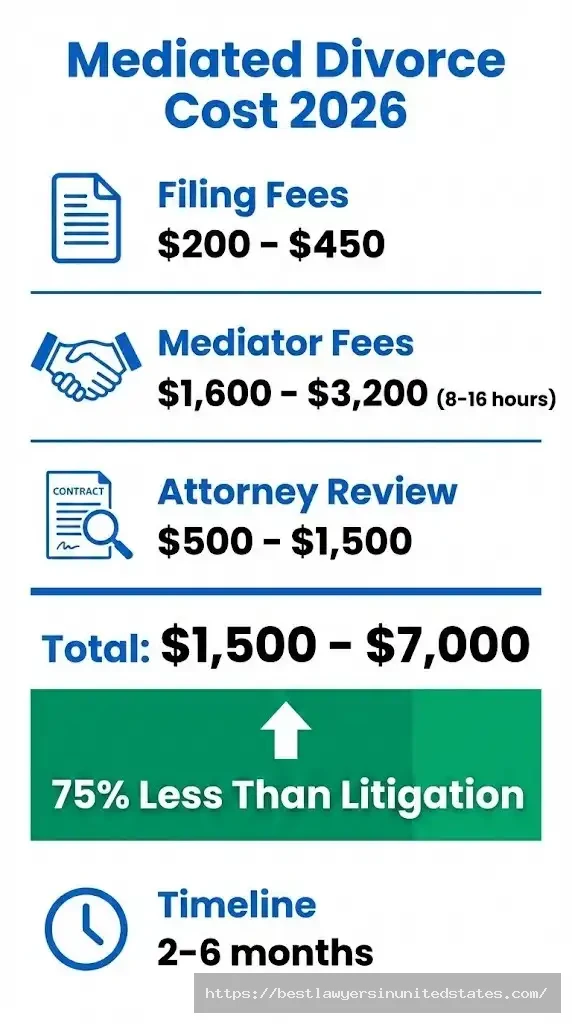
Divorce doesn’t have to mean courtroom battles and $30,000 legal bills. Mediated divorce lets you and your spouse work with a neutral mediator to negotiate your settlement outside of court. Most couples pay $1,500 to $7,000 total and finalize everything in 2 to 6 months.
Mediation costs about 75% less than traditional litigation. You keep control over the outcome instead of letting a judge decide. The process stays private and often preserves better relationships for co-parenting.
This guide explains how mediated divorce works, what it costs, and whether it’s right for your situation.
What Is Mediated Divorce?
Mediated divorce is when you and your spouse work with a trained neutral mediator to negotiate your divorce settlement. The mediator helps you communicate and find solutions but doesn’t make decisions for you. Once you reach an agreement, it becomes a legally binding contract.
The mediator acts as a neutral third party. They don’t represent either spouse. They can’t give legal advice or advocate for one person over the other. Their job is to facilitate productive discussions and help you both reach fair agreements.
Types of Divorce Mediation
Private mediation means you hire and pay for your own mediator. Sessions happen on your schedule. You can take as much time as you need.
Court-ordered mediation happens when a judge requires you to try mediation before trial. Many states mandate this for custody disputes. These sessions are usually free or low-cost but limited to 1-2 meetings.
Online mediation lets you participate from separate locations via video call. This works well for low-conflict situations and couples who live apart.
Shuttle mediation keeps you in separate rooms. The mediator goes back and forth between you. This option works when there’s past domestic violence or high conflict but you still want to avoid litigation.
How Mediation Differs from Other Divorce Types
| Divorce Type | Cost Range | Timeline | Control | Privacy |
|---|---|---|---|---|
| Mediated | $1,500-$7,000 | 2-6 months | High (you decide) | Private |
| Collaborative | $5,000-$15,000 | 6-12 months | High (team approach) | Private |
| Uncontested | $500-$2,500 | 2-4 months | High (mutual agreement) | Private |
| Contested | $15,000-$50,000+ | 12-24+ months | Low (judge decides) | Public record |
Mediation differs from uncontested divorce because you need help negotiating the terms. It differs from contested divorce because you work together instead of fighting in court.
How Divorce Mediation Works: The 5 Stages
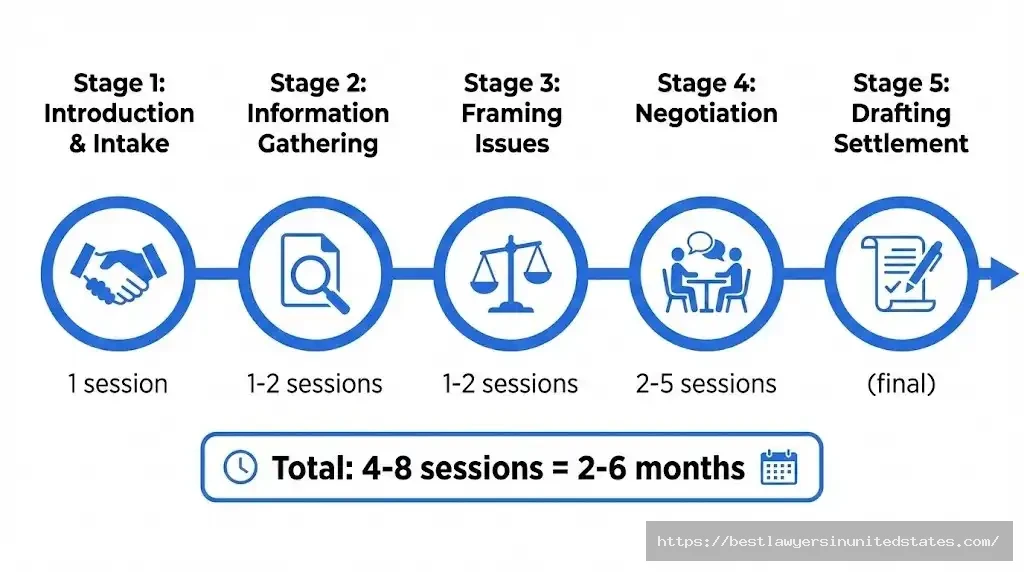
Most divorce mediation follows five stages. The process takes 4 to 8 sessions with each session lasting 2 hours. You can complete everything in 2 to 6 months depending on complexity and scheduling.
Stage 1: Introduction and Intake
Your first contact with the mediator covers the basics. You discuss the process, ground rules, and fees. Both spouses meet together or separately depending on your situation.
The mediator explains confidentiality rules. What you say in mediation stays private and can’t be used in court later. You sign a mediation agreement outlining the process and payment terms.
This stage usually takes one session. The mediator asks about your marriage length, children, property, and main concerns.
Stage 2: Information Gathering
You need to share complete financial information. Both spouses disclose all assets, debts, income, and expenses. Transparency is critical because mediation relies on voluntary disclosure rather than formal discovery.
Documents to gather:
- Pay stubs from the last 3 months
- Tax returns from the last 2-3 years
- Bank statements for all accounts
- Credit card statements
- Retirement account statements
- Property deeds and vehicle titles
- Business valuations if you own a business
- Any prenuptial or postnuptial agreements
This stage takes 1-2 sessions. The mediator helps you organize information and identify what’s missing. You might need to get appraisals or valuations for major assets.
Stage 3: Framing Issues and Interests
The mediator helps you identify what needs to be decided. You discuss priorities, concerns, and what matters most to each person. This isn’t about positions like “I want the house.” It’s about underlying interests like “I need stability for the kids.”
Common issues to address:
- How to divide marital property and debts
- Whether anyone pays or receives spousal support
- Child custody and parenting time schedules
- Child support calculations
- Who keeps the house or how to sell it
- How to split retirement accounts
- Health insurance coverage
Some mediators conduct this stage separately with each spouse. Others keep you together. Separate sessions work better when conflict is high or one spouse tends to dominate.
Stage 4: Negotiation
This is where you work through options and reach agreements. The mediator helps you explore different solutions. You discuss trade-offs and compromises. The goal is finding arrangements that address both people’s most important interests.
Negotiation typically takes 2-5 sessions. Complex finances or high-conflict situations need more time. The mediator keeps discussions productive and helps you move past sticking points.
The mediator doesn’t decide anything. They ask questions, offer information about legal standards, and help you problem-solve. You and your spouse make all the decisions.
Key to success: Focus on interests instead of positions. “I need housing security” is more workable than “I demand the house.”
Stage 5: Drafting the Settlement Agreement
Once you’ve negotiated all issues, the mediator drafts your Marital Settlement Agreement. This document covers all the terms you agreed to. Both spouses review it carefully. Many people hire separate attorneys to review the agreement before signing.
You can request changes if something doesn’t reflect what you agreed to. The mediator revises the document until both of you are satisfied.
After both spouses sign, the agreement becomes legally binding. You file it with the court along with other divorce paperwork. The judge typically approves mediated agreements without requiring a hearing. The settlement terms become part of your divorce decree.
How Much Does Mediated Divorce Cost?
The average mediated divorce costs $1,500 to $7,000 total. This includes mediator fees, filing fees, and attorney review. Complex cases with significant assets or business interests cost more.
Mediator Fees
Private mediators charge $100 to $400 per hour depending on experience and location. Attorney-mediators in major cities charge higher rates than mediators with counseling backgrounds in rural areas.
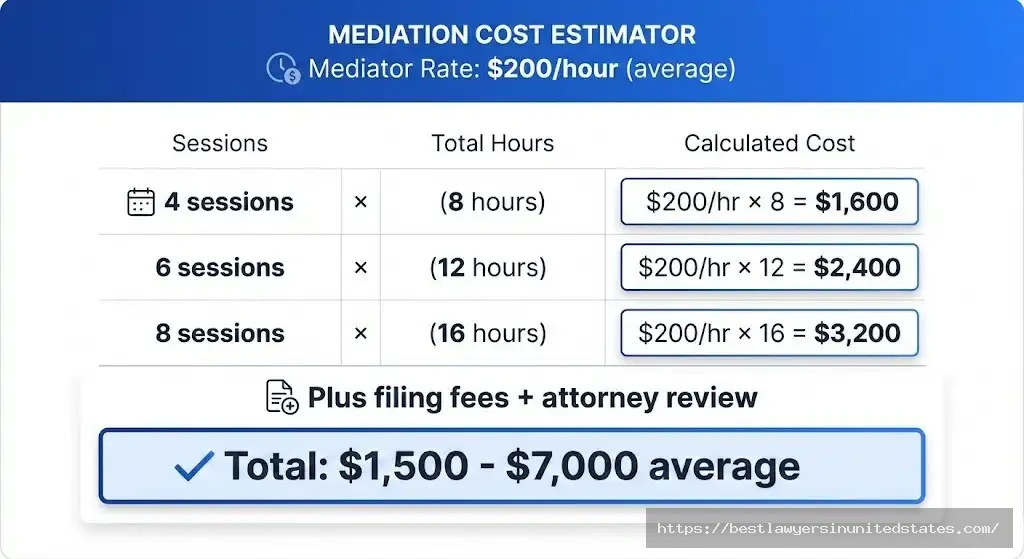
Most couples need 4-8 sessions at 2 hours each. Total mediation time runs 8-16 hours. At $200 per hour, you’d pay $1,600 to $3,200 just for the mediator.
Calculate Your Divorce Costs
Planning a divorce? Use our free calculator to estimate your total costs based on typical mediator rates, filing fees, and whether you need attorney assistance.
Divorce Cost Calculator
Get an estimated cost for your divorce based on your specific situation
Your Estimated Divorce Cost
Cost Breakdown
📧 Get a Personalized Consultation
Have questions about your specific situation? Contact our legal experts for guidance tailored to your needs.
Contact Us via EmailCalculator features:
- Mediation cost estimates by session count
- Attorney cost comparisons
- Contested vs uncontested vs mediated comparison
- Total cost breakdown
- Money-saving tips based on your situation
Questions about your divorce or need legal help? [Find Divorce Lawyers – Free Consultation]
Email: [email protected]
Additional Costs
| Cost Type | Amount | Notes |
|---|---|---|
| Mediator fees | $1,600-$3,200 | 8-16 hours at $200/hour average |
| Court filing fees | $200-$450 | Varies by state and county |
| Attorney review | $500-$1,500 | Optional but recommended |
| Financial experts | $500-$2,000 | For complex asset valuations |
| Parenting classes | $50-$200 | Required in some states if you have children |
| Total | $1,500-$7,000 | Average mediated divorce |
Free and Low-Cost Mediation Options
Court-sponsored mediation costs nothing or $50-$200. Many family courts offer free mediation programs. These typically focus on custody and visitation issues. Sessions are limited to 1-2 meetings.
Community mediation centers use sliding scale fees based on income. You might pay $25-$100 per hour instead of $200-$400.
Legal aid organizations sometimes offer free mediation services if you meet income requirements. Check your state’s legal aid website.
Cost Comparison: Mediation vs Litigation
| Factor | Mediated Divorce | Contested Litigation |
|---|---|---|
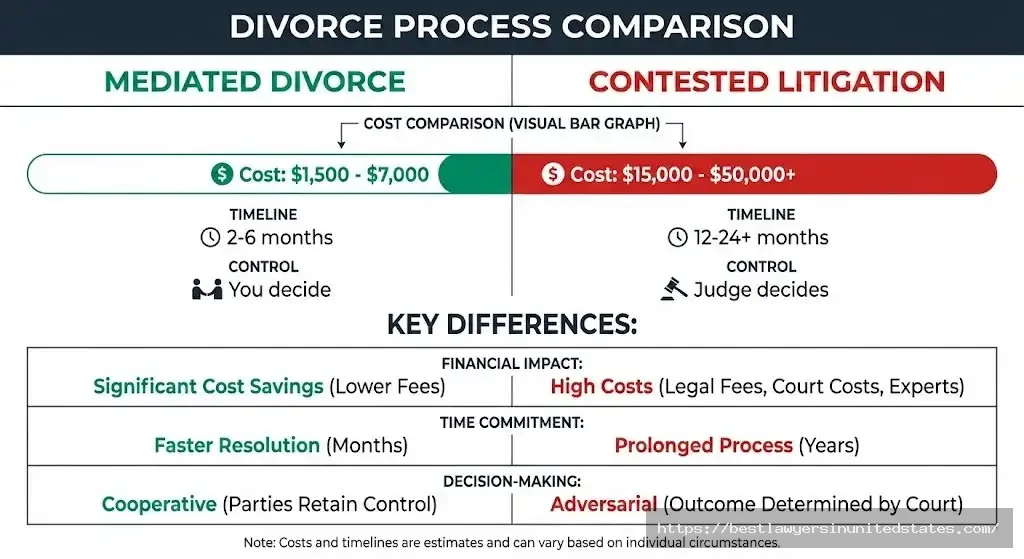
| Average cost | $1,500-$7,000 | $15,000-$50,000+ |
| Timeline | 2-6 months | 12-24+ months |
| Attorney fees | Optional ($500-$1,500 for review) | Required ($5,000-$30,000+) |
| Court costs | $200-$450 filing fee | $200-$450 plus hearing fees |
| Discovery costs | None (voluntary disclosure) | $2,000-$10,000+ |
| Expert witnesses | Rare | $2,000-$10,000 per expert |
| Trial costs | None | $5,000-$15,000+ |
Mediation saves money by avoiding attorney fees for court appearances, motion practice, discovery, and trial preparation. Even if you hire consulting attorneys, the total cost stays far below traditional litigation.
For more details on overall divorce expenses, see our guide on how much divorce costs.
Advantages of Mediated Divorce
Mediated divorce offers significant benefits over traditional litigation. Most couples choose mediation because it costs less, takes less time, and reduces conflict.
Lower Cost and Faster Timeline
Mediation costs 70-80% less than contested divorce. You avoid expensive attorney fees for court appearances, depositions, and trial preparation. Most couples finalize mediated divorces in 2-6 months compared to 12-24+ months for litigation.
You split the mediator’s fee. At $200 per hour for 12 hours total, each spouse pays $1,200. Compare that to attorney fees of $15,000-$25,000 each for a contested case.
The divorce process moves faster because you schedule sessions at your convenience. You don’t wait months for court dates.
More Control Over the Outcome
You make all the decisions instead of letting a judge decide. Judges follow rigid legal formulas. Mediators help you create custom solutions that work for your family.
Want to keep the house but give up your retirement account? Fine. Prefer an unusual parenting schedule that fits your work shifts? No problem. Courts can only order standard arrangements. Mediation lets you be creative.
You understand the agreements because you negotiated them yourself. This leads to better compliance. People follow rules they created more willingly than court orders imposed on them.
Privacy and Confidentiality
Mediation sessions stay private. Court proceedings become public record. Anyone can access your financial disclosures, custody arguments, and personal details once they’re filed with the court.
What you discuss in mediation can’t be used in court later. This encourages honest negotiation. You can explore options and make offers without worrying about them being used against you if mediation fails.
Better Co-Parenting Relationships
Mediation is less adversarial than litigation. You work together to solve problems instead of fighting. This cooperative approach preserves relationships. Parents who mediate typically co-parent more effectively after divorce.
Children benefit from reduced conflict. They don’t hear about courtroom battles. Their parents model problem-solving instead of fighting.
Flexible and Creative Solutions
Courts can only order what the law allows. Mediators help you craft unique arrangements. You might agree to:
- Gradually transition the house to one spouse over several years
- Split vacation home time in creative ways
- Create flexible support arrangements that change with income
- Design parenting schedules around work travel
- Keep joint ownership of investment property
Key point: Mediation works best when both people want to avoid court and are willing to negotiate in good faith.
Disadvantages and When Mediation Won’t Work
Mediation isn’t right for everyone. It requires cooperation and honest disclosure. Certain situations make mediation inappropriate or unlikely to succeed.
Key Disadvantages
Both must participate willingly. If your spouse refuses to mediate, you can’t force them unless a court orders it. One uncooperative person derails the process.
No formal discovery process. Mediation relies on voluntary disclosure. If you suspect your spouse is hiding assets or income, litigation’s formal discovery tools work better. You can subpoena records, take depositions, and force complete disclosure.
Power imbalances can be problematic. If one spouse dominates decisions or intimidates the other, mediation might not produce fair results. A skilled mediator can manage some imbalance, but extreme cases need different approaches.
Mediators can’t give legal advice. You might not fully understand your legal rights. Hiring a consulting attorney helps, but that adds cost. Some people agree to unfavorable terms because they don’t know what they’re entitled to receive.
Time and effort required. You must attend all sessions and do homework between meetings. Gathering financial documents and preparing proposals takes work. Some people prefer letting attorneys handle everything.
When to Avoid Mediation
| Situation | Why Mediation Fails | Alternative |
|---|---|---|
| Active domestic violence | Safety concerns, intimidation prevents honest negotiation | Shuttle mediation or litigation with protective orders |
| Hidden assets | Can’t verify disclosure without discovery | Litigation with forensic accountants |
| Substance abuse (untreated) | Person can’t negotiate rationally | Wait until treatment or litigate |
| Extreme power imbalance | One spouse controls all decisions | Individual attorneys, litigation |
| Fault-based divorce filed | Allegations of adultery or abuse create hostility | Court resolution of fault claims |
| Mental illness affecting capacity | Person can’t understand or agree to terms | Guardianship, litigation |
| Spouse refuses to negotiate | Won’t make reasonable offers or consider compromise | Direct to litigation |
Critical point: Never mediate if you fear for your safety. Domestic violence victims need legal protection, not mediation.
Shuttle Mediation for High-Conflict Cases
Some couples can mediate with modifications. Shuttle mediation keeps you in separate rooms. The mediator goes back and forth with proposals and responses. You never face your spouse directly.
This works when:
- There’s past abuse but both want to avoid court
- Emotions run too high for joint sessions
- One person feels intimidated in the same room
- You need the mediator as a buffer
Shuttle mediation costs more because it takes longer. Each offer and response requires the mediator to travel between rooms and explain things separately. Budget for 10-15 hours instead of 8-12 hours.
Can a Mediated Divorce Settlement Be Overturned?
Mediated settlement agreements are legally binding once both spouses sign them. Courts enforce these agreements like any contract. You generally cannot overturn or change a mediated agreement unless you prove serious problems.
Requirements for Enforceability
Most states require specific elements for a mediated agreement to be binding:
The agreement must state it’s irrevocable. Many states require language like “This agreement is not subject to revocation” in bold, capital letters, or underlined text.
Both spouses must sign. Your signature confirms you understood and agreed to the terms.
Attorneys must sign if present. If you had a lawyer at the mediation, they must sign to confirm they advised you about the agreement.
Texas Family Code Section 6.602 provides one example of strict requirements. The law requires specific bold or underlined language plus signatures from both spouses and any attorneys present.
Limited Exceptions for Challenging Agreements
Courts rarely overturn mediated agreements. You must prove one of these serious problems:
| Exception | What It Means | Example |
|---|---|---|
| Fraud | One spouse lied about significant facts | Hiding a bank account worth $200,000 |
| Duress or coercion | One spouse was threatened or pressured | “Sign this or I’ll take the kids away” |
| Mutual mistake of fact | Both were wrong about something important | Both thought the house was worth $500K when it’s worth $300K |
| Unconscionability | Agreement is extremely unfair | One spouse gets 95% of assets with no justification |
| Lack of mental capacity | Person couldn’t understand what they were signing | Severe mental illness, dementia, extreme intoxication |
These exceptions apply in extreme situations only. Feeling like you agreed to a bad deal doesn’t qualify. Wishing you’d negotiated harder doesn’t either.
Mediated Settlement Agreement vs Divorce Decree
The Mediated Settlement Agreement (MSA) is the contract you and your spouse create and sign during mediation. The divorce decree is the court’s final order ending your marriage.
The MSA gets incorporated into the divorce decree. Both documents become legally binding. The difference matters for enforcement:
- Violating the MSA = breach of contract
- Violating the decree = contempt of court
Courts enforce decrees more aggressively. Judges can impose penalties, fines, or jail time for contempt. Contract breaches might only result in monetary damages.
Important: Have an attorney review your mediated agreement before signing. Once signed, it’s nearly impossible to undo.
Court-Ordered vs Private Mediation
You can choose between private mediation and court-sponsored programs. Each has advantages depending on your situation and budget.
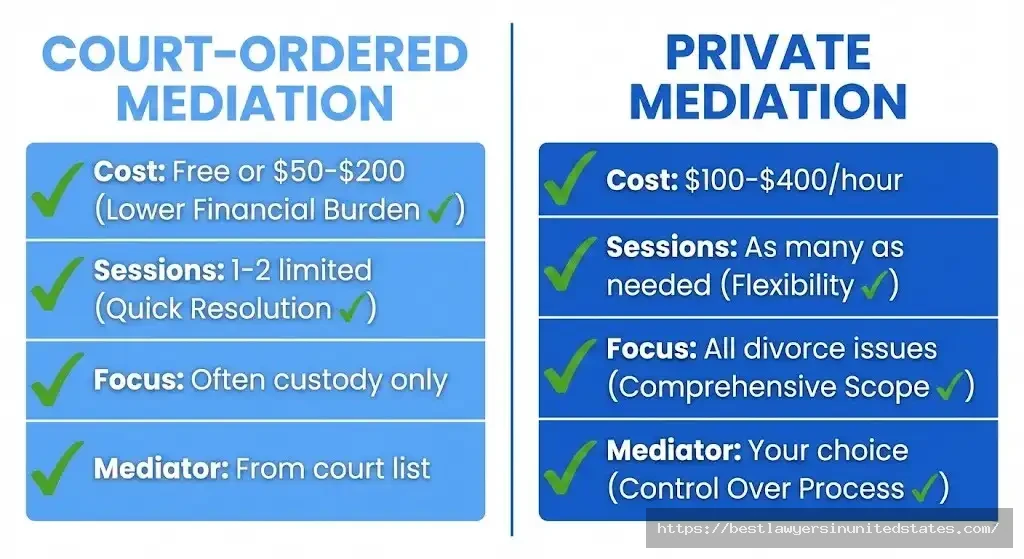
Court-Ordered Mediation
Many judges require mediation before allowing a case to proceed to trial. This mandate is especially common for custody disputes. Some states require mediation for all contested divorces.
Benefits of court-ordered mediation:
- Free or low-cost ($50-$200 typical)
- Convenient (often at the courthouse)
- Satisfies court requirement for good faith negotiation
- Judge sees you tried to settle
Limitations:
- Limited sessions (usually 1-2 meetings)
- Less choice in mediator selection
- Focus often limited to custody issues
- Less flexible scheduling
- May feel rushed
Private Mediation
You hire and pay your own mediator outside the court system. This works well before filing for divorce or when you need more than the court provides.
Benefits of private mediation:
- Choose your mediator based on experience and specialization
- Schedule sessions at your convenience
- Take as much time as needed
- Address all divorce issues comprehensively
- Select attorney-mediators for complex cases
Costs:
- $100-$400 per hour for the mediator
- Both spouses split the fee
- Total usually $1,500-$5,000 for complete divorce
When to Choose Private Mediation
| Situation | Best Choice | Reason |
|---|---|---|
| Complex finances or business | Private | Need experienced attorney-mediator |
| Before filing for divorce | Private | Court programs require pending case |
| Need 4+ sessions | Private | Court programs limit sessions |
| Want specific mediator | Private | Court assigns from approved list |
| Limited budget | Court-ordered | Free or low-cost |
| Custody-only dispute | Court-ordered | Focused programs work well |
Many couples use both. They start with court-ordered mediation. If it succeeds, great. If not, they hire a private mediator for more comprehensive help.
For state-specific filing requirements, see our guide to divorce filing fees by state.
Online and Virtual Divorce Mediation
Virtual mediation became standard during 2020 and remains popular in 2026. You and your spouse join video calls from separate locations. The mediator facilitates discussions just like in-person sessions.
How Online Mediation Works
Most mediators use Zoom, Google Meet, or specialized mediation platforms. You need a computer, tablet, or smartphone with a camera and microphone. A stable internet connection is essential.
Sessions follow the same five-stage process as in-person mediation. You share screens to review documents. The mediator uses breakout rooms for private conversations with each spouse.
Advantages of virtual mediation:
- No travel time or expense
- Attend from home or any private space
- Easier scheduling across different locations
- More comfortable environment
- Works well if you live in different cities
Disadvantages:
- Technology problems can disrupt sessions
- Harder to read body language and facial expressions
- Some people find video calls less personal
- Requires private space with good wifi
Best Cases for Online Mediation
Virtual mediation works best for:
- Low-conflict couples who communicate reasonably well
- Straightforward finances without complex businesses
- Couples living in different cities or states
- People with mobility issues or transportation challenges
- Second marriages with simple asset division
Not ideal for:
- High-conflict situations needing in-person intervention
- Cases where body language matters a lot
- Older adults uncomfortable with technology
- Situations where you suspect dishonesty (easier to catch in person)
Most mediators now offer both in-person and virtual options. You can mix formats. Start virtually and switch to in-person if needed.
How to Prepare for Divorce Mediation
Preparation makes mediation more efficient and successful. Organized information leads to faster sessions and lower costs. Good preparation also helps you negotiate confidently.
Financial Documents to Gather
Create a complete financial picture before your first session. The mediator needs accurate information to help you negotiate fairly.
Required documents:
- Pay stubs from the last 3 months
- Federal and state tax returns for the last 2-3 years
- Bank statements for all checking and savings accounts (last 3-6 months)
- Credit card statements showing balances and monthly payments
- Mortgage statements and loan documents
- Retirement account statements (401k, IRA, pension)
- Investment account statements (brokerage, stocks, bonds)
- Business financial statements if you own a business
- Property deeds for real estate
- Vehicle titles and loan information
- Life insurance policies with cash values
- Health insurance information
Organize documents by category. Use a binder or digital folder. Make copies for your spouse and the mediator.
Personal Preparation Steps
List all assets and debts. Create a spreadsheet. Include current values and who holds each account. Don’t forget:
- Forgotten bank accounts
- Old retirement accounts from previous jobs
- Valuable collections or belongings
- Debts you took on during marriage
Calculate your monthly budget. Track what you actually spend on housing, food, transportation, insurance, and other necessities. This helps with support negotiations and figuring out who keeps what.
Identify your priorities. What matters most? Keeping the house? Maintaining your retirement savings? Specific custody arrangements? Know what you’re willing to compromise on and what you won’t budge about.
Consider acceptable compromises. Think through various scenarios before negotiations. If you keep the house, what could you give up? If you split retirement accounts, how would that affect your other requests?
Prepare questions for the mediator. Write down anything you’re unclear about. Mediators can explain legal standards, common practices, and how different options might work.
Should You Consult an Attorney First?
Meeting with an attorney before mediation helps you understand your rights. You learn what a court would likely order if you litigated. This knowledge makes you a better negotiator.
A consulting attorney can:
- Explain state laws about property division, support, and custody
- Estimate what you’d receive in court
- Help you spot unfair proposals
- Prepare you for tough negotiations
- Review the final agreement before you sign
Consultation typically costs $200-$500 for 1-2 hours. This investment protects you from agreeing to bad terms out of ignorance.
Important: The mediator can’t give legal advice. They stay neutral. Your consulting attorney advocates for your interests.
Switching from Litigation to Mediation
You can switch to mediation even if you’ve already filed for divorce and started litigation. Many couples try court first, then realize mediation makes more sense.
How to Switch Mid-Divorce
Discuss with your spouse. Both of you must agree to try mediation. If one person wants to keep fighting in court, mediation won’t work.
Notify the court. File a joint motion requesting a stay of proceedings while you attempt mediation. Most judges grant these requests gladly. Courts prefer settlements over trials.
Inform your attorneys. If you have lawyers, tell them you want to mediate. They can help you prepare or attend sessions as consulting attorneys.
Hire a mediator. Choose someone experienced with complex or high-conflict cases. You’re switching because litigation isn’t working, so you need skilled help.
Attend mediation sessions. Work through the issues you couldn’t resolve in litigation. The mediator approaches problems differently than adversarial lawyers do.
File your agreement if successful. The mediated settlement replaces your litigation strategy. You submit it to the court for approval and finalization.
Why Couples Switch to Mediation
Litigation costs are too high. Legal bills reach $20,000, $30,000, or more before trial. Many people can’t afford to continue fighting.
The process drags on. Court dates get continued. Discovery takes months. Spouses want to move on with their lives.
Attorneys aren’t settling. Sometimes lawyers are too aggressive. They view every issue as a battle. The clients want to compromise but their attorneys won’t.
Judge suggests mediation. Many judges recommend or even order mediation during pretrial conferences. They see cases headed for expensive trials over issues that could be negotiated.
Key benefit: You avoid paying for the rest of litigation. Everything spent on attorneys so far is gone. But switching to mediation now prevents spending another $10,000-$30,000 on trial.
Even switching late saves money. Divorce attorney fees for trial preparation and court time are the most expensive part.
What If Mediation Fails?
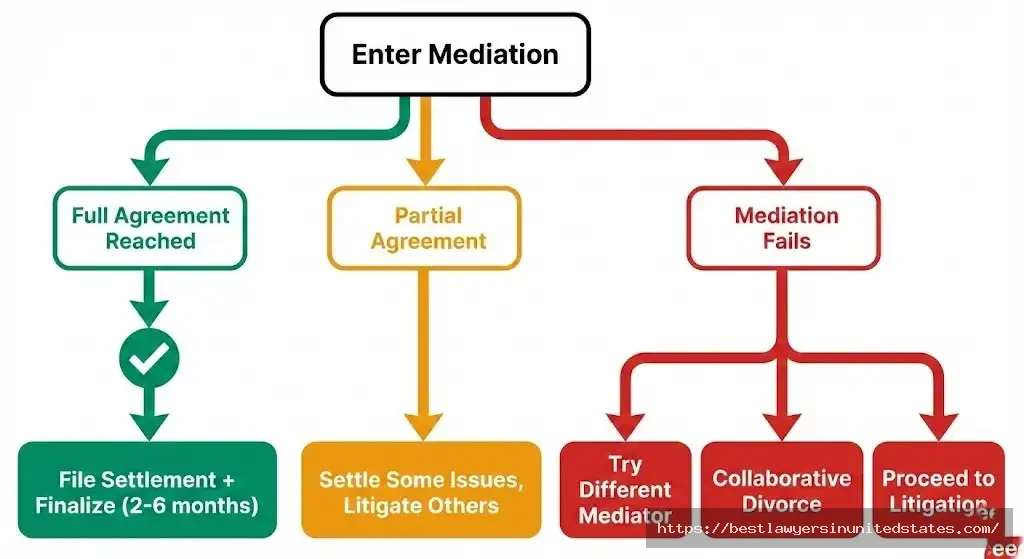
Not all mediations result in complete agreements. About 70-80% succeed fully. Others reach partial agreements or fail completely. You have options when mediation doesn’t work.
Partial Agreements Count
You might settle custody and support but not property division. Courts will approve partial agreements. You only litigate the remaining issues.
This still saves significant money. Attorney fees for arguing about one or two issues cost far less than fighting over everything. The resolved issues stay settled even if you go to court on others.
Try Again with a Different Mediator
Sometimes personalities don’t mesh. A different mediator might use approaches that work better for your situation. Consider trying:
- An attorney-mediator if you used a therapist-mediator before
- A therapist-mediator if you used an attorney-mediator before
- A mediator experienced with your specific sticking point (business valuation, high-conflict custody, etc.)
Switch to Collaborative Divorce
Collaborative divorce adds a team of professionals to help you settle. Each spouse has an attorney. You might also work with:
- A neutral financial specialist
- A child specialist for custody issues
- A divorce coach for emotional support
Collaborative divorce costs $5,000-$15,000. It’s more than mediation but far less than full litigation. Everyone signs an agreement committing to settle without court.
Proceed to Litigation
If all settlement attempts fail, you proceed to divorce trial. The judge hears evidence and makes all decisions.
Litigation makes sense when:
- Your spouse won’t negotiate in good faith
- Asset hiding requires formal discovery
- Domestic violence needs court protection
- Legal issues need judicial determination
Hybrid approach: Many divorces combine methods. You might settle custody through mediation but litigate property division. Or mediate most financial issues but let a judge decide one contested asset.
Important: Most states require mediation attempts before trial anyway. Judges want proof you tried to settle. Failed mediation counts as good faith effort.
State-Specific Mediation Laws
Mediation rules vary by state. Some mandate mediation before trial. Others make it optional. Requirements for binding agreements differ.
States with Mandatory Mediation
Several states require mediation attempts before contested divorces can proceed to trial:
California: Mandatory custody mediation in most counties. Financial mediation is optional. California Family Code Section 3170 requires parents to attend mediation before custody hearings.
Florida: Courts routinely order mediation before trial. Florida Family Law Rules require mediation in most contested cases. Mediators must complete 20-40 hour certification programs.
Texas: Courts frequently order mediation. Texas Family Code Section 6.602 allows judges to refer cases to mediation. Binding agreements need specific bold language stating they’re not revocable.
New York: Many counties require mediation attempts. New York offers court-connected mediation programs at low or no cost.
Illinois: Courts encourage mediation as an alternative to litigation. Illinois provides mediator qualification guidelines.
Binding Agreement Requirements by State
| State | Signature Requirements | Special Language | Attorney Signatures |
|---|---|---|---|
| Texas | Both spouses | Bold/capital/underlined “not subject to revocation” | Required if present |
| California | Both spouses | No special language | Not required |
| Florida | Both spouses | No special language | Not required |
| New York | Both spouses | No special language | Not required |
| Illinois | Both spouses | No special language | Not required |
Finding State-Specific Requirements
Check your state’s family court website for mediation rules. Each state has different:
- Mediator certification requirements
- Mandatory vs voluntary mediation
- Confidentiality protections
- Binding agreement formalities
For state-specific divorce information, visit our divorce laws by state guide.
Do You Need a Lawyer for Mediation?
You don’t need an attorney to mediate. Many couples go through the process without lawyers. But legal consultation often helps, especially for complex situations.
Three Attorney Roles in Mediation
Attorney-mediator: This person serves as your neutral mediator. They have legal training but don’t represent either spouse. They can explain legal concepts but can’t give advice to either party.
Consulting attorney: Your private lawyer who advises you outside mediation sessions. They explain your rights, help you evaluate offers, and prepare you for negotiations. They don’t usually attend sessions.
Review attorney: A lawyer who reviews your final mediated agreement before you sign. They check for unfair terms, legal problems, and missing provisions. One meeting usually suffices.
When to Hire a Consulting Attorney
Consider getting legal help if you:
- Have assets over $500,000
- Own a business
- Have complex retirement accounts or stock options
- Expect to pay or receive significant support
- Feel confused about your legal rights
- Need help negotiating effectively
- Worry your spouse knows more than you do
Typical costs:
- Consulting attorney: $200-$500 per hour, usually 2-4 hours total
- Review attorney: $500-$1,500 flat fee for agreement review
The consulting attorney doesn’t attend every session. You meet separately to prepare for mediation, discuss options, and evaluate proposals.
What Mediators Cannot Do
Mediators stay neutral and can’t:
- Give legal advice to either spouse
- Tell you what to do
- Represent your interests
- Advocate for one person over the other
- Guarantee the agreement is fair
- Practice law for you
A mediator can explain general legal standards. They might say “Most judges divide retirement accounts 50/50 in your state.” But they can’t say “You should insist on 60% of the retirement account.”
Your consulting attorney fills this gap. They advocate for your interests and help you make informed decisions.
Frequently Asked Questions
How much does a mediated divorce cost?
Quick Answer: Mediated divorce costs $1,500 to $7,000 on average, including mediator fees, filing fees, and attorney review.
Most couples pay $100-$400 per hour for mediators and need 8-16 hours of sessions. Use our divorce cost calculator to estimate your specific situation.
How long does mediated divorce take?
Quick Answer: Most mediated divorces finalize in 2 to 6 months from start to finish.
Timeline depends on scheduling availability, complexity of issues, and how quickly you reach agreements. Simple cases with few assets can finish in 2 months. Complex finances or custody disputes might take 6 months.
Can mediated divorce be done online?
Quick Answer: Yes, virtual mediation via Zoom or other video platforms is widely available in 2026.
Online mediation works well for straightforward cases and low-conflict couples. It saves travel time and lets you participate from anywhere.
What happens if we can’t agree on everything?
Quick Answer: Partial agreements are common and still save money compared to full litigation.
Courts will approve the issues you settled. You only litigate or continue mediating the remaining disputes. Even partial success reduces overall divorce costs significantly.
Do both spouses have to agree to mediation?
Quick Answer: Yes, unless court-ordered, both people must voluntarily participate for mediation to work.
One uncooperative spouse derails the process. If your spouse refuses to negotiate in good faith, you’ll need to pursue litigation instead.
Can I mediate if there’s a protection order?
Quick Answer: Possibly through shuttle mediation where you stay in separate rooms throughout the process.
Discuss safety concerns with the mediator first. They can arrange separate entrances, staggered arrival times, and complete physical separation during sessions.
Is mediated divorce only for amicable couples?
Quick Answer: No. You don’t need to be friendly, just willing to negotiate and find solutions.
Many high-conflict couples successfully mediate. Shuttle mediation works when joint sessions would be too difficult. The key is commitment to settle without court.
Can child support and custody be decided in mediation?
Quick Answer: Yes, all divorce issues including custody, support, property division, and alimony can be mediated.
You can address every aspect of your divorce through mediation. The mediator helps you negotiate parenting plans, support calculations, and all financial issues.
Calculate Child Support:
Have children? Our calculator estimates child support payments based on state guidelines and income.
Child Support Calculator
Calculate child support estimates based on your state’s guidelines. Get accurate payment amounts using income shares model calculations.
Enter Your Information
Provide income, custody, and children details
Estimated Monthly Child Support
📍 State Child Support Guidelines
Information about this state’s child support calculation method will appear here.
📊 Calculation Breakdown
| Component | Value |
|---|
Questions about child support or custody arrangements? [Contact Family Law Attorneys]
Email: [email protected]
Will the mediated agreement hold up in court?
Quick Answer: Yes, properly executed mediated agreements are legally binding and enforceable in court.
Both spouses must sign. Some states require specific language like "not subject to revocation" in bold. Once signed and filed, the agreement becomes part of your divorce decree.
Can we change our mediated agreement later?
Quick Answer: Only through formal modification if circumstances change significantly, like job loss or relocation.
Courts don't allow changes just because you regret the terms. You must prove substantial changes in circumstances warrant modification. Child support and custody are easier to modify than property division.
Does mediation work with a narcissist?
Quick Answer: Challenging but possible with an experienced mediator and sometimes shuttle mediation is required.
Narcissistic personalities make negotiation difficult. Consider hiring a consulting attorney for support. The mediator needs experience with high-conflict cases. Be prepared for longer negotiations.
How is property divided in mediated divorce?
Quick Answer: You and your spouse decide together rather than following rigid legal formulas.
Mediation lets you create custom arrangements. You might trade the house for retirement accounts, or split assets unevenly if both agree. Courts must approve the division as fair, but you have flexibility to meet both people's needs.
What if my spouse is hiding assets?
Quick Answer: Mediation relies on voluntary disclosure and works poorly when one spouse conceals assets.
If you suspect hidden money or property, litigation with formal discovery might be necessary. Subpoenas, depositions, and forensic accountants can uncover hidden assets. Mediation assumes honesty.
Do I need a lawyer to review the mediated agreement?
Quick Answer: Not legally required, but highly recommended before signing any binding agreement.
Attorney review costs $500-$1,500 but protects you from unfair terms or legal mistakes. Lawyers spot problems lay people miss. The agreement is nearly impossible to change after you sign.
Can we mediate before filing for divorce?
Quick Answer: Yes, pre-filing mediation is common and often recommended.
Work out your settlement before filing paperwork. Then submit an agreed divorce petition. This approach saves time and ensures you only file once with complete agreements. The court process becomes simple approval rather than contested litigation.
Conclusion
Mediated divorce offers a practical alternative to expensive courtroom battles. You'll pay $1,500-$7,000 instead of $15,000-$50,000 for litigation. The process takes 2-6 months instead of 12-24+ months. You maintain control over decisions rather than letting a judge decide your future.
Mediation works best when both spouses commit to negotiating in good faith. You need complete financial honesty and willingness to compromise. Complex cases still succeed but require more sessions and possibly consulting attorneys.
Consider mediation if you want:
- Lower costs than litigation
- Faster resolution
- Privacy and confidentiality
- Control over the outcome
- Better co-parenting relationships
- Creative solutions customized for your family
Avoid mediation if there's active domestic violence, hidden assets you can't verify, or extreme power imbalances. These situations need the structure and protection of formal litigation.
Next steps:
- Use our divorce cost calculator to compare mediation and litigation costs
- Research mediators in your area with family law experience
- Gather financial documents and make copies
- Consider consulting an attorney about your rights
- Schedule initial mediator consultations to find the right fit
Questions about mediation or need help finding the right approach? [Contact Divorce Attorneys]
Email: [email protected]