
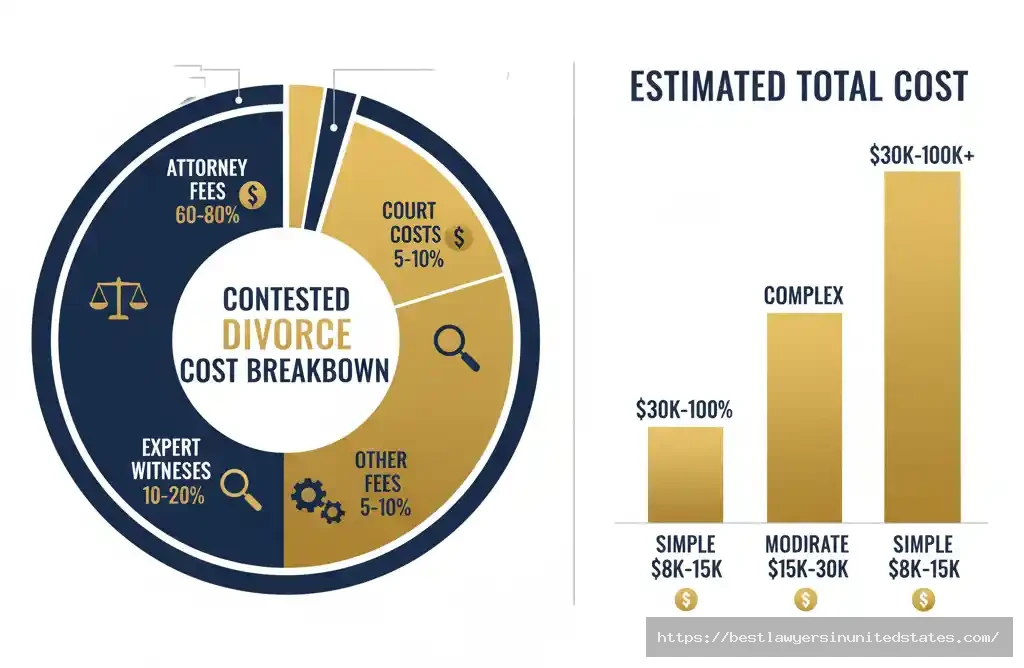
Quick Answer: A contested divorce typically costs between $15,000 and $30,000 nationwide. However, costs can range from as low as $8,000 for simple cases to over $100,000 for complex, high-asset divorces. Your final cost depends on your state, attorney fees, case complexity, and how long the process takes.
Key Cost Factors:
- Attorney fees: $150-$500 per hour (varies by location and experience)
- Court filing fees: $200-$450 depending on your state
- Average timeline: 12-24 months from filing to final decree
- Compare to uncontested: Uncontested divorces average $1,500-$5,000
Calculate Your Estimated Contested Divorce Cost
Divorce Cost Calculator
Get an estimated cost for your divorce based on your specific situation
Your Estimated Divorce Cost
Cost Breakdown
📧 Get a Personalized Consultation
Have questions about your specific situation? Contact our legal experts for guidance tailored to your needs.
Contact Us via EmailUse our free calculator to get a personalized estimate based on your specific situation. Input your state, case complexity, and assets to see what you might expect to pay.
What Is a Contested Divorce?
A contested divorce happens when you and your spouse can’t agree on one or more key issues in your separation. This forces a judge to make decisions for you instead of you reaching a settlement together.

The disagreement can be about anything from who keeps the house to how much time each parent spends with the kids. Even one unresolved issue makes your divorce “contested” in legal terms.
Common reasons divorces become contested:
- Child custody and visitation schedules
- Division of marital property (homes, cars, savings)
- Spousal support (alimony) amounts and duration
- Retirement account division
- Business ownership and valuation
- Debt responsibility
The more issues you disagree on, the more expensive and time-consuming your divorce becomes. Each contested issue requires additional court time, attorney work, and potentially expert witnesses.
How Does a Contested Divorce Differ from Uncontested?
The difference comes down to cooperation. In an uncontested divorce, you and your spouse work together to resolve everything before filing. In a contested divorce, the court system becomes the referee.
Contested divorces require:
- More court appearances (hearings, depositions, trial)
- Extensive discovery process (exchanging financial documents)
- Potentially hiring expert witnesses
- Significantly more attorney time
- Formal litigation procedures
Uncontested divorces involve:
- Minimal court involvement (often just one hearing)
- Simple paperwork filed jointly
- Quick resolution (3-6 months typically)
- Much lower legal fees
Most divorces start contested but become uncontested through negotiation. Your goal should be settling as many issues as possible to minimize costs.
How Much Does a Contested Divorce Cost on Average?
The national average for a contested divorce is $15,000 to $30,000 per person. But this number masks huge variations based on your specific circumstances.
Here’s what you can expect based on case complexity:
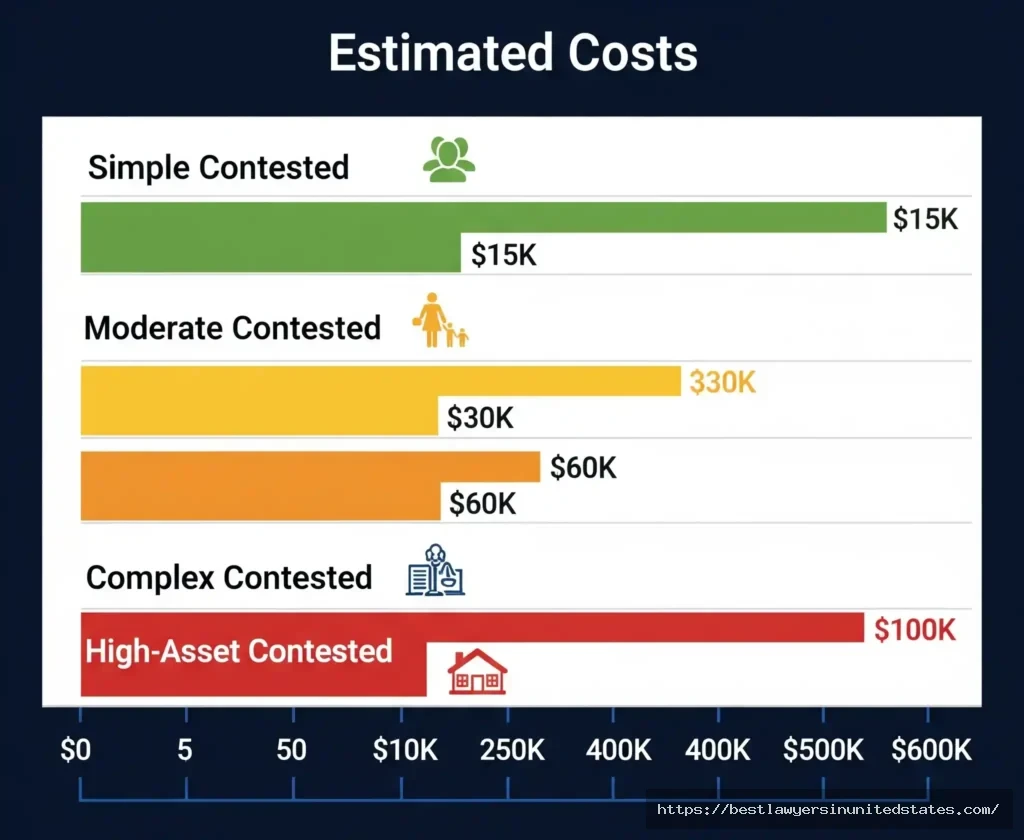
| Case Type | Average Cost | Timeline | What’s Included |
|---|---|---|---|
| Simple Contested | $8,000-$15,000 | 6-9 months | One or two disputed issues, minimal assets |
| Moderate Contested | $15,000-$30,000 | 9-12 months | Child custody, home, retirement accounts |
| Complex Contested | $30,000-$60,000 | 12-18 months | Business ownership, multiple properties, heated custody battle |
| High-Asset Contested | $100,000-$1,000,000+ | 18-36+ months | Extensive assets, forensic investigations, multiple experts |
What Makes Up the Total Cost?
Understanding where your money goes helps you make smarter decisions during the process.
Attorney fees (60-80% of total cost)
- Initial retainer: $2,500-$10,000
- Hourly rates: $150-$500 depending on location and experience
- Average hours: 30-100+ hours for contested cases
Court filing fees (varies by state)
- Petition filing: $200-$450
- Additional motions: $50-$200 each
- Service of process: $50-$150
Discovery costs (gathering evidence)
- Depositions: $300-$1,000 per deposition
- Court reporter: $3-$5 per page of transcript
- Document production: $0.25-$1 per page
Expert witness fees
- Forensic accountant: $5,000-$15,000
- Child custody evaluator: $2,000-$5,000
- Real estate appraiser: $300-$500
- Business valuator: $5,000-$25,000+
Other professional fees
- Guardian ad litem: $1,000-$5,000
- Mediator: $100-$300 per hour
- Process server: $50-$150
The single biggest variable in your cost? How much you fight versus negotiate. Every additional hearing, motion, or deposition adds hundreds or thousands to your bill.
Contested Divorce Cost by State (All 50 States)
Your state determines your baseline costs through filing fees and typical attorney rates. Here’s what you’ll pay across the United States.
Filing Fees and Attorney Rates by State
| State | Filing Fee | Avg Attorney Rate | Simple Contested | Complex Contested |
|---|---|---|---|---|
| Alabama | $290 | $200-$300/hr | $10,000-$18,000 | $30,000-$75,000 |
| Alaska | $250 | $250-$350/hr | $12,000-$20,000 | $35,000-$90,000 |
| Arizona | $349 | $200-$350/hr | $11,000-$19,000 | $32,000-$80,000 |
| Arkansas | $165 | $175-$275/hr | $9,000-$16,000 | $28,000-$65,000 |
| California | $435 | $300-$500/hr | $17,000-$35,000 | $50,000-$150,000+ |
| Colorado | $230 | $200-$350/hr | $11,000-$20,000 | $33,000-$85,000 |
| Connecticut | $360 | $275-$450/hr | $15,000-$28,000 | $40,000-$120,000 |
| Delaware | $165 | $225-$350/hr | $12,000-$21,000 | $35,000-$90,000 |
| Florida | $409 | $250-$400/hr | $13,000-$25,000 | $38,000-$100,000 |
| Georgia | $218 | $200-$350/hr | $11,000-$20,000 | $32,000-$85,000 |
| Hawaii | $265 | $250-$400/hr | $14,000-$26,000 | $40,000-$110,000 |
| Idaho | $221 | $175-$275/hr | $9,000-$17,000 | $28,000-$70,000 |
| Illinois | $334 | $250-$400/hr | $14,000-$26,000 | $40,000-$105,000 |
| Indiana | $157 | $175-$300/hr | $9,000-$17,000 | $28,000-$75,000 |
| Iowa | $185 | $175-$300/hr | $9,500-$18,000 | $30,000-$78,000 |
| Kansas | $196 | $175-$300/hr | $9,500-$18,000 | $30,000-$75,000 |
| Kentucky | $148 | $175-$300/hr | $9,000-$17,000 | $28,000-$73,000 |
| Louisiana | $250 | $200-$325/hr | $11,000-$20,000 | $33,000-$83,000 |
| Maine | $120 | $175-$300/hr | $9,000-$17,000 | $28,000-$75,000 |
| Maryland | $165 | $250-$400/hr | $13,000-$24,000 | $38,000-$98,000 |
| Massachusetts | $215 | $275-$450/hr | $15,000-$28,000 | $42,000-$125,000 |
| Michigan | $230 | $200-$350/hr | $11,000-$20,000 | $33,000-$85,000 |
| Minnesota | $397 | $225-$375/hr | $13,000-$23,000 | $38,000-$95,000 |
| Mississippi | $152 | $175-$275/hr | $9,000-$16,000 | $27,000-$68,000 |
| Missouri | $163 | $200-$325/hr | $10,000-$19,000 | $31,000-$80,000 |
| Montana | $170 | $175-$300/hr | $9,500-$18,000 | $30,000-$75,000 |
| Nebraska | $158 | $175-$300/hr | $9,500-$18,000 | $30,000-$76,000 |
| Nevada | $326 | $250-$400/hr | $13,000-$24,000 | $38,000-$100,000 |
| New Hampshire | $251 | $200-$350/hr | $11,000-$21,000 | $34,000-$88,000 |
| New Jersey | $300 | $275-$450/hr | $15,000-$29,000 | $43,000-$128,000 |
| New Mexico | $137 | $175-$300/hr | $9,500-$18,000 | $30,000-$75,000 |
| New York | $335 | $300-$500/hr | $17,000-$35,000 | $50,000-$155,000+ |
| North Carolina | $225 | $200-$350/hr | $11,000-$21,000 | $33,000-$88,000 |
| North Dakota | $80 | $150-$250/hr | $8,000-$15,000 | $25,000-$65,000 |
| Ohio | $200 | $200-$325/hr | $10,000-$19,000 | $31,000-$80,000 |
| Oklahoma | $183 | $175-$300/hr | $9,500-$18,000 | $30,000-$75,000 |
| Oregon | $301 | $225-$375/hr | $12,000-$22,000 | $36,000-$93,000 |
| Pennsylvania | $350 | $225-$375/hr | $13,000-$24,000 | $38,000-$98,000 |
| Rhode Island | $160 | $225-$375/hr | $12,000-$22,000 | $36,000-$93,000 |
| South Carolina | $150 | $200-$325/hr | $10,000-$19,000 | $31,000-$80,000 |
| South Dakota | $95 | $150-$275/hr | $8,500-$16,000 | $27,000-$68,000 |
| Tennessee | $184 | $200-$325/hr | $10,000-$19,000 | $31,000-$81,000 |
| Texas | $300 | $250-$400/hr | $13,000-$25,000 | $38,000-$103,000 |
| Utah | $360 | $200-$350/hr | $11,000-$21,000 | $34,000-$88,000 |
| Vermont | $295 | $200-$350/hr | $11,000-$21,000 | $34,000-$88,000 |
| Virginia | $86 | $225-$375/hr | $12,000-$22,000 | $36,000-$93,000 |
| Washington | $314 | $250-$400/hr | $13,000-$24,000 | $38,000-$100,000 |
| West Virginia | $135 | $175-$300/hr | $9,500-$18,000 | $30,000-$75,000 |
| Wisconsin | $184 | $200-$350/hr | $11,000-$20,000 | $33,000-$85,000 |
| Wyoming | $70 | $175-$300/hr | $9,000-$17,000 | $28,000-$73,000 |
State-specific notes:
- California, New York, Massachusetts: Highest costs due to expensive attorney rates and complex property laws
- North Dakota, Wyoming, Maine: Lowest filing fees and generally lower attorney costs
- Community property states (AZ, CA, ID, LA, NV, NM, TX, WA, WI): May have different division rules affecting costs
- Major metro areas: Expect 20-40% higher attorney rates in cities like NYC, LA, Chicago, Miami

Need specific information for your state? Check our detailed guides:
- Divorce cost in Texas
- Divorce cost in California
- Divorce cost in Florida
- Divorce cost in New York
- Divorce cost in Pennsylvania
- Divorce cost in Georgia
- Divorce cost in Ohio
- Divorce cost in Illinois
- Divorce cost in Michigan
- Divorce cost in North Carolina
Contested vs Uncontested Divorce: Cost Comparison
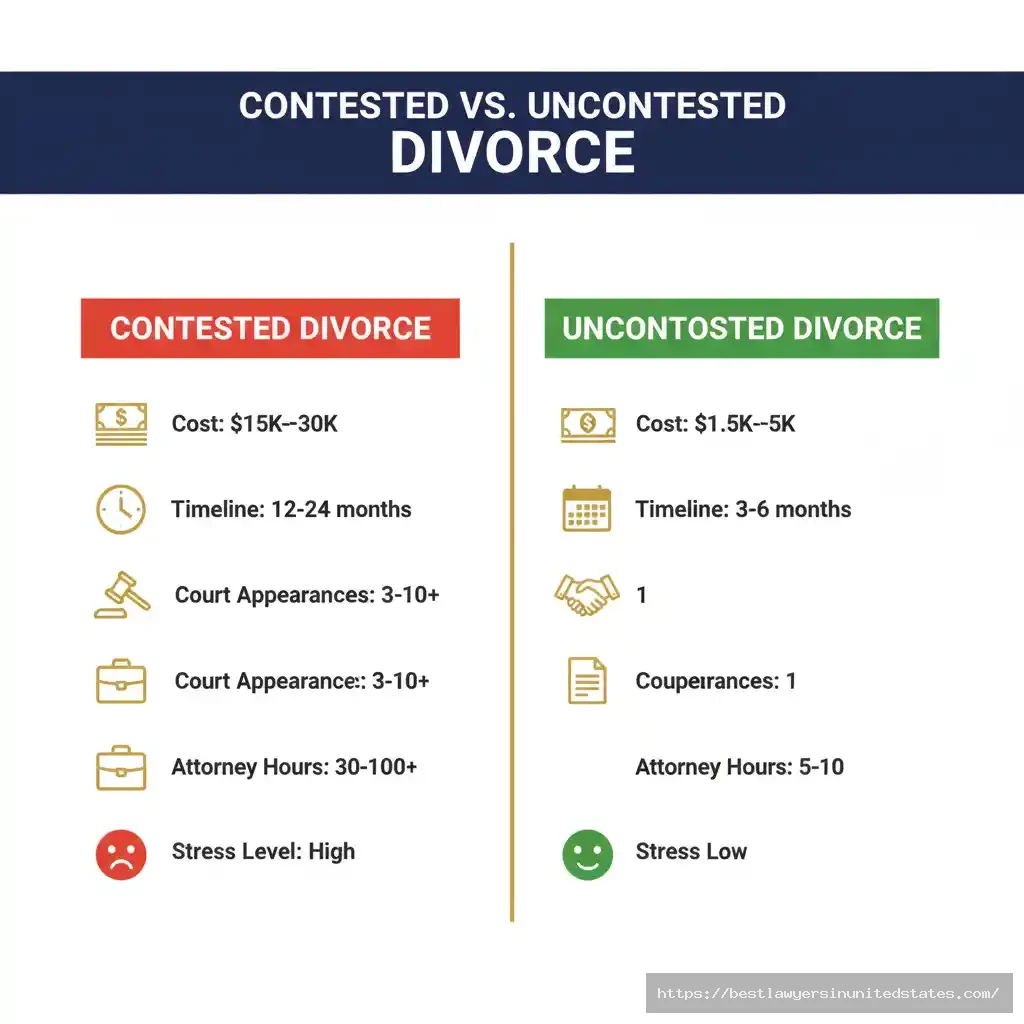
The difference in cost between contested and uncontested divorces is dramatic. Understanding this helps you decide which battles are worth fighting.
| Factor | Uncontested Divorce | Contested Divorce |
|---|---|---|
| Average Cost | $1,500-$5,000 | $15,000-$30,000+ |
| Timeline | 3-6 months | 12-24 months |
| Attorney Hours | 5-10 hours | 30-100+ hours |
| Court Appearances | 1 (sometimes zero) | 3-10+ |
| Discovery Process | Minimal/none | Extensive |
| Expert Witnesses | Rarely needed | Often required |
| Emotional Toll | Lower stress | High stress |
| Control Over Outcome | You decide terms | Judge decides |
When Is Contested Divorce Necessary?
Sometimes you have no choice but to fight. Certain situations require court intervention regardless of cost.
You need a contested divorce when:
- Your spouse refuses to cooperate or negotiate
- There’s domestic violence or abuse involved
- Your spouse is hiding assets or income
- Serious child safety concerns exist
- Your spouse demands unreasonable terms
- Complex business valuations are needed
- You can’t locate your spouse
You might avoid contested divorce if:
- Both parties want a fair split
- You can communicate civilly
- You’re willing to compromise
- No abuse or safety issues exist
- Assets are straightforward
- Both have similar income levels
The smartest financial move? Start contested but settle before trial. Most divorces (90%+) settle eventually. The earlier you settle, the more money you save.
Learn more about your options in our complete guide to divorce costs.
Hidden Costs of Contested Divorce You Need to Know
Beyond attorney fees and filing costs, contested divorces come with numerous hidden expenses. These can add thousands to your total bill if you’re not prepared.

Discovery and Documentation Costs
The discovery phase is where you exchange financial information with your spouse. This seemingly simple process gets expensive fast.
Common discovery expenses:
- Subpoenas for records: $50-$200 per subpoena (bank statements, employment records, tax returns)
- Document copying: $0.25-$1 per page (can be thousands of pages)
- Electronic discovery: $500-$5,000+ for email searches and phone records
- Credit reports: $30-$50 for three-bureau pulls
- Background checks: $50-$200 if needed for custody issues
Deposition costs:
- Court reporter fee: $300-$600 per deposition
- Transcript copies: $3-$5 per page (150-300 pages typical)
- Video recording: $500-$1,000 if needed
- Expert deposition: Add expert’s hourly rate ($300-$500/hr)
One deposition can easily cost $1,500-$3,000 when you include all the fees. Complex cases may require 5-10 depositions.
Expert Witness and Professional Fees
Contested divorces often require outside professionals to value assets or assess custody arrangements.
| Expert Type | Cost Range | When Needed |
|---|---|---|
| Forensic Accountant | $5,000-$15,000 | Hidden assets, business income, complex finances |
| Business Valuator | $5,000-$25,000 | Valuing family business or professional practice |
| Real Estate Appraiser | $300-$500 | Property value disputes |
| Child Custody Evaluator | $2,000-$5,000 | Contested custody cases |
| Child Psychologist | $1,500-$4,000 | Mental health assessment for kids |
| Vocational Expert | $2,000-$5,000 | Earning capacity disputes for alimony |
| Pension Valuator | $500-$2,000 | QDRO preparation for retirement accounts |
Guardian ad litem costs: If the court appoints a guardian ad litem (attorney for your children), expect $1,000-$5,000 or more. Some jurisdictions split this cost between parents, others make one party pay.
Mediation and Alternative Resolution
Even in contested cases, courts often require mediation attempts before trial.
Mediation expenses:
- Mediator fee: $100-$300 per hour (both parties split)
- Minimum 3-4 hours typically required: $600-$2,400 total
- Multiple sessions often needed: $1,500-$5,000+
- Your attorney attending: $150-$500 per hour additional
Arbitration costs (if chosen):
- Arbitrator fee: $200-$400 per hour
- Minimum 6-8 hours: $2,400-$6,400
- Attorney preparation time: $1,000-$5,000
- More expensive than mediation but cheaper than trial
Court and Administrative Fees
Beyond the initial filing fee, you’ll pay for various court services throughout the process.
Additional court costs:
- Motion filings: $50-$200 per motion
- Hearing fees: $50-$150 per scheduled hearing
- Process server: $50-$150 per service of documents
- Certified copies: $5-$25 per document
- Recording fees: $25-$50 for deed transfers
- Modification fees: $100-$300 if you need to change temporary orders
Required programs (state-dependent):
- Parenting classes: $50-$150 (both parents usually required)
- Co-parenting education: $75-$200
- Financial disclosure workshops: $25-$100
Lifestyle and Soft Costs
Contested divorces affect your finances beyond direct legal fees.
Indirect costs to consider:
- Setting up second household during separation
- Moving expenses and deposits
- Lost work time for court appearances (often requiring full days off)
- Travel costs if spouse moves away
- Therapy and mental health support ($100-$250 per session)
- Childcare during meetings and court dates
- Tax penalties from asset division
- Credit card interest if financing the divorce
These “soft costs” can add $5,000-$20,000 to your total divorce expense. Factor them into your budget from day one.
Real Cost Scenarios: What You’ll Actually Pay
Let’s look at four realistic scenarios based on actual contested divorce cases. These examples show how different situations affect total costs.
Scenario 1: Simple Contested Divorce (No Children, Minimal Assets)
The situation:
- Married 4 years
- No children
- One dispute: who keeps the car worth $18,000
- Rented apartment (no property)
- Combined savings: $25,000
- Both employed with similar incomes
Timeline: 7 months from filing to final decree
Cost breakdown:
- Attorney fees (22 hours at $250/hr): $5,500
- Initial retainer: $3,000 (balance billed)
- Court filing fee: $300
- Process server: $75
- Two mediation sessions: $800
- Document copying: $150
- Total cost: $9,825
Why it stayed relatively cheap: Only one disputed issue meant fewer attorney hours. No expert witnesses or custody evaluations needed. Settled in mediation without going to trial.
Scenario 2: Moderate Contested Divorce (Children + Home)
The situation:
- Married 11 years
- Two children (ages 6 and 9)
- Disputes: custody schedule, child support amount, house division
- Marital home worth $380,000
- Combined retirement accounts: $180,000
- Spouse earning significantly more
Timeline: 14 months from filing to settlement
Cost breakdown:
- Attorney fees (68 hours at $275/hr): $18,700
- Initial retainer: $5,000
- Additional retainer payments: $8,000
- Court filing fee: $350
- Process server: $100
- Four mediation sessions: $2,400
- Child custody evaluator: $3,500
- Real estate appraisal: $450
- Guardian ad litem: $2,200
- Parenting class (required): $125
- Deposition costs: $1,800
- Document production: $425
- Total cost: $43,050 (split between both parties means $21,525 each for shared costs)
Why costs increased: Child custody disputes require more professional involvement. Multiple contested issues meant more hearings and attorney preparation time. Settled before trial but after extensive discovery.
Scenario 3: Complex Contested Divorce (Business + Multiple Properties)
The situation:
- Married 18 years
- Three children (ages 8, 12, 15)
- Disputes: business valuation, alimony, custody, property division
- Family business (construction company)
- Primary home + rental property + vacation condo
- Retirement accounts: $450,000
- Allegations of hidden income
Timeline: 22 months from filing to trial completion
Cost breakdown:
- Attorney fees (142 hours at $350/hr): $49,700
- Initial retainer: $10,000
- Additional retainer payments: $25,000
- Court filing fee: $400
- Process server: $150
- Eight mediation sessions (failed): $4,800
- Forensic accountant: $12,000
- Business valuator: $18,500
- Three real estate appraisals: $1,350
- Child custody evaluator: $4,200
- Guardian ad litem: $3,800
- Five depositions: $7,500
- Trial costs (3 days): $8,000
- Expert witness testimony: $6,500
- Document production/discovery: $2,100
- Parenting classes: $125
- Vocational expert (alimony): $3,500
- Total cost: $157,625
Why costs skyrocketed: Business ownership required expensive valuation. Allegations of hidden income triggered forensic accounting. Multiple properties needed appraisals. Case went to full trial instead of settling. Expert witnesses testified at trial.
Scenario 4: High-Asset Contested Divorce (Multi-Million Dollar Estate)
The situation:
- Married 24 years
- Two adult children (college-aged)
- Disputes: everything (prenup validity, business interests, international assets, alimony)
- Multiple businesses and investment properties
- Assets exceeding $8 million
- Complex trust structures
- Offshore accounts
Timeline: 31 months from filing through appeals
Cost breakdown:
- Attorney fees (340+ hours at $475/hr): $161,500
- Initial retainer: $25,000
- Additional retainer payments: $90,000
- Forensic accountants (two firms): $42,000
- Business valuation experts (multiple businesses): $67,000
- Real estate appraisals (six properties): $4,200
- International asset investigator: $18,000
- Trust and estate attorney consultation: $8,500
- Pension valuators: $4,500
- Private investigators: $12,000
- Depositions (15+): $28,000
- Trial costs (8 days): $35,000
- Expert witness fees (multiple): $24,000
- Appeals attorney fees: $45,000
- Court filing fees (multiple motions): $3,800
- Discovery costs: $8,500
- Total cost: $577,000
Why costs exceeded half a million: Complex asset structures required multiple expert witnesses. Prenup validity contest added legal complexity. International assets needed specialized investigation. Case went to full trial then appeal. Both parties willing to spend heavily to “win.”
How Costs Accumulate Over Time in a Contested Divorce
Understanding the timeline helps you budget and make strategic decisions about when to settle.
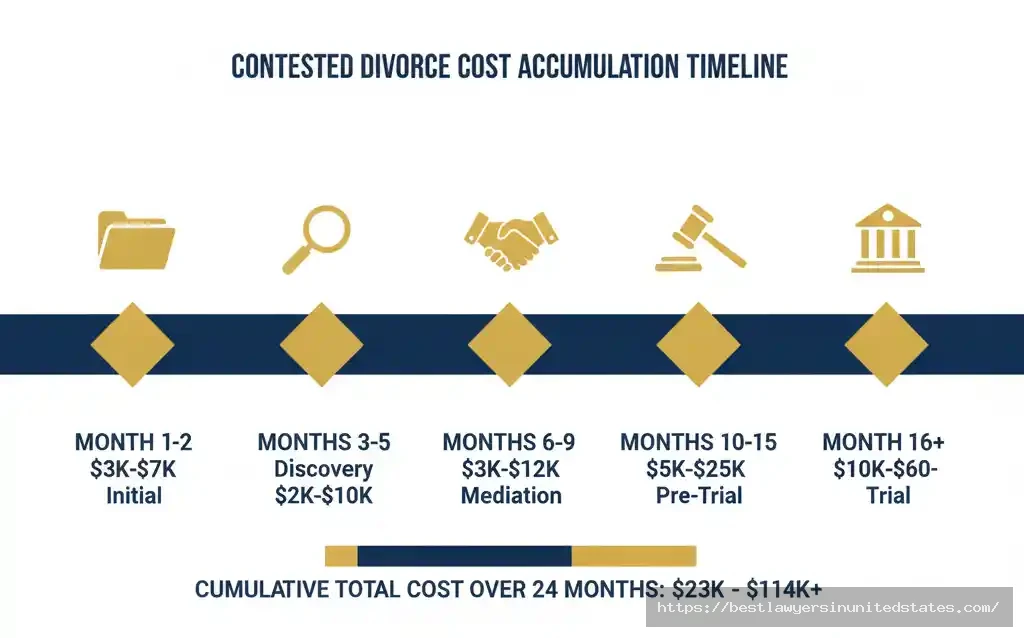
Month 1-2: Initial Phase ($3,000-$7,000)
What happens: You meet with attorneys, hire representation, and file the petition. Your attorney prepares initial documents and serves your spouse.
Typical costs:
- Initial consultation: $0-$500 (many offer free consultations)
- Retainer payment: $2,500-$5,000
- Court filing fee: $200-$450
- Process service: $50-$150
- Temporary orders motion (if needed): $500-$1,500
Attorney time: 5-10 hours
What you’re paying for: Case evaluation, document preparation, filing paperwork, initial strategy session, responding to immediate concerns (custody, support, restraining orders if needed).
Months 3-5: Discovery Phase ($2,000-$10,000)
What happens: Both sides exchange financial information. You gather bank statements, tax returns, property deeds, and employment records. Attorneys send formal discovery requests.
Typical costs:
- Attorney time for discovery prep: $1,500-$4,000
- Document subpoenas: $200-$800
- Copying and organizing records: $200-$600
- Financial disclosure preparation: $500-$2,000
- Responding to spouse’s discovery: $1,000-$3,000
Attorney time: 10-20 hours
What you’re paying for: Drafting interrogatories, reviewing documents, organizing financial information, preparing responses, analyzing spouse’s financial disclosure.
Cost-saving tip: Do your own document gathering and organization before meeting with your attorney. Every hour you save them is $150-$500 saved.
Months 6-9: Negotiation and Mediation ($3,000-$12,000)
What happens: You attempt to settle through negotiation and court-ordered mediation. Multiple settlement offers exchanged. Potential temporary hearings on urgent issues.
Typical costs:
- Attorney negotiation time: $1,500-$5,000
- Mediation sessions (2-4): $1,000-$4,000
- Preparing for mediation: $500-$2,000
- Temporary hearing (if needed): $1,000-$3,000
- Expert witnesses (if needed): $2,000-$8,000
Attorney time: 15-30 hours
What you’re paying for: Settlement negotiations, mediation attendance, preparing mediation briefs, temporary hearing representation, conferencing with opposing counsel.
This is your best settlement window. Cases settled during mediation save $10,000-$50,000 compared to going to trial.
Months 10-15: Pre-Trial Preparation ($5,000-$25,000)
What happens: If mediation fails, your attorney prepares for trial. Depositions taken, expert witnesses hired, trial strategy developed.
Typical costs:
- Attorney trial preparation: $3,000-$10,000
- Depositions (yours and spouse’s): $2,000-$6,000
- Expert witness hiring: $2,000-$15,000
- Pre-trial motions: $1,000-$4,000
- Trial exhibits and evidence prep: $500-$2,000
Attorney time: 30-60 hours
What you’re paying for: Reviewing all evidence, preparing witnesses, creating trial exhibits, deposing opposing witnesses, drafting pre-trial briefs, attending pre-trial conferences.
Settlement opportunity: Many cases settle during pre-trial conference when both sides see trial costs looming.
Month 16+: Trial Phase ($10,000-$60,000+)
What happens: Your case goes to trial. A judge hears testimony from both sides and makes final decisions on all contested issues.
Typical costs:
- Attorney trial time: $5,000-$30,000 (depends on trial length)
- Expert witness testimony: $3,000-$15,000
- Court reporter: $1,000-$3,000
- Trial preparation (final): $2,000-$8,000
- Post-trial motions: $500-$2,000
- Final document preparation: $500-$2,000
Attorney time: 40-100+ hours
What you’re paying for: Full trial representation (opening statements, witness examination, closing arguments), daily trial attendance, immediate response to opposing arguments, post-trial briefs.
Trial length matters hugely:
- 1-day trial: $5,000-$15,000
- 3-day trial: $15,000-$35,000
- Week-long trial: $25,000-$60,000+
The Cost of Delay
Every month your contested divorce continues, you’re spending money. Here’s the harsh reality:
Monthly carrying costs:
- Attorney retainer replenishment: $500-$3,000/month
- Maintaining two households: $1,500-$4,000/month
- Lost productivity/work time: Variable
- Mental health support: $400-$1,000/month
- Interest on credit cards used for fees: 2-3% monthly on balances
A 12-month contested divorce that stretches to 24 months can cost an additional $20,000-$50,000 just from the extended timeline.
Who Pays for a Contested Divorce?
One of the most common questions: “Do I have to pay for everything, or will my spouse contribute?”
The Default Rule: Each Party Pays Their Own
In most states, the default assumption is that each spouse pays their own attorney fees and costs. This applies regardless of who filed for divorce or who’s “at fault.”
Standard rule:
- You pay your attorney
- Your spouse pays their attorney
- Court fees split or paid by filing party
- Shared costs (mediators, appraisers) often split 50/50
This system assumes both spouses have roughly equal access to funds and equal ability to pay for representation.
When Courts Award Attorney Fees
Courts can order one spouse to pay the other’s attorney fees in specific situations. This helps level the playing field when there’s income disparity.
Common reasons for fee awards:
- Significant income gap: Higher-earning spouse may pay lower-earning spouse’s fees
- Asset control: One spouse has all the money or controls access to accounts
- Bad faith litigation: One spouse is intentionally prolonging the case or filing frivolous motions
- Violation of court orders: Spouse who disobeys temporary orders may pay opposing fees
- Hiding assets: Discovery of concealed income/assets triggers fee penalties
- Unreasonable positions: Refusing reasonable settlement offers can result in fee sanctions
How much courts award:
- Partial contribution (common): 25-50% of opposing fees
- Full reimbursement (rare): 100% of reasonable attorney fees
- Specific expenses: Just deposition costs or expert fees
- Sanctions (punishment): $500-$5,000+ for specific misconduct
State-by-State Differences
Different states have different rules about attorney fee awards:
Liberal attorney fee states: (More likely to award fees based on need)
- California – Judges have broad discretion to award fees based on income disparity
- Florida – Strong presumption for fee awards when income gap exists
- Texas – Courts can award fees based on “just and right” principles
- New York – Need-based fees common in high-asset cases
Conservative attorney fee states: (Awards less common)
- Georgia – Each pays own unless bad faith shown
- Ohio – Limited fee awards, mostly for contempt
- Pennsylvania – Need must be clearly demonstrated
- Virginia – Fee awards relatively rare
Community property considerations: In community property states (AZ, CA, ID, LA, NV, NM, TX, WA, WI), courts sometimes allow spouses to use community funds to pay attorney fees since the money belongs to both parties.
How to Request Attorney Fees
If you need your spouse to contribute to your legal costs, you must formally request it.
The process:
- File a motion for attorney fees with the court
- Provide financial documentation showing your income, assets, and ability to pay
- Detail your expenses including itemized attorney bills
- Show spouse’s ability to pay with their income and asset information
- Attend a hearing where the judge considers the request
What courts consider:
- Comparative income and earning capacity
- Control over marital assets
- Need for representation
- Reasonableness of fees charged
- Complexity of the case
- Conduct of both parties
Timing matters: Request attorney fees early in the case. Waiting until you’ve already paid $30,000 makes it harder to argue need.
Temporary vs. Final Fee Awards
Courts can award attorney fees at different stages:
Temporary fee awards (during the case):
- Help you afford representation during proceedings
- Based on immediate financial need
- Can be modified as circumstances change
- Paid from marital assets or spouse’s income
Final fee awards (at judgment):
- Made as part of final divorce decree
- Often offset against property division
- Consider total case costs and outcome
- May be structured as payment plan
What If Neither of Us Can Afford Attorneys?
When both spouses truly can’t afford legal representation, several options exist:
Legal aid organizations:
- Income qualification required (usually 125% of federal poverty level)
- Free representation for qualifying individuals
- Priority given to domestic violence victims
- Find legal aid in your state
Pro bono programs:
- State bar associations often maintain referral lists
- Requirements vary by program
- May handle full case or specific issues only
Unbundled services:
- Attorney helps with specific tasks only
- You handle other parts yourself
- Costs $500-$3,000 instead of $15,000-$30,000
- Good for document review, hearing representation, or advice
Court fee waivers:
- Available if you qualify based on income
- Covers filing fees and court costs
- Doesn’t cover attorney fees
- File “Application to Proceed In Forma Pauperis”
Learn more about managing legal costs in our guide to divorce lawyer costs and family lawyer fees.
How to Reduce Your Contested Divorce Costs
Even in a contested case, you can significantly reduce expenses with smart strategies. Here are ten proven ways to keep costs under control.
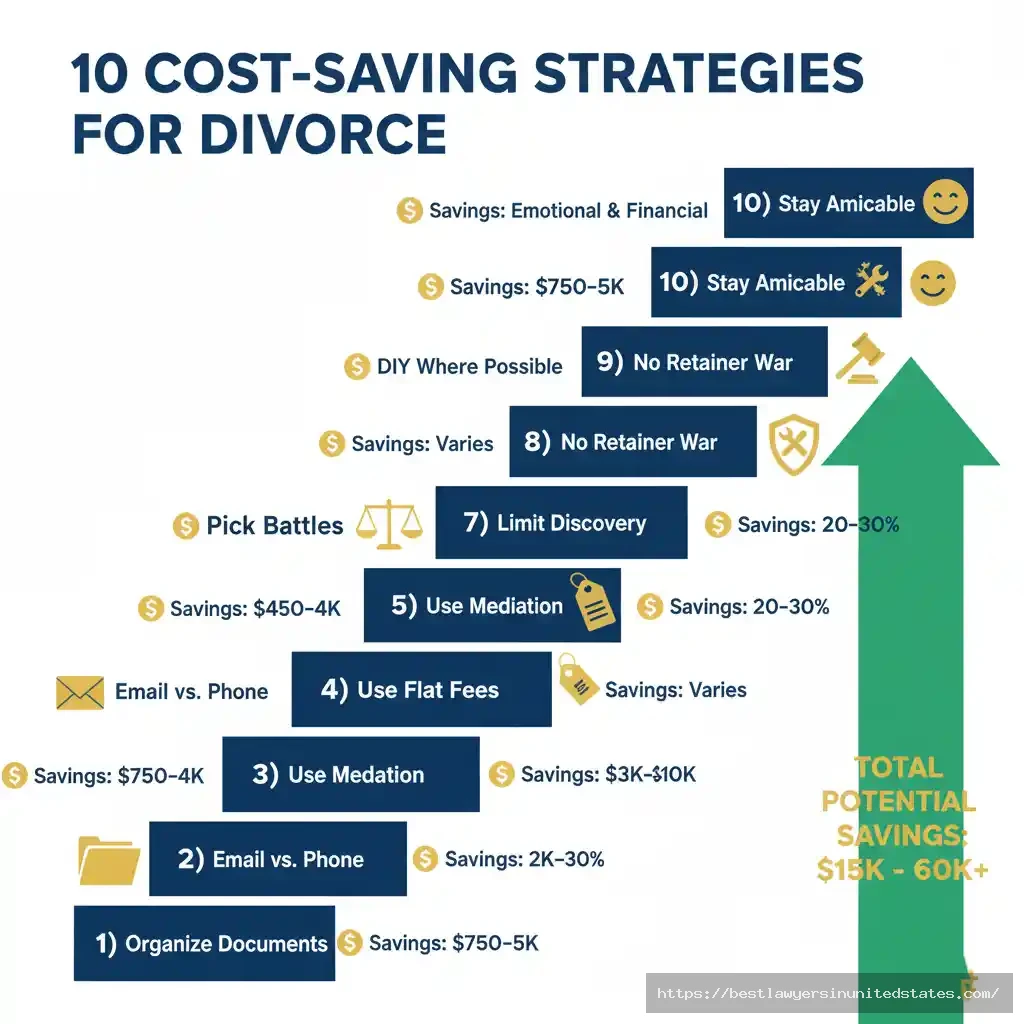
1. Organize All Financial Documents Yourself
Every hour your attorney spends gathering and organizing documents is billable time. Do this work yourself and save thousands.
What to compile:
- Three years of tax returns (federal and state)
- Six months of bank statements (all accounts)
- Investment account statements (current)
- Retirement account statements (401k, IRA, pension)
- Credit card statements (all cards, six months)
- Mortgage statements and property deeds
- Vehicle titles and loan statements
- Pay stubs (three months current)
- Business financial statements (if applicable)
- Insurance policies (life, health, property)

How to organize: Create a binder with labeled tabs for each category. Make two copies – one for your attorney, one for yourself. Add a summary sheet listing all accounts with current balances.
Time saved: 5-10 attorney hours = $750-$5,000 saved
2. Communicate Efficiently With Your Attorney
How you communicate with your attorney dramatically affects your bill. Five two-minute phone calls cost more than one organized email.
Best practices:
- Use email over phone – Easier to keep brief and on-topic
- Batch your questions – Send one email with five questions instead of five separate emails
- Be specific – “What happens if my spouse refuses the settlement offer?” not “I’m worried about things”
- Prepare before meetings – Send questions in advance, arrive with notes
- Respect boundaries – Don’t email at midnight or text on weekends unless emergency
Questions to ask yourself before contacting your attorney:
- Is this truly urgent or can it wait?
- Have I checked the paperwork they already sent me?
- Could their paralegal or assistant answer this instead?
- Can I research this myself first then ask specific follow-up questions?
Time saved: 3-8 attorney hours = $450-$4,000 saved
3. Pick Your Battles Wisely
Not every disagreement is worth fighting over. Run a cost-benefit analysis before digging in.
The $500 rule: If an item is worth less than $500, let it go. The attorney fees to fight over it will cost more than the item’s value.
Questions to ask:
- What will fighting over this cost me in attorney fees?
- What’s the actual dollar value of what I’m fighting for?
- Is this about principle or actual financial impact?
- Will this issue matter in five years?
Example: Fighting over who gets the $1,200 TV could cost $3,000 in attorney time. Just buy a new TV.
Issues worth fighting:
- Child custody and visitation (your relationship with your kids)
- Primary residence (your home)
- Retirement accounts (your future security)
- Business ownership (your livelihood)
- Substantial assets (anything over $10,000)
Issues usually not worth fighting:
- Furniture and household goods (easy to replace)
- Cars less than five years old (depreciated value)
- Wedding rings and gifts (emotional not financial value)
- Small bank accounts (under $5,000)
4. Consider Mediation for Some Issues
You don’t have to mediate everything or nothing. Strategic use of mediation can resolve specific issues cheaply.
How it works:
- Hire a mediator for just custody dispute = $1,500-$3,000
- Attorney handles other issues = Continue litigation for property division
- Partial settlement = Reduce overall scope and cost
Best issues for mediation:
- Parenting time schedules
- Holiday visitation
- Child support modifications
- Minor property disputes
- Personal property division
Issues that need attorneys:
- Complex business valuations
- Hidden asset investigations
- Legal interpretation questions
- Enforcement of existing orders
Cost comparison:
- Full mediation: $3,000-$8,000 total
- Mediation for custody only: $1,500-$3,000
- Litigating custody: $5,000-$15,000
5. Negotiate Alternative Fee Arrangements
Not all attorneys charge by the hour. Alternative arrangements can save money and provide certainty.
Options to request:
Flat fee for specific tasks:
- “Can you review my settlement offer for a flat $500?”
- “Will you attend one hearing for $1,500 instead of hourly?”
- “Can we do mediation preparation for $1,000 flat?”
Capped fees:
- “Will you handle discovery phase with a $5,000 cap?”
- Protects you from runaway billing
- Attorney agrees to maximum charge for defined work
Unbundled services:
- Attorney helps with some parts, you handle others
- Common splits: Attorney does hearings, you do paperwork
- Costs 50-70% less than full representation
Reduced retainers:
- Negotiate lower initial retainer ($2,000 instead of $5,000)
- Replenish as work is done
- Better for cash flow management
What attorneys often agree to:
- Payment plans (monthly installments)
- Credit card payments (watch interest rates)
- Using marital funds pending distribution
- Flat fees for uncontested portions
What to ask: “I understand you typically charge hourly, but I’m concerned about costs. Are there any alternative fee arrangements you’d consider for my situation?”
6. Do Your Own Legal Research
You can’t practice law, but you can understand it. Basic legal research saves billable consultation time.
Free resources:
- Your state court website (forms, procedures, local rules)
- State bar association (free pamphlets on divorce process)
- Law libraries (often open to public, librarians help with research)
- Cornell Legal Information Institute (free access to state laws)
What you can research:
- Required forms and filing procedures
- Timelines and deadlines in your jurisdiction
- Definition of legal terms
- General process overview
- Local court rules
What you should NOT research:
- Specific legal advice for your situation
- Complex strategy decisions
- Courtroom procedures and argument
- Document drafting beyond simple forms
How this saves money: You come to attorney meetings informed with specific questions instead of paying them to explain basic concepts.
7. Use Paralegal Time When Appropriate
Many law firms have paralegals who bill at $75-$150/hour instead of attorney rates of $250-$500/hour.
Tasks perfect for paralegals:
- Document organization and filing
- Scheduling court dates and appointments
- Basic correspondence with court clerk
- Gathering routine records
- Filling out standardized forms
- Creating financial disclosure spreadsheets
Always ask: “Could your paralegal handle this instead?” Most attorneys appreciate cost-conscious clients.
8. Prepare Thoroughly for Every Meeting and Hearing
Wasted attorney time is expensive attorney time. Come prepared and stay on track.
Before every meeting:
- Send questions in advance (24-48 hours notice)
- Bring all relevant documents
- Create a written agenda
- List decisions you need to make
- Note what’s happened since last meeting
During meetings:
- Stay focused on legal issues, not emotional venting
- Take notes so you don’t have to call later to ask what was decided
- Get action items in writing before leaving
- Ask for time estimates on next steps
After meetings:
- Send follow-up email confirming decisions
- Complete any homework immediately
- Don’t call to re-discuss what was already covered
9. Avoid Unnecessary Motions and Hearings
Every court appearance costs money. Some are necessary, many are not.
Necessary motions:
- Emergency custody (safety issues)
- Temporary support (you have no income)
- Restraining orders (domestic violence)
- Asset protection (spouse draining accounts)
Often unnecessary:
- Forcing spouse to return your belongings
- Punishing spouse for minor violations
- Discovery disputes over minor documents
- Scheduling conflicts that could be resolved by agreement
Before filing any motion ask:
- Can this be resolved through a letter from my attorney?
- Could a phone call between attorneys solve this?
- What happens if we just wait and address at next scheduled hearing?
- Is this $2,000 motion going to gain me more than $2,000 in value?
10. Track Your Attorney’s Time Carefully
You’re entitled to understand what you’re paying for. Most billing disputes come from poor communication about time spent.
What to do:
- Request itemized bills monthly (not lump sum invoices)
- Review bills within 48 hours of receiving them
- Question anything unclear or excessive
- Compare time estimates attorney gave you vs actual time spent
- Track major milestones and costs associated
Red flags for excessive billing:
- Numerous phone calls with opposing counsel (should be email)
- Reviewing the same documents multiple times
- Time entries that seem rounded up
- Conferences between multiple attorneys on simple issues
- Excessive time on routine tasks
How to address concerns: “I notice this brief took 8 hours to draft when you estimated 4 hours. Can you help me understand what additional work was involved?”
Most attorneys appreciate informed clients who pay attention to costs. The ones who don’t want your business anyway.
Affordability Options When You Can’t Afford Legal Fees
Contested divorces are expensive, but several options exist for people who can’t afford traditional representation.
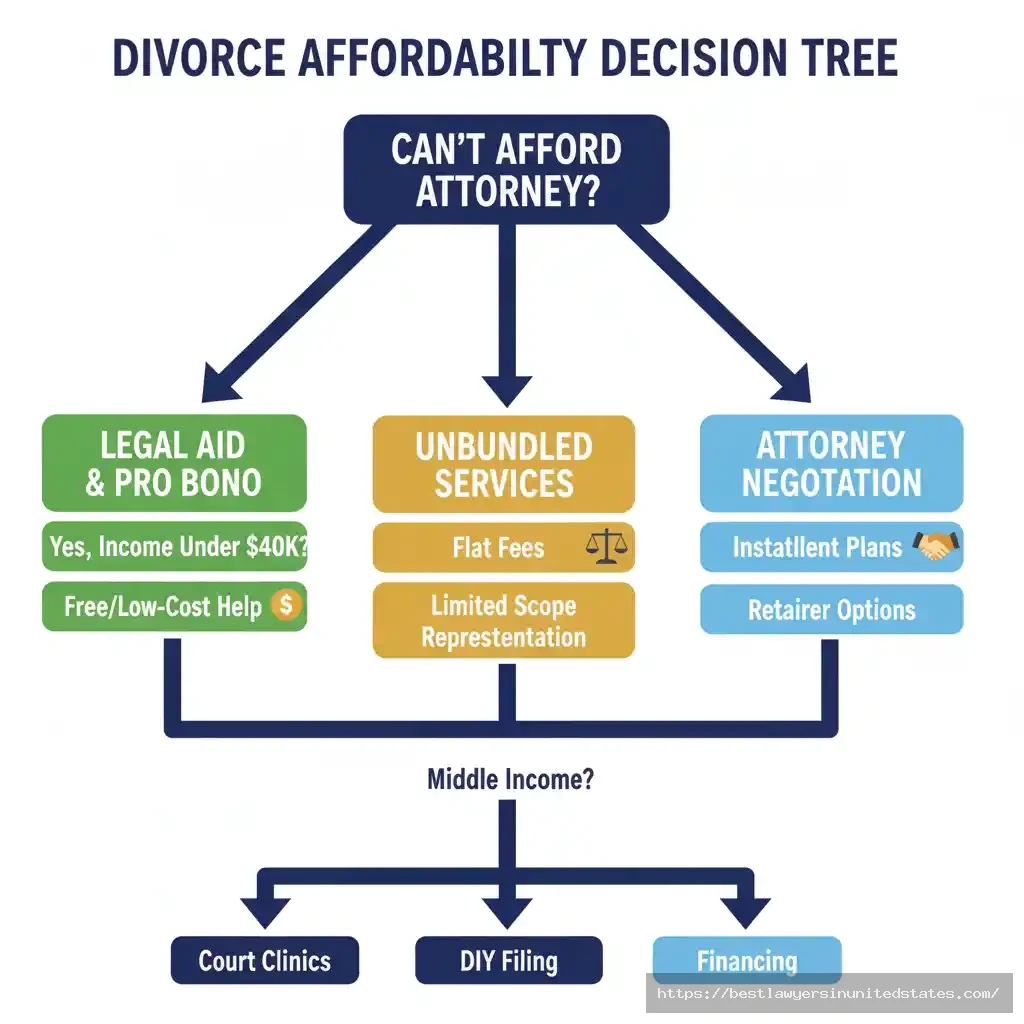
Legal Aid Organizations
Legal aid provides free legal services to low-income individuals. These nonprofit organizations receive government and private funding to help people who otherwise couldn’t afford attorneys.
Who qualifies:
- Income at or below 125% of federal poverty level (approximately $40,000/year for family of four)
- Some programs prioritize domestic violence victims
- Asset limits may apply
- Citizenship usually not required
What they provide:
- Full legal representation through entire divorce
- Attorney-client relationship same as paid attorney
- All court appearances and document preparation
- No fees – completely free if you qualify
How to apply:
- Find your local legal aid office at Legal Services Corporation
- Call to schedule intake appointment
- Bring proof of income (pay stubs, tax returns)
- Bring documentation of your legal issue
- Complete application and wait for acceptance (may be waitlist)
Limitations:
- High demand, often with waiting lists
- May not be available in all areas
- Complex cases might not be accepted
- Limited resources mean prioritization of cases
Pro Bono Programs
Many attorneys donate time to help low-income clients for free (pro bono = “for the public good”).
How pro bono differs from legal aid:
- Private attorneys donating time
- Usually through state bar referral programs
- May have less strict income requirements
- Often handled by experienced attorneys who volunteer specific hours
Finding pro bono help:
- Contact your state bar association
- Ask at local courthouse (many have pro bono referral desks)
- Check law school clinics in your area
- Search “[Your State] pro bono divorce attorney”
What to expect:
- Attorney takes your case for free or reduced fee
- Limited availability (attorneys donate specific hours/cases per year)
- May need to demonstrate both financial need and case merit
- Usually reserved for simpler cases
Law School Clinics
Many law schools run legal clinics where supervised law students provide free or low-cost help.
Services provided:
- Legal advice and consultation
- Document review and preparation
- Limited court representation
- Mediation services
Advantages:
- Free or very low cost ($0-$100 typically)
- Supervised by experienced professors
- Students are motivated and thorough
- Good for straightforward cases
Limitations:
- Only available in areas with law schools
- Students are learning (though supervised)
- May not handle complex litigation
- Limited availability during summer and winter breaks
Find clinics: Search “[Your State] law school legal clinic divorce”
Unbundled Legal Services (Limited Scope Representation)
Instead of hiring an attorney for everything, you hire them for specific tasks only. You handle the rest yourself.
Common unbundled arrangements:
Coaching model ($500-$1,500):
- Attorney advises you on strategy
- You file documents yourself
- Attorney available for questions
- You represent yourself in court
Document preparation ($300-$1,000):
- Attorney prepares settlement agreement
- You negotiate terms yourself
- Attorney ensures legal compliance
- You file documents
Hearing representation ($1,000-$2,500 per hearing):
- You handle negotiations and paperwork
- Attorney represents you at specific hearings
- Limited to court appearances only
Mediation assistance ($800-$2,000):
- Attorney attends mediation with you
- You handle everything else
- Attorney advises during negotiations
Benefits:
- Costs 50-75% less than full representation
- You maintain control over your case
- Attorney ensures critical tasks are done correctly
- Pay only for help you actually need
Best for:
- People comfortable with paperwork
- Relatively amicable divorces with few contested issues
- Cases without complex assets or custody disputes
- Budget-conscious individuals willing to do work
How to find: Ask attorneys if they offer “unbundled services” or “limited scope representation.” Many do but don’t advertise it.
Payment Plans and Financing Options
If you can’t pay the full retainer upfront, discuss payment arrangements with your attorney.
Payment plan options:
Installment retainers:
- Pay $1,000/month for 3 months instead of $3,000 upfront
- Attorney agrees to start work with partial payment
- Balance due on schedule
Milestone payments:
- Pay $2,000 at filing
- Pay $2,000 at mediation
- Pay $3,000 before trial
- Tied to case progress
Credit card payments:
- Many attorneys accept credit cards
- Allows you to spread payments over time
- Warning: Credit card interest (18-25% APR) can add thousands to total cost
- Only use if absolutely necessary
Legal funding companies:
- Specialized loans for legal fees
- Interest rates 12-30%
- Typically $2,500-$15,000 loans
- Some require employment verification
- Caution: Expensive option, use as last resort
Using marital assets:
- Request court permission to use joint savings for legal fees
- Spouse may need to do same
- Court may order one party to pay both legal fees temporarily
- Sorted out in final property division
State-Specific Assistance Programs
Some states offer special programs for divorce assistance.
Check if your state has:
- Divorce fee waiver programs (beyond just filing fees)
- State-funded family law facilitators
- Self-help centers in courthouses
- Online document preparation assistance
- Reduced-fee attorney referral programs
Examples by state:
- California: Family Law Facilitator in each county (free help with forms and process)
- Florida: Family Law Self-Help Programs at courthouses
- Texas: Forms and instructions available free online through state bar
- New York: Court Help Centers with free assistance
Visit your local courthouse and ask about self-help resources. Most have programs you may not know about.
Temporary Spousal Support to Cover Legal Fees
If your spouse earns significantly more, you might request temporary support that includes attorney fee assistance.
How it works:
- File motion for temporary spousal support early in case
- Request amount to cover living expenses PLUS attorney fees
- Court may order spouse to pay you extra specifically for legal costs
- Creates level playing field for litigation
When courts grant this:
- Large income disparity between spouses
- You have no separate income source
- Spouse controls all marital assets
- You need representation but truly can’t afford it
This isn’t a guaranteed solution, but it’s worth requesting if income disparity is significant.
Warning Signs Your Contested Divorce Will Be Expensive
Certain situations signal a costly divorce from day one. Recognizing these red flags helps you budget appropriately and make strategic decisions.

Your Spouse Is Hiding Assets or Income
When one spouse conceals financial information, discovery costs skyrocket. You’ll need forensic accountants and extensive investigation.
Red flags:
- Cash businesses with unreported income
- Offshore accounts or foreign assets
- Assets transferred to family members or friends
- Sudden “business losses” right before filing
- Missing documents or incomplete financial disclosure
- Lifestyle that doesn’t match claimed income
Additional costs triggered:
- Forensic accountant: $5,000-$15,000
- Private investigator: $2,000-$10,000
- Additional depositions: $2,000-$5,000
- Subpoenas for third-party records: $500-$2,000
- Expert testimony at trial: $3,000-$8,000
What to do: Document everything. Save copies of all financial records before filing. Track spending patterns and lifestyle evidence.
High-Conflict Personality Spouse
Some people can’t compromise or communicate rationally. They’ll fight over everything, even when it’s financially irrational.
Signs of high-conflict personality:
- Everything is “all or nothing” thinking
- Refuses any compromise on any issue
- Uses court system to punish or control you
- Files numerous motions over minor issues
- Makes false allegations regularly
- Ignores court orders without consequence concerns
Why this costs more:
- Excessive court appearances
- Emergency motions for non-emergencies
- Endless discovery disputes
- Mediation failures
- Higher likelihood of going to trial
- Post-divorce modification fights
What to do: Document everything in writing. Don’t engage in arguments. Focus on court compliance. Consider requesting spouse pay your attorney fees due to bad faith.
Complex Business Ownership
If you or your spouse own a business, expect significant valuation costs.
Business types that add expense:
- Professional practices (medical, dental, law)
- Partnerships with multiple owners
- Family businesses with unclear ownership
- Cash businesses (restaurants, retail)
- Companies with complex assets
- Businesses operating at loss (suspiciously)
Additional costs:
- Business valuation expert: $5,000-$25,000
- Forensic accountant: $5,000-$15,000
- Tax specialist consultation: $2,000-$5,000
- Disputes over business value: $3,000-$10,000 additional attorney time
What to do: Gather all business records immediately (tax returns, profit/loss statements, balance sheets, operating agreements). Get personal consultation with business valuation expert before filing.
Multiple Properties Across Different States
Real estate in multiple jurisdictions complicates everything.
Why this increases costs:
- Multiple appraisals needed
- Different state laws may apply
- Tax implications vary by jurisdiction
- Mortgage issues more complex
- May require attorneys in multiple states
What to expect:
- Appraisal costs: $300-$500 per property
- Tax consultation: $1,000-$3,000
- Additional attorney time: 5-15 hours
- Potential second attorney in other state: $2,000-$10,000
Interstate Custody Disputes
When parents live in different states, custody battles become far more complicated.
UCCJEA complications:
- Determining which state has jurisdiction
- Potential custody litigation in two states
- Travel costs for hearings
- Interstate enforcement issues
Additional expenses:
- Travel to other state for hearings: $500-$2,000 per trip
- Attorney in other state: $3,000-$10,000+
- Custody evaluator who understands interstate issues: $3,000-$6,000
- Guardian ad litem: $2,000-$5,000
Abuse Allegations (Domestic Violence or Child Abuse)
Allegations of abuse—whether true or false—dramatically increase costs and complexity.
Why this costs more:
- Guardian ad litem usually appointed
- Child protective services investigation
- Supervised visitation requirements
- Psychological evaluations
- Expert testimony needed
- Restraining orders and enforcement
Additional costs:
- Guardian ad litem: $2,000-$5,000
- Psychological evaluations: $1,500-$4,000 per person
- Supervised visitation: $50-$150 per visit
- Expert witnesses on abuse: $3,000-$10,000
- Additional attorney time: 10-30 hours
Important: If abuse is real, these costs are necessary for safety. If allegations are false, they’re still expensive to defend against.
Retirement Account Complexity
Dividing retirement accounts requires specialized work beyond standard divorce proceedings.
Complications:
- Multiple retirement accounts (401k, IRA, pension, military retirement)
- Defined benefit pension plans requiring actuarial valuation
- Stock options and restricted stock
- Executive compensation packages
Additional costs:
- QDRO preparation: $500-$2,000 per account
- Pension valuation: $1,000-$3,000
- Tax consultation: $500-$2,000
- Financial planner for settlement evaluation: $1,000-$3,000
Your Spouse Hires an Aggressive Attorney
Some attorneys encourage conflict rather than settlement. When your spouse hires one, expect higher costs.
Signs of unnecessarily aggressive attorney:
- Files motions for everything
- Refuses informal resolution attempts
- Uses inflammatory language in court documents
- Demands unreasonable discovery
- Won’t return phone calls from your attorney
- Makes settlement negotiations difficult
Why this costs you more:
- You must respond to every motion (even frivolous ones)
- More court appearances
- Extended discovery process
- Higher likelihood of trial
- Need more attorney time for defense
What to do: Don’t let their aggression control you. Focus on reasonable positions. Document their unreasonableness to potentially request fee sanctions.
Long Marriage with Commingled Finances
Marriages over 15-20 years with completely combined finances take longer to unwind.
Complications:
- Decades of financial records to review
- Forgotten accounts and assets
- Inheritance and separate property tracing
- Complex debt allocation
- Higher likelihood of spousal support disputes
Why this adds cost:
- More extensive discovery
- Tracing separate vs. marital property
- Longer attorney time reviewing history
- More difficult valuation of contributions
What NOT to Do: Mistakes That Increase Your Contested Divorce Costs
Certain behaviors dramatically increase your legal fees. Avoid these common mistakes.
Using Your Attorney as a Therapist
Your attorney bills $250-$500 per hour. That’s an extremely expensive therapist.
Costly mistakes:
- Calling to vent about your spouse
- Lengthy emails about emotional pain
- Rehashing old arguments from your marriage
- Discussing parenting frustrations unrelated to legal issues
- Seeking validation rather than legal advice
Better approach:
- Hire an actual therapist ($100-$200/hour)
- Join a divorce support group (often free)
- Talk to friends and family for emotional support
- Keep attorney communications focused on legal issues only
Ignoring Court Orders
Violating temporary orders creates expensive enforcement problems.
Common violations:
- Skipping child support payments
- Refusing agreed-upon visitation
- Taking children without permission
- Draining joint accounts after ordered not to
- Hiding assets after disclosure deadline
Costs of violations:
- Contempt hearing: $1,500-$4,000
- Make-up visitation attorney time: $500-$2,000
- Court sanctions: $500-$5,000
- Potential jail time (unpaid support)
- Damage to your credibility with judge
Follow every order exactly, even ones you think are unfair. Challenge them through proper legal channels, don’t just ignore them.
Making Last-Minute Changes or Requests
Attorneys plan their work around deadlines. Last-minute requests create emergencies.
Expensive last-minute issues:
- “I need this motion filed tomorrow” (when you’ve known about it for weeks)
- “Can you review these 50 documents tonight?” (sent at 6pm before morning hearing)
- “I forgot to mention…” (day before trial)
- Changing settlement positions at the last second
Why this costs more:
- Rush work bills at higher rates
- Other cases get disrupted
- Less time for quality work
- May require rescheduling (court fees + attorney time wasted)
Plan ahead: Give your attorney as much notice as possible for everything.
Fighting Over Items Worth Less Than Attorney Time
The $20,000 furniture fight is a classic divorce mistake.
Real example: Client spent $8,000 in attorney fees fighting over furniture worth $3,500. The spouse then sold it for $800.
Items not worth fighting over:
- Household furniture (easily replaced)
- Kitchen items and appliances
- Clothing and personal items
- Tools and equipment under $500
- Vehicles over 5 years old
- Collections without significant value
When to fight:
- Sentimental items impossible to replace
- Assets over $5,000 value
- Items that generate income
- Retirement accounts
- Real property
Refusing Reasonable Settlement Offers
Judges notice when one party is unreasonable. They may punish you financially.
What happens:
- Spouse offers settlement close to what law requires
- You refuse because you want more
- Case goes to trial
- Judge awards less than settlement offer
- Judge orders you to pay spouse’s attorney fees for trial
Example: Spouse offers $125,000 property division. You refuse, want $150,000. After trial, judge awards $115,000. You now pay both attorneys’ trial costs ($20,000+). You’re worse off than accepting original offer.
Be realistic: Ask your attorney honestly what you can expect. Reasonable settlement beats expensive trial.
Posting About Your Divorce on Social Media
Everything you post can be used against you in court.
Costly social media mistakes:
- Photos showing excessive spending (affects support/asset division)
- Posts about dating during separation (affects alimony in some states)
- Angry rants about spouse (affects custody if children see them)
- Check-ins showing you somewhere you claimed not to be
- Photos with children during “other parent’s time”
What this costs:
- Additional attorney time responding to evidence: $500-$2,000
- Damage control: $1,000-$5,000
- Lost credibility with judge: Priceless (in a bad way)
Solution: Stay completely off social media during divorce. Or at minimum, make everything private and post nothing about the divorce, spouse, or children.
Missing Deadlines
Court deadlines are non-negotiable. Missing them has consequences.
Missed deadline costs:
- Filing motion for extension: $500-$1,500
- Rescheduling hearings: $300-$1,000
- Sanctions from court: $250-$2,500
- Default judgment (if you miss answer deadline): Lose case entirely
Common deadlines:
- Answer to petition: 20-30 days typically
- Discovery responses: 30 days usually
- Pre-trial disclosures: Set by court order
- Trial preparation deadlines: Vary by jurisdiction
Avoid this: Put every deadline in your calendar with 5-day advance reminder. Tell your attorney immediately if you can’t meet a deadline.
Bringing Children Into the Dispute
Judges hate when parents use children as weapons or messengers.
Costly mistakes involving children:
- Having kids testify unnecessarily
- Questioning children about other parent’s activities
- Using children to deliver messages to spouse
- Keeping children from other parent during dispute
- Fighting in front of children
- Bad-mouthing other parent to kids
What this costs:
- Judge may appoint guardian ad litem: $2,000-$5,000
- Therapy for children: $100-$200 per session
- Custody evaluation: $2,000-$5,000
- Lost custody time if judge finds parental alienation
- Damage to your children: Immeasurable
Protect your children: They’re not marriage counselors, spies, or mediators. Keep them out of adult disputes entirely.
Frequently Asked Questions About Contested Divorce Costs
How much does a contested divorce cost on average?
The average contested divorce costs between $15,000 and $30,000 per person nationwide. Simple contested cases with one or two disputed issues may cost $8,000-$15,000, while complex cases involving businesses, multiple properties, or lengthy custody battles can exceed $100,000. Your total cost depends on your state’s filing fees, attorney hourly rates, case complexity, and how long the process takes.
How long does a contested divorce take?
Most contested divorces take 12-24 months from initial filing to final decree. Simple contested cases might resolve in 6-9 months if parties settle quickly. Complex cases involving businesses, extensive assets, or trial can take 18-36 months or longer. Each state has minimum waiting periods (30-365 days) before divorces can be finalized, regardless of agreement.
Can I get a contested divorce without a lawyer?
Yes, you can represent yourself (called “pro se” representation) in a contested divorce. However, this is extremely risky when issues are disputed. You’ll need to understand court procedures, rules of evidence, and family law. Mistakes can cost you custody time, financial assets, or rights you can’t get back later. Most experts recommend at least consulting an attorney for strategic advice, even if you handle some tasks yourself. Consider unbundled legal services where an attorney helps with critical tasks only.
What evidence is needed in a contested divorce?
Evidence requirements depend on your disputed issues. For property division, gather financial documents including bank statements, tax returns, property deeds, retirement account statements, and debt records. For custody disputes, document your parenting involvement, children’s school records, medical records, and evidence of stable housing. For spousal support, provide income documentation, earning capacity evidence, and standard of living proof. For fault-based grounds (where allowed), collect evidence of adultery, abuse, or abandonment. Always organize documents chronologically and make multiple copies.
Who pays for a contested divorce?
Generally, each spouse pays their own attorney fees and costs. However, courts can order one spouse to contribute to the other’s legal fees based on income disparity, asset control, or bad faith behavior. If one spouse earns significantly more or controls all marital assets, courts often award attorney fees to level the playing field. Spouses typically split shared costs like mediators and court-ordered evaluators.
Is contested divorce worth it?
Whether contested divorce is “worth it” depends on what you’re fighting for. Contested divorce makes sense when fighting for significant assets, fair custody arrangements, or protecting yourself from unfair terms. It’s less worthwhile when fighting over items you can replace, principle rather than financial impact, or punishment rather than resolution. Before committing to extended litigation, calculate whether the cost exceeds what you’d gain. Many cases start contested but settle before trial when parties realize legal fees are consuming the assets they’re fighting over.
What’s the difference between contested and uncontested divorce?
Contested divorce means you and your spouse disagree on one or more issues (custody, property division, support), requiring court intervention. Uncontested divorce means you agree on everything before filing, needing only court approval of your agreement. Contested divorces cost $15,000-$30,000+ and take 12-24 months. Uncontested divorces cost $1,500-$5,000 and take 3-6 months. The key difference is cooperation—contested requires litigation while uncontested requires compromise.
How can I afford a contested divorce if I have no money?
Several options exist for people who can’t afford attorneys. Apply for legal aid if your income qualifies (usually 125% of poverty level or about $40,000/year for family of four). Contact your state bar association about pro bono programs where attorneys donate time. Look into law school clinics that provide free or low-cost help. Request unbundled legal services where attorneys handle specific tasks only. Ask the court to order your spouse to pay your attorney fees if there’s significant income disparity. Some attorneys offer payment plans or reduced retainers.
What’s the cheapest way to get a contested divorce?
The cheapest contested divorce happens when you minimize attorney involvement while protecting critical interests. Organize all documents yourself instead of paying attorneys. Communicate efficiently through email rather than phone calls. Settle as many issues as possible through direct negotiation or mediation. Use unbundled legal services for specific tasks rather than full representation. Do your own legal research on basic procedures. Pick your battles—don’t fight over items worth less than attorney fees would cost. Consider representing yourself with attorney coaching for strategic guidance only.
How much does a contested divorce cost in Texas?
Contested divorces in Texas average $13,000-$25,000 for moderate cases and $38,000-$103,000 for complex cases. Texas filing fees are approximately $300, and attorney rates range from $250-$400 per hour depending on location (higher in Houston, Dallas, Austin). Community property laws may affect asset division costs. See our complete guide to divorce costs in Texas for state-specific details.
How much does a contested divorce cost in California?
California has among the highest contested divorce costs nationwide. Filing fees are $435, and attorney rates range from $300-$500 per hour in major cities. Simple contested cases cost $17,000-$35,000 while complex cases exceed $50,000-$150,000+. California’s community property laws and complex disclosure requirements add to costs. Check our California divorce cost guide for detailed information.
How much does a contested divorce cost in Florida?
Florida contested divorces average $13,000-$25,000 for moderate cases and $38,000-$100,000 for complex cases. Filing fees are $409, and attorney rates range from $250-$400 per hour. Florida law allows fee awards when income disparity exists. Visit our Florida divorce cost guide for state-specific details including county-by-county variations.
How much does a contested divorce cost in Georgia?
Georgia contested divorces typically cost $11,000-$20,000 for simple cases and $32,000-$85,000 for complex cases. Filing fees are $218, with attorney rates of $200-$350 per hour. Georgia is an equitable distribution state, which affects property division complexity. Our Georgia divorce cost guide provides detailed state information.
How much does a contested divorce cost in Pennsylvania?
Pennsylvania contested divorces average $13,000-$24,000 for moderate cases and $38,000-$98,000 for complex cases. Filing fees are $350, among the highest in the nation. Attorney rates range from $225-$375 per hour. Pennsylvania has specific requirements for economic claims that affect costs. See our Pennsylvania divorce cost guide for complete state details.
What makes a divorce contested vs uncontested?
A divorce becomes contested when spouses cannot agree on at least one significant issue requiring court resolution. Common contested issues include child custody and visitation schedules, child support amounts, division of marital property, spousal support/alimony, debt allocation, and business valuation. Even one unresolved issue makes the divorce contested. The divorce remains contested until parties reach settlement or a judge makes final decisions at trial.
Do both parties pay for contested divorce?
Typically, each party pays their own attorney fees and costs in contested divorce. However, courts may order one spouse to contribute to the other’s legal fees based on income disparity (higher earner helps lower earner), asset control (one spouse controls all money), or bad faith litigation (one spouse unnecessarily prolonging case). Courts split shared expenses like mediators, appraisers, and custody evaluators. State laws vary on fee awards—some states regularly award fees while others rarely do.
Can contested divorce be resolved without going to trial?
Yes, approximately 90-95% of contested divorces settle before trial through negotiation, mediation, or collaborative law. Cases start contested but become resolved through compromise as both parties realize trial costs and uncertainty. Settlement can happen at any point—during initial negotiations, in mediation, during pre-trial conference, or even on courthouse steps before trial begins. The earlier you settle, the more money both parties save.
How much does it cost to contest a divorce filed by my spouse?
When your spouse files for divorce, you’ll need to respond. Hiring an attorney to represent you in a contested case costs the same whether you filed or responded—$15,000-$30,000 average. Your initial response (called an “answer”) costs $500-$2,000 in attorney time. If you don’t respond within the deadline (usually 20-30 days), your spouse can get a default judgment granting everything they requested. Never ignore divorce papers—even if you can’t afford an attorney, file a response to protect your rights.
What happens if I can’t afford my contested divorce anymore?
If you run out of money mid-divorce, several options exist. Request that your spouse pay your attorney fees based on income disparity. Ask your attorney about payment plans or reduced fees. Seek unbundled services for remaining tasks only. Apply for legal aid or pro bono help mid-case. Request court-ordered temporary support that includes attorney fee assistance. Consider settling rather than continuing to trial. As a last resort, you may need to represent yourself for remaining proceedings while consulting an attorney as budget allows.
How much do expert witnesses cost in contested divorce?
Expert witness costs vary significantly by specialty. Forensic accountants charge $5,000-$15,000 for asset investigation and hidden income detection. Business valuators cost $5,000-$25,000 depending on business complexity. Child custody evaluators range from $2,000-$5,000. Real estate appraisers charge $300-$500 per property. Vocational experts for earning capacity cost $2,000-$5,000. Guardian ad litem fees run $1,000-$5,000. Each expert may also charge hourly rates for testimony ($300-$500/hour) if case goes to trial.
Does divorce cost more if my spouse cheated?
Adultery’s effect on divorce cost depends on your state. In no-fault divorce states (most states), adultery doesn’t affect property division or significantly impact costs. In fault-based states, proving adultery adds costs for evidence gathering ($1,000-$5,000+ for investigators, documentation, witness testimony). However, adultery may reduce the cheating spouse’s alimony in some states or factor into property division, potentially justifying the additional expense. Some states allow attorney fee awards when fault is proven.
Can I use my divorce cost calculator to estimate contested costs?
Yes, use our divorce cost calculator for personalized estimates. Input your state, contested issues, asset complexity, and whether children are involved. The calculator provides ranges based on typical costs for your situation. Remember that actual costs can vary significantly based on how much you and your spouse fight, cooperation level, attorney rates in your specific area, and case duration. Treat calculator estimates as starting points rather than guarantees.
What happens to attorney fees if my spouse refuses to pay ordered contribution?
If a court orders your spouse to pay toward your attorney fees and they refuse, you can file a motion for contempt. This requires additional court time (cost: $500-$2,000) and another hearing. If found in contempt, your spouse may face penalties including wage garnishment, asset seizure, or jail time. The court may order them to pay your additional attorney fees for the enforcement action. However, enforcement takes time and money—often 2-4 months and $1,000-$3,000 in additional costs.
Find a Divorce Attorney Near You

Contested divorces require experienced legal representation. Browse our directory of qualified family law attorneys in your area.
Most family law attorneys offer free initial consultations. Use this time to discuss your case, get cost estimates, and determine if the attorney is a good fit.
Related Resources
Learn more about divorce costs and process:
- Complete Guide to Divorce Costs in the USA
- Uncontested Divorce Cost Guide
- Divorce Cost Calculator
- Divorce Lawyer Costs Explained
- Family Lawyer Cost Guide
State-specific guides:
- Texas Divorce Costs
- California Divorce Costs
- Florida Divorce Costs
- New York Divorce Costs
- Pennsylvania Divorce Costs
