Quick Answer: A divorce in Idaho typically costs between $207 and $30,000+ depending on whether it’s uncontested or contested. DIY divorces cost $207-$500, uncontested divorces with an attorney run $1,500-$3,000, while contested divorces can exceed $15,000-$30,000 due to legal fees, court costs, and complexity.
Getting divorced in Idaho involves more than just emotional decisions—it requires careful financial planning. Whether you’re considering filing without a lawyer or anticipating a complex property division, understanding the complete cost picture helps you prepare and potentially save thousands.
Divorce Cost Calculator
Get an estimated cost for your divorce based on your specific situation
Your Estimated Divorce Cost
Cost Breakdown
📧 Get a Personalized Consultation
Have questions about your specific situation? Contact our legal experts for guidance tailored to your needs.
Contact Us via EmailIdaho Divorce Cost Overview: What You’ll Actually Pay
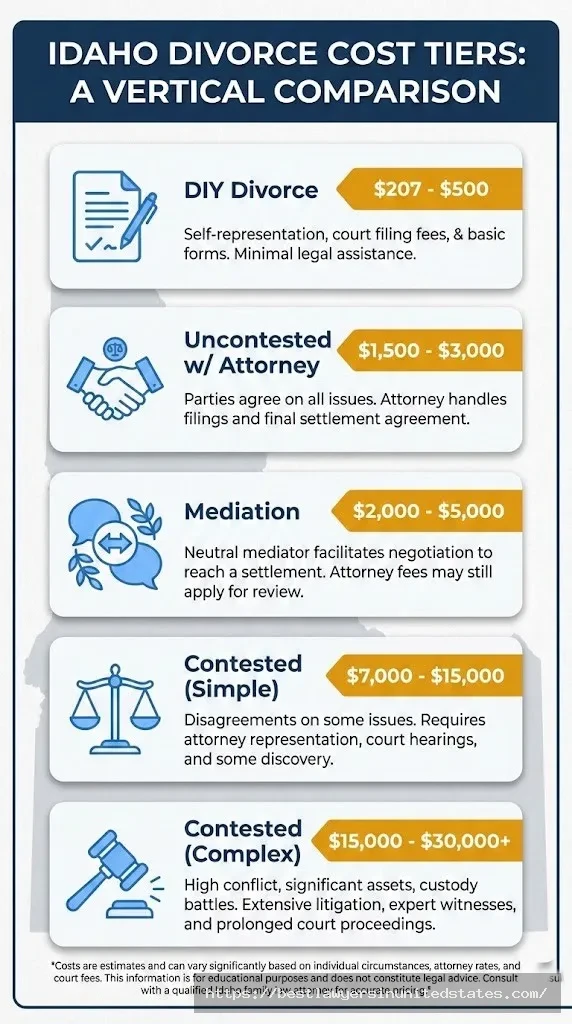
The total cost of your Idaho divorce depends on several factors: whether you and your spouse agree on terms, if you have children, the complexity of your assets, and whether you hire an attorney.
| Divorce Type | Cost Range | Timeline | Best For |
|---|---|---|---|
| DIY (No Attorney) | $207-$500 | 20-90 days | Amicable splits, no children, minimal assets |
| Uncontested with Attorney | $1,500-$3,000 | 21-90 days | Agreement reached, want legal guidance |
| Mediation | $2,000-$5,000 | 2-6 months | Willing to negotiate, need neutral help |
| Contested (Simple) | $7,000-$15,000 | 6-12 months | Some disagreements on assets/custody |
| Contested (Complex) | $15,000-$30,000+ | 12-24+ months | High assets, custody battles, business ownership |
Idaho follows an equitable distribution model (not 50/50 automatically), meaning courts divide marital property fairly but not necessarily equally. This affects both negotiation strategies and potential legal costs.
How Much Are Filing Fees in Idaho?
Court filing fees represent your first mandatory expense when starting a divorce in Idaho. The petitioner (person filing) pays these fees to the county clerk when submitting divorce papers.
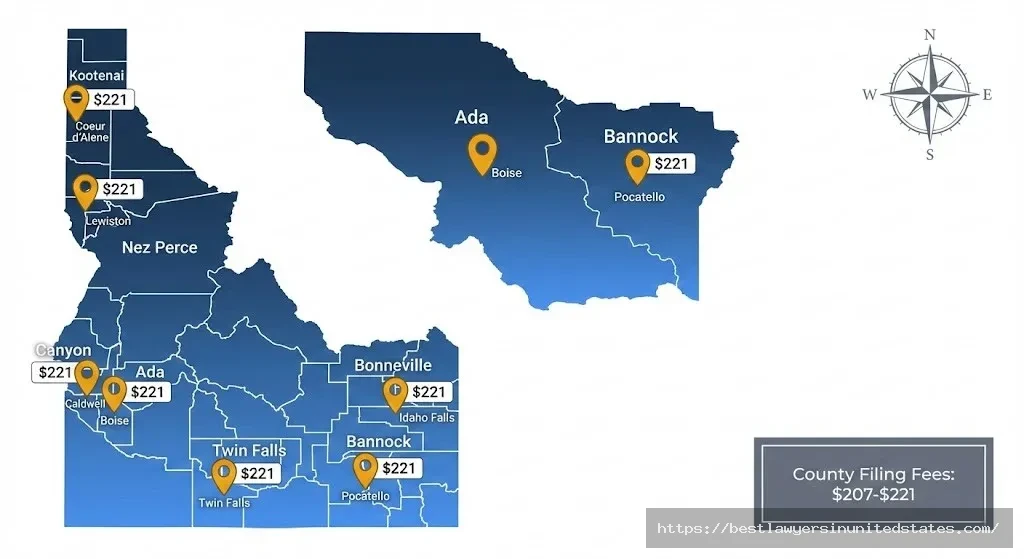
Idaho County Filing Fees (2026)
| County | Filing Fee | Notes |
|---|---|---|
| Ada County (Boise) | $221 | Most populous county |
| Canyon County | $221 | Nampa, Caldwell areas |
| Kootenai County | $221 | Coeur d’Alene area |
| Bonneville County | $221 | Idaho Falls area |
| Twin Falls County | $221 | Southern Idaho |
| Bannock County | $221 | Pocatello area |
| Nez Perce County | $221 | Lewiston area |
| Statewide Average | $207-$221 | Varies slightly by county |
Service of Process: After filing, you must formally serve divorce papers to your spouse. Professional process servers charge $50-$125 depending on location and difficulty. If your spouse lives out of state, expect $75-$150.
Fee Waivers Available: If you cannot afford filing fees, Idaho courts offer fee waivers for low-income filers. You’ll need to complete an Application to Waive or Defer Fees and Costs (CAO Form 1-23) and provide proof of income. Generally, those earning below 125% of federal poverty guidelines qualify.
What Does a Divorce Lawyer Cost in Idaho?
Attorney fees represent the largest variable expense in most Idaho divorces. Understanding how lawyers charge helps you budget and compare options effectively.
Idaho Attorney Fee Structures
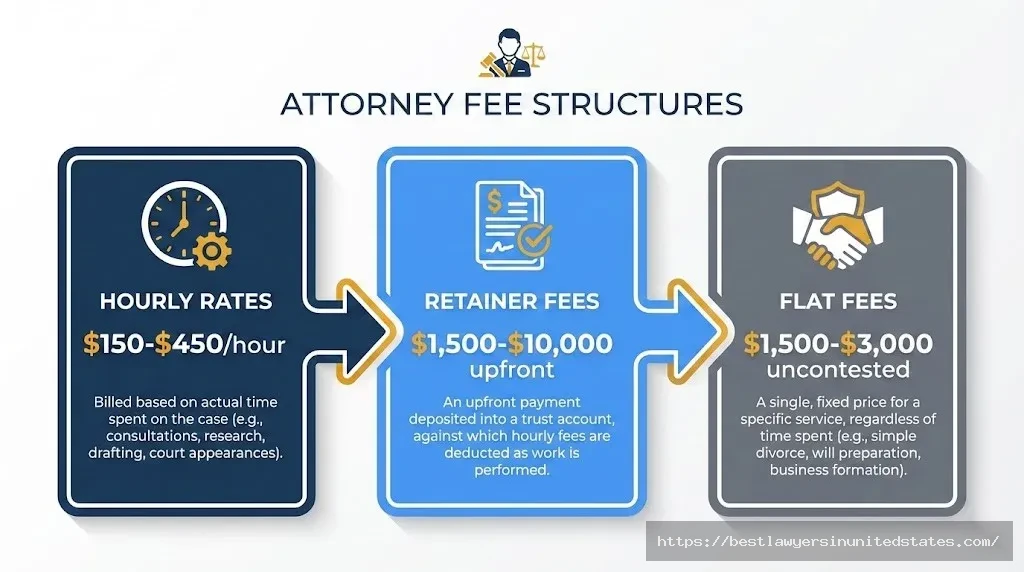
Hourly Rates (Most Common)
- Entry-level attorneys: $150-$225/hour
- Mid-level experience (5-10 years): $225-$300/hour
- Senior attorneys (15+ years): $300-$450/hour
- Paralegal time: $75-$125/hour
Retainer Requirements Most Idaho divorce attorneys require an upfront retainer deposit:
- Uncontested divorce: $1,500-$2,500 retainer
- Contested divorce: $3,000-$10,000 retainer
- High-asset/complex cases: $10,000-$25,000+ retainer
The retainer acts like a down payment. Your attorney bills against it hourly, and you replenish the retainer if it runs low. Any unused portion gets refunded after the case closes.
Flat-Fee Arrangements Some attorneys offer flat fees for straightforward uncontested divorces:
- Basic uncontested (no children): $1,500-$2,000 flat
- Uncontested with children: $2,000-$3,000 flat
- Divorce by stipulation: $1,800-$2,500 flat
Flat fees typically don’t cover contested hearings, trials, or unexpected complications. Read the fee agreement carefully to understand what’s included.
What Increases Attorney Costs:
- Multiple court hearings or motions
- Discovery process (depositions, interrogatories)
- Expert witnesses (custody evaluators, appraisers)
- Complex asset valuation (businesses, pensions)
- High-conflict custody disputes
- Emergency motions or temporary orders
- Trial preparation and court appearances
When comparing divorce attorney fees, ask about billing increments. Some attorneys bill in 6-minute increments (0.1 hours), while others use 15-minute minimums. A quick phone call could cost you $40-$100 depending on this policy.
How Much Does an Uncontested Divorce Cost in Idaho?
An uncontested divorce occurs when both spouses agree on all major issues: property division, debt allocation, child custody (if applicable), child support, and spousal support. This represents the most affordable divorce option.
Total Uncontested Divorce Costs:
- DIY (self-filed): $207-$500
- Filing fee: $207-$221
- Service of process: $50-$100
- Document preparation (optional): $100-$200
- Parenting class (if children): $30-$50 per parent
- With Attorney Assistance: $1,500-$3,000
- Filing fee: $207-$221
- Attorney flat fee: $1,200-$2,500
- Service of process: $50-$100
- Parenting class (if children): $30-$50 per parent
Idaho requires a 20-day waiting period after serving divorce papers before the court can finalize your divorce. Most uncontested divorces complete within 21-90 days if paperwork is correct and spouses remain cooperative.
When Uncontested Makes Sense:
- No children or complete agreement on custody/support
- Limited marital assets (under $100,000 total value)
- No real estate or simple equity division
- No retirement accounts requiring QDRO division
- Both spouses willing to negotiate fairly
- No domestic violence or safety concerns
Learn more about uncontested divorce costs and whether this path fits your situation.
How Much Does a Contested Divorce Cost in Idaho?
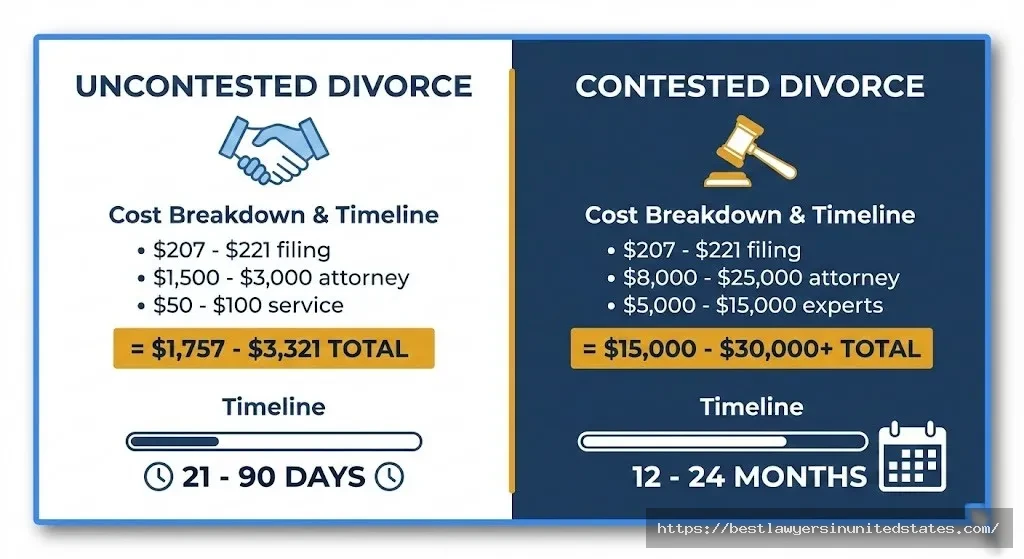
A contested divorce means spouses disagree on one or more significant issues requiring court intervention. These cases involve substantially higher costs due to increased attorney time, court proceedings, and expert involvement.
Contested Divorce Cost Breakdown:
| Cost Component | Amount | When Required |
|---|---|---|
| Filing fees | $207-$221 | Always |
| Attorney retainer | $3,000-$10,000 | Initial deposit |
| Attorney hourly fees | $8,000-$25,000+ | Ongoing legal work |
| Discovery costs | $1,500-$5,000 | Document requests, depositions |
| Custody evaluation | $2,000-$5,000 | Disputed custody |
| Property appraisal | $400-$800 per property | Real estate division |
| Business valuation | $5,000-$15,000 | Business ownership |
| QDRO preparation | $500-$2,500 | Retirement account division |
| Expert witnesses | $200-$500/hour | Trial testimony |
| Mediation attempts | $150-$300/hour | Court-ordered or voluntary |
| Trial costs | $5,000-$15,000 | If case goes to trial |
| Guardian ad Litem | $3,000-$8,000 | Child custody disputes |
Total Range: $15,000-$30,000+ for contested divorces
The longer your case drags on, the more expensive it becomes. Each court hearing, motion filed, or negotiation session adds to your legal bill. Understanding contested divorce costs helps you make informed decisions about settlement versus litigation.
What Makes Divorces Contested:
- Disagreement over child custody or parenting time
- Disputes about child support amounts
- Conflicting views on spousal support (alimony)
- Complex property division (multiple properties, businesses)
- Hidden assets or financial dishonesty
- Retirement account or pension division
- Debt allocation disagreements
- Personal property battles (valuables, collections)
Most contested divorces settle before trial. Your attorney’s negotiation skills can save you thousands compared to a full courtroom trial.
What Does a Divorce with Children Cost in Idaho?
Having minor children adds complexity and costs to Idaho divorces. Both parents must complete specific requirements, and custody arrangements require careful legal documentation.
Additional Costs with Children:
Mandatory Parenting Classes: $30-$50 per parent Idaho requires divorcing parents to complete a court-approved parent education program before finalizing the divorce. These 4-hour classes cover co-parenting strategies, child adjustment issues, and communication skills. Both parents must attend separately and file completion certificates with the court.
Child Custody Evaluation: $2,000-$5,000 When parents can’t agree on custody arrangements, courts may order a professional custody evaluation. A licensed evaluator interviews parents, children, and sometimes teachers or therapists, then recommends a custody plan to the court. These evaluations take 6-12 weeks and include home visits, psychological testing, and detailed reports.
Guardian ad Litem (GAL): $3,000-$8,000 In high-conflict custody cases, Idaho courts appoint a GAL to represent the child’s best interests. This attorney investigates family circumstances and makes custody recommendations. Parents typically split GAL fees equally.
Child Support Calculation Services: $200-$500 While basic child support calculations follow Idaho’s guidelines, complex situations (self-employment, multiple income sources, shared custody) may require professional calculation services to ensure accuracy.
Parenting Plan Preparation: $300-$800 Detailed parenting plans outline decision-making authority, residential schedules, holiday rotations, and communication protocols. Attorneys charge $300-$800 to draft comprehensive plans that prevent future disputes.
Total Additional Costs for Divorces with Children: $2,500-$15,000+
The exact amount depends on cooperation level between parents and custody complexity. Learn more about handling divorce with minor children costs in Idaho.
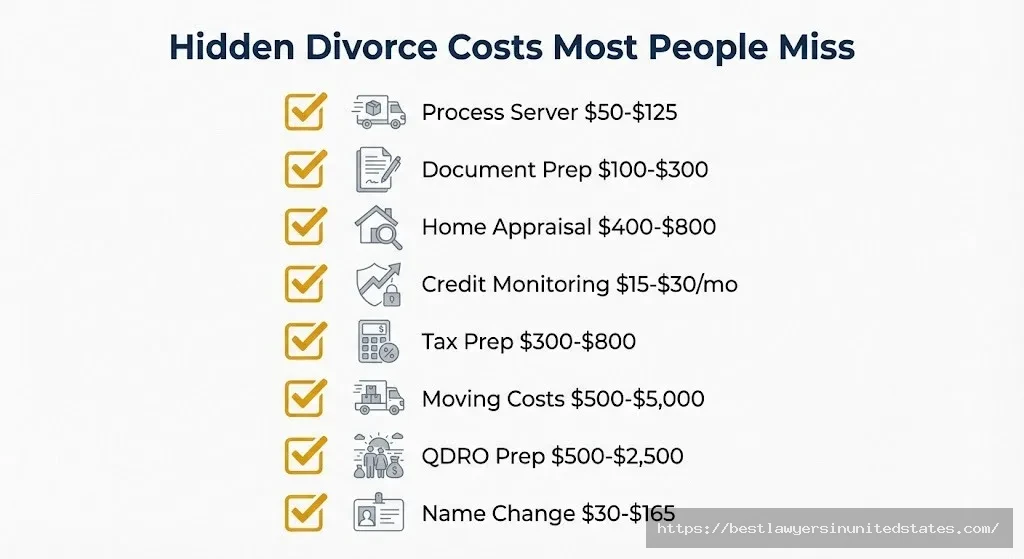
Hidden Divorce Costs Most People Miss
Beyond obvious legal fees and filing costs, several hidden expenses catch divorcing couples off guard. Planning for these prevents budget surprises.
Service and Process Costs
Process Server Fees: $50-$125 Professional service ensures proper legal notification to your spouse. Sheriff’s departments charge less ($40-$75) but may take longer.
Certified Mail Service: $8-$15 If your spouse cooperates, they can sign an Acceptance of Service form, avoiding process server costs. You’ll still need certified mail delivery.
Publication Service: $200-$400 When you cannot locate your spouse, Idaho allows service by publication in a local newspaper for several weeks. This requires court approval and additional paperwork.
Document and Administrative Costs
Certified Copy Fees: $1-$3 per page You’ll need certified copies of your divorce decree for various purposes (name changes, property transfers, loan modifications). Courts charge per page.
Document Preparation Services: $100-$300 Online divorce services help complete paperwork correctly. While cheaper than attorneys, they don’t provide legal advice.
Notary Fees: $5-$25 Many divorce documents require notarization. Idaho limits notary fees to $5 per signature, but mobile notaries charge more for travel.
Recording Fees: $15-$30 Recording property transfer documents (quit claim deeds) with the county recorder costs additional fees.
Financial and Tax Implications
Tax Preparation: $300-$800 Your first tax year post-divorce requires professional help navigating filing status changes, dependency claims, and potential tax consequences of property settlements.
Financial Advisor Consultation: $200-$500 Understanding retirement account division, investment reallocation, and budget adjustments benefits from professional financial advice.
Credit Report Monitoring: $15-$30/month Monitoring credit reports ensures your spouse doesn’t open accounts in your name during divorce proceedings.
Property-Related Costs
Home Appraisal: $400-$800 Determining fair market value for property division requires professional appraisal, especially if refinancing or buying out your spouse’s equity.
Mortgage Refinancing: $2,000-$5,000 Removing your spouse from the mortgage involves refinancing, which includes application fees, appraisal, title search, and closing costs.
Title Transfer Fees: $150-$500 Transferring property titles requires quit claim deeds, title searches, and recording fees.
Vehicle Title Transfers: $30-$85 per vehicle Changing vehicle titles through Idaho DMV involves transfer fees and new registration costs.
Name Change Expenses
Driver’s License Update: $30 If you’re reverting to a maiden name or changing names, Idaho DMV charges for license replacement.
Passport Update: $130-$165 Name changes require new passport applications with associated federal fees.
Social Security Card Update: Free While the Social Security Administration doesn’t charge for name changes, you’ll need certified divorce decree copies.
Moving and Transition Costs
Moving Expenses: $500-$5,000+ Whether hiring movers or renting trucks, relocating to separate residences costs money many couples haven’t budgeted.
Duplicate Household Items: $2,000-$10,000 Setting up a second household requires furniture, kitchenware, linens, and appliances one spouse previously shared.
Security Deposits: $500-$2,000 New apartments require first/last month’s rent plus deposits.
Storage Units: $75-$200/month Temporary storage during transition periods adds unexpected monthly costs.
Total Hidden Costs: $3,000-$15,000+ over the divorce process
Using a comprehensive divorce cost calculator helps you account for these often-overlooked expenses.
Can I File for Divorce in Idaho Without a Lawyer?
Yes, Idaho allows self-representation (called “pro se” filing) in divorce cases. This approach significantly reduces costs but requires careful attention to legal procedures and paperwork accuracy.
DIY Divorce Requirements in Idaho:
- Both spouses agree on all terms (uncontested)
- No complex property issues or high-value assets
- No retirement accounts requiring QDRO division
- Simple or no child custody arrangements
- Comfort with paperwork and legal forms
- Ability to communicate with spouse respectfully
How to File for Divorce Without a Lawyer in Idaho
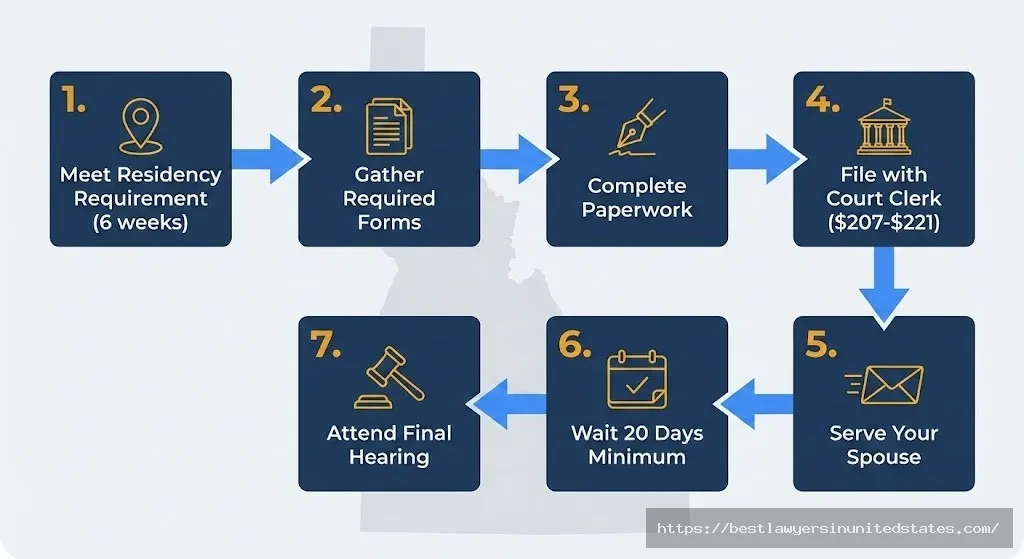
Step 1: Meet Residency Requirements Either spouse must live in Idaho for at least six weeks before filing. You file in the county where either spouse currently resides.
Step 2: Gather Required Forms Idaho provides free divorce forms through the Idaho Supreme Court’s iCourt Portal and Idaho Legal Aid Services. Key forms include:
- Complaint for Divorce (CV-01-3000)
- Summons (CV-01-3001)
- Affidavit and Verification (CV-01-3002)
- Decree of Divorce (CV-01-3010)
- Child Support Worksheet (if children)
- Parenting Plan (if children)
Step 3: Complete Paperwork Accurately Each form requires specific information about your marriage, assets, debts, and (if applicable) children. Errors delay your divorce and may require refiling with additional fees. The DIY divorce guide provides state-specific instructions.
Step 4: File with Court Clerk Submit completed forms to your county district court clerk’s office with the $207-$221 filing fee. The clerk assigns a case number and provides copies for service.
Step 5: Serve Your Spouse Legally notify your spouse by having someone over 18 (not you) deliver divorce papers. Your spouse has 21 days to respond if they live in Idaho, or 30 days if out-of-state.
Step 6: Wait 20 Days Minimum Idaho law requires a 20-day waiting period after service before the court can finalize divorce. This cooling-off period allows reconsideration.
Step 7: Attend Final Hearing Even in uncontested cases, most Idaho counties require a brief final hearing where you testify about your marriage and settlement terms under oath. Some counties waive this requirement if paperwork is complete.
When NOT to DIY Your Divorce:
- Your spouse contests any terms
- Domestic violence or safety concerns exist
- Significant assets require valuation
- Business ownership or complex investments
- Retirement accounts need division (QDRO)
- Custody disputes arise
- You’re unsure about legal procedures
Free or low-cost legal help is available through Idaho Legal Aid Services for qualifying individuals. Their offices throughout Idaho provide forms, instructions, and sometimes limited legal advice.
How Does Divorce Mediation Save Money in Idaho?
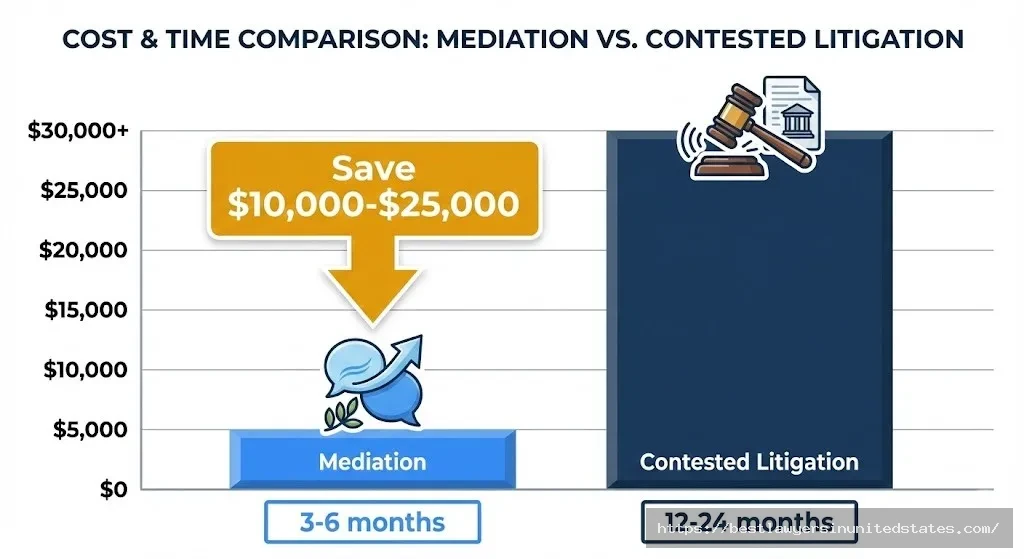
Divorce mediation involves a neutral third-party mediator who helps couples negotiate agreements on property division, custody, and support issues. While mediation costs money upfront, it typically saves thousands compared to contested litigation.
Idaho Divorce Mediation Costs
Mediator Hourly Rates: $150-$300/hour Most Idaho mediators charge hourly, with sessions lasting 2-4 hours. Couples typically split the mediator’s fee equally.
Total Mediation Costs: $2,000-$5,000 (complete divorce) Most divorces require 4-10 mediation hours to resolve all issues, plus attorney review time for the final agreement.
Cost Comparison:
| Approach | Average Cost | Timeline |
|---|---|---|
| Contested litigation | $15,000-$30,000 | 12-24 months |
| Divorce mediation | $2,000-$5,000 | 3-6 months |
| Collaborative divorce | $5,000-$15,000 | 4-8 months |
| Savings with mediation | $10,000-$25,000 | 6-18 months faster |
How Mediation Works in Idaho
1. Initial Consultation (1 hour): $150-$300 Meet with the mediator to explain your situation and learn the process. Some mediators offer free 30-minute consultations.
2. Financial Disclosure Exchange Both spouses complete financial affidavits listing all assets, debts, income, and expenses. Full transparency is essential for fair mediation.
3. Negotiation Sessions (4-10 hours typical): $150-$300/hour The mediator facilitates discussions on contentious issues, helping couples find middle ground. Sessions address:
- Property and debt division
- Child custody and parenting time
- Child support calculations
- Spousal support amounts and duration
4. Agreement Drafting After reaching consensus, the mediator drafts a detailed settlement agreement outlining all terms. This becomes part of your divorce decree.
5. Attorney Review (Optional but Recommended) Each spouse should have an independent attorney review the mediated agreement before signing. This costs $500-$1,500 per spouse but protects your interests.
6. Court Filing One spouse files the uncontested divorce with the mediated agreement attached. The court typically approves agreements reached through mediation if they’re fair and legal.
When Mediation Works Best:
- Both spouses willing to negotiate in good faith
- No power imbalances or abuse dynamics
- Similar knowledge about family finances
- Desire to maintain civil co-parenting relationship
- Complex issues requiring creative solutions
- Couples wanting more control over outcomes
When Mediation May Not Work:
- History of domestic violence or abuse
- Severe power imbalances (financial or emotional)
- Spouse hiding assets or being financially dishonest
- Mental health issues preventing rational discussion
- Complete unwillingness to compromise
Explore divorce mediation costs in detail to understand if this approach suits your situation.
Is Idaho a 50/50 Divorce State for Property Division?
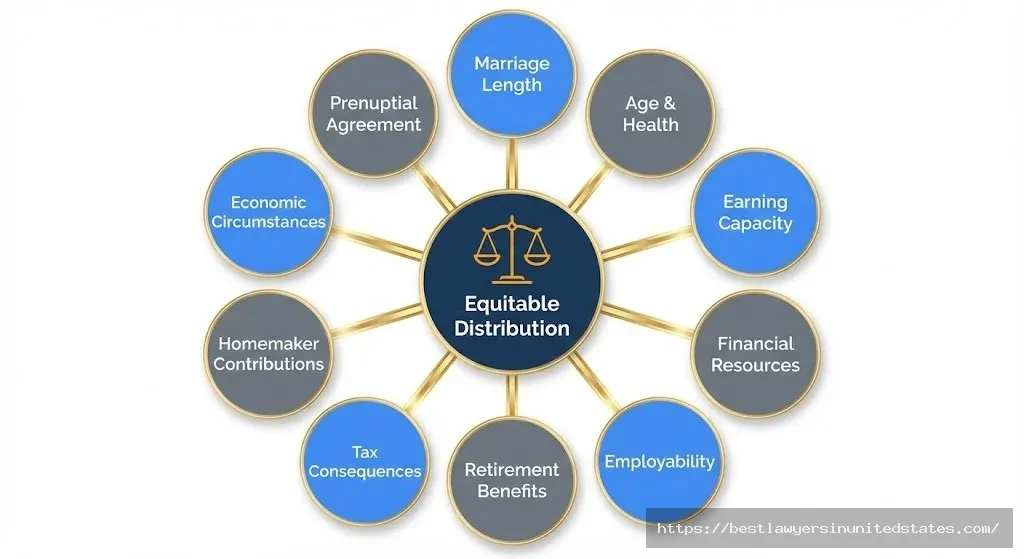
No, Idaho is not a community property state. Idaho follows “equitable distribution,” meaning courts divide marital property fairly but not necessarily equally. Understanding this difference affects your financial expectations and negotiation strategy.
Idaho’s Equitable Distribution Explained
Marital vs. Separate Property:
Marital Property (Subject to Division):
- Assets acquired during marriage
- Income earned by either spouse during marriage
- Retirement contributions made during marriage
- Increase in value of separate property due to marital efforts
- Gifts between spouses
- Property purchased with commingled funds
Separate Property (Not Divided):
- Assets owned before marriage
- Inheritances received by one spouse
- Gifts specifically given to one spouse
- Personal injury settlements (except lost wages)
- Property explicitly kept separate with documentation
Factors Idaho Courts Consider:
Idaho Code § 32-712 directs judges to consider multiple factors when dividing property:
- Length of marriage – Longer marriages typically result in more equal divisions
- Age and health of each spouse – Physical limitations or health needs influence awards
- Earning capacity and income – Future financial prospects matter
- Financial resources – Including separate property each spouse retains
- Employability – Education, job skills, and career potential
- Retirement benefits – Pensions, 401(k)s, and IRAs accumulated during marriage
- Tax consequences – How property division affects each spouse’s taxes
- Homemaker contributions – Non-financial contributions to the marriage
- Economic circumstances – Each spouse’s financial situation post-divorce
- Prenuptial agreements – Valid agreements override equitable distribution
Common Division Scenarios:
Short marriages (under 5 years): 60/40 to 70/30 splits are common, with higher earners receiving larger shares or each spouse keeping what they brought to the marriage.
Medium marriages (5-15 years): 55/45 to 60/40 splits typical, considering contributions and future earning potential.
Long marriages (15+ years): Divisions closer to 50/50, especially when both spouses contributed significantly.
Example: Sarah and Michael divorce after 12 years. Sarah earns $85,000 annually as a marketing manager, while Michael earns $52,000 as a teacher. They own a home with $120,000 equity, two vehicles worth $45,000 combined, and retirement accounts totaling $180,000. The court might award Michael 55% of marital assets ($189,750) and Sarah 45% ($155,250), considering Michael’s lower earning capacity and Sarah’s stronger career prospects.
This equitable distribution affects divorce costs because contested property division requires attorney time, expert valuations, and potentially court hearings. Clear documentation of separate property and willingness to negotiate fairly reduce these costs significantly.
Comparing with neighboring states, divorce costs in Utah and divorce costs in Nevada differ partly due to varying property division laws.
What Are Divorce Filing Fees Across the U.S.?
Understanding how Idaho’s filing fees compare nationally provides perspective on whether you’re getting reasonable value. Divorce costs vary significantly by state due to different filing requirements, legal frameworks, and cost of living.
National Filing Fee Comparison:
| State | Filing Fee Range | Relative Cost |
|---|---|---|
| Idaho | $207-$221 | Below average |
| California | $435-$450 | High |
| Texas | $250-$350 | Average |
| Florida | $408-$409 | High |
| New York | $335-$350 | Above average |
| Washington | $280-$320 | Average |
| Oregon | $260-$300 | Average |
| Montana | $200-$220 | Below average |
| Wyoming | $70-$140 | Very low |
| Utah | $310-$325 | Average |
Idaho’s filing fees rank below the national average, making it relatively affordable to initiate divorce proceedings compared to states like California or Florida. However, total divorce costs depend far more on attorney fees and case complexity than initial filing fees.
For comprehensive state-by-state comparisons, explore the complete guide to divorce filing fees across all 50 states.
10 Proven Ways to Reduce Your Idaho Divorce Costs
Strategic planning and informed decisions can save thousands on your Idaho divorce. These practical cost-reduction strategies work regardless of your situation’s complexity.
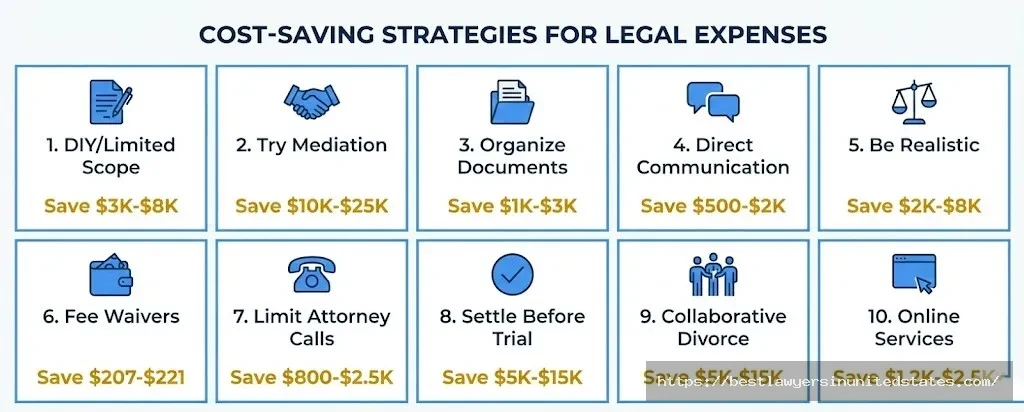
1. Consider DIY or Limited Scope Representation
Full legal representation isn’t always necessary. Many Idaho couples successfully file uncontested divorces themselves using Idaho Supreme Court forms available free online. If you need some legal help but can’t afford full representation, ask attorneys about “limited scope” or “unbundled” services where you handle some tasks while the attorney assists with specific aspects like paperwork review or court appearances.
Potential Savings: $3,000-$8,000
2. Try Mediation Before Litigation
Divorce mediation costs $2,000-$5,000 total versus $15,000-$30,000+ for contested litigation. Even couples with disagreements often reach settlements through mediation, avoiding expensive court battles. Many Idaho counties require mediation attempts before scheduling contested hearings anyway.
Potential Savings: $10,000-$25,000
3. Organize Financial Documents Proactively
Attorneys charge $150-$450 per hour. Every hour your lawyer spends tracking down bank statements, tax returns, or property deeds is money you’re wasting. Create organized files with:
- Three years of tax returns
- Recent pay stubs for both spouses
- Bank and investment account statements
- Credit card statements and loan documents
- Property deeds and vehicle titles
- Retirement account statements
- Business financial statements (if applicable)
Potential Savings: $1,000-$3,000
4. Communicate Directly When Possible
Every email your attorney sends to your spouse’s attorney costs you money. If you can communicate directly with your spouse about scheduling, document exchange, or minor decisions, do so. Save attorney involvement for substantive legal negotiations.
Potential Savings: $500-$2,000
5. Be Realistic About Property Division
Fighting over furniture, dishes, or personal items with sentimental value rarely makes financial sense. The cost of litigating who gets the $500 couch quickly exceeds the couch’s value. Focus negotiation energy on major assets (home equity, retirement accounts, vehicles) and compromise on smaller items.
Potential Savings: $2,000-$8,000
6. Apply for Fee Waivers If You Qualify
Low-income individuals can request filing fee waivers from Idaho courts. Complete the Application to Waive or Defer Fees and Costs (CAO Form 1-23) and provide proof of income. Generally, those earning below 125% of federal poverty guidelines qualify. This saves $207-$221 immediately.
Potential Savings: $207-$221
7. Limit Attorney Communication Frequency
Excessive phone calls to your attorney add up quickly. Before calling, ask yourself if the question can wait for your next scheduled meeting or if an email suffices. Batch your questions rather than calling each time something occurs to you. Many attorneys bill in 15-minute minimums, so a 3-minute call costs the same as a 15-minute call.
Potential Savings: $800-$2,500
8. Settle Before Trial
Trials are expensive. Attorney preparation time, expert witness fees, court reporter costs, and the trial itself can add $5,000-$15,000 to your divorce costs. Most divorce cases settle before trial—91% nationally. The sooner you settle, the more you save. Even settling during trial preparation (before the actual trial date) saves substantial money.
Potential Savings: $5,000-$15,000
9. Choose Collaborative Divorce Over Litigation
Collaborative divorce involves specially trained attorneys who help couples negotiate without going to court. While it costs more than basic mediation ($5,000-$15,000), it’s significantly cheaper than contested litigation and includes professional support throughout the process. Each spouse has their own attorney, and everyone commits to settling outside court.
Potential Savings: $5,000-$15,000 compared to litigation
10. Use Online Divorce Services for Document Preparation
Reputable online divorce services like CompleteCase.com or DivorceWriter.com charge $150-$300 to prepare your Idaho divorce paperwork. While they don’t provide legal advice, they ensure forms are completed correctly, reducing rejection risk at the courthouse. This middle-ground approach costs less than attorneys but provides more guidance than completely DIY filing.
Potential Savings: $1,200-$2,500
Total Potential Savings: $30,000-$82,000 by implementing multiple strategies
What Payment Options Do Idaho Divorce Attorneys Offer?
Affording an attorney doesn’t necessarily require tens of thousands in cash upfront. Many Idaho family law attorneys offer payment arrangements to make legal representation accessible.
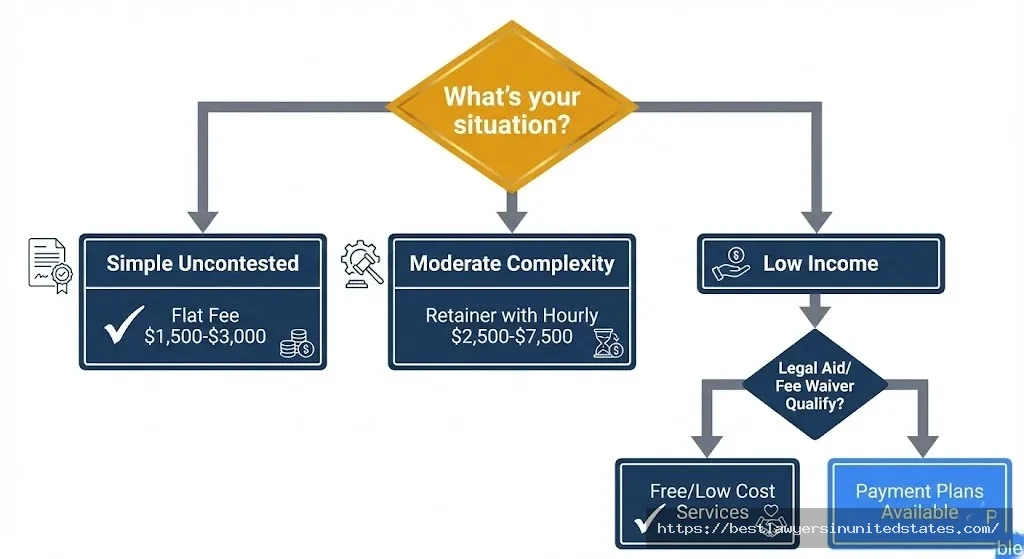
Common Attorney Payment Structures
1. Retainer with Replenishment Most common structure. You pay an initial retainer ($2,500-$10,000), and the attorney bills hourly against it. When the retainer depletes to a certain threshold ($500-$1,000 remaining), you replenish it. This continues throughout your case.
Pros: Predictable initial cost, pay as you go Cons: Can’t predict total cost, may need to replenish multiple times
2. Flat Fee Agreements For straightforward uncontested divorces, attorneys may offer flat fees covering all services through finalization.
Typical Flat Fees:
- Uncontested, no children: $1,500-$2,000
- Uncontested with children: $2,000-$3,000
Pros: Know exact cost upfront, no surprise bills Cons: Usually limited to simple cases, contested issues void the agreement
3. Payment Plans Some attorneys allow spreading the retainer over 2-6 months, though this is less common. You might pay $1,000 monthly for 3-5 months to cover representation.
Pros: More manageable monthly amounts Cons: Attorney may limit services until payments are current
4. Credit Card Payments Most Idaho law firms accept credit cards, allowing you to leverage available credit for legal fees. While you’ll pay credit card interest, you secure representation immediately.
Pros: Immediate access to representation Cons: High interest rates increase total cost
5. Legal Financing/Loans Specialized legal lending companies like LawPay or Affirm offer loans specifically for attorney fees. Interest rates vary but typically range from 8%-36% APR depending on creditworthiness.
Pros: Access to larger amounts, structured repayment Cons: Interest increases total cost, requires credit check
6. Legal Aid and Pro Bono Services Idaho Legal Aid Services provides free legal assistance to low-income residents (generally those earning below 125% of poverty guidelines). While they prioritize cases involving domestic violence, children, or housing, they sometimes assist with divorces.
Idaho Legal Aid Locations:
- Boise: (208) 746-7541
- Pocatello: (208) 236-0570
- Lewiston: (208) 746-7541
- Twin Falls: (208) 746-7541
- Coeur d’Alene: (208) 746-7541
Idaho Volunteer Lawyers Program also connects qualifying individuals with attorneys willing to provide limited free services.
Qualification: Generally under 125% of federal poverty level
Questions to Ask About Attorney Fees
Before hiring an Idaho divorce attorney, ask:
- What’s your hourly rate, and how do you bill (6-minute vs. 15-minute increments)?
- What retainer do you require, and when must I replenish it?
- Do you offer payment plans or accept credit cards?
- What’s included in the retainer (court appearances, phone calls, emails, document review)?
- How often will I receive billing statements?
- What happens if my retainer runs out before the case finishes?
- Do you charge for paralegal time, and at what rate?
- Are there any flat-fee options for my situation?
- Can you estimate total costs based on similar cases?
- Will any unused retainer be refunded?
Get the fee agreement in writing before paying anything. Idaho State Bar Rules require attorneys to provide written fee agreements for cases expected to exceed $1,000.
How Do I Qualify for Free or Low-Cost Divorce Help in Idaho?
Not everyone can afford private attorney representation, but Idaho provides several resources for low-income individuals facing divorce.
Idaho Legal Aid Services
Income Qualification: Generally 125% of federal poverty level
- Individual: ~$18,000/year
- Family of 2: ~$24,000/year
- Family of 3: ~$30,000/year
- Family of 4: ~$36,500/year
Services Provided:
- Free legal advice and consultations
- Help with divorce paperwork
- Court representation in priority cases (domestic violence)
- Self-help resources and forms
- Legal education workshops
Contact:
- Statewide: (208) 746-7541
- Website: idaholegalaid.org
- Walk-in offices in Boise, Pocatello, Lewiston, Twin Falls, and Coeur d’Alene
Priority Cases: Idaho Legal Aid prioritizes cases involving domestic violence, child custody safety concerns, and vulnerable populations (elderly, disabled, veterans). Simple property division cases receive lower priority due to limited resources.
Idaho Volunteer Lawyers Program
Service: Pro bono attorney matching for qualified individuals Qualification: Income below 200% of federal poverty level Application: Through Idaho Legal Aid Services or Idaho State Bar
The program connects low-income Idahoans with volunteer attorneys willing to provide free or reduced-fee services. Not all cases are accepted, and there’s often a waiting list.
Court Self-Help Centers
Many Idaho district courts operate self-help centers providing:
- Free divorce forms and instructions
- Assistance completing paperwork
- Information about court procedures
- Referrals to legal services
- Computer access for online forms
Major Self-Help Centers:
- Ada County (Boise): 4th Judicial District Court
- Kootenai County (Coeur d’Alene): 1st Judicial District Court
- Bonneville County (Idaho Falls): 7th Judicial District Court
- Canyon County (Caldwell): 3rd Judicial District Court
These centers cannot provide legal advice or represent you but offer valuable procedural guidance.
Fee Waiver Applications
Can’t afford the $207-$221 filing fee? Idaho courts allow qualifying individuals to request fee waivers by completing:
Application to Waive or Defer Fees and Costs (CAO Form 1-23)
You’ll need to provide:
- Proof of income (pay stubs, benefit statements)
- List of monthly expenses
- Information about assets
- Number of household dependents
Qualification Guidelines:
- Receiving public benefits (SNAP, Medicaid, SSI)
- Household income below 125% poverty level
- Unable to pay fees without hardship to yourself or dependents
The court reviews applications and approves based on demonstrated financial need. If approved, you don’t pay filing fees, service fees, or other court costs.
Law School Clinics
University of Idaho College of Law (Moscow) Limited availability, but the law school sometimes operates clinics where law students, supervised by professors, provide free or low-cost legal services.
Concord Law School Online Clinics Occasional virtual clinics may serve Idaho residents remotely.
Alternative Resources
Idaho State Bar Lawyer Referral Service: $35 for a 30-minute consultation with an attorney Often enough time to get basic questions answered and determine if you need full representation.
Modest Means Programs: Some Idaho attorneys offer reduced hourly rates ($75-$125/hour) for clients earning 200%-400% of poverty level—too much for free aid but not enough for full market rates.
Real Idaho Divorce Cost Examples
Understanding theoretical costs helps, but real-world examples provide practical perspective. These case studies (names changed for privacy) illustrate how different situations affect total divorce expenses.
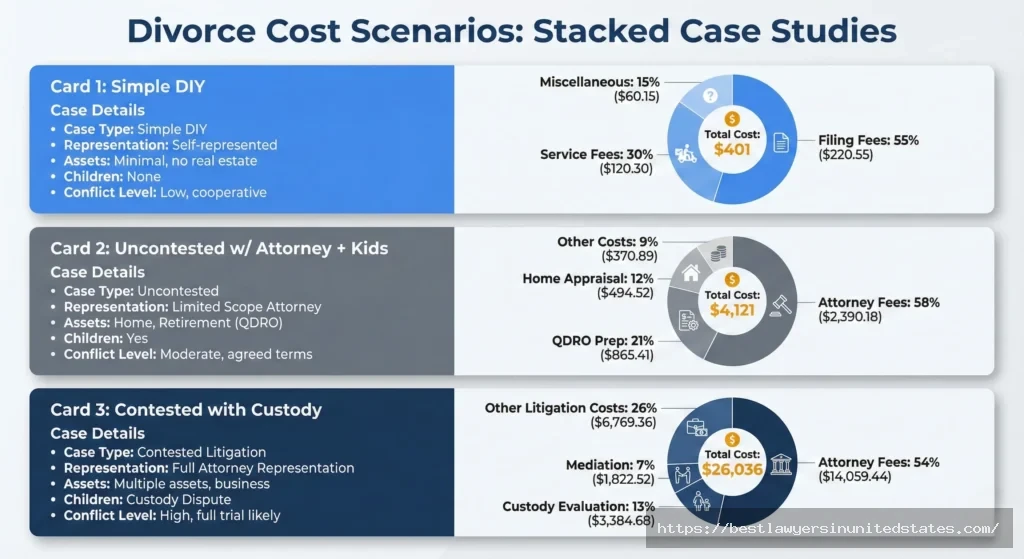
Case 1: Simple Uncontested DIY Divorce
Situation: Mark and Jennifer, married 4 years, no children, renting their home, minimal shared assets (one vehicle, $8,000 savings, $3,000 credit card debt). Both agreed on division before filing.
Costs:
- Filing fee (Ada County): $221
- Service by certified mail: $12
- Online document preparation: $149
- Notary fees: $10
- Certified divorce decree copies (3): $9
Total: $401 Timeline: 6 weeks from filing to final decree
Key Success Factor: Complete agreement before filing, simple asset division, no children, used free Idaho Supreme Court forms with online guidance.
Case 2: Uncontested Divorce with Attorney and Children
Situation: Rachel and Tom, married 9 years, two children (ages 6 and 8), owned home with $85,000 equity, two vehicles, retirement accounts totaling $62,000. Reached full agreement on custody and property division before hiring attorney.
Costs:
- Filing fee (Canyon County): $221
- Process server: $85
- Attorney flat fee: $2,400
- Parenting classes (both parents): $90
- QDRO preparation (retirement division): $850
- Home appraisal: $475
Total: $4,121 Timeline: 10 weeks from filing to final decree
Key Success Factor: Complete settlement agreement before hiring attorney, who simply prepared paperwork and handled court filing. Avoided hourly billing by settling everything first.
Case 3: Contested Divorce with Custody Dispute
Situation: David and Michelle, married 14 years, three children (ages 10, 8, 4), owned home, two vehicles, retirement accounts. Disputed custody arrangements and child support amounts. Eventually settled through mediation after 6 months.
Costs:
- Filing fee (Kootenai County): $221
- Attorney retainer (David): $5,000
- Additional attorney fees (David): $6,800
- Attorney for Michelle: $7,200
- Mediation sessions (6 hours): $1,800
- Custody evaluation: $3,500
- Parenting classes: $90
- QDRO preparation: $900
- Home appraisal: $525
Total: $26,036 (combined both spouses) Timeline: 13 months from filing to final decree
Key Success Factor: Eventually agreed to mediation, which resolved custody disputes without trial. If the case had gone to trial, costs would have exceeded $40,000 combined.
Case 4: High-Asset Contested Divorce
Situation: Steven and Patricia, married 22 years, two adult children (no custody issues), owned home worth $485,000, vacation property worth $220,000, business valued at $380,000, retirement accounts totaling $420,000, investment portfolio worth $195,000. Disputed business valuation and spousal support.
Costs:
- Filing fee (Ada County): $221
- Attorney fees (Steven): $28,400
- Attorney fees (Patricia): $24,800
- Business valuation expert: $12,000
- Forensic accountant: $8,500
- Real estate appraisals (2 properties): $1,450
- QDRO preparation (multiple accounts): $2,100
- Mediation attempts (8 hours): $2,400
- Trial costs (3 days): $11,200
Total: $91,071 (combined both spouses) Timeline: 26 months from filing to trial conclusion
Key Factor: Complex assets requiring expert valuation, disagreement on spousal support amounts, business ownership complications. Trial added $15,000+ compared to if they’d settled beforehand.
Case 5: Mediated Divorce with Moderate Assets
Situation: Lisa and Kevin, married 11 years, one child (age 7), owned modest home with $45,000 equity, two vehicles, retirement accounts totaling $78,000. Disagreed initially on custody schedule and house buyout terms.
Costs:
- Filing fee (Bonneville County): $221
- Mediation sessions (8 hours total): $2,400
- Attorney review of agreement (each): $1,400
- Parenting class: $90
- Home appraisal: $475
- QDRO preparation: $750
- Process server: $75
Total: $5,411 Timeline: 5 months from initial consultation to final decree
Key Success Factor: Committed to mediation rather than hiring attorneys for full representation. Each spouse had independent attorney review the mediated agreement before signing, protecting both parties while controlling costs.
What Affects the Cost of Divorce in Idaho?
Multiple variables determine whether your Idaho divorce costs $500 or $50,000. Understanding these factors helps you anticipate expenses and make informed decisions.
1. Agreement Level Between Spouses
Uncontested (full agreement): $500-$3,000 Some disagreements: $3,000-$10,000 Highly contested: $15,000-$30,000+
The single biggest cost factor is whether you and your spouse agree or fight. Every disputed issue adds attorney hours, court appearances, and stress.
2. Presence and Age of Children
No children: Simplest, lowest cost Children under 18: Adds custody plans, support calculations, parenting classes ($2,000-$5,000 additional) Multiple children with custody disputes: Can add $5,000-$15,000 in evaluation and attorney fees
Cases involving children require additional court filings, parenting plans, and often custody evaluations if parents disagree.
3. Complexity of Marital Assets
Simple (under $50,000 total marital assets): Minimal valuation costs Moderate ($50,000-$500,000): May need appraisals ($500-$2,000 additional) High-net-worth ($500,000+): Requires expert valuations, forensic accounting ($5,000-$20,000+ additional)
Complex assets requiring professional valuation:
- Business ownership
- Commercial real estate
- Stock options and restricted stock units
- Intellectual property
- Collectibles and art
- Cryptocurrency holdings
4. Retirement Account Division
Simple division (one 401k or IRA): $500-$750 for QDRO Multiple accounts: $1,000-$2,500 Pensions requiring actuarial valuations: $2,000-$5,000 Federal government or military pensions: $1,500-$3,000
Qualified Domestic Relations Orders (QDROs) require specialized attorneys or QDRO preparation services to divide retirement accounts without tax penalties.
5. Real Estate Holdings
No real estate: No appraisal costs Primary residence: $400-$800 appraisal Multiple properties: $400-$800 per property Commercial property: $1,500-$5,000 per property
Plus potential costs:
- Title searches: $150-$300
- Refinancing (if buying out spouse): $2,000-$5,000
- Quit claim deed preparation: $150-$500
6. Spousal Support (Alimony) Disputes
Agreement on alimony: Minimal cost Disputed amount or duration: Adds 10-20 attorney hours ($1,500-$8,000) Vocational evaluation needed: $2,000-$4,000 additional
Idaho courts consider multiple factors when determining spousal maintenance. Disputes over these factors require substantial attorney argument and evidence presentation.
7. Attorney Experience Level and Reputation
New attorneys (0-3 years): $150-$225/hour Mid-level (5-10 years): $225-$300/hour Senior attorneys (15+ years): $300-$450/hour Top family law specialists: $400-$500+/hour
More experienced attorneys often resolve cases faster and more favorably, potentially offsetting their higher rates. However, simple uncontested divorces don’t require senior attorney expertise.
8. Discovery Process Extent
Minimal discovery (voluntary exchange): $500-$1,500 Formal discovery (interrogatories, requests for production): $2,000-$5,000 Depositions: $500-$1,500 per person Forensic accounting or asset tracing: $5,000-$15,000
Discovery—the formal legal process of obtaining information—becomes expensive quickly. Depositions require court reporters, attorney time, and witness fees.
9. Expert Witness Requirements
Custody evaluator: $2,000-$5,000 Vocational expert: $2,000-$4,000 Business valuator: $5,000-$15,000 Real estate appraiser: $400-$800 Forensic accountant: $5,000-$15,000 Psychological evaluator: $2,000-$5,000
Each expert adds consultation fees, report preparation costs, and potential trial testimony charges ($200-$500/hour for court appearances).
10. Court Proceedings and Trial
Settlement before trial: Save $5,000-$15,000 Temporary orders hearings: $1,500-$3,000 each Full trial (1-5 days): $5,000-$20,000+
Trials represent the most expensive divorce path. Attorney preparation time, court reporter fees, expert witness trial testimony, and the actual trial days create massive costs.
How Long Does an Idaho Divorce Take?
Timeline directly affects cost—longer divorces mean more attorney hours billed. Understanding Idaho’s divorce timeline helps you budget appropriately.
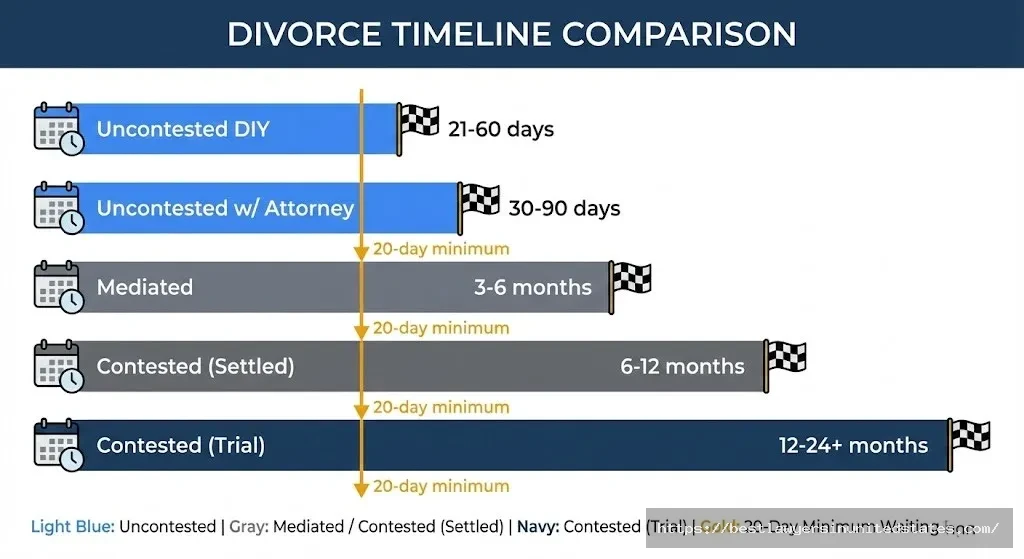
Idaho Divorce Timeline by Type
| Divorce Type | Minimum Timeline | Typical Timeline | Maximum Timeline |
|---|---|---|---|
| Uncontested (DIY) | 20 days | 21-60 days | 90 days |
| Uncontested (with attorney) | 20 days | 30-90 days | 120 days |
| Mediated | 20 days | 3-6 months | 8 months |
| Contested (settled) | 20 days | 6-12 months | 18 months |
| Contested (trial) | 20 days | 12-24 months | 36+ months |
Idaho’s 20-Day Waiting Period
Idaho law requires a mandatory 20-day waiting period after serving divorce papers before the court can finalize your divorce (Idaho Code § 32-705). This cooling-off period allows reconsideration and prevents hasty decisions.
Timeline starts: When your spouse is properly served with divorce papers Timeline ends: 20 days later (the earliest the court can finalize the divorce)
Even in completely uncontested cases with full agreement, you cannot finalize your divorce faster than 20 days. Most Idaho counties require 30-45 days minimum due to court scheduling.
What Delays Idaho Divorces?
1. Service Complications (adds 2-8 weeks) If you can’t locate your spouse or they avoid service, the process delays significantly. Service by publication (newspaper) requires multiple weeks and court approval.
2. Incomplete or Incorrect Paperwork (adds 2-6 weeks) The court rejects improperly completed forms, requiring corrections and refiling. Each rejection adds 2-3 weeks.
3. Discovery Disputes (adds 2-6 months) If one spouse hides assets or refuses to provide financial information, formal discovery becomes necessary, lengthening the timeline substantially.
4. Custody Evaluations (adds 6-12 weeks) Court-ordered custody evaluations require scheduling, home visits, psychological testing, and report preparation, typically taking 2-3 months.
5. Court Calendar Congestion (adds 4-16 weeks) Idaho district courts, especially in populous counties like Ada and Kootenai, have limited hearing dates. Contested hearings or trials may wait months for available court time.
6. Negotiation Breakdowns (adds 3-12 months) Each time negotiations fail and you return to court for hearings or motion practice, the timeline extends significantly.
7. Appeals (adds 6-18 months) If either party appeals the trial court’s decision to the Idaho Supreme Court, expect an additional 12-18 months before final resolution.
How to Speed Up Your Idaho Divorce
Complete agreement before filing: Finalize settlement terms before paperwork submission.
Hire an experienced attorney: They know procedures and avoid costly mistakes.
Respond promptly: Answer attorney questions immediately, provide requested documents quickly.
Attend mediation early: Resolve disputes before expensive litigation begins.
Be flexible and reasonable: Fighting over minor issues extends timelines unnecessarily.
Complete mandatory classes quickly: If children are involved, finish parenting classes immediately rather than waiting.
Attend all hearings: Missing court dates causes automatic continuances, delaying months.
The fastest Idaho divorces (20-30 days) involve couples who:
- Agree on all terms before filing
- Have no children or complete custody agreements
- Own minimal assets requiring no valuation
- Use correct paperwork from the start
- Both appear at the final hearing promptly
Frequently Asked Questions
How much does a simple divorce cost in Idaho?
A simple uncontested divorce in Idaho costs $207-$500 for DIY filing (court fees, service, forms) or $1,500-$3,000 with attorney assistance. This assumes no children, minimal assets, complete agreement, and uncontested proceedings.
What is the cheapest way to get a divorce in Idaho?
The cheapest divorce method is DIY filing for uncontested divorces with no children and minimal assets. Use free Idaho Supreme Court forms, file yourself for $207-$221, serve via certified mail for $12, and represent yourself at the final hearing. Total cost: $220-$500.
Do I need a lawyer for a divorce in Idaho?
No, Idaho allows self-representation (pro se) in divorce cases. You need a lawyer if you have contested issues, complex assets, business ownership, custody disputes, or feel uncomfortable with legal procedures. Simple uncontested divorces often work as DIY cases.
How much does a divorce lawyer cost in Idaho?
Idaho divorce attorneys charge $150-$450 per hour depending on experience. Initial retainers range from $1,500-$10,000. Flat fees for simple uncontested divorces run $1,500-$3,000. Total attorney costs vary from $2,000 (uncontested) to $25,000+ (complex contested).
Is Idaho a 50/50 divorce state?
No, Idaho uses “equitable distribution,” not 50/50 community property division. Courts divide marital property fairly based on factors like marriage length, earning capacity, age, health, and contributions. Divisions often range from 45/55 to 60/40 depending on circumstances.
What is a wife entitled to in a divorce in Idaho?
Idaho has no automatic entitlements based on gender. Courts consider marriage length, earning capacity, age, health, contributions, and economic circumstances when dividing property and awarding spousal support. Both spouses have equal rights to fair property division and potential alimony regardless of gender.
How long does an Idaho divorce take?
Idaho requires a 20-day minimum waiting period after serving divorce papers. Uncontested divorces finalize in 21-90 days, mediated divorces take 3-6 months, and contested divorces require 6-24+ months depending on complexity and court scheduling.
Can I get a fee waiver for Idaho divorce filing?
Yes, low-income filers can request fee waivers by completing Idaho’s Application to Waive or Defer Fees and Costs (CAO Form 1-23). Generally, those receiving public benefits or earning below 125% of federal poverty level qualify. The waiver covers filing fees and service costs.
What disqualifies you from alimony in Idaho?
Idaho has no automatic disqualifications. Courts consider fault in marriage breakdown, each spouse’s financial resources, earning capacity, and length of marriage when determining spousal maintenance. Adultery, abandonment, or other fault factors may reduce or eliminate alimony awards.
How much does it cost to file for divorce in Idaho?
Idaho filing fees range from $207-$221 depending on the county. This covers only the court filing fee. Additional costs include service of process ($50-$125), attorney fees (if hired), parenting classes (if children), and document preparation services (if used).
Who pays divorce attorney fees in Idaho?
Each spouse typically pays their own attorney fees. However, Idaho courts can order one spouse to contribute toward the other’s attorney fees if there’s significant income disparity and the lesser-earning spouse cannot afford representation (Idaho Code § 32-704).
How much does divorce mediation cost in Idaho?
Divorce mediators in Idaho charge $150-$300 per hour. Most couples need 4-10 hours of mediation to resolve all issues. Total mediation costs range from $2,000-$5,000 for a complete divorce, which is significantly less than contested litigation.
Can I get free legal help for divorce in Idaho?
Yes, Idaho Legal Aid Services provides free legal assistance to qualifying low-income residents (generally those below 125% of poverty level). Contact them at (208) 746-7541 or visit idaholegalaid.org. The Idaho Volunteer Lawyers Program also offers pro bono services for qualifying individuals.
What are grounds for divorce in Idaho?
Idaho allows no-fault divorce based on “irreconcilable differences” without proving wrongdoing. You can also file fault-based divorce for adultery, extreme cruelty, willful desertion, neglect, habitual intemperance, conviction of a felony, or permanent insanity. Most people use irreconcilable differences.
How is child support calculated in Idaho?
Idaho uses income shares model guidelines considering both parents’ gross income, number of children, health insurance costs, and childcare expenses. The state provides online calculators. Courts can deviate from guidelines based on special circumstances, but most follow the standard formula.
Do you have to go to court to get divorced in Idaho?
Most Idaho divorces require at least one brief court appearance for the final hearing, even if uncontested. Some counties waive final hearings if all paperwork is complete and proper. Contested divorces involve multiple court appearances for temporary orders, hearings, and potentially trial.
How much does a QDRO cost in Idaho?
Qualified Domestic Relations Orders (QDROs) for dividing retirement accounts cost $500-$2,500 in Idaho depending on account complexity. Simple 401(k) divisions run $500-$750, while multiple accounts or pensions requiring actuarial calculations cost $1,500-$2,500.
Can my spouse block our divorce in Idaho?
No, Idaho is a no-fault state. Your spouse cannot prevent divorce by refusing to agree or participate. If they don’t respond to divorce papers, you can obtain a default judgment. However, non-cooperation makes the process longer and more expensive.
What is the 10-10-10 rule for divorce?
The 10-10-10 military pension rule states that the Defense Finance and Accounting Service (DFAS) will directly pay a former spouse their share of military retirement if the marriage lasted at least 10 years overlapping with 10 years of military service. This is federal law, not specific to Idaho, but affects military divorces there.
How much does a custody evaluation cost in Idaho?
Court-ordered custody evaluations in Idaho cost $2,000-$5,000. These comprehensive assessments include parent interviews, child interviews, home visits, psychological testing, collateral contacts, and detailed written recommendations to the court. Parents typically split the cost equally unless the court orders otherwise.
Next Steps: Getting Started with Your Idaho Divorce
Making informed decisions about your divorce starts with understanding costs, options, and available resources. Whether you pursue DIY filing, mediation, or full attorney representation, careful planning reduces both expenses and stress.
Immediate Actions:
- Gather financial documents: Collect tax returns, bank statements, property deeds, retirement account statements, and debt information. Organized records save attorney time (and your money) and ensure complete financial disclosure.
- Explore free resources: Visit Idaho Legal Aid Services (idaholegalaid.org) to access free forms, instructions, and determine if you qualify for free legal help based on income.
- Calculate your costs: Use the divorce cost calculator to estimate expenses based on your specific situation, including assets, children, and cooperation level.
- Consider mediation: If you and your spouse can communicate respectfully, mediation offers substantial savings compared to contested litigation while providing professional guidance.
- Consult an attorney: Most Idaho family law attorneys offer free or low-cost initial consultations ($0-$100). Even if you plan DIY divorce, a brief consultation helps identify potential issues you might miss.
- Apply for fee waivers if needed: Don’t let the $207-$221 filing fee prevent starting your divorce. Complete the fee waiver application if you qualify based on income.
- Complete mandatory education: If you have children, start the parenting class requirement early rather than waiting. This prevents delays when you’re ready to finalize.
Remember: While divorce involves costs, informed decisions and strategic planning help you control those expenses. Most Idaho divorces cost far less than the worst-case scenarios because couples find ways to cooperate and avoid expensive courtroom battles.
The emotional and financial cost of remaining in an unhealthy marriage often exceeds divorce expenses. Focus on making the best decisions for your long-term wellbeing and financial security.
Legal Disclaimer: This article provides general information about divorce costs in Idaho and does not constitute legal advice. Divorce laws and procedures vary by county and individual circumstances. Consult with a licensed Idaho family law attorney for advice specific to your situation. The cost figures presented represent typical ranges based on 2026 data and may vary. Court fees, attorney rates, and legal requirements are subject to change.