
Massachusetts minimum wage is $15.00 per hour in 2026, with no scheduled increases. This rate has remained unchanged since January 1, 2023. Tipped workers earn $6.75 per hour plus tips, and all employees are entitled to time-and-a-half for hours over 40 per week.
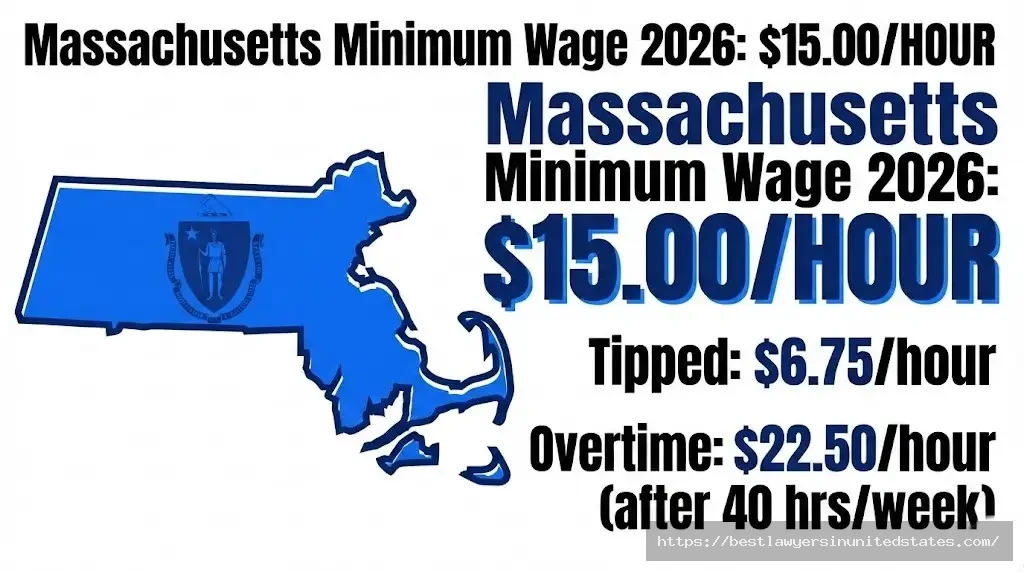
This guide covers everything Massachusetts workers and employers need to know about minimum wage laws, tipped employee rules, overtime pay, wage theft recovery, and the state’s unique labor regulations including the 3-hour reporting pay rule and recent Sunday premium pay elimination.
Calculate Your Earnings in Massachusetts
Want to know exactly how much you’ll earn at Massachusetts’s $15.00 minimum wage? Use our free calculator to estimate your weekly, monthly, and annual income based on your hours worked.
💰 Minimum Wage Earnings Calculator
Calculate your weekly, monthly, and annual earnings with overtime and tax estimates
📊 Your Earnings Breakdown
💰 Gross Earnings
Calculator features:
- Automatic Massachusetts wage rates for 2026
- Weekly, monthly, and annual earnings
- Overtime calculations
- Tax withholding estimates
- Take-home pay breakdown
Full calculator with all features: https://bestlawyersinunitedstates.com/minimum-wage-calculator/
Questions about your wages or need legal help?
Email: [email protected]
What Is the Minimum Wage in Massachusetts in 2026?
Massachusetts minimum wage is $15.00 per hour as of 2026. This rate became effective on January 1, 2023, and remains unchanged for 2026 and 2027. The state has no scheduled increases, unlike many neighboring states that index wages to inflation.
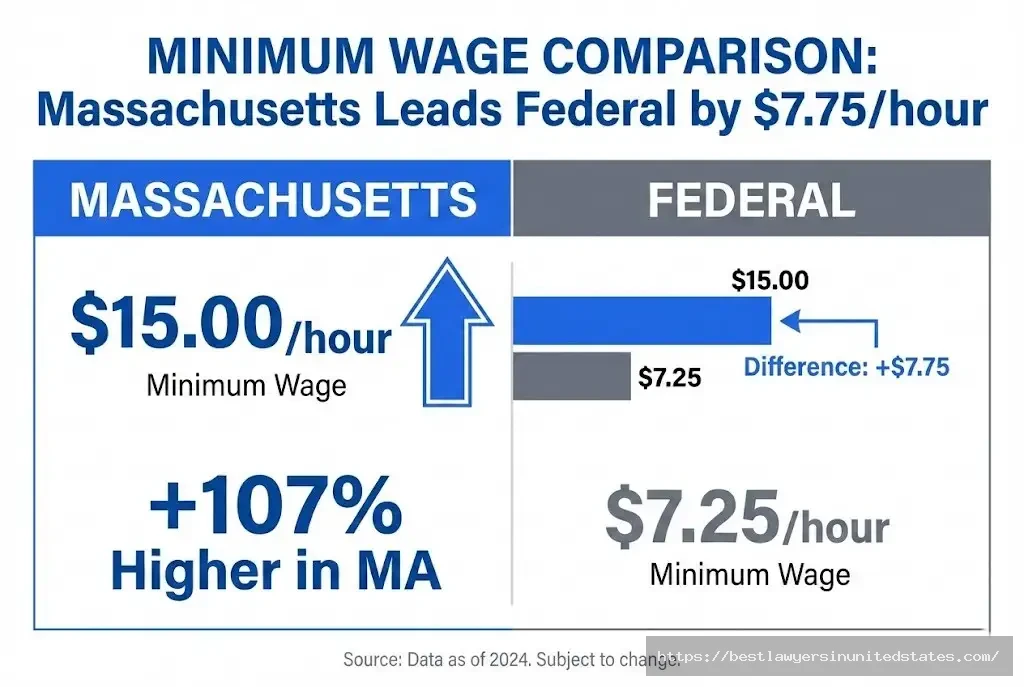
This rate applies to all non-exempt employees aged 18 and older working in Massachusetts. The state minimum wage is $7.75 higher than the federal minimum wage of $7.25 per hour.
Monthly and Annual Earnings at Massachusetts Minimum Wage
Full-time workers earning Massachusetts minimum wage can expect these earnings before taxes:
| Hours Per Week | Weekly Gross Pay | Monthly Gross Pay | Annual Gross Pay |
|---|---|---|---|
| 40 hours (full-time) | $600 | $2,600 | $31,200 |
| 30 hours (part-time) | $450 | $1,950 | $23,400 |
| 20 hours (part-time) | $300 | $1,300 | $15,600 |
Important note: These are gross earnings before taxes and deductions. Your actual take-home pay will be lower after federal income tax, state income tax, Social Security, and Medicare deductions.
How Massachusetts Compares to Federal Minimum Wage
| Jurisdiction | Minimum Wage 2026 | Difference |
|---|---|---|
| Massachusetts | $15.00/hour | Baseline |
| Federal (FLSA) | $7.25/hour | -$7.75 |
| Advantage | Massachusetts | +107% higher |
Key point: When state and federal minimum wages differ, employers must pay the higher rate. Massachusetts workers always receive $15.00 per hour minimum.
Massachusetts Minimum Wage History: 1912 to 2026
Massachusetts holds a unique place in labor history as the first state to establish a minimum wage law in 1912. That groundbreaking legislation covered women and children only. Today, Massachusetts maintains one of the nation's highest state minimum wages.
Timeline of Recent Increases
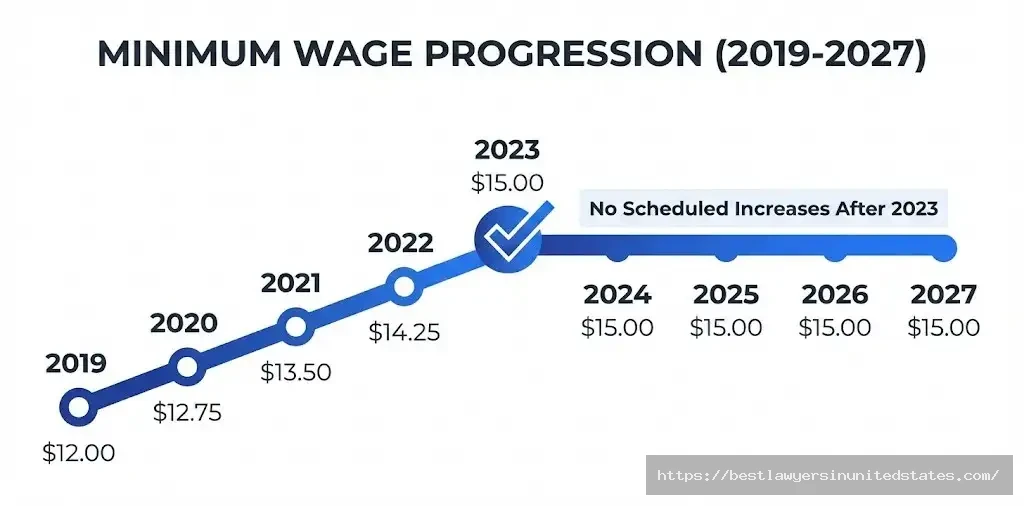
The current $15.00 minimum wage resulted from legislation passed in 2018 that scheduled gradual increases:
| Effective Date | Minimum Wage | Tipped Wage | Annual Increase |
|---|---|---|---|
| January 1, 2019 | $12.00 | $4.35 | +$0.75 |
| January 1, 2020 | $12.75 | $4.95 | +$0.75 |
| January 1, 2021 | $13.50 | $5.55 | +$0.75 |
| January 1, 2022 | $14.25 | $6.15 | +$0.75 |
| January 1, 2023 | $15.00 | $6.75 | +$0.75 |
| January 1, 2026 | $15.00 | $6.75 | No change |
| January 1, 2027 | $15.00 | $6.75 | No scheduled increase |
Critical difference from other states: Massachusetts does not index minimum wage to inflation. The rate stays at $15.00 unless the legislature passes new increases. States like California and Colorado automatically adjust wages annually based on cost of living changes.
Massachusetts as a Labor Rights Pioneer
Massachusetts enacted the nation's first minimum wage law on June 4, 1912. The law created a commission to set minimum wages for women and children in specific industries. This pioneering legislation influenced labor standards nationwide and eventually led to the federal Fair Labor Standards Act of 1938.
Massachusetts Tipped Minimum Wage for Servers & Bartenders
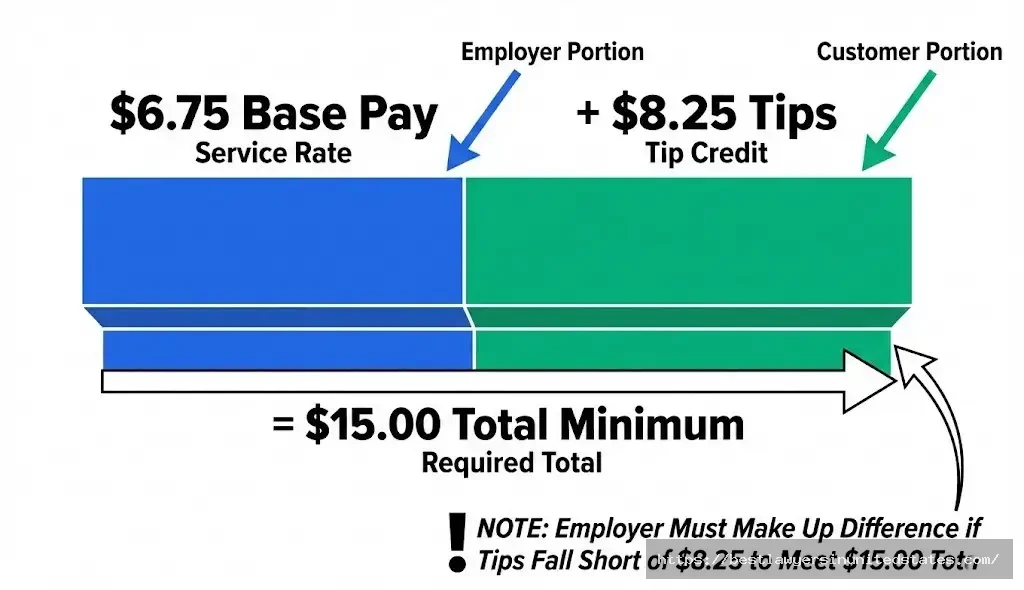
Massachusetts allows a "service rate" for tipped employees that differs from the regular minimum wage. This rate is $6.75 per hour in 2026, but employers must ensure workers earn at least $15.00 per hour when tips are included.
What Is the Service Rate in Massachusetts?
The service rate (also called tipped minimum wage) is $6.75 per hour for workers who regularly receive more than $20 per month in tips. This includes:
- Restaurant servers and waitstaff
- Bartenders
- Bussers
- Hotel service staff
- Parking attendants
- Hairstylists (if tips are customary)
Legal requirement: M.G.L. c. 151, § 1A mandates that tipped employees must receive at least the full minimum wage ($15.00) when combining their service rate ($6.75) plus tips. If tips don't reach this threshold, employers must make up the difference.
How Tip Credits Work in Massachusetts
Massachusetts law allows employers to take a "tip credit" of $8.25 per hour ($15.00 - $6.75 = $8.25). This means employers can pay $6.75 per hour directly if tips bring total compensation to $15.00 or more per hour.
| Component | Amount |
|---|---|
| Service rate (base pay) | $6.75/hour |
| Maximum tip credit | $8.25/hour |
| Required total compensation | $15.00/hour minimum |
Example calculation:
- Your employer pays you $6.75/hour
- You work 40 hours = $270 base pay
- You earn $330 in tips
- Total compensation = $600 ($15/hour average)
- ✅ Legal - employer meets minimum wage requirement
Example of illegal underpayment:
- Your employer pays you $6.75/hour
- You work 40 hours = $270 base pay
- You earn only $200 in tips
- Total compensation = $470 ($11.75/hour average)
- ❌ Illegal - employer owes you $130 in make-up pay
Recent Ballot Initiative to Eliminate Tip Credits
In 2024, Massachusetts voters rejected Question 5, which would have gradually eliminated the service rate and required all tipped workers to receive the full $15.00 minimum wage plus tips. The measure failed, so the current tip credit system remains in effect for 2026.
Restaurant industry groups argued elimination would force price increases and reduce tipped positions. Worker advocacy groups contended servers deserve full minimum wage regardless of tips. The debate continues in the Massachusetts legislature.
Who Keeps the Tips?
Massachusetts law strictly protects employee tips under M.G.L. c. 149, § 152A:
Allowed:
- ✅ Employees keep 100% of individual tips
- ✅ Voluntary tip pooling among service staff
- ✅ Sharing tips with bussers, hosts, bartenders
Prohibited:
- ❌ Managers or supervisors participating in tip pools
- ❌ Employers keeping any portion of tips
- ❌ Mandatory tip-outs to non-service staff
- ❌ Using tips to cover business expenses
Violation penalties: Employers who illegally take or redistribute tips face treble damages (3x the amount stolen) plus attorney fees under Massachusetts wage law.
Massachusetts-Specific Wage Rules You Need to Know
Massachusetts has unique labor laws that set it apart from most states. Workers and employers must understand these Massachusetts-only rules to stay compliant.
The 3-Hour Reporting Pay Rule
Massachusetts General Law c. 151, § 1B requires employers to pay workers for a minimum of 3 hours when they report for a scheduled shift, even if sent home early.
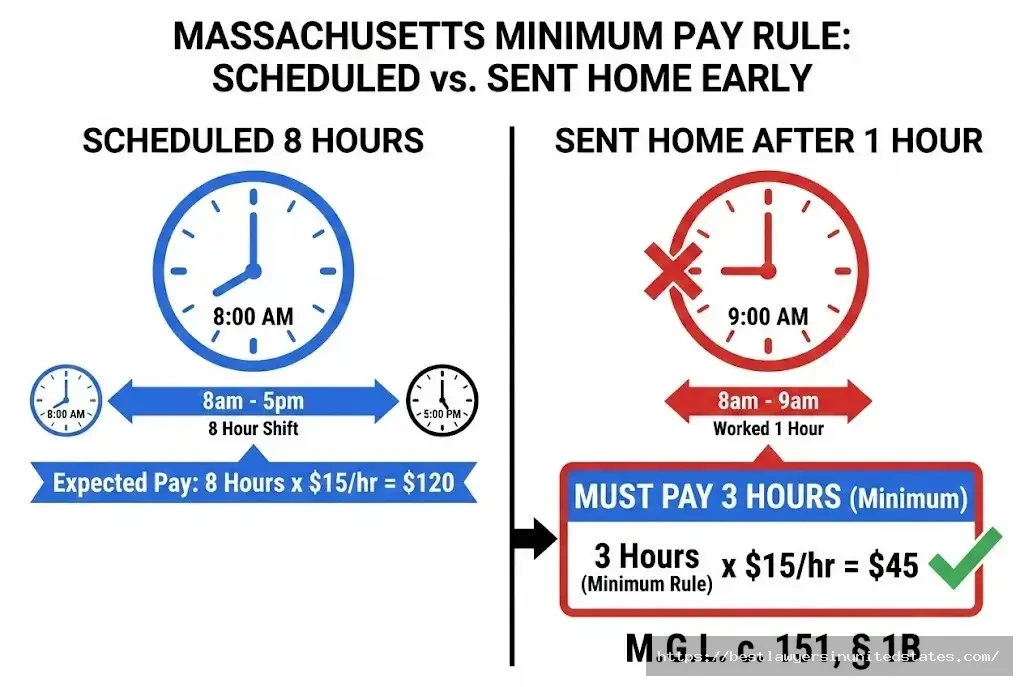
How it works:
- You're scheduled for an 8-hour shift
- You arrive on time
- Your boss sends you home after 1 hour
- Your employer must pay you for 3 hours minimum
When the rule applies:
- ✅ You reported to work as scheduled
- ✅ No work was available or business was slow
- ✅ You were willing and able to work
When the rule doesn't apply:
- ❌ You arrived late or unprepared to work
- ❌ Emergency building closure (fire, natural disaster)
- ❌ You voluntarily chose to leave early
- ❌ You were terminated for cause
Pay calculation for reporting time:
| Scenario | Hours Worked | Hours Paid | Pay Owed (at $15/hour) |
|---|---|---|---|
| Sent home after 1 hour | 1 hour | 3 hours | $45 |
| Sent home after 2 hours | 2 hours | 3 hours | $45 |
| Sent home after 4 hours | 4 hours | 4 hours | $60 |
| Sent home after 6 hours | 6 hours | 6 hours | $90 |
Key takeaway: The 3-hour minimum only applies when you work less than 3 hours. If you work 3 hours or more, you're paid for actual hours worked.
The 7-Minute Rule for Time Clock Rounding
Massachusetts follows federal Department of Labor guidelines on time clock rounding. Employers can round employee time to the nearest 15 minutes, but the rounding must be neutral (not always in the employer's favor).
Legal rounding:
- 1-7 minutes = rounds down to :00
- 8-14 minutes = rounds up to :15
- 16-22 minutes = rounds down to :15
- 23-29 minutes = rounds up to :30
Example of proper rounding:
- Clock in: 8:07 AM → Rounded to 8:00 AM
- Clock out: 5:08 PM → Rounded to 5:15 PM
- Hours worked: 9 hours, 15 minutes
Illegal wage theft through rounding:
- ❌ Always rounding down, never up
- ❌ Rounding to the nearest half-hour or hour
- ❌ Different rounding rules for clock-in vs. clock-out
If your employer consistently rounds against your favor, document your actual times versus paid times and file a wage complaint with the Attorney General's Fair Labor Division.
Sunday and Holiday Premium Pay Elimination (2023)
Critical change: Massachusetts eliminated mandatory Sunday and holiday premium pay on January 1, 2023. Before this change, employers had to pay time-and-a-half (1.5x regular rate) for work on Sundays and certain holidays.
What changed under the 2018 Grand Bargain law:
- ❌ No more automatic Sunday premium pay
- ❌ No more automatic holiday premium pay for most holidays
- ✅ Employers can choose to offer premium pay voluntarily
- ✅ Union contracts may still require premium pay
Retail workers most affected: The old "blue laws" (M.G.L. c. 136) historically restricted Sunday retail operations and required premium pay. These restrictions are now largely eliminated for most businesses.
Exceptions - these holidays may still require premium pay:
- New Year's Day (if specified in employment contract)
- Memorial Day (if specified in contract)
- Independence Day (if specified in contract)
- Labor Day (if specified in contract)
- Columbus Day (if specified in contract)
- Veterans Day (if specified in contract)
- Thanksgiving (if specified in contract)
- Christmas (if specified in contract)
Bottom line: Check your employment contract or union agreement. Sunday and holiday premium pay is no longer required by Massachusetts law but may be negotiated in individual employment agreements.
Massachusetts Overtime Laws & Rates
Massachusetts follows the federal Fair Labor Standards Act (FLSA) for most overtime rules but adds stricter enforcement and reporting requirements under M.G.L. c. 151, § 1A.
Calculate Your Overtime Pay in Massachusetts
Working more than 40 hours per week? Calculate your overtime earnings based on Massachusetts's overtime laws. This calculator accounts for weekly overtime rules and helps you verify your paychecks.
⏰ Overtime Pay Calculator
Calculate your overtime earnings based on your state's specific labor laws
📍 Select Your State
💰 Your Hourly Wage
📊 Calculation Method
📅 Weekly Hours
💵 Your Weekly Overtime Pay
📊 Earnings Breakdown
📅 Pay Period Estimates
⚖️ State vs Federal Comparison
Calculator features:
- Massachusetts-specific overtime rules
- Weekly overtime calculations
- Pay period breakdowns
- Comparison with federal law
- Underpayment detection
Full overtime calculator: https://bestlawyersinunitedstates.com/overtime-pay-calculator/
Questions about your wages or need legal help?
Email: [email protected]
How Overtime Works in Massachusetts
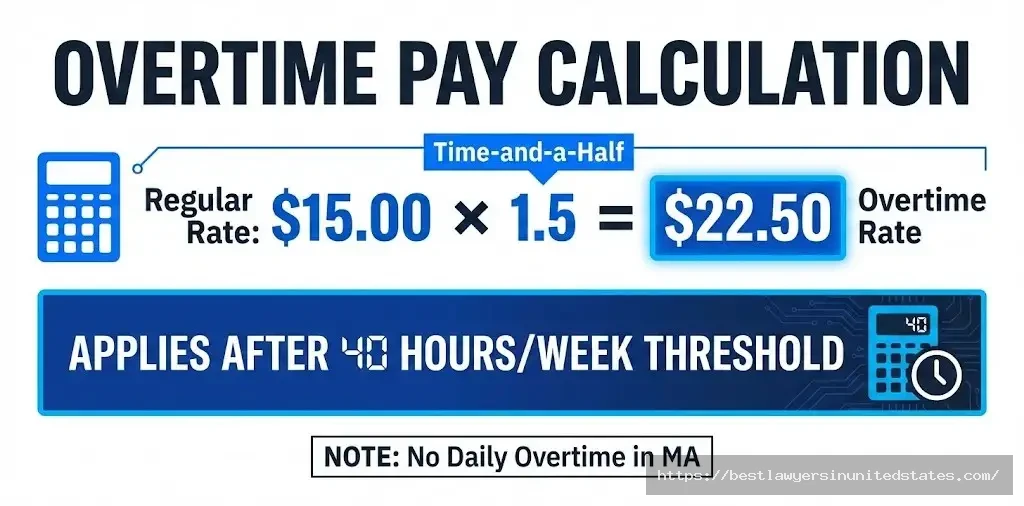
Basic rule: Employees must receive 1.5 times their regular hourly rate for all hours worked over 40 in a workweek.
Overtime calculation:
- Regular rate: $15.00/hour
- Overtime rate: $22.50/hour (1.5 × $15.00)
Massachusetts vs. other states:
| State | Overtime Trigger | Daily Overtime |
|---|---|---|
| Massachusetts | 40 hours/week | ❌ No |
| Federal (FLSA) | 40 hours/week | ❌ No |
| California | 40 hours/week AND 8 hours/day | ✅ Yes |
| Colorado | 40 hours/week AND 12 hours/day | ✅ Yes |
Key difference: Massachusetts has no daily overtime requirement. You don't earn overtime for working 10 hours in one day unless your total weekly hours exceed 40.
Who Is Exempt from Massachusetts Overtime?
Not all employees qualify for overtime pay. Massachusetts recognizes several overtime exemptions under M.G.L. c. 151, § 1A:
Common exemptions:
- Executive, administrative, and professional employees earning at least $684/week ($35,568/year)
- Outside sales employees
- Certain computer professionals earning $27.63/hour or $684/week
- Drivers, helpers, loaders, and mechanics covered by Motor Carrier Act
- Seasonal amusement/recreation employees
- Agricultural workers
Misclassification warning: Many employers incorrectly classify employees as "exempt" to avoid paying overtime. Just because your employer calls you a "manager" doesn't automatically make you exempt. True exempt status requires both a salary threshold AND specific job duties.
Common misclassification examples:
- "Assistant manager" who spends 90% of time doing regular employee work
- "Salaried" employee earning less than $684 per week
- "Independent contractor" who works set hours under company control
If you suspect misclassification, consult the Massachusetts Attorney General's Fair Labor Division or an employment attorney.
Compensatory Time Off Is Illegal for Private Employers
Critical rule: Private sector employers in Massachusetts cannot substitute "comp time" (time off) for overtime pay. This is illegal under both state and federal law.
Illegal practice:
- You work 50 hours one week (10 hours overtime)
- Boss says "Take Friday off next week instead of overtime pay"
- ❌ This violates Massachusetts wage law
Legal requirement:
- You work 50 hours = you must be paid for 50 hours
- 40 regular hours at $15/hour = $600
- 10 overtime hours at $22.50/hour = $225
- Total owed = $825
Exception: Public sector employees (government workers) may be eligible for comp time under specific conditions in collective bargaining agreements.
Massachusetts Break & Meal Period Laws
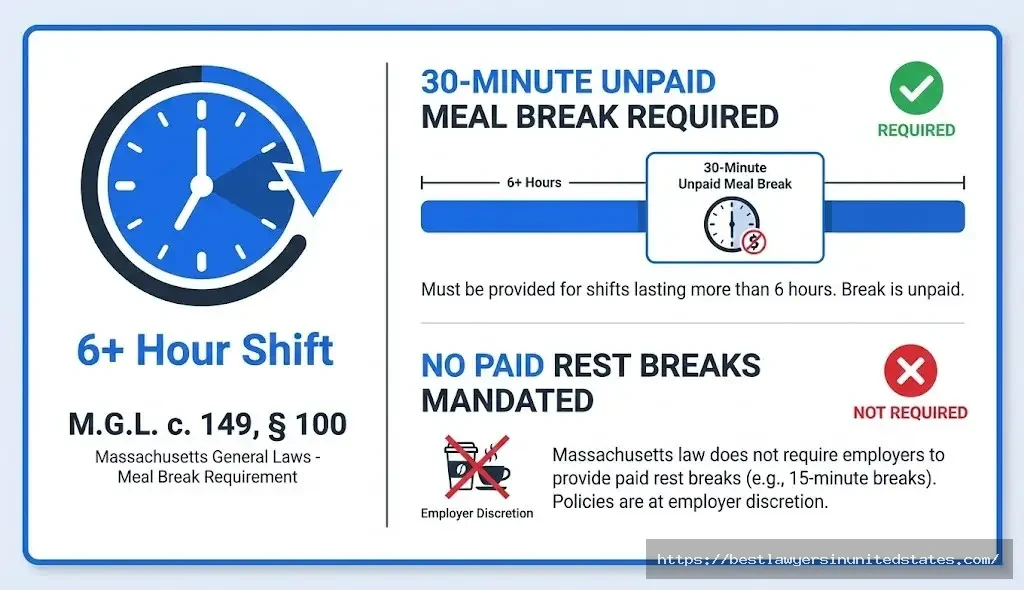
Massachusetts requires unpaid meal breaks but does not mandate paid rest breaks. Understanding these rules helps both employees and employers stay compliant with M.G.L. c. 149, § 100.
30-Minute Meal Break Requirement
Basic rule: Employees working more than 6 hours must receive a 30-minute unpaid meal break.
Requirements:
- ✅ Must be at least 30 consecutive minutes
- ✅ Must occur after first 2 hours but before last 2 hours of shift
- ✅ Employee must be completely relieved of duties
- ✅ Employee must be free to leave workplace
Timing examples for 8-hour shift:
| Shift Start | Earliest Break | Latest Break | Shift End |
|---|---|---|---|
| 9:00 AM | 11:00 AM | 3:00 PM | 5:00 PM |
| 8:00 AM | 10:00 AM | 2:00 PM | 4:00 PM |
Break violation = wage theft: If your employer forces you to work through your meal break or requires you to remain on-call during lunch, you must be paid for that time.
Can You Skip Your Lunch Break?
Short answer: Only if both you and your employer agree in writing, and your shift is less than 6 hours.
Voluntary waiver rules:
- Both parties must agree to skip the meal period
- Agreement should be documented
- Employer cannot pressure employees to skip breaks
- Workers can revoke the agreement at any time
When break cannot be skipped:
- ❌ Shifts longer than 6 hours
- ❌ Under age 18 (minors must take breaks)
- ❌ Employer requires you to remain on duty
Massachusetts Does Not Require Paid Rest Breaks
Unlike some states, Massachusetts law does not mandate short paid rest breaks (like 10-15 minute breaks). However, if your employer chooses to offer short breaks:
Federal law applies:
- Breaks under 20 minutes must be paid
- Breaks must be available to all employees
- Employees cannot be required to work through paid break time
Common employer policies:
- Two 15-minute paid breaks for 8-hour shifts
- One 10-minute paid break for 4-hour shifts
- Additional breaks for nursing mothers (federal law)
Check your employee handbook for your workplace's specific break policies.
Who Is Exempt from Massachusetts Minimum Wage?
Most Massachusetts workers must receive at least $15.00 per hour, but several categories of employees are exempt under state law. Understanding these exemptions helps workers know their rights.
Executive, Administrative, and Professional Exemptions
Salary threshold: To qualify as exempt, you must earn at least $684 per week ($35,568 annually) and perform specific duties.
Executive exemption requirements:
- Primary duty is managing the business or a department
- Regularly supervises two or more full-time employees
- Has authority to hire, fire, or make recommendations about employment status
Administrative exemption requirements:
- Primary duty is office/non-manual work
- Work directly relates to management or business operations
- Exercises discretion and independent judgment on significant matters
Professional exemption requirements:
- Work requires advanced knowledge in science or learning
- Knowledge typically acquired through prolonged specialized instruction
- Includes lawyers, doctors, teachers, accountants, engineers
Common misclassifications:
- Retail "assistant manager" who mostly stocks shelves
- Administrative "assistant" who follows set procedures
- Low-level "professionals" who lack independent judgment
Agricultural Worker Exemptions
Farm workers in Massachusetts face different wage and hour rules under M.G.L. c. 151, § 1A:
Minimum wage: Agricultural workers must receive at least $8.00/hour (not the standard $15.00/hour)
Overtime: Most agricultural workers are exempt from overtime requirements
Who counts as agricultural:
- Workers employed by farms, orchards, nurseries
- Direct farming operations (planting, harvesting, livestock care)
- On-farm processing of agricultural commodities
Who doesn't count:
- Landscaping employees
- Garden center retail workers
- Food processing in factories
Au Pairs and Live-In Domestic Workers
Massachusetts treats live-in domestic workers differently from other employees:
Au pairs: Cultural exchange visitors on J-1 visas who provide childcare must receive weekly stipends meeting federal requirements (approximately $195.75/week in 2026). They are not subject to Massachusetts minimum wage law.
Live-in domestic workers: May be paid a weekly salary rather than hourly wage, but total compensation must exceed minimum wage for all hours worked.
Home health aides: Most are covered by minimum wage and overtime laws unless providing "companionship services" to elderly or disabled individuals.
Other Exemptions
| Worker Category | Minimum Wage Exemption? | Overtime Exemption? |
|---|---|---|
| Student workers (work-study) | ✅ Yes (may be paid 85% of minimum) | ❌ No |
| Seasonal amusement workers | ❌ No | ✅ Yes |
| Newspaper delivery | ✅ Yes | ✅ Yes |
| Commissioned salespeople | ❌ No | ✅ Yes (if meeting requirements) |
| Volunteers (non-profit) | ✅ Yes | ✅ Yes |
Warning: Employers sometimes claim exemptions that don't apply. If you're unsure whether you're truly exempt, contact the Massachusetts Department of Labor Standards or consult an employment attorney.
Living Wage vs. Minimum Wage in Massachusetts
Massachusetts's $15.00 minimum wage sounds substantial, but it falls short of the actual cost of living in many parts of the state. Understanding the gap between minimum wage and living wage helps workers make informed financial decisions.
What Is a Living Wage?
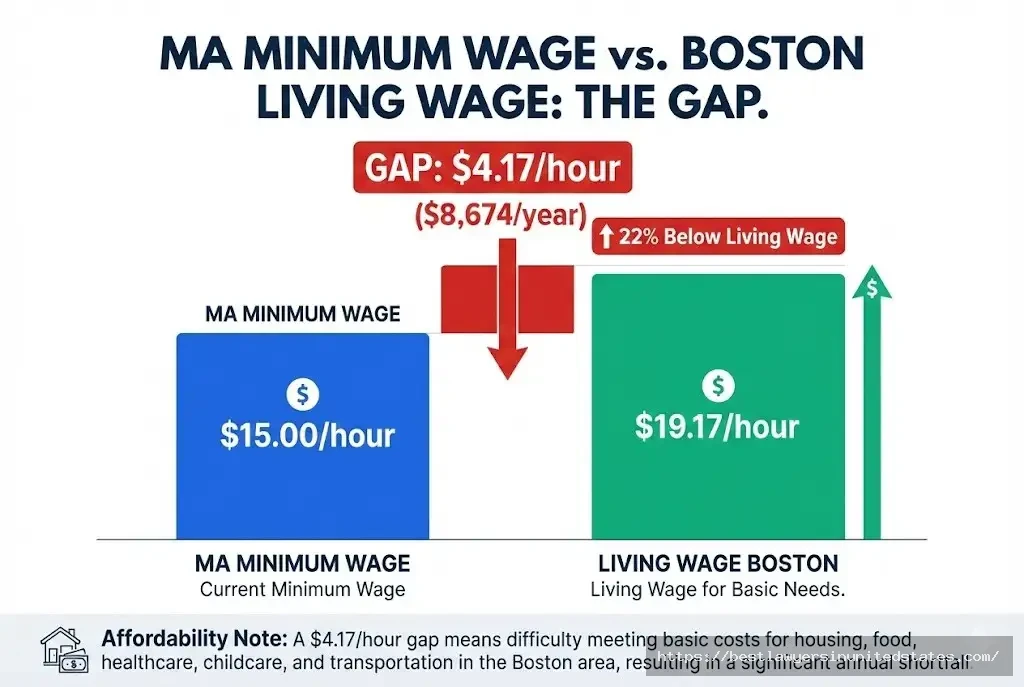
A living wage is the hourly rate needed to cover basic necessities without public assistance or second jobs. The MIT Living Wage Calculator (updated regularly) estimates living wages based on local costs for housing, food, transportation, healthcare, and other essentials.
Massachusetts Living Wage by Household Type (2025 Data)
| Household Type | Living Wage | Annual Income | vs. Minimum Wage |
|---|---|---|---|
| 1 Adult | $19.17/hour | $39,874 | +$4.17/hour |
| 1 Adult, 1 Child | $37.93/hour | $78,894 | +$22.93/hour |
| 1 Adult, 2 Children | $47.00/hour | $97,760 | +$32.00/hour |
| 2 Adults (both working) | $13.49/hour each | $56,099 total | -$1.51/hour |
| 2 Adults, 1 Child | $17.27/hour each | $71,762 total | +$2.27/hour |
Reality check: A single adult working full-time at Massachusetts minimum wage earns $31,200 annually. The MIT Living Wage Calculator estimates $39,874 is needed. That's a gap of $8,674 per year, or 22% below what's considered livable.
Regional Variations in Massachusetts
Cost of living varies significantly across Massachusetts:
Boston Metro Area (highest):
- Living wage for single adult: $21.32/hour
- Minimum wage: $15.00/hour
- Shortfall: $6.32/hour ($13,146 annually)
Springfield/Western Massachusetts (lower):
- Living wage for single adult: $17.28/hour
- Minimum wage: $15.00/hour
- Shortfall: $2.28/hour ($4,742 annually)
Cape Cod (seasonal variation):
- Living wage for single adult: $19.84/hour
- Minimum wage: $15.00/hour
- Shortfall: $4.84/hour ($10,067 annually)
Major expense driving gap: Housing costs in Massachusetts rank among the nation's highest. The average one-bedroom apartment in Boston costs $2,500+/month ($30,000/year), consuming nearly 100% of a minimum wage worker's annual income.
Is Minimum Wage Enough to Live on in Massachusetts?
Short answer: No, not comfortably, especially in Greater Boston.
Breakdown of $31,200 annual minimum wage income:
| Expense Category | Estimated Annual Cost | % of Income |
|---|---|---|
| Housing (1-bedroom) | $18,000-$30,000 | 58-96% |
| Food | $4,000 | 13% |
| Transportation | $2,400 | 8% |
| Healthcare | $3,000 | 10% |
| Other necessities | $2,400 | 8% |
| Total | $29,800-$41,800 | 96-134% |
Key findings:
- Minimum wage covers basic needs only in most affordable areas
- Boston-area workers need roommates or second jobs
- Single parents earning minimum wage require public assistance
- No room for savings, emergencies, or debt repayment
Strategies minimum wage workers use:
- Multiple roommates to split housing costs
- Second jobs or overtime hours
- Public transportation instead of car ownership
- Supplemental programs (SNAP, Section 8, Medicaid)
- Moving to more affordable western Massachusetts
What Would a Living Wage Minimum Be?
Several Massachusetts legislators have proposed increasing minimum wage to $20/hour or indexing it to inflation. However, even $20/hour ($41,600 annually) barely covers living wage for single adults in expensive areas.
For comparison, states with higher minimum wages include:
- Washington: $16.28/hour (2026)
- California: $16.50/hour (2026)
- Connecticut: $15.69/hour (2025) - now higher than Massachusetts
Massachusetts vs. Neighboring States: Minimum Wage Comparison
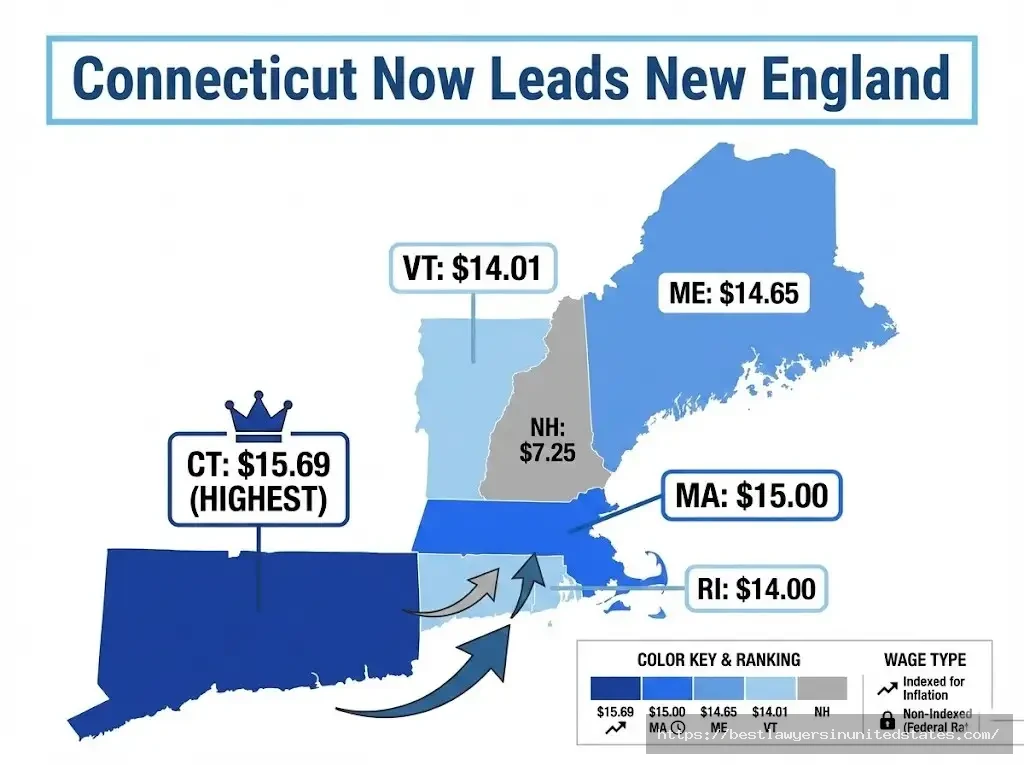
Massachusetts once led New England in minimum wage rates, but several neighboring states now match or exceed the Bay State's $15.00/hour rate. Understanding regional differences helps workers evaluate opportunities across state lines.
New England Minimum Wage Comparison (2026)
| State | Minimum Wage | Tipped Wage | Last Increase | Indexed to Inflation? |
|---|---|---|---|---|
| Massachusetts | $15.00 | $6.75 | Jan 2023 | ❌ No |
| Connecticut | $15.69 | $8.23 | Jun 2025 | ✅ Yes |
| Maine | $14.65 | $7.33 | Jan 2026 | ✅ Yes |
| Vermont | $14.01 | $7.01 | Jan 2026 | ✅ Yes |
| Rhode Island | $14.00 | $3.89 | Jan 2025 | ❌ No |
| New Hampshire | $7.25 (federal) | $2.13 (federal) | 2009 | ❌ No |
Key finding: Connecticut now has the highest minimum wage in New England at $15.69/hour, surpassing Massachusetts for the first time. Connecticut indexes its minimum wage to inflation, meaning it automatically increases each year.
Why Connecticut's Minimum Wage Exceeds Massachusetts
Connecticut passed indexing legislation that ties minimum wage to the Consumer Price Index (CPI). Each year, Connecticut's Department of Labor calculates the adjustment based on inflation. Massachusetts has no such indexing, so the wage remains frozen at $15.00 until the legislature passes new increases.
Practical impact for workers:
- Massachusetts minimum wage buys less each year due to inflation
- Connecticut workers maintain purchasing power through automatic adjustments
- Gap will widen unless Massachusetts legislature acts
New Hampshire's Unusual Position
New Hampshire is the only New England state without a state minimum wage law. Workers receive the federal minimum of $7.25/hour, which hasn't increased since 2009. This creates a significant wage disparity:
- Massachusetts minimum wage worker: $31,200/year
- New Hampshire minimum wage worker: $15,080/year
- Difference: $16,120 annually (113% higher in MA)
Many New Hampshire residents commute to Massachusetts for higher-paying jobs, particularly in the Boston suburbs and along the southern border.
Cross-Border Work Considerations
Working in Massachusetts but living elsewhere:
- You receive Massachusetts minimum wage ($15.00/hour)
- You pay Massachusetts state income tax
- You may owe income tax to your home state (NH has no income tax)
Working remotely for Massachusetts employer:
- Wage laws depend on where you physically work
- If you work from home in New Hampshire, NH wage laws typically apply
- Consult tax professional for state income tax obligations
What Popular Employers Pay in Massachusetts
Many major employers in Massachusetts pay above minimum wage to attract workers in a competitive labor market. Here's what you can typically expect at popular employers based on publicly available data and job postings.
Restaurant and Fast Food Wages
McDonald's Massachusetts:
- Entry-level crew: $16.00-$18.00/hour
- Shift managers: $18.00-$21.00/hour
- General managers: $55,000-$65,000/year
Dunkin' Donuts Massachusetts:
- Crew members: $15.00-$17.00/hour
- Shift leaders: $17.00-$19.00/hour
- Store managers: $45,000-$55,000/year
Starbucks Massachusetts:
- Baristas: $16.50-$18.50/hour
- Shift supervisors: $19.00-$22.00/hour
- Store managers: $60,000-$75,000/year
These wages typically start above minimum wage due to worker shortages and competition with other employers.
Retail Employer Wages
Target Massachusetts:
- Team members: $18.00-$20.00/hour starting
- Department leads: $20.00-$24.00/hour
- Store directors: $100,000+/year
Walmart Massachusetts:
- Associates: $16.00-$18.00/hour
- Department managers: $19.00-$23.00/hour
- Store managers: $90,000-$150,000/year
Amazon Warehouses (Massachusetts):
- Warehouse associates: $18.00-$20.00/hour starting
- Shift managers: $22.00-$26.00/hour
- Area managers: $55,000-$70,000/year
Rideshare Driver Settlement (Uber/Lyft)
Massachusetts reached a landmark settlement with Uber and Lyft in June 2024 requiring minimum pay rates:
Settlement terms:
- Minimum $32.50/hour for "engaged time" (when transporting passengers)
- Paid sick leave
- Occupational accident insurance
- Healthcare stipend for qualifying drivers
Important: The $32.50/hour only applies to engaged time, not waiting time between rides. Average hourly earnings including wait time range from $20-$25/hour depending on location and hours worked.
Note on wage data: Employer wages vary by location, experience, and position. These figures come from Glassdoor, Indeed, company job postings, and news reports as of late 2025. Actual offers may differ.
Wage Theft in Massachusetts: Your Rights & Remedies
Wage theft occurs when employers fail to pay workers their full earned wages. Massachusetts has strong worker protections and allows employees to recover triple damages for wage violations.
Calculate Your Wage Theft Recovery in Massachusetts
Think your employer owes you money? Use our wage theft calculator to estimate how much you could recover, including unpaid wages, penalties, and interest under Massachusetts law.
Wage Theft Recovery Calculator
Estimate how much you can recover in unpaid wages, penalties, and damages based on your state's laws
💵 Estimated Total Recovery
💰 Unpaid Wages
⚖️ Penalties & Damages
📋 Total Summary
Calculator features:
- Multiple violation types (unpaid wages, overtime, tips)
- Massachusetts-specific penalties and damages
- Filing deadline tracker
- Total recovery estimate
- Next steps guidance
Full wage theft calculator: https://bestlawyersinunitedstates.com/wage-theft-calculator/
Need help with unpaid wages?
Email: [email protected]
Common Types of Wage Theft in Massachusetts
Unpaid regular wages:
- Employer doesn't pay for all hours worked
- Bounced paychecks or NSF checks
- Illegal deductions from wages
- Failure to pay final wages upon termination
Unpaid overtime:
- No overtime pay for hours over 40/week
- Miscalculating overtime rate
- Off-the-clock work
- Working through unpaid meal breaks
Tip violations:
- Employer keeping portion of tips
- Forcing tip-outs to non-service staff
- Taking tips to cover business costs
- Not making up difference between $6.75 service rate and $15.00/hour
Misclassification:
- Calling employees "independent contractors" to avoid wage laws
- Misclassifying non-exempt workers as "exempt" to avoid overtime
- Treating employees as "volunteers"
Minimum wage violations:
- Paying less than $15.00/hour
- Illegal "training wage" periods
- Not paying for required work activities (uniform changes, meetings)
How to File a Wage Complaint in Massachusetts
Massachusetts provides multiple pathways for workers to recover unpaid wages:
Option 1: Attorney General's Fair Labor Division
Massachusetts Attorney General's Office handles most wage claims. This process is free to workers.
How to file:
- Gather documentation: Pay stubs, timesheets, work schedules, employment contract, written communications about wages
- Complete complaint form: Available at mass.gov/ago/wagetheft
- Submit within 3 years: Massachusetts statute of limitations for wage claims
- Attend hearing: AG's office investigates and may schedule hearing
- Receive determination: AG can order employer to pay wages plus damages
Contact information:
- Phone: 617-727-3465
- Website: mass.gov/ago/wagetheft
- Boston office: One Ashburton Place, Boston, MA 02108
Option 2: Massachusetts Department of Labor Standards
For certain types of claims, the Department of Labor Standards can investigate:
Contact information:
- Phone: 617-626-6952
- Website: mass.gov/dols
- Address: 19 Staniford Street, 2nd Floor, Boston, MA 02114
Option 3: Private lawsuit
You can hire an employment lawyer and sue directly in court. Benefits include:
- Potentially faster resolution
- Attorney can handle all legal work
- Ability to sue for additional claims (discrimination, retaliation)
Treble Damages: Massachusetts's Powerful Penalty
Massachusetts Wage Act (M.G.L. c. 149, § 150) provides for mandatory treble damages in most wage theft cases. This means:
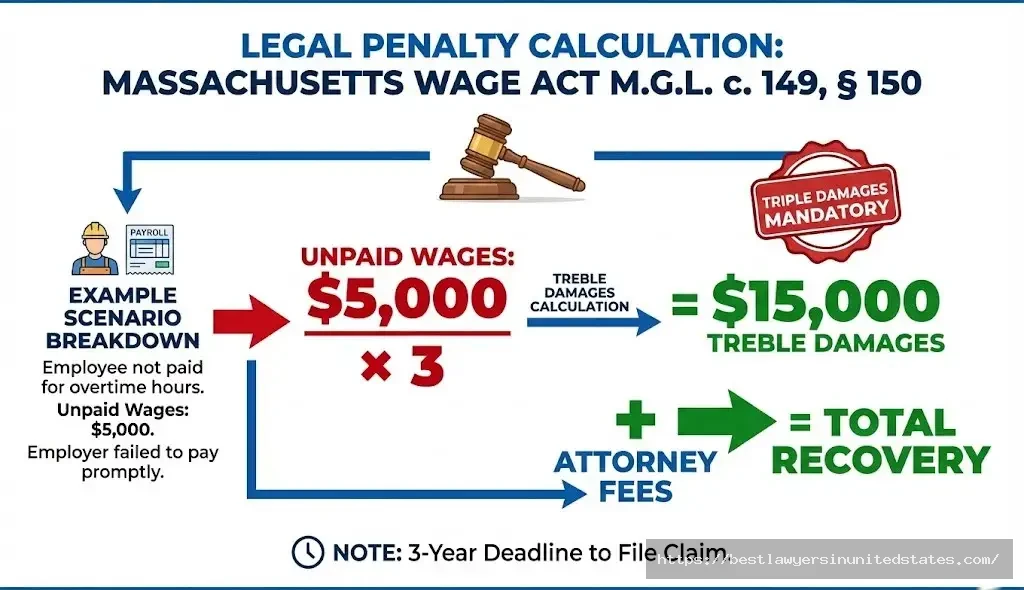
Standard recovery formula:
- Unpaid wages × 3 = Total award
- Plus reasonable attorney fees
- Plus court costs
Example calculation:
- Your employer owes you $5,000 in unpaid overtime
- Treble damages: $5,000 × 3 = $15,000
- Attorney fees: $10,000
- Total recovery: $25,000
When treble damages don't apply:
- Employer proves the violation was based on "good faith" mistake
- Court finds employer had reasonable grounds to believe they were complying
- These defenses rarely succeed
How Long Do You Have to File?
| Claim Type | Statute of Limitations |
|---|---|
| Unpaid wages | 3 years |
| Unpaid overtime | 3 years |
| Tip violations | 3 years |
| Final paycheck not received | 3 years |
| Retaliation for wage complaint | 3 years |
Critical deadline: You must file within 3 years from when wages were due. After 3 years, you lose your right to recover those wages.
Example:
- Unpaid wages from January 2023
- File by January 2026
- File in February 2026 = too late, claim barred
Continuing violations: If wage theft is ongoing (like systematic unpaid overtime every week), you can recover for the full 3-year period before filing.
Protection Against Retaliation
Massachusetts law prohibits employer retaliation against workers who:
- File wage complaints
- Testify in wage investigations
- Discuss wages with coworkers
- Report wage violations to authorities
Illegal retaliation includes:
- Firing
- Demotion
- Pay cuts
- Schedule changes (reduced hours)
- Hostile work environment
- Threats or intimidation
Retaliation penalties:
- Reinstatement to job
- Lost wages during time out of work
- Compensatory damages for emotional distress
- Punitive damages
- Attorney fees
If your employer retaliates against you for asserting your wage rights, this creates a separate legal claim worth potentially more than the original wage theft.
Employer Obligations & Compliance
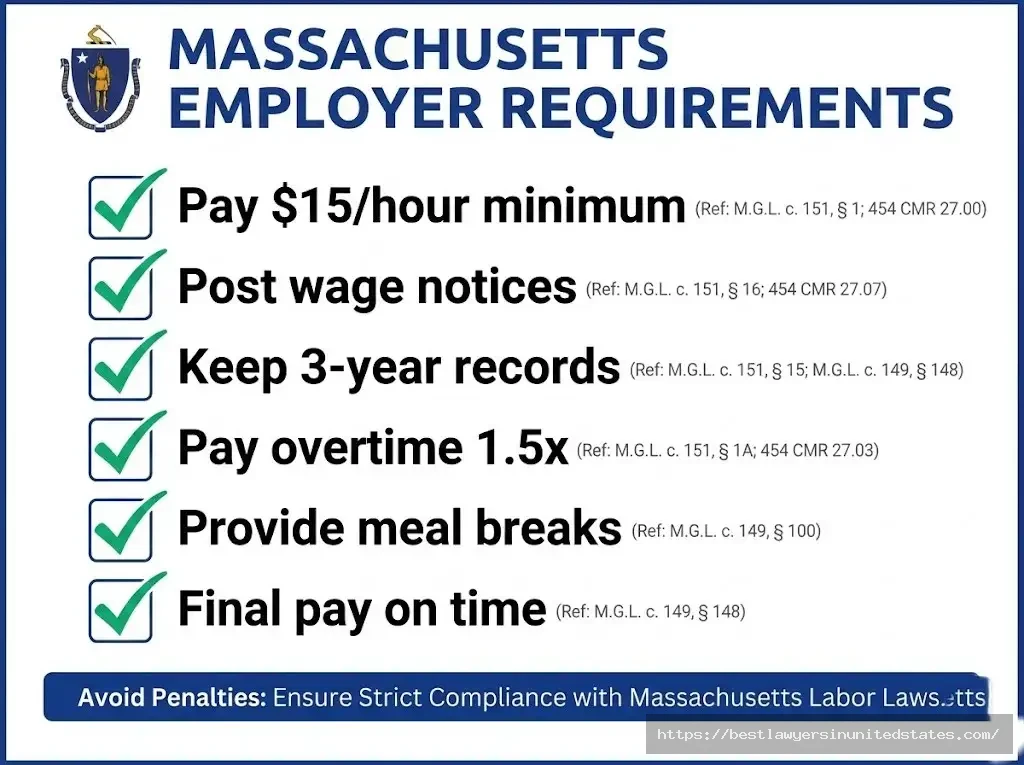
Massachusetts employers must follow specific requirements for paying wages, keeping records, and posting notices. Failure to comply can result in penalties and wage claims.
Wage Payment Timing Requirements
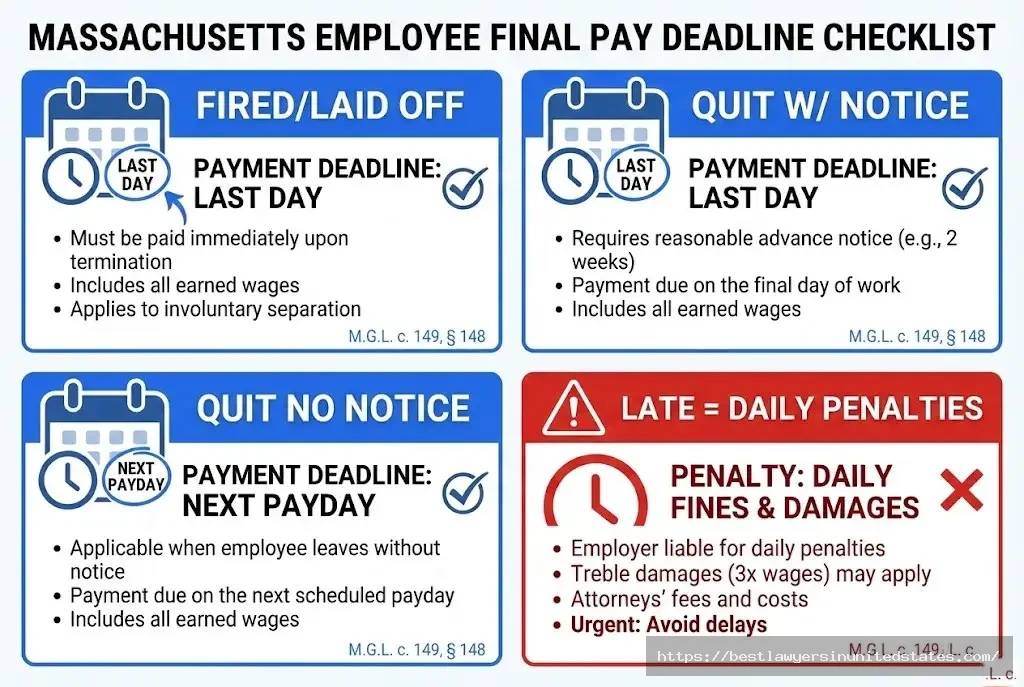
M.G.L. c. 149, § 148 sets strict deadlines for when employers must pay wages:
Regular payday requirements:
- Most employees: weekly or biweekly
- Executive, administrative, professional: monthly permitted
- Must establish and maintain regular paydays
- Cannot change paydays to delay payment
Final paycheck when employment ends:
| Termination Type | Payment Deadline |
|---|---|
| Fired/laid off | Last day of work |
| Resignation without notice | Next regular payday |
| Resignation with 5+ days notice | Last day of work |
Penalties for late final payment:
- Employer owes full day's wages for each day payment is late
- Up to triple damages for willful violations
- Attorney fees if employee must sue
Required Wage Notices
Massachusetts employers must provide written notice to all employees at time of hiring and whenever pay information changes (454 CMR 27.04):
Required information:
- Rate of pay
- Basis of pay (hourly, salary, commission)
- Frequency of pay (weekly, biweekly, etc.)
- Employer's name and contact information
- Employer's physical address
Language requirement: Notice must be provided in employee's primary language if available.
Penalty: $100 per violation, potentially more for systematic violations affecting multiple employees.
Workplace Poster Requirements
Employers must display current Massachusetts minimum wage posters in conspicuous locations where employees can read them:
Required posters:
- Massachusetts minimum wage notice
- Earned sick time notice
- Fair employment practices notice
- Sexual harassment notice
- Parental leave notice
Where to post:
- Break rooms
- Time clock areas
- Main entry areas
- Anywhere employees congregate
Where to obtain: Download free official posters at mass.gov/dols
Penalty: Failure to post can result in citations and fines, plus creates evidence of potential wage violations in any disputes.
Record Keeping Requirements
Employers must maintain accurate records for all employees under 454 CMR 27.05:
Required records (kept for 3 years):
- Name, address, occupation
- Hours worked each day and week
- Hourly rate or salary
- Gross wages earned
- Deductions from wages
- Net wages paid
Time records requirements:
- Daily start and end times
- Meal break start and end times
- Total hours worked each day
- Hours worked each week
Failure to keep records:
- Creates legal presumption in employee's favor in wage disputes
- Employer cannot defend wage claims without proper records
- Additional penalties for systematic recordkeeping failures
Is Massachusetts Raising Minimum Wage to $20?
Massachusetts minimum wage remains at $15.00/hour in 2026 with no scheduled increases. Several proposals to raise the wage to $20/hour or tie it to inflation have been introduced in the state legislature but have not passed as of late 2025.
Current Legislative Proposals
Bill H.1705 - Minimum Wage Increase to $20:
- Would raise minimum wage to $20/hour
- Gradual increases over 3-4 years
- Status: In committee as of December 2025
Bill S.1124 - Inflation Indexing:
- Would tie minimum wage to Consumer Price Index
- Automatic annual adjustments like Connecticut
- Status: Under review
Tipped Wage Elimination:
- After 2024 ballot question failed, some legislators still pushing for full minimum wage for tipped workers
- Would eliminate $6.75 service rate
- Strong opposition from restaurant industry
Why Massachusetts Doesn't Index to Inflation
Unlike neighboring Connecticut, Maine, and Vermont, Massachusetts has no automatic inflation adjustment for minimum wage. Each increase requires new legislation passed by the Massachusetts General Court and signed by the Governor.
Arguments for indexing:
- Maintains purchasing power over time
- Reduces need for contentious legislative fights every few years
- Provides certainty to workers and employers
- Connecticut's successful model
Arguments against indexing:
- Reduces legislative flexibility
- Potential during high-inflation periods to create rapid increases
- Concerns about business costs in economic downturns
- Loss of political negotiation tool
Comparison to $20+ Minimum Wage States
No state currently has a $20/hour statewide minimum wage, but several cities do:
Cities with $20+ minimum wage:
- Tukwila, Washington: $20.29/hour (2026)
- SeaTac, Washington: $19.71/hour (2026)
- Denver, Colorado (by 2027): $20.00+/hour projected
States approaching $20:
- Washington State: $16.28/hour (2026)
- California: $16.50/hour (2026), some cities higher
- Connecticut: $15.69/hour (2025) with annual increases
Massachusetts Cost of Living Analysis
MIT Living Wage Calculator estimates $19.17/hour needed for single adult in Boston to meet basic needs. This suggests $20/hour minimum wage would better align with actual living costs in Greater Boston, though it might exceed living wage needs in rural western Massachusetts.
Regional variation challenge:
- Boston area needs: $21+/hour
- Western Massachusetts needs: $17-18/hour
- Statewide $20 minimum might overcompensate in some areas while remaining insufficient in others
Likely outcome: Massachusetts minimum wage will remain at $15.00/hour through 2026 and possibly 2027 unless the legislature acts. Watch for new bills in 2026 legislative session.
Frequently Asked Questions
What is the minimum wage in Massachusetts in 2026?
Quick Answer: Massachusetts minimum wage is $15.00 per hour in 2026, unchanged from 2023. There are no scheduled increases for 2026 or 2027.
This rate applies to all non-exempt employees age 18 and older. Massachusetts minimum wage is $7.75 higher than the federal minimum wage of $7.25 per hour.
How do I calculate my earnings at Massachusetts minimum wage?
Quick Answer: Use our minimum wage calculator to calculate weekly, monthly, and annual earnings based on hours worked.
Full-time workers (40 hours/week) earn $600 weekly, $2,600 monthly, or $31,200 annually before taxes at $15.00/hour.
What is the tipped minimum wage in Massachusetts?
Quick Answer: Tipped employees in Massachusetts can be paid $6.75 per hour, but total compensation including tips must equal at least $15.00 per hour.
If your tips don't bring you to $15.00/hour average, your employer must make up the difference. This is called "make-up pay" and is legally required under M.G.L. c. 151, § 1A.
How much overtime pay am I entitled to in Massachusetts?
Quick Answer: Massachusetts requires 1.5 times your regular pay rate for all hours over 40 per week. Use our overtime calculator to calculate your overtime pay.
At $15.00/hour minimum wage, overtime rate is $22.50/hour. Massachusetts has no daily overtime requirement - you only earn overtime for weekly hours exceeding 40.
What is the 3-hour rule in Massachusetts?
Quick Answer: If you report to work for a scheduled shift and are sent home early, your employer must pay you for at least 3 hours under M.G.L. c. 151, § 1B.
This applies even if you only work 1 or 2 hours. The rule protects workers from losing income when employers send them home due to slow business or lack of work.
Can my employer pay me less than minimum wage in Massachusetts?
Quick Answer: No, with limited exceptions for students, agricultural workers, and certain exempt employees earning salaries above threshold.
Most workers must receive at least $15.00/hour. If your employer pays less, file a complaint with the Massachusetts Attorney General's Fair Labor Division.
Do I get time and a half on Sundays in Massachusetts?
Quick Answer: No. Massachusetts eliminated mandatory Sunday premium pay on January 1, 2023.
Before 2023, Massachusetts required time-and-a-half pay for Sunday work. This is no longer required by law, though some employers voluntarily offer it or union contracts may require it.
How do I calculate wage theft recovery in Massachusetts?
Quick Answer: Use our wage theft calculator to estimate your recovery including triple damages available under Massachusetts law.
Massachusetts provides treble damages (3x unpaid wages) plus attorney fees for most wage violations. You have 3 years to file a claim from when wages were due.
What if my employer calls me an independent contractor?
Quick Answer: Many employers illegally misclassify employees as independent contractors to avoid wage laws. Massachusetts uses a strict ABC test to determine proper classification.
If your employer controls your work hours, provides tools/equipment, or you perform services integral to their business, you're likely an employee entitled to minimum wage and overtime. Contact the Attorney General's office if misclassified.
Does Massachusetts minimum wage apply to salaried employees?
Quick Answer: Salaried employees earning less than $684/week ($35,568/year) must still receive minimum wage for all hours worked and overtime for hours over 40/week.
Just being paid "salary" doesn't make you exempt from minimum wage laws. Your salary must meet the threshold AND you must perform exempt duties to be excluded from wage and hour protections.
Can my employer deduct money from my paycheck?
Quick Answer: Massachusetts strictly limits paycheck deductions. Employers can only deduct taxes, court-ordered garnishments, and deductions you authorize in writing for your benefit.
Illegal deductions include uniforms, cash register shortages, broken equipment, or business operating costs. Deductions cannot reduce your pay below minimum wage.
How long does my employer have to pay me after I quit?
Quick Answer: If you quit with at least 5 days notice, final pay is due on your last day. If you quit without notice, final pay is due on the next regular payday.
If you're fired or laid off, your employer must pay you immediately on your last day of work. Delays can result in daily penalties equal to your full day's wages.
Massachusetts Minimum Wage Resources
State Agencies
Massachusetts Attorney General's Office - Fair Labor Division
- Purpose: File wage complaints, report wage theft, get help with unpaid wages
- Phone: 617-727-3465
- Website: mass.gov/ago/wagetheft
- Address: One Ashburton Place, Boston, MA 02108
Massachusetts Department of Labor Standards
- Purpose: Workplace safety, wage and hour enforcement, labor law questions
- Phone: 617-626-6952
- Website: mass.gov/dols
- Address: 19 Staniford Street, 2nd Floor, Boston, MA 02114
Massachusetts Executive Office of Labor and Workforce Development
- Purpose: Unemployment insurance, job training, workforce programs
- Phone: 617-626-5400
- Website: mass.gov/eolwd
Federal Resources
U.S. Department of Labor - Wage and Hour Division (Boston)
- Purpose: Federal wage law violations, FLSA complaints
- Phone: 617-624-6700
- Address: JFK Federal Building, Room E-365, Boston, MA 02203
- Website: dol.gov/agencies/whd
Legal Aid Organizations
Greater Boston Legal Services
- Phone: 617-371-1234
- Website: gbls.org
- Services: Free legal help for low-income workers
Massachusetts Law Reform Institute
- Phone: 617-357-0700
- Website: mlri.org
- Services: Policy advocacy, legal resources
MassLegalHelp.org
- Website: masslegalhelp.org
- Services: Legal information, forms, lawyer referrals
Free Calculators
Minimum Wage Calculator:
https://bestlawyersinunitedstates.com/minimum-wage-calculator/
Overtime Pay Calculator:
https://bestlawyersinunitedstates.com/overtime-pay-calculator/
Wage Theft Recovery Calculator:
https://bestlawyersinunitedstates.com/wage-theft-calculator/
Additional Massachusetts Wage Law Articles
For more information about minimum wage laws in other states, see our comprehensive guides:
- Connecticut Minimum Wage - Now highest in New England at $15.69
- Maine Minimum Wage - $14.65 with annual inflation adjustments
- California Minimum Wage - $16.50 statewide, higher in many cities
- Florida Minimum Wage - Gradual increases toward $15
- Illinois Minimum Wage - $15.00, reaching goal in 2025
Questions or concerns about your wages?
Email: [email protected]
