
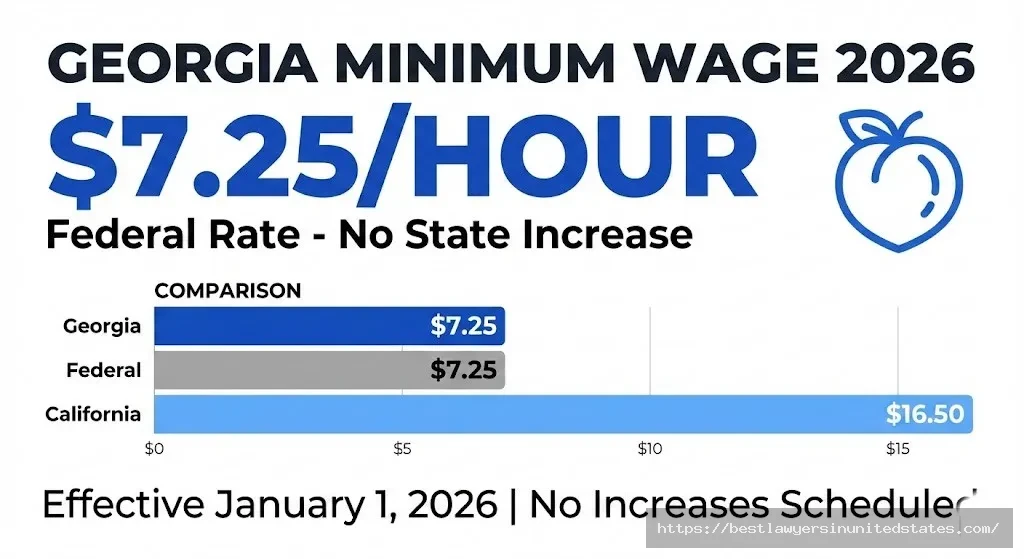
Quick Answer: Georgia’s minimum wage is $7.25 per hour in 2026, which is the federal minimum wage. Georgia’s state minimum wage is technically $5.15/hour, but the federal rate applies to most workers.
Georgia remains one of only five states without a minimum wage increase scheduled for 2026. Workers in the Peach State earn the federal minimum of $7.25/hour, which hasn’t changed since 2009.
This guide covers everything you need to know about Georgia minimum wage laws, including tipped employee rules, overtime pay, wage theft recovery, and how to calculate your earnings. We’ll also explain why Georgia’s wage is so low and whether you can actually live on minimum wage in the state.
Calculate Your Earnings in Georgia
Want to know exactly how much you’ll earn at Georgia’s $7.25 minimum wage? Use our free calculator to estimate your weekly, monthly, and annual income based on your hours worked.
💰 Minimum Wage Earnings Calculator
Calculate your weekly, monthly, and annual earnings with overtime and tax estimates
📊 Your Earnings Breakdown
💰 Gross Earnings
Calculator features:
- Automatic Georgia wage rates for 2026
- Weekly, monthly, and annual earnings
- Overtime calculations
- Tax withholding estimates
- Take-home pay breakdown
Full calculator with all features: Calculate your minimum wage earnings in Georgia
Questions about your wages or need legal help?
[Find Employment Lawyers in Georgia - Free Consultation]
Email: [email protected]
Georgia Minimum Wage 2026: Current Rates by Worker Type
Georgia follows federal minimum wage laws under the Fair Labor Standards Act (FLSA). The state has no plans to increase its minimum wage above the federal level in 2026.
Standard Minimum Wage Rates
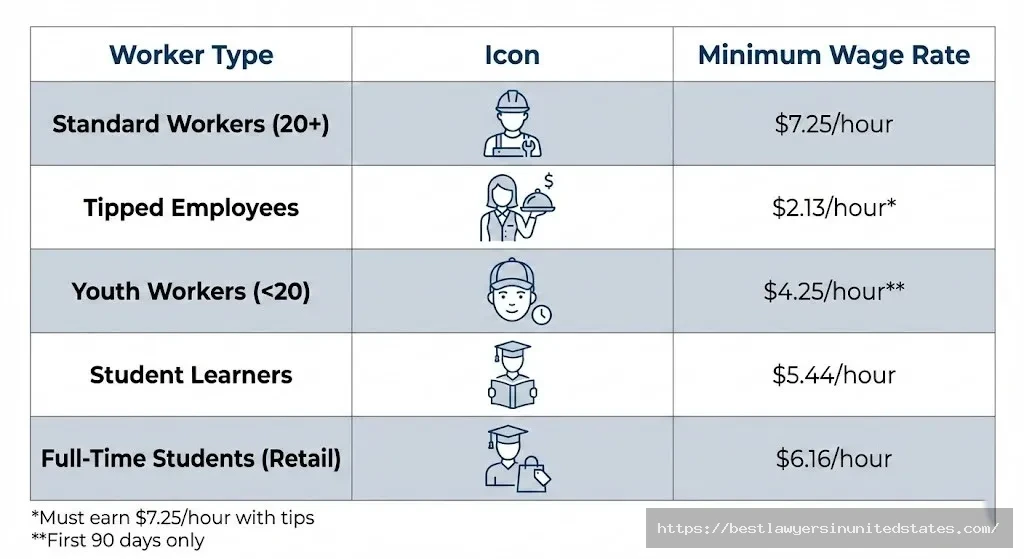
Georgia's minimum wage structure applies different rates to different types of workers. Most employees fall under the standard federal rate.
| Worker Category | Minimum Wage | Overtime Rate | Notes |
|---|---|---|---|
| Standard Workers (Age 20+) | $7.25/hour | $10.88/hour | Federal minimum wage applies |
| Tipped Employees | $2.13/hour | $3.20/hour | Must earn $7.25/hour with tips |
| Youth Workers (Under 20) | $4.25/hour | $6.38/hour | First 90 days only |
| Student Learners | $5.44/hour | $8.16/hour | 75% of minimum wage |
| Full-Time Students (Retail) | $6.16/hour | $9.24/hour | 85% of minimum wage |
Annual Salary at Minimum Wage
Full-time earnings at Georgia's minimum wage:
- 40 hours/week × 52 weeks = $15,080/year (before taxes)
- Monthly: $1,256.67 (before taxes)
- Weekly: $290 (before taxes)
- After 15% taxes: $12,818/year or $1,068/month
These calculations matter because many workers need to know if minimum wage can cover basic living expenses. Spoiler: it can't in most Georgia cities, which we'll cover later.
Federal vs. State Minimum Wage in Georgia: Which One Applies?
Why Georgia Has Two Different Minimum Wages
Georgia's labor law creates confusion because the state has two minimum wages on the books. One is the state minimum wage of $5.15/hour set in 2001. The other is the federal minimum wage of $7.25/hour set in 2009.
The federal minimum wage wins. Under the FLSA, when state and federal minimum wages differ, employers must pay the higher rate.
Who Gets Paid $5.15/Hour?
Only workers not covered by the FLSA can legally earn Georgia's $5.15 state minimum wage. This applies to less than 1% of Georgia workers.
Workers potentially earning $5.15/hour:
- Employees at businesses with less than $500,000 in annual revenue (no interstate commerce)
- Farm workers on small farms (fewer than 500 man-days of labor per year)
- Immediate family members working for family businesses
- Certain seasonal or recreational workers
Everyone else earns at least $7.25/hour under federal law.
Georgia vs. Federal Minimum Wage Comparison
| Jurisdiction | Minimum Wage | Tipped Wage | Last Increase | Next Scheduled Increase |
|---|---|---|---|---|
| Georgia State | $5.15/hour | $2.13/hour | 2001 | None scheduled |
| Federal | $7.25/hour | $2.13/hour | 2009 | None scheduled |
| Effective Rate | $7.25/hour | $2.13/hour | 2009 | None scheduled |
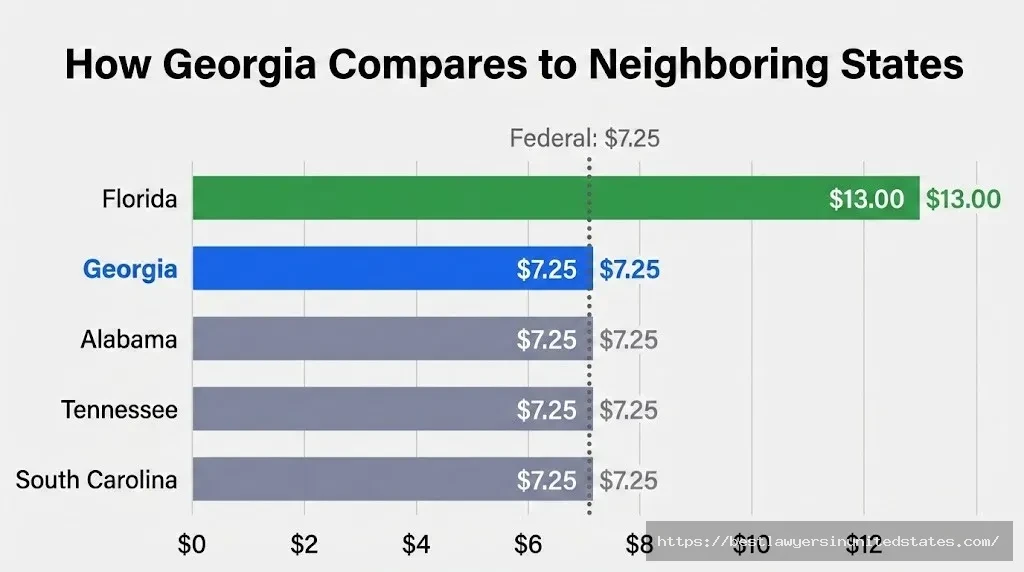
Georgia stands out as one of the few states that hasn't raised its minimum wage above the federal level. Compare this to neighboring Florida's minimum wage, which increased to $13.00 in 2025 and continues to rise annually toward $15.00.
Why Is Georgia's Minimum Wage So Low?
Georgia's $5.15 state minimum wage ties with Wyoming for the lowest in the nation. Even though most workers earn the federal $7.25 minimum, the question remains: why hasn't Georgia updated its state law?
Political and Legislative Factors
Georgia's Republican-controlled legislature has consistently opposed minimum wage increases. State lawmakers argue that higher wages would hurt small businesses and reduce job growth.
The state also lacks a ballot initiative process. Unlike California or Florida, Georgia residents can't petition to put a minimum wage increase directly on the ballot. All wage changes must go through the General Assembly.
No Cost of Living Adjustments
Unlike California, Colorado, or 17 other states, Georgia doesn't tie its minimum wage to inflation. California's minimum wage adjusts automatically based on the Consumer Price Index. Georgia's wage stays frozen regardless of rising costs.
States with automatic inflation adjustments:
- California ($16.50 in 2026)
- Arizona (indexed to inflation)
- Colorado (indexed to inflation)
- Washington ($16.66 in 2026)
Georgia's $5.15 state minimum hasn't changed since 2001. That's 25 years of zero increases.
Business-Friendly Economic Philosophy
Georgia markets itself as a pro-business state with low taxes, minimal regulations, and low labor costs. State officials believe this attracts companies relocating from higher-wage states like New York or California.
This strategy has worked to bring businesses to Georgia. The state added over 100,000 jobs in 2024. But critics argue workers pay the price through stagnant wages that don't keep up with rising housing and food costs.
Federal Preemption Makes State Minimum Irrelevant
Since federal law ($7.25) overrides Georgia's state minimum ($5.15) for 99% of workers, state lawmakers see no urgency to update the law. The $5.15 rate exists on paper but rarely applies in practice.
Comparison to neighboring states:
- Georgia: $7.25/hour (federal only)
- Alabama: $7.25/hour (no state minimum)
- Florida: $13.00/hour (2025), rising to $15.00
- Tennessee: $7.25/hour (no state minimum)
- South Carolina: $7.25/hour (no state minimum)
Only Florida has moved beyond the federal minimum among Georgia's neighbors.
Georgia Tipped Minimum Wage: Rules for Servers and Bartenders
What Is the Tipped Minimum Wage in Georgia?
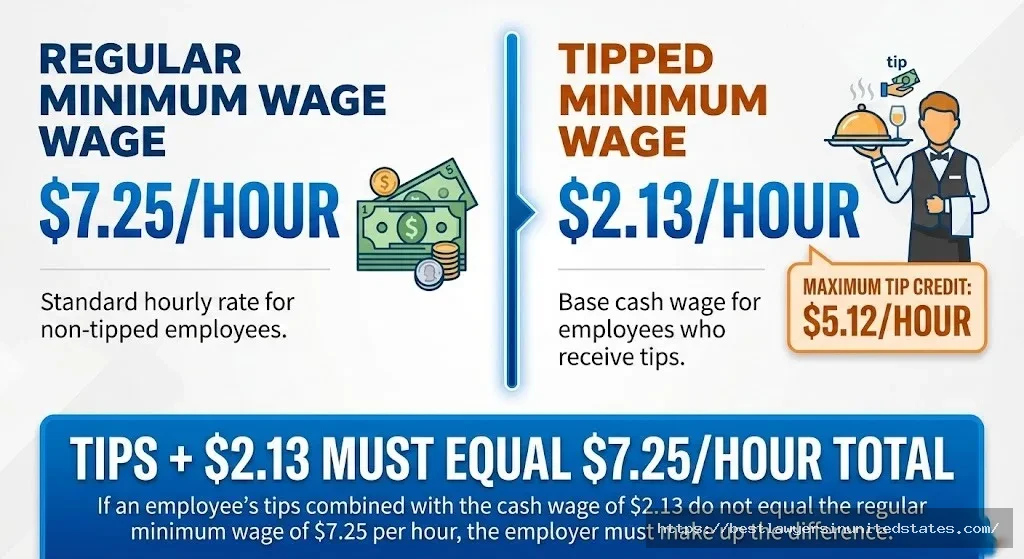
Georgia allows employers to pay tipped workers $2.13 per hour under the federal tip credit system. This is the lowest tipped minimum wage allowed under federal law.
Critical rule: Tipped employees must earn at least $7.25/hour total when you add their base wage ($2.13) plus tips. If tips don't reach this level, the employer must make up the difference.
Who Qualifies as a Tipped Employee?
The FLSA defines tipped employees as workers who regularly earn more than $30 per month in tips. This includes:
Common tipped positions:
- Restaurant servers and waiters
- Bartenders
- Bussers (if they receive tips)
- Valets
- Bellhops and hotel porters
- Delivery drivers who receive tips
- Hair stylists and barbers (in some cases)
How the Tip Credit System Works
Georgia follows the federal tip credit rules under the FLSA. Employers can claim a maximum tip credit of $5.12 per hour (the difference between $7.25 and $2.13).
Example calculation:
- Server works 8 hours, earns $60 in tips
- Base pay: 8 × $2.13 = $17.04
- Tips: $60.00
- Total: $77.04 (meets $7.25/hour minimum = $58.00)
- Employer owes $0 extra
Example with low tips:
- Server works 8 hours, earns $25 in tips
- Base pay: 8 × $2.13 = $17.04
- Tips: $25.00
- Total: $42.04 (below $58.00 minimum)
- Employer must pay $15.96 extra to reach $58.00
Georgia Tip Pooling Rules
Georgia follows federal tip pooling regulations. Employers can require tipped employees to share tips with other service staff, but strict rules apply.
Legal tip pooling:
- ✅ Servers can share tips with bussers, bartenders, and hosts
- ✅ Tip pools must include only regularly tipped employees
- ✅ Each employee keeps a proportional share
Illegal tip pooling:
- ❌ Managers and supervisors cannot participate in tip pools
- ❌ Employers cannot take any portion of employee tips
- ❌ Kitchen staff (cooks, dishwashers) cannot be included in tip pools if they don't regularly receive tips
What if my employer violates these rules? You can file a wage complaint with the Georgia Department of Labor or the U.S. Department of Labor's Wage and Hour Division. Employers who steal tips face penalties including back pay and liquidated damages.
If you're dealing with wage garnishment issues on top of tip violations, you may need legal help to protect your income.
Georgia Minimum Wage for Youth and Training Programs
Youth Minimum Wage (Under Age 20)
Georgia allows employers to pay workers under age 20 a reduced minimum wage of $4.25 per hour for their first 90 consecutive calendar days of employment.
After 90 days, the wage must increase to $7.25 per hour. Employers cannot fire a worker and hire a new young worker to keep paying the youth minimum wage.
Student Learners
Students enrolled in vocational education programs can be paid $5.44 per hour (75% of minimum wage). This requires a certificate from the U.S. Department of Labor and approval from the student's school.
Full-Time Students in Retail or Service
College students working part-time in retail or service jobs can be paid $6.16 per hour (85% of minimum wage). This program has strict limits:
Full-time student wage restrictions:
- Cannot exceed 8 hours per day
- Cannot exceed 20 hours per week when school is in session
- Can work up to 40 hours per week during school breaks
- Requires certificate from U.S. Department of Labor
| Worker Type | Regular Wage | Overtime Rate | Maximum Hours |
|---|---|---|---|
| Youth (Under 20, First 90 Days) | $4.25/hour | $6.38/hour | No limit |
| Student Learners | $5.44/hour | $8.16/hour | Per DOL certificate |
| Full-Time Students | $6.16/hour | $9.24/hour | 20/week (school), 40/week (break) |
Important: These reduced wages don't apply to all young workers. Most teenagers working in fast food, retail, or other common jobs earn the full $7.25 minimum wage.
Minimum Wage by City in Georgia: Atlanta, Savannah, Augusta, and More
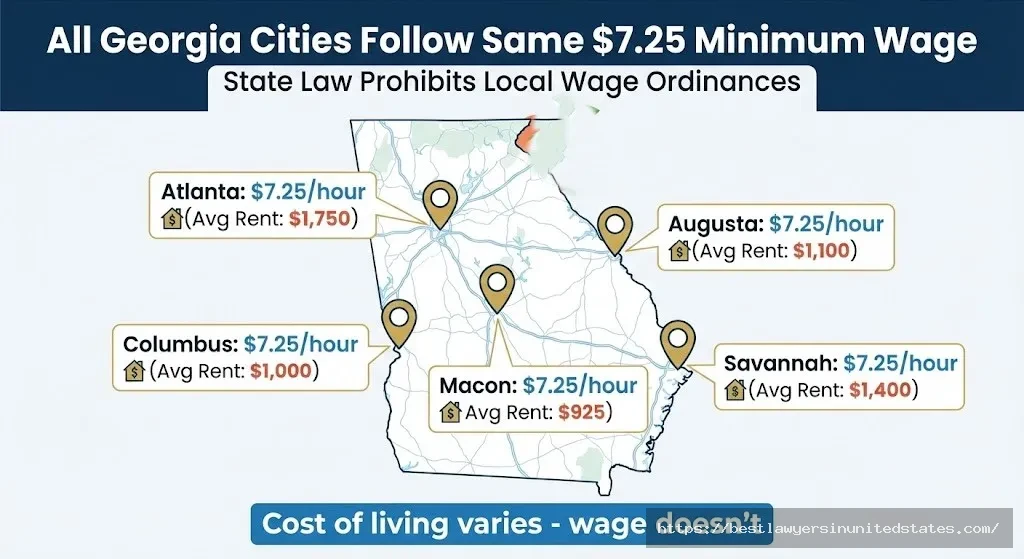
Does Atlanta Have Its Own Minimum Wage?
No. Atlanta does not have a separate city minimum wage. Georgia state law prohibits cities and counties from setting their own minimum wages higher than the state or federal level.
All Georgia cities follow the same minimum wage: $7.25/hour (federal)
This differs significantly from states like California, where cities can set higher local minimums. San Francisco's minimum wage reached $18.07 in 2024, while Los Angeles set its minimum at $17.28.
City-Specific Cost of Living Context
While the minimum wage stays the same across Georgia, the cost of living varies dramatically between cities. Here's how far $7.25/hour actually goes in major Georgia metros.
| City | Minimum Wage | Avg. Rent (1BR) | Livable Wage (Single Adult)* | Monthly Shortfall |
|---|---|---|---|---|
| Atlanta | $7.25/hour | $1,600-1,900/month | $17.50/hour | -$1,500/month |
| Savannah | $7.25/hour | $1,300-1,600/month | $15.50/hour | -$1,200/month |
| Augusta | $7.25/hour | $950-1,250/month | $14.00/hour | -$950/month |
| Columbus | $7.25/hour | $900-1,150/month | $13.50/hour | -$900/month |
| Macon | $7.25/hour | $850-1,050/month | $13.00/hour | -$850/month |
*Livable wage data from MIT Living Wage Calculator
Key insight: Minimum wage doesn't change by city in Georgia, but your ability to survive on it does. A minimum wage worker in Atlanta needs a second job or roommates just to afford rent. In smaller cities like Macon, the situation improves slightly but remains challenging.
Why Can't Georgia Cities Raise Their Minimum Wage?
Georgia state law prohibits local governments from setting their own minimum wages. O.C.G.A. § 34-4-3.1 specifically forbids cities, counties, and other political subdivisions from establishing minimum wages that exceed state or federal levels.
Several Atlanta city council members have proposed local minimum wage ordinances over the years. All have failed because state law preempts local wage laws.
States that allow local minimum wages:
- California (San Francisco: $18.07, Los Angeles: $17.28)
- New York (New York City: $16.00)
- Washington (Seattle: $19.97)
- Colorado (Denver: $18.29)
Georgia is not among them. If you're facing legal issues beyond wage laws, such as DUI charges in Georgia or divorce proceedings, different county and city-specific rules do apply in those areas.
Can You Actually Live on Minimum Wage in Georgia?
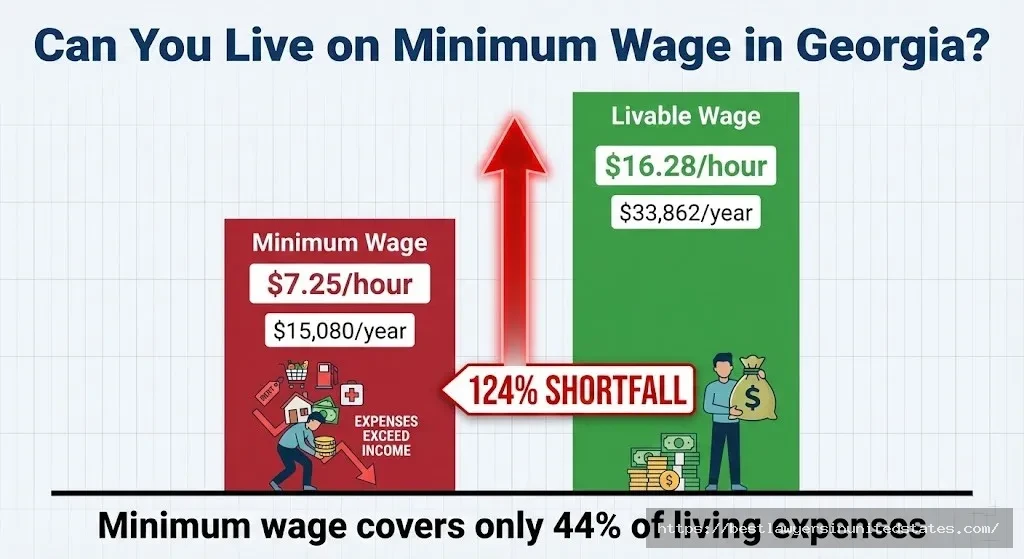
Minimum Wage vs. Livable Wage in Georgia
Georgia's minimum wage of $7.25/hour falls far short of what most economists consider a livable wage. Let's break down the numbers.
Minimum wage annual income:
- $7.25/hour × 40 hours/week × 52 weeks = $15,080/year (before taxes)
- After 15% tax withholding: $12,818/year or $1,068/month
Livable wage in Georgia (MIT Living Wage Calculator):
- Single adult: $16.28/hour ($33,862/year)
- Single adult + 1 child: $32.48/hour ($67,558/year)
- Two adults (one working) + 1 child: $25.89/hour ($53,851/year)
- Two adults (both working) + 2 children: $20.15/hour per adult ($83,824/year combined)
The gap: A single adult needs to earn $16.28/hour just to cover basic expenses in Georgia. That's 124% more than minimum wage.
Monthly Budget Reality Check
Let's look at a real monthly budget for a minimum wage worker in Georgia's most affordable city (Augusta).
After-tax income: $1,068/month
| Expense Category | Monthly Cost | % of Income | Affordable? |
|---|---|---|---|
| Rent (1BR, Augusta) | $950 | 89% | ❌ |
| Food (USDA Low-Cost Plan) | $260 | 24% | ❌ |
| Utilities (Electric, Water, Gas) | $180 | 17% | ❌ |
| Transportation (Gas, Insurance) | $250 | 23% | ❌ |
| Healthcare (Marketplace Plan) | $150 | 14% | ❌ |
| Phone/Internet | $80 | 7% | ❌ |
| TOTAL | $1,870 | 175% | ❌ |
The math doesn't work. Even in Georgia's cheapest city, minimum wage doesn't cover basic expenses. You'd need $1,870 per month but only earn $1,068 per month after taxes.
What Minimum Wage Workers Actually Do
Most minimum wage workers in Georgia survive through:
- Working multiple jobs (60-80 hours per week)
- Living with roommates or family
- Public assistance (SNAP, Medicaid, housing subsidies)
- Side gigs (DoorDash, Uber, freelance work)
- Going without (no healthcare, delayed car repairs, food insecurity)
Georgia ranks 12th worst in the nation for housing affordability for minimum wage workers according to the National Low Income Housing Coalition.
What Do Major Employers Actually Pay in Georgia?
While Georgia's minimum wage remains at $7.25/hour, most major employers pay significantly more to attract and retain workers. The labor shortage following COVID-19 pushed many companies to raise starting wages.
Retail and Food Service Wages in Georgia
| Employer | Starting Wage (Georgia) | Above Minimum? | 2026 Status |
|---|---|---|---|
| Walmart | $14-16/hour | ✅ +106% above minimum | Hiring |
| Target | $15-18/hour | ✅ +113% above minimum | Hiring |
| Amazon | $16-19/hour | ✅ +127% above minimum | Hiring |
| Costco | $17-20/hour | ✅ +141% above minimum | Hiring |
| Starbucks | $13-16/hour | ✅ +86% above minimum | Hiring |
| Chick-fil-A | $12-15/hour | ✅ +72% above minimum | Hiring |
| McDonald's | $10-13/hour | ✅ +44% above minimum | Hiring |
| Kroger | $11-14/hour | ✅ +58% above minimum | Hiring |
| Publix | $12-15/hour | ✅ +72% above minimum | Hiring |
| Home Depot | $13-16/hour | ✅ +86% above minimum | Hiring |
Why Companies Pay Above Minimum Wage
Market forces drive wages higher than the legal minimum. Companies compete for workers, especially in metro Atlanta where unemployment stays below 3%.
Factors pushing wages up:
- Labor shortage: Not enough workers for available jobs
- Competition: Other employers offering more
- Retention costs: Training new workers costs more than paying existing ones better
- Brand reputation: Companies want to be seen as good employers
- Productivity: Better pay often means better work
The takeaway: Very few workers in Georgia actually earn $7.25/hour. Most entry-level jobs start at $10-15/hour. But this market-driven wage floor doesn't help workers in industries that still pay minimum wage, like some restaurants, small retail shops, and agricultural work.
Compare Georgia's market wages to states with higher legal minimums like Arizona ($14.35) or Alaska ($11.73), where even the floor is higher.
Georgia Minimum Wage Exemptions: Who Doesn't Get Minimum Wage?
Not all workers in Georgia are entitled to minimum wage. The FLSA creates several exemptions that apply in Georgia.
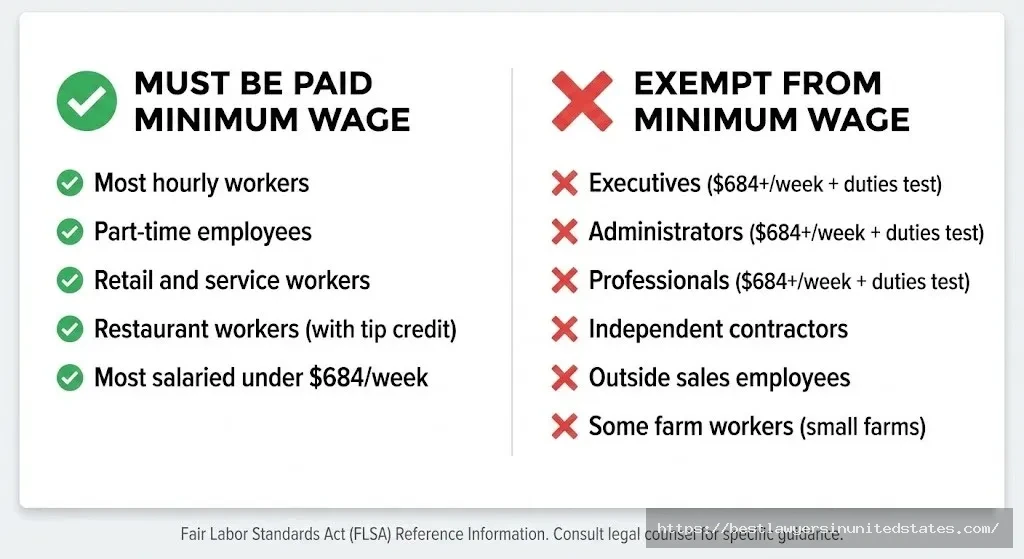
Exempt vs. Non-Exempt Employees
Non-exempt employees must be paid at least minimum wage and receive overtime pay. Most hourly workers fall into this category.
Exempt employees don't have to be paid minimum wage or overtime. To qualify as exempt, workers must meet three tests:
- Salary basis test: Paid a fixed salary (not hourly)
- Salary level test: Earn at least $684 per week ($35,568 per year)
- Duties test: Perform executive, administrative, or professional duties
Common Minimum Wage Exemptions in Georgia
| Worker Category | Exempt from Minimum Wage? | Exempt from Overtime? | Requirements |
|---|---|---|---|
| Executive Employees | ✅ Yes | ✅ Yes | Manage 2+ employees, $684/week salary |
| Administrative Employees | ✅ Yes | ✅ Yes | Office/non-manual work, $684/week salary |
| Professional Employees | ✅ Yes | ✅ Yes | Learned profession, $684/week salary |
| Outside Sales | ✅ Yes | ✅ Yes | Primarily work outside employer's place of business |
| Computer Professionals | ✅ Yes | ✅ Yes | $684/week salary or $27.63/hour |
| Farm Workers | ⚠️ Sometimes | ⚠️ Sometimes | Small farms only |
| Seasonal/Recreational | ✅ Yes | ✅ Yes | Amusement parks, camps |
| Newspaper Delivery | ✅ Yes | ✅ Yes | Carriers only |
| Independent Contractors | ✅ Yes | ✅ Yes | Not employees under IRS tests |
Independent Contractors vs. Employees
Many employers misclassify workers as independent contractors to avoid paying minimum wage and benefits. Georgia follows federal law in determining whether someone is an employee or contractor.
Employee indicators:
- Employer controls when and how you work
- Employer provides tools and equipment
- Long-term relationship
- Work is part of employer's core business
Contractor indicators:
- You control your own schedule and methods
- You provide your own tools
- Short-term project basis
- Work is outside employer's core business
Misclassification is illegal. If you're classified as a contractor but work like an employee, you may be entitled to minimum wage and overtime pay. File a complaint with the Georgia Department of Labor.
Agricultural Worker Exemptions
Farm workers in Georgia have limited wage protections. Small farms (fewer than 500 "man-days" of agricultural labor per year) are exempt from federal minimum wage laws.
Covered farm workers (large farms) must receive:
- At least $7.25/hour
- Overtime for hours over 40 per week (in some cases)
Exempt farm workers (small farms):
- No minimum wage requirement
- No overtime requirement
Immediate family members working on family farms are always exempt.
Overtime Pay in Georgia: Rules and Calculations
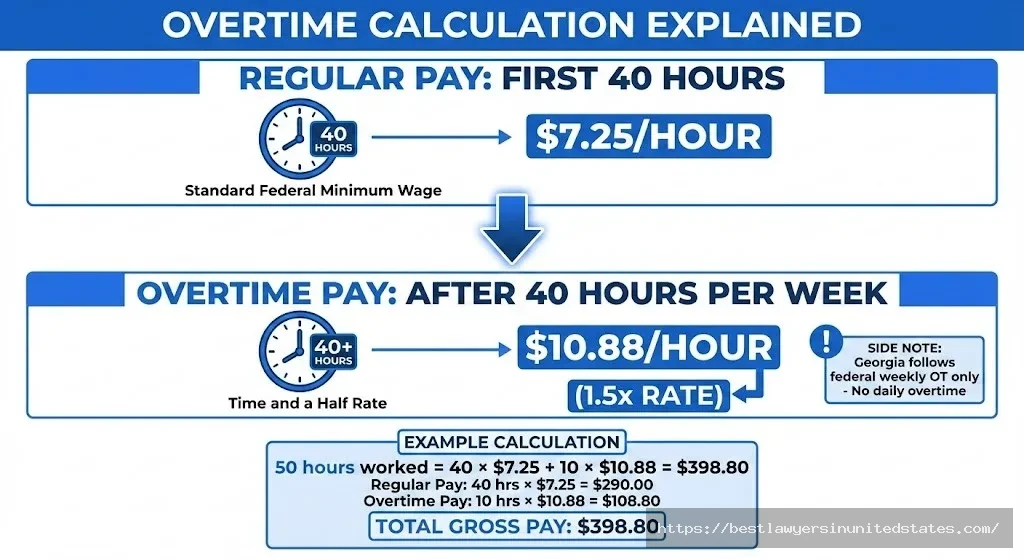
What Is Overtime Pay in Georgia?
Georgia follows federal overtime law under the FLSA. Non-exempt employees must be paid time-and-a-half (1.5× their regular rate) for hours worked over 40 in a workweek.
Georgia has no daily overtime requirement. Unlike California, where workers earn overtime after 8 hours in a day, Georgia only requires overtime after 40 hours in a week.
Georgia Overtime Rates by Worker Type
| Worker Category | Regular Rate | Overtime Rate (1.5×) | Double-Time Rate |
|---|---|---|---|
| Minimum Wage Workers | $7.25/hour | $10.88/hour | N/A |
| Tipped Employees | $2.13/hour | $3.20/hour* | N/A |
| $15/hour Workers | $15.00/hour | $22.50/hour | N/A |
| $20/hour Workers | $20.00/hour | $30.00/hour | N/A |
*Plus tips must equal at least $10.88/hour total
Calculate Your Overtime Pay in Georgia
Working more than 40 hours per week? Calculate your overtime earnings based on Georgia's overtime laws. This calculator accounts for Georgia's weekly overtime threshold and helps you estimate your total pay.
⏰ Overtime Pay Calculator
Calculate your overtime earnings based on your state's specific labor laws
📍 Select Your State
💰 Your Hourly Wage
📊 Calculation Method
📅 Weekly Hours
💵 Your Weekly Overtime Pay
📊 Earnings Breakdown
📅 Pay Period Estimates
⚖️ State vs Federal Comparison
Calculator features:
- Georgia-specific overtime rules (40-hour threshold)
- Weekly overtime calculations
- Pay period breakdowns
- Comparison with federal law
- Tracks regular and overtime hours separately
Full overtime calculator: Calculate your overtime pay
Questions about your wages or need legal help?
[Find Employment Lawyers in Georgia - Free Consultation]
Email: [email protected]
Overtime Calculation Examples
Example 1: Minimum Wage Worker
- Regular wage: $7.25/hour
- Hours worked: 50 hours in one week
- Regular pay (first 40 hours): 40 × $7.25 = $290.00
- Overtime pay (next 10 hours): 10 × $10.88 = $108.80
- Total weekly pay: $398.80
Example 2: $15/Hour Worker
- Regular wage: $15.00/hour
- Hours worked: 55 hours in one week
- Regular pay (first 40 hours): 40 × $15.00 = $600.00
- Overtime pay (next 15 hours): 15 × $22.50 = $337.50
- Total weekly pay: $937.50
Who Is Entitled to Overtime in Georgia?
Non-exempt employees (most hourly workers) must receive overtime pay. Exempt employees do not receive overtime pay.
Workers entitled to overtime:
- Most hourly employees
- Salaried employees earning less than $684/week
- Workers who don't meet executive/administrative/professional duties test
Workers NOT entitled to overtime:
- Salaried employees earning $684+/week who meet duties test
- Independent contractors
- Outside sales employees
- Certain computer professionals
- Some farm workers
Common Overtime Violations in Georgia
Employers sometimes violate overtime laws in these ways:
Illegal practices:
- ❌ Refusing to pay overtime after 40 hours
- ❌ Requiring "off the clock" work
- ❌ Misclassifying employees as exempt
- ❌ Averaging hours across two weeks
- ❌ Paying straight time for overtime hours
- ❌ Retaliating against workers who request overtime pay
If your employer violates overtime laws, you can file a wage complaint with the U.S. Department of Labor's Wage and Hour Division or the Georgia Department of Labor.
Wage Theft and Recovery in Georgia: Know Your Rights
What Is Wage Theft?
Wage theft occurs when employers don't pay workers the full wages they've earned. This is one of the most common workplace violations in Georgia.
Common types of wage theft:
- Not paying minimum wage
- Not paying overtime
- Not paying for all hours worked
- Requiring "off the clock" work
- Taking illegal deductions from paychecks
- Stealing employee tips
- Not paying final paychecks after termination
- Misclassifying employees as contractors
The Economic Policy Institute estimates that wage theft costs workers in the United States over $15 billion per year.
Calculate Your Wage Theft Recovery in Georgia
Think your employer owes you money? Use our wage theft calculator to estimate how much you could recover, including unpaid wages, penalties, and interest under Georgia and federal law.
Wage Theft Recovery Calculator
Estimate how much you can recover in unpaid wages, penalties, and damages based on your state's laws
💵 Estimated Total Recovery
💰 Unpaid Wages
⚖️ Penalties & Damages
📋 Total Summary
Calculator features:
- Multiple violation types (unpaid wages, overtime, tips)
- Georgia-specific penalties and damages
- Federal FLSA penalties
- Filing deadline tracker
- Total recovery estimate
- Next steps guidance
Full wage theft calculator: Calculate your potential wage theft recovery
Need help with unpaid wages? Contact Georgia Department of Labor or consult with an employment attorney.
Questions about your wages or need legal help?
[Find Employment Lawyers in Georgia - Free Consultation]
Email: [email protected]
How to File a Wage Theft Complaint in Georgia
If your employer isn't paying you properly, you can file a wage complaint with state or federal agencies.
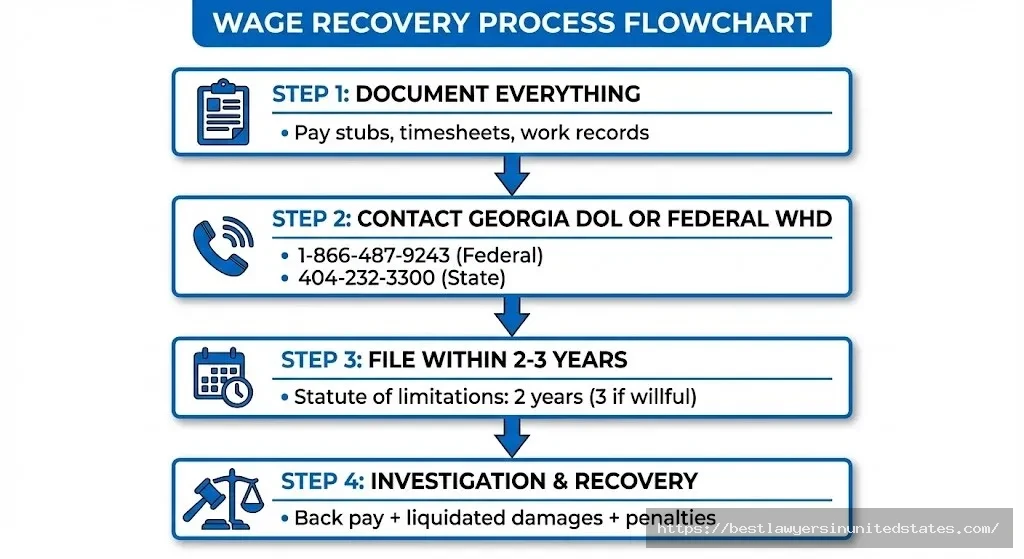
Step 1: Document Everything
Gather evidence of unpaid wages:
- Pay stubs
- Time sheets or time clock records
- Work schedules
- Text messages or emails about hours worked
- Bank statements showing direct deposits
- Notes about conversations with your employer
Step 2: File a Complaint
You have two options for filing a wage complaint in Georgia:
Option 1: Georgia Department of Labor (GDOL)
- Website: gdol.georgia.gov
- Phone: 404-232-3300
- Offices in Atlanta, Savannah, Augusta, Macon, Columbus
- Handles state wage and hour violations
Option 2: U.S. Department of Labor, Wage and Hour Division
- Website: dol.gov/agencies/whd
- Phone: 1-866-487-9243
- Atlanta District Office: 61 Forsyth St SW, Suite 7B75, Atlanta, GA 30303
- Handles federal FLSA violations
Most Georgia workers should file with the federal Wage and Hour Division because the FLSA provides stronger protections than Georgia state law.
Step 3: Investigation
After you file a complaint, investigators will:
- Review your evidence
- Contact your employer
- Request employer payroll records
- Interview you and possibly coworkers
- Determine if violations occurred
Step 4: Recovery
If investigators find violations, your employer must:
- Pay all back wages owed
- Pay liquidated damages (up to 2× back wages)
- Pay interest on unpaid wages
- Face civil penalties
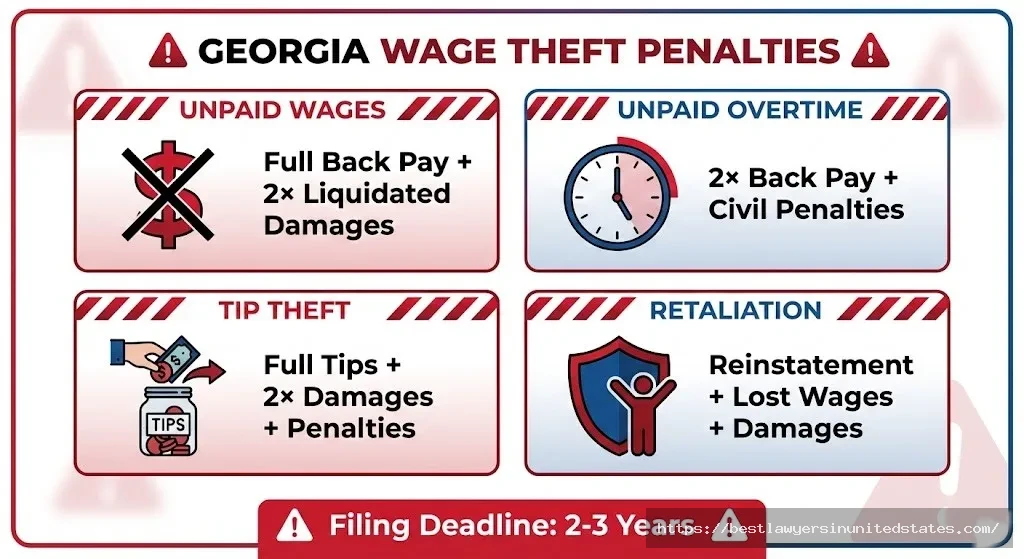
Georgia Wage Theft Penalties and Damages
Georgia and federal law provide different remedies for wage theft.
| Violation Type | Back Pay | Liquidated Damages | Penalties | Statute of Limitations |
|---|---|---|---|---|
| Unpaid Minimum Wage | Full amount owed | 2× back pay | Up to $1,000 per violation | 2-3 years |
| Unpaid Overtime | Full amount owed | 2× back pay | Up to $1,000 per violation | 2-3 years |
| Tip Theft | Full tips owed | 2× back pay | Up to $1,000 per violation | 2-3 years |
| Final Paycheck Delay | Full amount owed | N/A | N/A | 2-3 years |
| Retaliation | Reinstatement + lost wages | 2× back pay | Additional damages | 2-3 years |
Statute of limitations: You have 2 years to file a wage claim for most violations. If the violation was "willful" (intentional), you have 3 years.
Example calculation:
- Unpaid wages: $3,000
- Liquidated damages: $6,000
- Civil penalty: $1,000
- Total recovery: $10,000
What If Your Employer Retaliates?
It's illegal for employers to retaliate against workers who file wage complaints or ask about unpaid wages. Retaliation includes:
- Firing or threatening to fire you
- Reducing your hours
- Demoting you
- Harassing you
- Reporting you to immigration authorities (if you're undocumented)
Retaliation is a separate violation. You can file an additional complaint if your employer retaliates. Remedies for retaliation include reinstatement, back pay, and additional damages.
If you're facing both wage issues and other legal problems, you might also need guidance on matters like wage garnishment, which can further complicate your financial situation.
Historical Minimum Wage Data in Georgia (2010-2026)
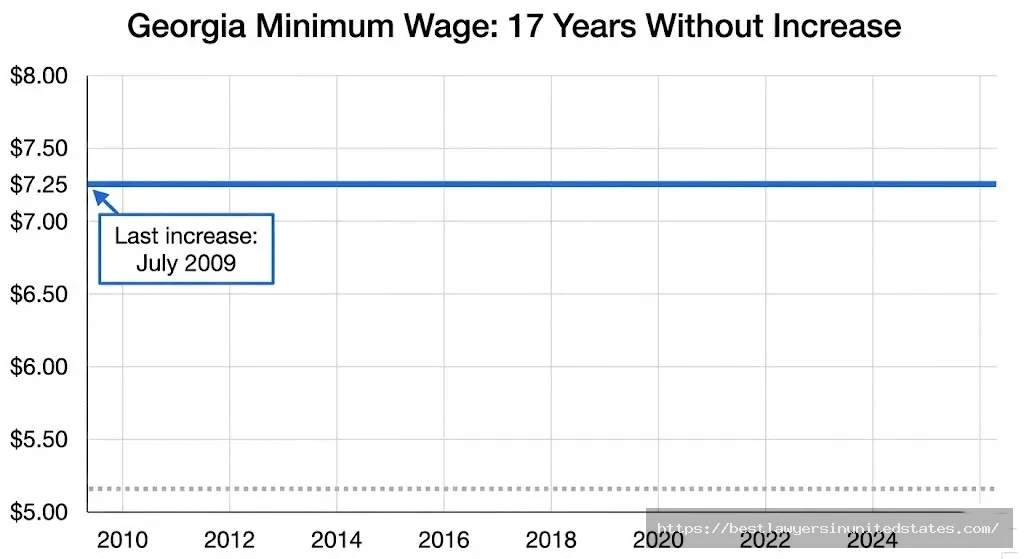
Georgia's minimum wage hasn't increased in over 17 years at the federal level and over 25 years at the state level. This table shows how Georgia's minimum wage has remained frozen while costs have risen.
| Year | Georgia State Minimum | Federal Minimum | Effective Wage in Georgia | Annual Earnings (Full-Time) |
|---|---|---|---|---|
| 2026 | $5.15 | $7.25 | $7.25 | $15,080 |
| 2025 | $5.15 | $7.25 | $7.25 | $15,080 |
| 2024 | $5.15 | $7.25 | $7.25 | $15,080 |
| 2023 | $5.15 | $7.25 | $7.25 | $15,080 |
| 2022 | $5.15 | $7.25 | $7.25 | $15,080 |
| 2021 | $5.15 | $7.25 | $7.25 | $15,080 |
| 2020 | $5.15 | $7.25 | $7.25 | $15,080 |
| 2019 | $5.15 | $7.25 | $7.25 | $15,080 |
| 2018 | $5.15 | $7.25 | $7.25 | $15,080 |
| 2017 | $5.15 | $7.25 | $7.25 | $15,080 |
| 2016 | $5.15 | $7.25 | $7.25 | $15,080 |
| 2015 | $5.15 | $7.25 | $7.25 | $15,080 |
| 2014 | $5.15 | $7.25 | $7.25 | $15,080 |
| 2013 | $5.15 | $7.25 | $7.25 | $15,080 |
| 2012 | $5.15 | $7.25 | $7.25 | $15,080 |
| 2011 | $5.15 | $7.25 | $7.25 | $15,080 |
| 2010 | $5.15 | $7.25 | $7.25 | $15,080 |
| 2009 | $5.15 | $7.25 | $7.25 | $15,080 |
| 2008 | $5.15 | $6.55 | $6.55 | $13,624 |
| 2007 | $5.15 | $5.85 | $5.85 | $12,168 |
The Real Cost of Frozen Wages
$7.25 in 2009 had the same buying power as $10.37 in 2026 when adjusted for inflation (using CPI data). This means minimum wage workers have lost 30% of their purchasing power over the past 17 years.
What $7.25 could buy in 2009 vs. 2026:
- Gallon of gas: $1.87 (2009) → $3.20 (2026)
- Gallon of milk: $2.88 (2009) → $4.10 (2026)
- Loaf of bread: $1.49 (2009) → $2.50 (2026)
- Dozen eggs: $1.77 (2009) → $3.85 (2026)
- Average rent (1BR, Atlanta): $750 (2009) → $1,750 (2026)
While costs have risen 43% on average, wages have stayed completely flat.
States That Left Georgia Behind
Many states have increased their minimum wages significantly since 2009 while Georgia remained at the federal minimum.
| State | 2009 Minimum Wage | 2026 Minimum Wage | Increase |
|---|---|---|---|
| Georgia | $7.25 | $7.25 | $0.00 (0%) |
| California | $8.00 | $16.50 | +$8.50 (106%) |
| Washington | $8.55 | $16.66 | +$8.11 (95%) |
| Arizona | $7.25 | $14.35 | +$7.10 (98%) |
| Colorado | $7.28 | $14.42 | +$7.14 (98%) |
| Florida | $7.25 | $13.00 | +$5.75 (79%) |
Even neighboring Alabama, which has no state minimum wage, follows the same federal $7.25 as Georgia. But states like Florida have pulled ahead dramatically.
Frequently Asked Questions About Georgia Minimum Wage
What is the minimum wage in Georgia in 2026?
Quick Answer: Georgia's minimum wage is $7.25 per hour in 2026, which is the federal minimum wage.
Georgia's state minimum wage is technically $5.15/hour, but the federal minimum wage of $7.25 applies to most workers under the Fair Labor Standards Act (FLSA). Since federal law requires employers to pay the higher of the two rates, nearly all Georgia workers earn at least $7.25/hour.
Is Georgia's minimum wage $15?
Quick Answer: No, Georgia's minimum wage is $7.25/hour, not $15/hour.
Georgia has no plans to increase its minimum wage to $15. The state legislature has consistently opposed minimum wage increases above the federal level. Unlike states like California ($16.50), Washington ($16.66), or even neighboring Florida (rising to $15), Georgia remains at the federal minimum of $7.25/hour.
Which states have a $15 minimum wage in 2026?
Quick Answer: California ($16.50), Washington ($16.66), Connecticut ($16.35), Massachusetts ($15.00), New York ($15-16), New Jersey ($15.49), Maryland ($15.00), and several others have minimum wages at or above $15/hour.
Compare Georgia's $7.25 to these higher-wage states:
- California: $16.50/hour
- Washington: $16.66/hour
- Connecticut: $16.35/hour
- Massachusetts: $15.00/hour
- New York: $15.00-16.00/hour (varies by region)
Why is Georgia's minimum wage so low?
Quick Answer: Georgia's state minimum wage ($5.15) is low due to conservative state legislature opposition to increases, no cost-of-living adjustments, and federal preemption making the state rate largely irrelevant.
Georgia's state minimum hasn't changed since 2001. The Republican-controlled legislature opposes raising it above the federal level, arguing that higher wages hurt small businesses. Since the federal minimum of $7.25 applies to most workers anyway, state lawmakers see no urgency to update the law.
Can you live on minimum wage in Georgia?
Quick Answer: No, minimum wage in Georgia ($15,080/year) falls far below the livable wage ($33,862/year for a single adult).
A minimum wage worker in Georgia earns about $1,068/month after taxes. Even in Georgia's cheapest cities like Augusta, average rent for a one-bedroom apartment costs $950/month. That leaves just $118 for food, transportation, utilities, healthcare, and all other expenses. Most minimum wage workers need multiple jobs, roommates, or public assistance to survive.
What is the tipped minimum wage in Georgia?
Quick Answer: The tipped minimum wage in Georgia is $2.13/hour, but total earnings (tips plus wages) must reach at least $7.25/hour.
If a tipped employee doesn't earn enough in tips to reach $7.25/hour, the employer must make up the difference. Georgia follows the federal tip credit system under the FLSA.
Is there a youth minimum wage in Georgia?
Quick Answer: Yes, workers under age 20 can be paid $4.25/hour for their first 90 days of employment.
After 90 consecutive days, the minimum wage increases to the full $7.25/hour. This youth minimum wage applies only to workers under age 20 and only for their first 90 days with a new employer.
Do Atlanta or Savannah have separate minimum wages?
Quick Answer: No, Georgia law prohibits cities from setting minimum wages higher than the state or federal level.
All Georgia cities—including Atlanta, Savannah, Augusta, Columbus, and Macon—follow the same $7.25/hour federal minimum wage. Unlike California or Washington, where cities can set higher local minimums, Georgia state law preempts local wage ordinances.
How do I calculate my earnings at Georgia's minimum wage?
Quick Answer: Use our free minimum wage calculator at minimum wage calculator to calculate weekly, monthly, and annual earnings based on your hours worked.
Quick calculation:
- Weekly: 40 hours × $7.25 = $290/week
- Monthly: $290 × 4.33 = $1,256/month (before taxes)
- Annual: $290 × 52 = $15,080/year (before taxes)
- After taxes (~15%): $1,068/month take-home
What is overtime pay in Georgia?
Quick Answer: Overtime pay in Georgia is time-and-a-half (1.5× your regular wage) for hours worked over 40 in a workweek.
For minimum wage workers, overtime pay is $10.88/hour ($7.25 × 1.5). Georgia follows federal overtime law, which requires overtime after 40 hours per week, not after 8 hours per day like some states.
Use our overtime calculator to calculate your overtime earnings based on your hourly rate and hours worked.
How much overtime pay am I entitled to in Georgia?
Quick Answer: You're entitled to 1.5× your regular hourly rate for all hours worked over 40 in a workweek.
For example, if you earn $15/hour and work 50 hours in one week:
- First 40 hours: 40 × $15 = $600
- Next 10 hours (overtime): 10 × $22.50 = $225
- Total: $825 for that week
How do I report wage theft in Georgia?
Quick Answer: File a wage complaint with the U.S. Department of Labor's Wage and Hour Division (1-866-487-9243) or the Georgia Department of Labor (404-232-3300).
Document all unpaid wages with pay stubs, timesheets, and work schedules before filing. You have 2-3 years to file a wage claim depending on whether the violation was willful.
How do I calculate wage theft recovery in Georgia?
Quick Answer: Use our wage theft calculator to estimate your potential recovery including unpaid wages, liquidated damages (up to 2× wages), and penalties.
Example calculation:
- Unpaid wages: $2,000
- Liquidated damages: $4,000 (2× unpaid wages)
- Civil penalty: $1,000
- Total potential recovery: $7,000
What jobs are exempt from minimum wage in Georgia?
Quick Answer: Exempt workers include salaried employees earning $684+/week who meet executive/administrative/professional duties tests, independent contractors, outside sales employees, some farm workers, and certain seasonal workers.
Most hourly employees are non-exempt and must be paid at least $7.25/hour. If you're classified as exempt but don't meet all three exemption tests (salary basis, salary level, and duties), you may be entitled to minimum wage and overtime pay.
Is Georgia raising minimum wage in 2026?
Quick Answer: No, Georgia has no scheduled minimum wage increases for 2026 or beyond.
Georgia's minimum wage remains at $7.25/hour (federal) with no plans to increase. Unlike 22 states that raised their minimum wages in 2026, Georgia's wage has been frozen since 2009 at the federal level.
What is the minimum wage in Columbus, Georgia?
Quick Answer: The minimum wage in Columbus, Georgia is $7.25/hour (federal).
Columbus follows the same minimum wage as all Georgia cities. State law prohibits cities from setting higher local minimum wages.
What is the minimum wage for servers in Georgia?
Quick Answer: The tipped minimum wage for servers in Georgia is $2.13/hour, but total earnings (wages plus tips) must reach at least $7.25/hour.
If a server's tips don't bring total earnings to $7.25/hour, the employer must make up the difference. Georgia follows federal tip credit rules under the FLSA.
How much does McDonald's pay in Georgia?
Quick Answer: McDonald's typically pays $10-13/hour in Georgia, which is 38-79% above the minimum wage.
Most major employers in Georgia pay above minimum wage to attract workers. Market competition drives wages higher than the legal minimum of $7.25/hour for most entry-level jobs.
Final Thoughts on Georgia Minimum Wage in 2026
Georgia's minimum wage remains stuck at the federal level of $7.25/hour in 2026 with no increases planned. This puts Georgia among the lowest-wage states despite rising costs of living across the state.
Key takeaways:
- Georgia's effective minimum wage is $7.25/hour (federal)
- Tipped employees can be paid $2.13/hour if tips bring total to $7.25
- No city in Georgia can set its own higher minimum wage
- Minimum wage hasn't increased in 17 years
- Living on minimum wage in Georgia requires multiple jobs or assistance
What Georgia workers should know:
- Most employers pay more than minimum wage due to labor market competition
- You have rights to overtime pay after 40 hours per week
- Wage theft is illegal and you can recover 2× unpaid wages
- Use our calculators to estimate your earnings, overtime pay, and potential wage theft recovery
If you're struggling with minimum wage issues or need help with unpaid wages, document everything and consider filing a complaint with the U.S. Department of Labor. For other legal matters in Georgia such as DUI cases or divorce proceedings, state and local laws vary significantly.
Questions about your wages or need legal help?
[Find Employment Lawyers in Georgia - Free Consultation]
Email: [email protected]
