
Filing for divorce starts with meeting your state’s residency requirements and preparing the divorce petition. You’ll file papers at your county courthouse, serve your spouse, and wait for their response. The process takes 3 to 24 months depending on whether your divorce is contested or uncontested.
Most people feel overwhelmed when starting the divorce process. This guide breaks down every step from preparing documents to receiving your final decree. You’ll learn when you can file without a lawyer, how much it costs, and what mistakes to avoid.
Whether you’re planning an uncontested divorce with your spouse’s agreement or facing a contested case, understanding the filing process helps you make informed decisions and save money.
Before You File: Essential Preparation
Understand Divorce Basics
Divorce legally ends your marriage and divides property, debts, and parental responsibilities. Most states offer no-fault divorce, meaning you don’t need to prove wrongdoing. You simply cite irreconcilable differences or irretrievable breakdown of the marriage.
Divorce vs. Legal Separation:
- Divorce permanently ends marriage
- Legal separation keeps marriage intact but divides assets
- Both require court filings and legal processes
- Separation may become divorce later
Types of Divorce:
| Type | Agreement Level | Timeline | Cost Range |
|---|---|---|---|
| Uncontested | Both parties agree | 3-6 months | $500-$3,000 |
| Contested | Disputes require court | 12-24+ months | $15,000-$50,000+ |
| Default | One party doesn’t respond | 4-6 months | $1,000-$2,500 |
| Mediated | Third party helps negotiate | 6-12 months | $3,000-$8,000 |
Understanding the complete divorce process before filing helps you choose the right path. Most couples save significant money with uncontested divorces when both parties cooperate.
Check Your State’s Residency Requirements
Every state requires you to live there for a specific period before filing. Residency requirements range from no minimum to one year depending on your state.
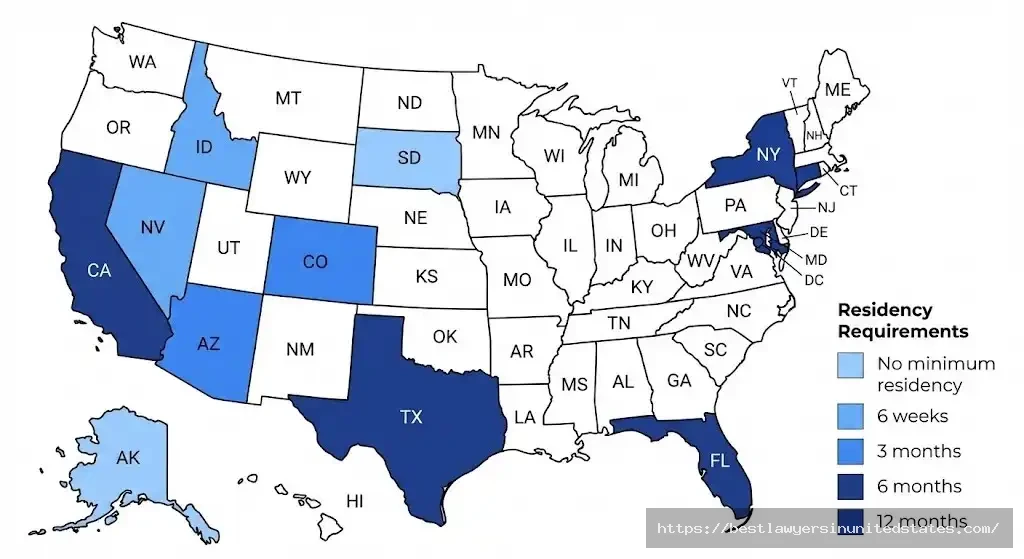
State Residency Requirements:
| State | Residency Period | Notes |
|---|---|---|
| Alaska | No minimum | Must intend to stay |
| California | 6 months | Plus 3 months in county |
| Texas | 6 months | Plus 90 days in county |
| Florida | 6 months | Must prove with documentation |
| New York | 1 year | Or if married in NY |
| Nevada | 6 weeks | Popular for quick divorces |
| Idaho | 6 weeks | Must establish residence |
| South Dakota | No minimum | Either spouse resident |
You must file in the county where you or your spouse lives. If you recently moved, you may need to wait before filing. Military members can file in their home state, stationed state, or spouse’s state.
Check your state’s specific divorce laws to confirm residency requirements. Filing in the wrong location delays your case and wastes filing fees.
Gather Required Documents
Courts require extensive documentation to process your divorce. Collecting these documents before filing saves time and prevents delays.
Financial Documents Needed:
- Last 3 years of tax returns
- Recent pay stubs (last 3 months)
- Bank statements (all accounts)
- Credit card statements
- Investment and retirement account statements
- Mortgage statements and property deeds
- Vehicle titles and loan documents
- Business ownership documents
Personal Documents Required:
- Marriage certificate (certified copy)
- Birth certificates for all children
- Social Security cards
- Prenuptial or postnuptial agreements
- Previous divorce decrees (if applicable)
- Immigration documents (if applicable)
Why Documentation Matters:
Courts divide property and debts based on complete financial disclosure. Missing documents delay your case. Hidden assets can result in court sanctions and unfavorable rulings.
Start organizing documents 2-3 months before filing. Make copies of everything. Keep originals in a safe location your spouse cannot access.
Understanding Divorce Costs in 2026
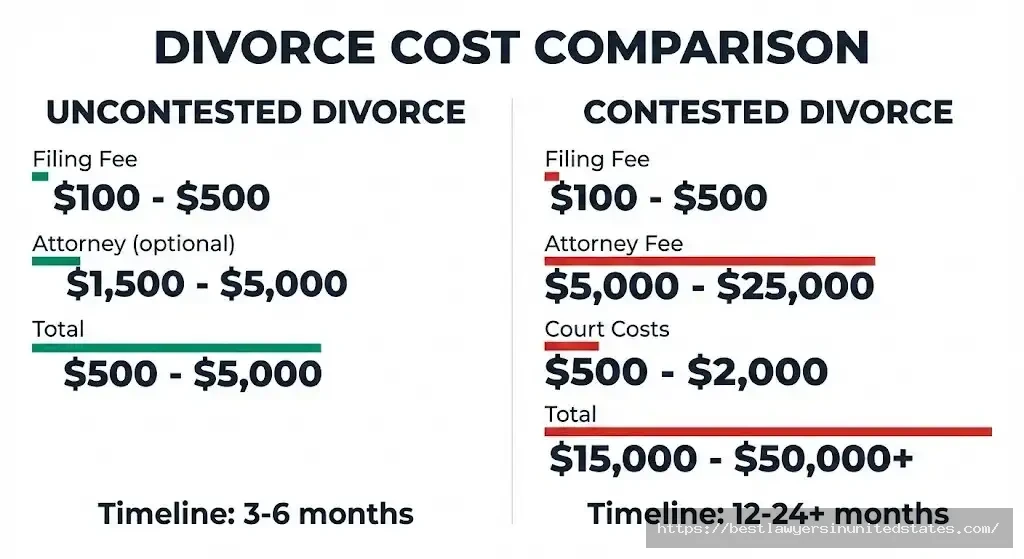
How Much Does Filing for Divorce Cost?
Divorce costs range from $500 for simple uncontested cases to $50,000+ for complex contested divorces. Filing fees alone cost $100 to $500 depending on your state.
Average Divorce Costs by Type:
| Divorce Type | Total Cost Range | Attorney Fees | Filing Fees | Timeline |
|---|---|---|---|---|
| DIY Uncontested | $500-$1,500 | $0 | $100-$500 | 3-6 months |
| Uncontested with Lawyer | $1,500-$5,000 | $1,000-$4,500 | $100-$500 | 3-6 months |
| Mediated | $3,000-$8,000 | $2,000-$7,000 | $100-$500 | 6-12 months |
| Contested | $15,000-$30,000 | $5,000-$25,000 | $100-$500 | 12-18 months |
| High-Conflict | $30,000-$100,000+ | $25,000-$90,000+ | $100-$500 | 18-36+ months |
State Filing Fees Comparison
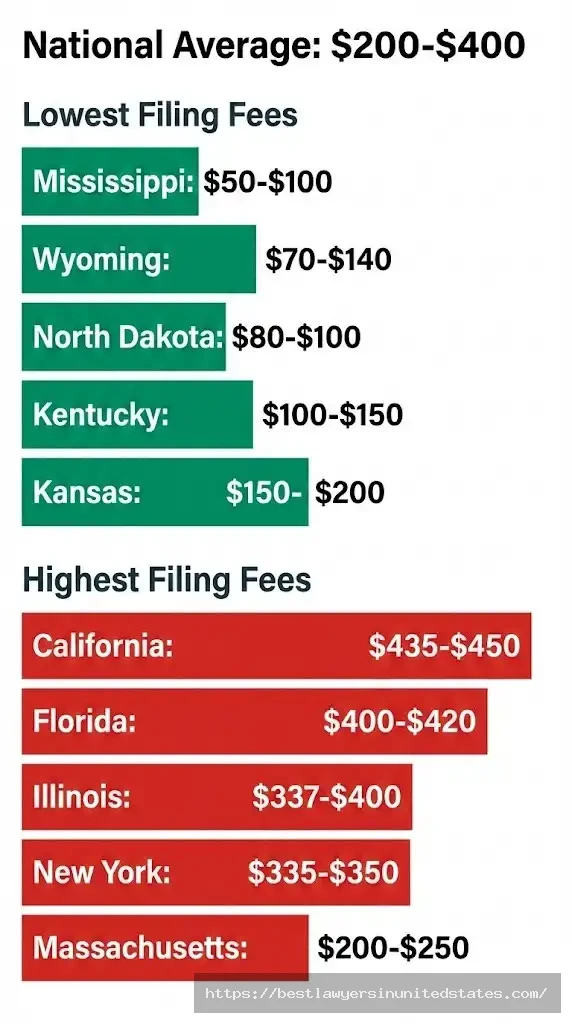
Filing fees vary significantly by state and county. Some states charge under $150 while others exceed $400.
Filing Fees by State (2026):
| State | Filing Fee | Response Fee | Notes |
|---|---|---|---|
| Mississippi | $50-$100 | $50 | Lowest in US |
| Wyoming | $70-$140 | $70 | Varies by county |
| California | $435-$450 | $435 | Highest in US |
| Florida | $400-$420 | $400 | Depends on county |
| Texas | $250-$350 | $250 | County variations |
| New York | $335-$350 | $335 | Index number fee |
| Illinois | $337-$400 | $337 | Cook County higher |
Most courts offer fee waivers for low-income filers. If you earn below 125% of the federal poverty level, you likely qualify. Submit a fee waiver application with proof of income when filing.
Calculate Your Divorce Costs
Planning a divorce requires understanding total expenses. Costs vary dramatically based on cooperation level, assets, children, and whether you hire an attorney.
Calculate Your Divorce Costs
Use our free calculator to estimate your total divorce costs based on your state’s filing fees, typical attorney rates, and case complexity.
Divorce Cost Calculator
Get an estimated cost for your divorce based on your specific situation
Your Estimated Divorce Cost
Cost Breakdown
📧 Get a Personalized Consultation
Have questions about your specific situation? Contact our legal experts for guidance tailored to your needs.
Contact Us via EmailCalculator features:
- State-specific filing fees
- Attorney cost estimates by complexity
- Contested vs uncontested comparison
- Total cost breakdown
- Money-saving tips based on your situation
Need help finding an affordable divorce attorney? Contact family law attorneys for free consultation.
Email: [email protected]
Attorney Fees and Hourly Rates
Attorney fees represent the largest divorce expense. Lawyers charge $200 to $500 per hour depending on location and experience.
Attorney Fee Structures:
Hourly Billing:
- Most common for contested cases
- Rates: $200-$500 per hour
- Typical retainer: $5,000-$10,000
- Billed in 6-15 minute increments
- Final cost depends on hours worked
Flat Fee:
- Common for uncontested divorces
- Range: $1,500-$5,000 total
- Covers start to finish
- Additional fees for complications
- Best for simple cases
What Affects Attorney Costs:
- Experience level (new lawyers cheaper than 20-year veterans)
- Location (urban areas cost more)
- Case complexity (children and assets increase time)
- Cooperation level (fighting costs more)
- Court appearances needed
Deciding: DIY Divorce vs. Hiring a Lawyer
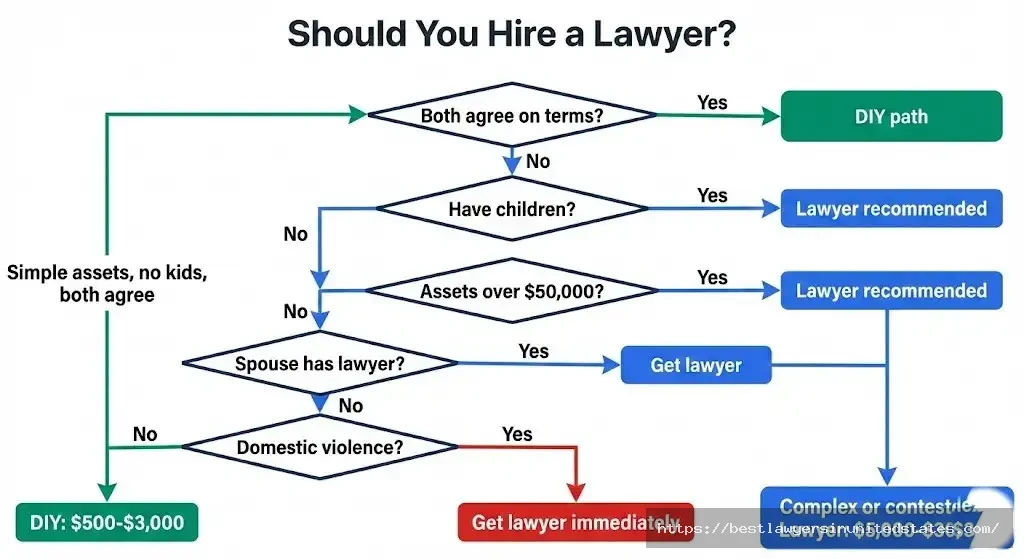
When You Can File Without a Lawyer
Many people successfully file for divorce without attorneys in uncontested cases. DIY divorce saves $5,000 to $25,000 in attorney fees.
DIY Divorce Works When:
- Both spouses agree on all terms
- No minor children or custody disputes
- Minimal assets (under $50,000 total)
- No complex property (businesses, multiple properties)
- Short marriage (under 5 years)
- No significant debt disputes
- No domestic violence concerns
- Both parties financially stable
- Neither spouse hiding assets
DIY Divorce Risks:
- Missing important legal protections
- Unfair property division
- Future modification problems
- Unclear custody arrangements
- Tax consequences not considered
Many states offer self-help centers at courthouses. Staff cannot give legal advice but help with forms and procedures. Online divorce services charge $150 to $500 to prepare documents.
When You Need a Lawyer
Complex situations require legal expertise. The cost of mistakes often exceeds attorney fees.
Hire a Lawyer When:
| Situation | Why Lawyer Needed |
|---|---|
| Contested divorce | Court representation required |
| Child custody disputes | Best interest determinations complex |
| High assets | Property division requires expertise |
| Business ownership | Valuation and division complicated |
| Retirement accounts | QDROs need attorney preparation |
| Domestic violence | Protection orders and safety planning |
| Substance abuse issues | Affects custody and support |
| Hidden assets suspected | Discovery process requires legal tools |
| Spouse has attorney | Unequal legal representation risky |
| Complex property | Multiple homes, investments, etc. |
Even in uncontested cases, consulting an attorney protects your interests. Many lawyers offer limited scope representation. They review your settlement agreement for $500 to $1,500 without handling the entire case.
Step-by-Step: How to File for Divorce
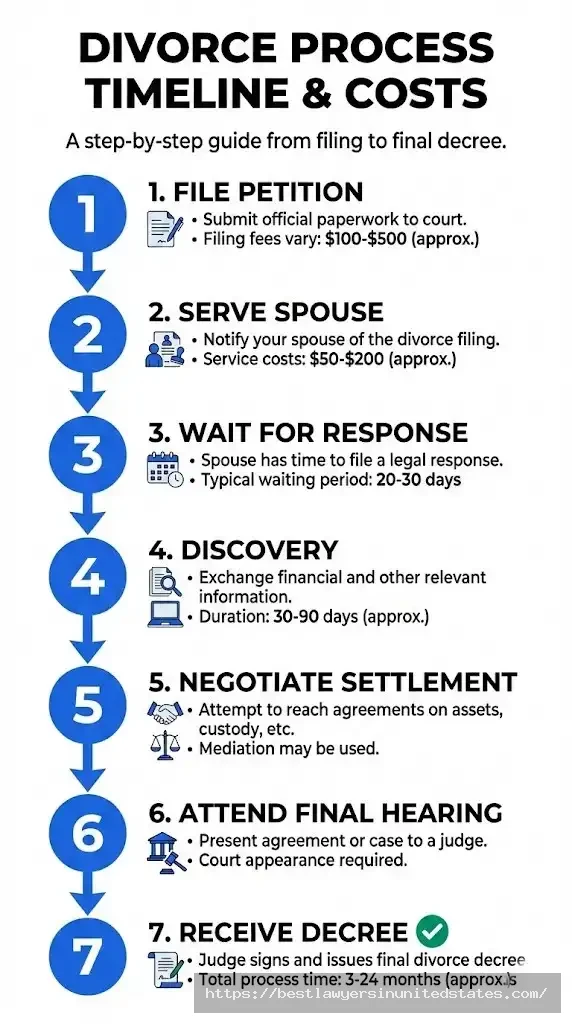
Step 1: File the Divorce Petition
The divorce petition starts your case. You become the petitioner and your spouse becomes the respondent.
What is a Divorce Petition?
The petition formally requests divorce and outlines your desired outcome. You state grounds for divorce, request property division, and address custody and support if applicable.
Where to File:
File at the county courthouse where you or your spouse lives. Most states require filing in your county of residence. Large counties have dedicated family law divisions.
Required Forms:
- Petition for Dissolution of Marriage
- Summons (notice to spouse)
- Financial Affidavit or Declaration
- Child Custody and Support forms (if children)
- Confidential Information Sheet
- Fee Waiver Application (if qualifying)
Filing Methods Available:
| Method | Process | Timeline | Best For |
|---|---|---|---|
| In-Person | Visit courthouse clerk | Same day | First-time filers |
| By Mail | Send certified mail | 5-10 days | Simple cases |
| Online | E-filing portal | 1-3 days | Tech-comfortable users |
| Through Attorney | Lawyer handles everything | 1-2 days | Complex cases |
Most states now offer online filing. You upload documents and pay fees electronically. The system assigns a case number immediately.
Filing Fees:
Expect to pay $100 to $500 when filing. The clerk stamps your documents and provides copies. Keep these copies safe as proof of filing.
Fee Waiver Eligibility:
Apply for a fee waiver if:
- Income below 125% of poverty level
- Receiving public assistance (SNAP, TANF, SSI)
- Cannot afford fees without hardship
Submit a fee waiver application with recent pay stubs, tax returns, and expense documentation. The court reviews and approves or denies within 5 to 10 business days.
Step 2: Serve Divorce Papers to Your Spouse
Service of process legally notifies your spouse about the divorce. Proper service protects your rights and allows the case to proceed.
Service Methods:
Personal Service ($75-$200):
- Professional process server delivers papers
- Most reliable method
- Server provides proof of service affidavit
- Required in most contested cases
Sheriff’s Service ($40-$100):
- County sheriff delivers documents
- Official law enforcement record
- Takes longer than private servers
- Mandatory in some counties
Certified Mail ($10-$20):
- Available in some states
- Requires spouse signature
- Less expensive option
- Not accepted everywhere
Publication Service ($200-$500):
- Used when spouse cannot be located
- Requires proof of search efforts
- Notice published in newspaper
- Last resort option
Service Timeline:
Most states require service within 60 to 120 days of filing. Your spouse then has 20 to 30 days to respond depending on your state.
Proof of Service:
The server completes an affidavit confirming delivery date, time, and location. File this proof with the court. Without it, your case cannot proceed.
Service Problems:
Spouse refuses papers: Service still counts if papers left at residence or workplace.
Cannot find spouse: File motion for service by publication after proving search efforts.
Spouse lives abroad: Follow Hague Convention procedures for international service.
Spouse evades service: Hire experienced process server who attempts multiple times at different locations.
Step 3: Wait for Your Spouse’s Response
Your spouse has 20 to 30 days to respond after service. The response determines whether your divorce proceeds as contested or uncontested.
Possible Outcomes:
Agreement (Uncontested):
Your spouse files a response agreeing to divorce terms. You draft a marital settlement agreement covering:
- Property and debt division
- Spousal support amount and duration
- Child custody and visitation schedule
- Child support payments
- Health insurance and benefits
Submit the signed agreement to the court. Most judges approve fair agreements without hearings.
Contest (Disagreement):
Your spouse disputes terms in their response. The case enters discovery. You exchange financial documents and negotiate through attorneys or mediators.
No Response (Default):
If your spouse doesn’t respond within the deadline, you can request a default divorce. The court grants your requests without spouse input. Default hearings typically occur 30 to 45 days after the response deadline.
Default Divorce Requirements:
- Proof of proper service
- Spouse missed response deadline
- No response filed with court
- Notice of default hearing sent
- Judge reviews your requests
- Decree granted if reasonable
Default divorces work well when spouses agree but avoid paperwork. They also apply when one spouse abandons the marriage.
Step 4: Exchange Financial Information (Discovery)
Discovery ensures both parties disclose all assets, debts, and income. This process prevents hidden assets and promotes fair division.
Mandatory Disclosures:
Most states require automatic financial disclosure within 30 to 45 days. You must provide:
- Complete income documentation
- Bank account statements
- Investment and retirement accounts
- Real estate holdings
- Vehicle ownership
- Business interests
- Debt obligations
- Credit reports
Discovery Tools:
Interrogatories:
- Written questions requiring sworn answers
- Limited to 25-50 questions
- 30-day response deadline
- Used to gather basic information
Requests for Production:
- Formal requests for documents
- Bank statements, tax returns, etc.
- 30-day response deadline
- Can request electronic records
Depositions:
- In-person testimony under oath
- Attorney asks questions
- Court reporter records answers
- Used in contested cases
- Costs $500-$2,000 per deposition
Subpoenas:
- Court orders requiring documents
- Used for third-party records
- Banks, employers, etc.
- Must be properly served
Discovery Timeline:
Simple cases complete discovery in 30 to 60 days. Complex cases with business valuations or hidden assets take 3 to 6 months.
Failure to Disclose:
Courts sanction parties who hide assets or refuse discovery. Penalties include:
- Contempt of court citations
- Attorney fee awards to other party
- Unfavorable property division
- Criminal perjury charges
Step 5: Negotiate Settlement or Go to Trial
Most divorces settle without trial. Negotiation saves money and gives you control over outcomes.
Uncontested Path:
When both parties agree, you draft a marital settlement agreement. This legally binding contract covers all divorce terms.
Settlement Agreement Contents:
- Property division details
- Debt responsibility assignment
- Spousal support terms
- Child custody schedule
- Child support amount
- Health insurance coverage
- Tax filing status
- Name change requests
Submit the agreement to the court with other required forms. Schedule a brief hearing or submit for judge approval without appearing. Uncontested divorce costs range from $1,500 to $5,000 total.
Contested Path:
Disagreements require additional negotiation or trial. Most courts mandate mediation before trial.
Mediation Process:
A neutral third party helps you negotiate. Mediators don’t make decisions but facilitate agreements. Sessions last 2 to 4 hours and cost $100 to $400 per hour.
Divorce mediation typically costs $3,000 to $8,000 total. Most cases settle in 3 to 6 mediation sessions.
Trial Preparation:
If mediation fails, your case goes to trial. This process includes:
- Pre-trial conferences
- Witness preparation
- Evidence gathering
- Expert witness hiring
- Trial briefs
- Opening statements
- Witness testimony
- Cross-examination
- Closing arguments
- Judge’s decision
Trials last 1 to 5 days. Contested divorce costs range from $15,000 to $50,000 or more.
Step 6: Attend Final Hearing
The final hearing concludes your divorce. Judges review agreements or make decisions after trial.
Uncontested Hearing:
These brief hearings last 10 to 15 minutes. The judge confirms:
- Both parties understand the agreement
- Terms are fair and voluntary
- Child custody serves children’s best interests
- Property division is equitable
Some judges approve uncontested divorces without hearings. You submit paperwork and receive the decree by mail.
Contested Hearing:
After trial, judges issue written decisions. These hearings address:
- Property and debt division
- Spousal support amount and duration
- Child custody and visitation
- Child support payments
- Attorney fee awards
Judges explain their reasoning. Decisions become part of your final decree.
What to Bring:
- Photo identification
- Case number
- Copies of all filed documents
- Proof of name change publication (if applicable)
- Final settlement agreement
- Any required financial disclosures
Hearing Etiquette:
- Arrive 15 minutes early
- Dress professionally
- Address judge as “Your Honor”
- Answer questions directly
- Speak clearly and honestly
- Turn off cell phone
- Bring attorney if represented
Step 7: Receive Final Divorce Decree
The divorce decree legally ends your marriage. It contains all terms and becomes effective immediately or after a waiting period.
When Decree Becomes Final:
Most states finalize divorces immediately after the judge signs. Some impose waiting periods:
- California: 6 months from filing date
- Texas: 60 days from filing date
- Nebraska: 6 months from hearing date
- Kansas: 60 days from filing date
Decree Contents:
- Official divorce date
- Property division orders
- Debt responsibility
- Alimony terms and payment schedule
- Child custody arrangement
- Visitation schedule
- Child support amount
- Name change authorization
- Benefit division (retirement, insurance)
Certified Copies:
Request 3 to 5 certified copies. You need them for:
- Changing your name on documents
- Dividing retirement accounts
- Refinancing property
- Updating beneficiaries
- Applying for benefits
- Proving marital status
Certified copies cost $15 to $50 each. Order them when receiving your decree to save time.
Enforcing the Decree:
If your ex-spouse violates decree terms, file a contempt motion. The court can:
- Order immediate compliance
- Impose fines and penalties
- Award attorney fees
- Modify custody arrangements
- Garnish wages
- Order jail time
Modifying the Decree:
Some terms can change if circumstances significantly change:
- Child support adjusts with income changes
- Custody modifies if parent relocates
- Alimony may end with remarriage
- Property division rarely changes
File a modification petition showing substantial change. The court reviews and approves or denies your request.
State-Specific Filing Requirements
State Residency and Waiting Periods
Each state sets unique rules for divorce. Understanding your state’s requirements prevents filing mistakes.
Complete State Comparison:
| State | Residency | Waiting Period | Property Division | Filing Fee Range |
|---|---|---|---|---|
| Alabama | 6 months | No waiting period | Equitable | $200-$300 |
| Alaska | No minimum | No waiting period | Equitable | $200-$250 |
| Arizona | 90 days | 60 days from service | Community | $300-$350 |
| Arkansas | 60 days | No waiting period | Equitable | $100-$200 |
| California | 6 months | 6 months from filing | Community | $435-$450 |
| Colorado | 91 days | 91 days from filing | Equitable | $200-$250 |
| Connecticut | 12 months | 90 days after filing | Equitable | $350-$425 |
| Delaware | 6 months | No waiting period | Equitable | $150-$200 |
| Florida | 6 months | No waiting period | Equitable | $400-$420 |
| Georgia | 6 months | 31 days after filing | Equitable | $200-$250 |
| Hawaii | 6 months | No waiting period | Equitable | $200-$250 |
| Idaho | 6 weeks | No waiting period | Community | $150-$200 |
| Illinois | 6 months | No waiting period | Equitable | $337-$400 |
| Indiana | 6 months | 60 days after filing | Equitable | $150-$200 |
| Iowa | 12 months | 90 days after filing | Equitable | $185-$265 |
| Kansas | 60 days | 60 days after filing | Equitable | $150-$200 |
| Kentucky | 180 days | 60 days after filing | Equitable | $100-$150 |
| Louisiana | 6 months | 180 days living apart | Community | $200-$300 |
| Maine | 6 months | 60 days after filing | Equitable | $120-$170 |
| Maryland | 12 months | No waiting period | Equitable | $165-$200 |
| Massachusetts | 12 months | 120 days nisi period | Equitable | $200-$250 |
| Michigan | 6 months | 60 days (180 with kids) | Equitable | $175-$250 |
| Minnesota | 180 days | 6 months from filing | Equitable | $300-$400 |
| Mississippi | 6 months | 60 days after filing | Equitable | $50-$100 |
| Missouri | 90 days | 30 days after filing | Equitable | $150-$200 |
| Montana | 90 days | No waiting period | Equitable | $170-$200 |
| Nebraska | 12 months | 60 days after filing | Equitable | $150-$200 |
| Nevada | 6 weeks | No waiting period | Community | $250-$300 |
| New Hampshire | 12 months | No waiting period | Equitable | $250-$275 |
| New Jersey | 12 months | No waiting period | Equitable | $300-$325 |
| New Mexico | 6 months | No waiting period | Community | $135-$160 |
| New York | 12 months | No waiting period | Equitable | $335-$350 |
| North Carolina | 6 months | 1 year separation | Equitable | $225-$250 |
| North Dakota | 6 months | No waiting period | Equitable | $80-$100 |
| Ohio | 6 months | 30 days after filing | Equitable | $200-$300 |
| Oklahoma | 6 months | 10 days after filing | Equitable | $150-$200 |
| Oregon | 6 months | 90 days after filing | Equitable | $250-$300 |
| Pennsylvania | 6 months | No waiting period | Equitable | $300-$350 |
| Rhode Island | 12 months | No waiting period | Equitable | $160-$190 |
| South Carolina | 12 months | 90 days after filing | Equitable | $150-$200 |
| South Dakota | No minimum | 60 days after filing | Equitable | $95-$140 |
| Tennessee | 6 months | 60 days after filing | Equitable | $200-$400 |
| Texas | 6 months | 60 days after filing | Community | $250-$350 |
| Utah | 90 days | 90 days after filing | Equitable | $310-$360 |
| Vermont | 6 months | 6 months after filing | Equitable | $290-$315 |
| Virginia | 6 months | 12 months separation | Equitable | $86-$100 |
| Washington | No minimum | 90 days after filing | Community | $280-$315 |
| West Virginia | 12 months | No waiting period | Equitable | $135-$165 |
| Wisconsin | 6 months | 120 days after filing | Community | $180-$210 |
| Wyoming | 60 days | No waiting period | Equitable | $70-$140 |
Visit your state’s specific divorce page for detailed local information:
- California Divorce Cost & Process
- Texas Divorce Cost & Process
- Florida Divorce Cost & Process
- New York Divorce Cost & Process
Community Property vs Equitable Distribution
Nine states follow community property rules. The remaining 41 use equitable distribution.
Community Property States:
- Arizona
- California
- Idaho
- Louisiana
- Nevada
- New Mexico
- Texas
- Washington
- Wisconsin
Community Property Division:
All marital assets and debts split 50/50 regardless of who earned more. Property acquired during marriage belongs equally to both spouses.
Separate Property:
- Owned before marriage
- Inherited by one spouse
- Gifted to one spouse specifically
- Acquired after separation
Equitable Distribution States:
Courts divide property fairly but not necessarily equally. Judges consider:
- Length of marriage
- Each spouse’s income and earning potential
- Contributions to marriage (including homemaking)
- Age and health of each spouse
- Standard of living during marriage
- Tax consequences of division
- Custody arrangements
Special Filing Situations
Filing for Divorce with Children
Children add complexity to divorce. Courts prioritize their best interests above parental preferences.
Additional Forms Required:
- Parenting plan proposal
- Child custody petition
- Child support worksheet
- Income verification
- Health insurance information
- Childcare expense documentation
Custody Decisions:
Courts consider:
- Child’s age and needs
- Parent-child relationship quality
- Each parent’s ability to care for child
- Child’s preference (if old enough)
- History of abuse or neglect
- Stability of each home environment
- Geographic proximity of parents
Physical Custody Types:
- Sole custody: Child lives primarily with one parent
- Joint custody: Child splits time between homes
- Primary custody: One parent has majority time
Legal Custody:
- Decision-making authority for education, healthcare, religion
- Usually joint unless safety concerns exist
Calculate Child Support:
Child support calculations follow state guidelines based on:
- Both parents’ incomes
- Custody time percentage
- Number of children
- Healthcare costs
- Childcare expenses
- Special needs
Calculate Child Support
Wondering about child support payments? Our calculator estimates support based on state guidelines, income, and custody arrangements.
Calculator features:
- State-specific child support formulas
- Income shares model calculations
- Custody time adjustments
- Additional expense estimates
Questions about custody or child support? Find family law attorneys for free consultation.
Email: [email protected]
Filing for Divorce Without a Lawyer
Self-represented divorce works for simple cases. Many resources help you complete the process independently.
Free Self-Help Resources:
Courthouse Resources:
- Self-help centers with staff assistance
- Free form packets
- Computer stations for online filing
- Law library access
- Filing workshops
Online Resources:
- State court websites with forms
- Legal aid organization websites
- Free document preparation guides
- Video tutorials
- Sample completed forms
Online Divorce Services:
Companies like CompleteCase, DivorceWriter, and LegalZoom charge $150 to $500. They prepare documents based on your information but don’t provide legal advice.
DIY Divorce Steps:
- Download state-specific forms from court website
- Complete forms carefully and accurately
- Make 3 copies of all documents
- File originals at courthouse
- Arrange service on spouse
- Submit proof of service to court
- File financial disclosures
- Draft settlement agreement
- Submit final documents
- Attend hearing if required
When DIY Becomes Risky:
- Spouse contests any terms
- Significant assets or complex property
- Business ownership or professional practice
- Retirement accounts requiring QDROs
- Out-of-state property
- Creditor claims against marital property
- Tax consequences unclear
Consider at least one attorney consultation for $200 to $500. They review your situation and identify potential problems.
Filing for Divorce for Free
Low-income filers can divorce without paying fees. Most courts offer fee waivers based on income.
Fee Waiver Eligibility:
You typically qualify if:
- Income below 125% of federal poverty level
- Receiving public assistance (SNAP, Medicaid, SSI, TANF)
- Cannot afford fees without depriving family of necessities
2026 Federal Poverty Levels:
| Household Size | 100% FPL | 125% FPL | 150% FPL |
|---|---|---|---|
| 1 person | $15,060 | $18,825 | $22,590 |
| 2 people | $20,440 | $25,550 | $30,660 |
| 3 people | $25,820 | $32,275 | $38,730 |
| 4 people | $31,200 | $39,000 | $46,800 |
| 5 people | $36,580 | $45,725 | $54,870 |
| 6 people | $41,960 | $52,450 | $62,940 |
Fee Waiver Application Process:
- Complete fee waiver affidavit
- Attach proof of income (pay stubs, tax returns)
- Document public assistance
- List monthly expenses
- Submit with divorce petition
- Court reviews within 5-10 days
- Receive approval or denial
Free Legal Services:
Legal aid organizations help low-income clients. Services include:
- Free consultations
- Document preparation assistance
- Court representation in some cases
- Self-help workshops
- Form clinics
Find legal aid near you:
- Legal Services Corporation: www.lsc.gov
- State bar association referrals
- Local law school clinics
- Pro bono programs
Filing When You Cannot Find Your Spouse
You can divorce a spouse who disappeared or avoids service. The process requires extra steps.
Due Diligence Search:
Courts require proof you attempted to locate your spouse. Document these efforts:
- Search last known address
- Contact family members and friends
- Check social media accounts
- Search public records databases
- Hire skip tracer or private investigator
- Check jail and hospital records
- Search voter registration
- Contact last known employer
Service by Publication:
After proving search efforts, request permission to serve by publication. The court orders:
- Publish notice in newspaper
- Usually 3-4 weeks consecutively
- In county of spouse’s last known address
- Cost: $200-$500
Your spouse has 30 to 60 days to respond after the final publication. If they don’t respond, request a default judgment.
Default Judgment Process:
- File affidavit detailing search efforts
- File motion for service by publication
- Court reviews and approves
- Publish notice in newspaper
- File proof of publication
- Wait required response period
- File for default judgment
- Attend default hearing
- Receive divorce decree
Property Division Limitations:
Courts cannot divide property located outside their jurisdiction when spouse isn’t served personally. You may need to:
- File separate property actions
- Pursue claims after divorce
- Accept limited property division
Common Mistakes to Avoid When Filing
The 7 Biggest Divorce Filing Mistakes
Mistakes during filing create long-term problems. These errors cost time and money to fix.
1. Filing in Wrong Jurisdiction
Meeting residency requirements matters. Filing too soon results in dismissal. You must wait until meeting your state’s residency period and file in the correct county.
2. Hiding or Transferring Assets
Courts require complete financial disclosure. Hiding assets results in:
- Contempt of court
- Sanctions and fines
- Unfavorable property division
- Loss of credibility with judge
- Criminal perjury charges
Judges can award the entire hidden asset to your spouse. The violation outweighs the value of hiding it.
3. Moving Out Before Consulting a Lawyer
Leaving the marital home affects:
- Property rights
- Child custody arrangements
- Temporary support obligations
- Access to marital assets
Courts may view moving out as abandonment. It can impact custody decisions if you leave children behind. Consult an attorney before moving out to protect your rights.
4. Not Documenting Everything
Financial records prove your claims. Missing documentation weakens your position. Before filing:
- Photocopy all financial documents
- Save electronic records
- Document condition of property
- Photograph valuable items
- Keep records of contributions
- Track expenses and debts
5. Using Children as Leverage
Courts prioritize children’s best interests over parental preferences. Using children as pawns backfires:
- Reduces your custody time
- Damages relationship with children
- Increases attorney fees
- Angers judge
- Prolongs proceedings
Never bad-mouth your spouse to children or restrict contact without court orders.
6. Refusing to Negotiate
Trial costs 3 to 5 times more than settlement. Judges make decisions you must accept. Refusing reasonable compromises:
- Increases attorney fees
- Delays resolution
- Reduces control over outcome
- Creates bitter relationships
- Complicates co-parenting
Most cases settle better than they try. Courts encourage mediation for good reason.
7. Failing to Update Estate Documents
Your spouse remains your beneficiary until divorce finalizes. Update immediately:
- Life insurance beneficiaries
- Retirement account beneficiaries
- Will and trust documents
- Power of attorney
- Healthcare directives
- Bank account beneficiaries
Check whether your state allows changes during divorce proceedings. Some states prohibit beneficiary changes until divorce completes.
What NOT to Do Before Filing
Certain actions damage your case permanently. Avoid these mistakes at all costs.
Financial Mistakes:
- Emptying joint bank accounts
- Maxing out joint credit cards
- Selling marital property
- Transferring assets to family
- Quitting your job
- Hiding income
- Making large purchases
Behavioral Mistakes:
- Dating publicly before filing
- Posting on social media
- Discussing case details publicly
- Refusing to cooperate
- Violating temporary orders
- Involving children in conflict
- Harassing or threatening spouse
Legal Mistakes:
- Signing documents without reading
- Missing court deadlines
- Ignoring court orders
- Lying under oath
- Destroying evidence
- Recording spouse without consent
- Changing locks without permission
Protecting Your Finances During Filing
Financial protection prevents problems during divorce. Take these steps immediately.
Account Protection:
- Close joint credit cards
- Open individual bank account
- Transfer half of joint accounts to new account
- Document all transfers
- Change passwords on accounts
- Get credit report
- Freeze joint credit cards
Asset Documentation:
- Photograph all property
- List all valuables with values
- Document condition of home
- Copy all financial statements
- Save tax returns
- Preserve email and text records
- Secure important documents
Property Separate from Marital:
- Inheritance received during marriage
- Gifts given to you specifically
- Property owned before marriage
- Personal injury settlements for your injury
- Items purchased with separate property
Keep separate property in separate accounts. Mixing separate and marital property converts it to marital.
Temporary Financial Orders:
Request temporary orders for:
- Exclusive use of home
- Temporary spousal support
- Temporary child support
- Payment of bills and expenses
- Health insurance continuation
- Protection from asset transfer
Courts issue these orders quickly to maintain status quo during divorce.
Divorce Filing Timeline
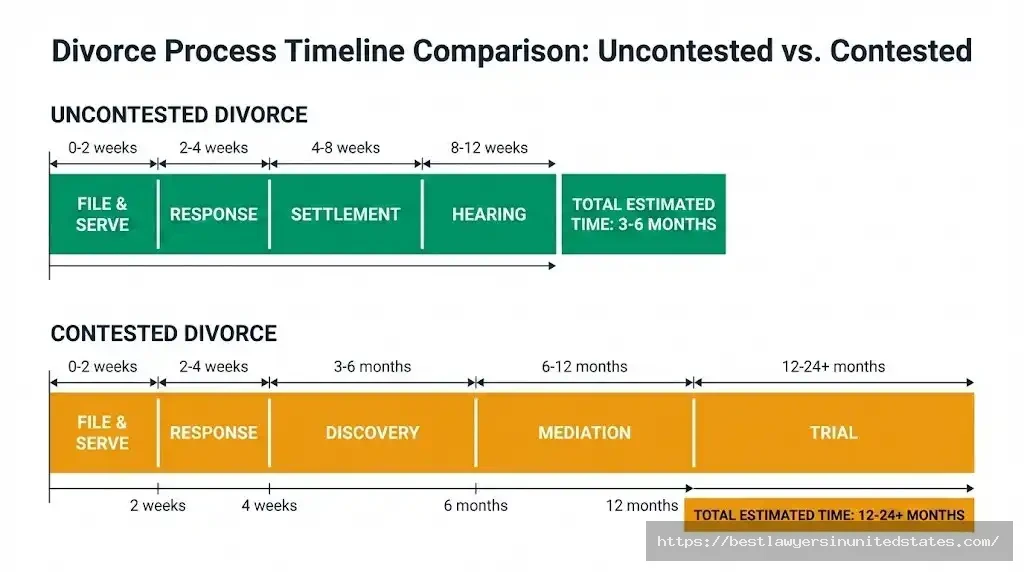
How Long Does the Divorce Process Take?
Divorce timelines range from 3 months to 2+ years. Cooperation level and case complexity determine duration.
Uncontested Divorce Timeline:
| Stage | Timeline | Action Required |
|---|---|---|
| Preparation | 1-2 weeks | Gather documents, complete forms |
| Filing | 1 day | Submit petition at courthouse |
| Service | 1-2 weeks | Serve spouse legally |
| Response Period | 20-30 days | Spouse files response |
| Settlement Agreement | 2-4 weeks | Draft and sign agreement |
| Court Review | 2-4 weeks | Submit to court for approval |
| Final Hearing | 1 day | Brief court appearance |
| Decree Issued | 1-2 weeks | Receive final decree |
| Total Uncontested | 3-6 months | Plus mandatory waiting period |
Add your state’s waiting period. California adds 6 months, Texas adds 60 days, many states have none.
Contested Divorce Timeline:
| Stage | Timeline | Action Required |
|---|---|---|
| Preparation | 1-2 weeks | Gather documents, hire attorney |
| Filing | 1 day | Submit petition at courthouse |
| Service | 1-2 weeks | Serve spouse legally |
| Response Period | 20-30 days | Spouse contests terms |
| Temporary Orders | 2-4 weeks | Emergency hearings if needed |
| Discovery | 3-6 months | Exchange financial information |
| Depositions | 2-3 months | Sworn testimony sessions |
| Expert Witnesses | 2-4 months | Property valuation, custody evaluation |
| Mediation | 2-4 months | Court-ordered negotiation |
| Pre-Trial Conference | 2-4 weeks | Final settlement attempts |
| Trial | 1-5 days | Court testimony and evidence |
| Judge’s Decision | 2-4 weeks | Written ruling issued |
| Decree Issued | 1-2 weeks | Receive final decree |
| Total Contested | 12-24+ months | Very complex cases longer |
Factors That Delay Divorce:
- Disputes over property division
- Child custody disagreements
- Hidden assets requiring discovery
- Business valuations needed
- Out-of-state property
- International custody issues
- Domestic violence allegations
- Substance abuse concerns
- Mental health evaluations
- Backlogged court dockets
Expediting Your Divorce:
- Agree on major issues before filing
- Complete financial disclosure quickly
- Respond to all requests promptly
- Attend mediation prepared
- Avoid filing unnecessary motions
- Follow court orders precisely
- Hire attorney familiar with local court
- File all documents correctly first time
Frequently Asked Questions
What is the first thing to do when you want a divorce?
Quick Answer: Gather financial documents, consult an attorney for strategy even if filing alone, and ensure you meet your state’s residency requirements before filing.
Document all marital assets, debts, and income sources. Understand your state’s divorce laws and grounds for divorce. Consider whether you need temporary living arrangements or immediate protective orders.
How much does it cost to file for divorce?
Quick Answer: Filing fees range from $50 to $450 depending on your state. Total divorce costs range from $500 (DIY uncontested) to $50,000+ (complex contested).
Use our divorce cost calculator to estimate expenses based on your situation. Most people pay $1,500 to $5,000 for uncontested divorces with attorneys and $15,000 to $30,000 for contested cases.
Can I file for divorce without a lawyer?
Quick Answer: Yes, for uncontested divorces with no children and minimal assets. Contested divorces and complex situations require legal representation.
Many people successfully complete DIY divorces using court self-help centers. Consult an attorney at least once to review your situation even if filing alone. One consultation costs $200 to $500 and identifies potential problems.
How long does it take to file for divorce?
Quick Answer: Filing takes 1-2 weeks to prepare documents. The complete divorce process takes 3-6 months (uncontested) or 12-24+ months (contested).
Your state’s waiting period adds time. California requires 6 months, Texas requires 60 days, many states have no waiting period. Complex cases with trials can take 2 years or longer.
Who pays for filing a divorce?
Quick Answer: The person filing (petitioner) typically pays filing fees. Courts can order one spouse to pay the other’s attorney fees based on income disparity and case circumstances.
Fee waivers are available for low-income filers earning below 125% of federal poverty level. Many people split divorce costs equally through settlement agreements.
What is the 10 10 10 rule for divorce?
Quick Answer: The 10/10/10 rule applies to military divorces where the spouse receives direct retirement payment if married 10 years with 10 years of military service overlap.
This rule only affects military retirement division payment method, not the amount awarded. Spouses can still receive retirement portions in marriages shorter than 10 years.
What money can’t be touched in a divorce?
Quick Answer: Separate property owned before marriage, inheritances received by one spouse, and gifts given specifically to one spouse typically remain protected from division.
State laws vary significantly. Community property states protect less than equitable distribution states. Money in separate accounts can become marital property if you mix funds or use separate funds for marital expenses.
What is the biggest mistake during a divorce?
Quick Answer: Moving out of the marital home before consulting a lawyer can affect property rights and child custody arrangements significantly.
Other major mistakes include hiding assets, using children as leverage, and refusing reasonable settlement offers. Each mistake increases costs and reduces your negotiating position.
How do I calculate alimony payments?
Quick Answer: Most states consider income difference, marriage length, standard of living, and each spouse’s earning capacity when determining spousal support amounts.
Calculate Alimony
Wondering about spousal support? Our calculator estimates alimony payments based on state guidelines, income difference, marriage length, and other factors.
Calculator features:
- State-specific alimony formulas
- Duration estimates
- Income-based calculations
- Modification factors
Need help understanding alimony rights? Contact family law attorneys for free consultation.
Email: [email protected]
What are grounds for divorce in my state?
Quick Answer: All states offer no-fault divorce based on irreconcilable differences or irretrievable breakdown. Some states also allow fault-based grounds like adultery, abandonment, or cruelty.
No-fault divorces are simpler and faster. Fault-based grounds may affect property division and alimony in some states. Check your state’s specific divorce laws for detailed requirements.
Can I file for divorce online?
Quick Answer: Most states offer online filing (e-filing) where you upload documents and pay fees electronically. Some states still require in-person or mail filing.
Online filing systems assign case numbers immediately. You still must serve your spouse personally. Online divorce services help prepare documents but don’t provide legal advice.
What happens if my spouse won’t sign divorce papers?
Quick Answer: You don’t need your spouse’s signature to get divorced. If they don’t respond within 20-30 days, you can request a default judgment and proceed without their participation.
Proper service is required. If your spouse actively contests, the divorce becomes contested but still proceeds. Courts cannot force people to stay married against their will.
How do I protect assets during divorce?
Quick Answer: Document all assets immediately, avoid transferring property, maintain separate accounts for new income, and follow all temporary court orders precisely.
Never hide assets or transfer property to family members. Courts reverse these transfers and sanction violators. Transparency protects you better than deception.
Do I need to prove fault to get divorced?
Quick Answer: No. All states offer no-fault divorce where you simply state the marriage is irretrievably broken without proving wrongdoing.
No-fault divorces are faster and less expensive. Fault-based grounds exist in some states but rarely provide significant advantages. Most lawyers recommend no-fault filings.
How is property divided in divorce?
Quick Answer: Nine states split marital property 50/50 (community property). The remaining 41 states divide property fairly but not necessarily equally (equitable distribution).
Courts consider marriage length, each spouse’s contributions, income and earning potential, age, health, and standard of living. Separate property owned before marriage usually remains with the original owner.
Next Steps After Filing
Filing your divorce petition starts the legal process. These actions protect your interests while your case proceeds.
Immediate Actions:
- Save all correspondence with your spouse
- Keep detailed records of all expenses
- Follow temporary orders precisely
- Attend all scheduled court dates
- Complete financial disclosures honestly
- Respond to discovery requests promptly
- Update emergency contacts
- Consider counseling or support groups
Financial Updates:
- Open individual bank account
- Update beneficiaries on accounts (if allowed)
- Get credit report
- Monitor joint accounts
- Pay bills on time
- Save for divorce costs
- Track child-related expenses
- Document support payments
Legal Compliance:
- Follow custody schedules exactly
- Make support payments on time
- Don’t remove children from state
- Keep communication civil
- Use Our Family Wizard or similar app
- Save all texts and emails
- Attend mediation prepared
- Complete parenting classes if required
Preparing for Settlement:
- Identify non-negotiable issues
- Determine acceptable compromises
- Calculate realistic budgets
- Understand property values
- Research custody guidelines
- Consider tax consequences
- Evaluate insurance needs
- Plan post-divorce living arrangements
Related Resources
Divorce Cost Information
- How Much Does a Divorce Cost? Complete State Breakdown
- Divorce Filing Fees by State
- Divorce Attorney Fees Guide
- Uncontested Divorce Costs
- Contested Divorce Costs
Divorce Process Guides
Interactive Tools
State-Specific Guides
- Alabama Divorce Cost & Laws
- Alaska Divorce Cost & Laws
- Arizona Divorce Cost & Laws
- California Divorce Cost & Laws
- Texas Divorce Cost & Laws
Filing for divorce requires careful preparation and understanding of your state’s requirements. The process varies significantly based on cooperation level, assets, children, and local court procedures. Most people benefit from at least consulting an attorney even in simple cases.
Start by gathering financial documents and understanding your state’s residency requirements. Use the divorce cost calculator to estimate expenses. Consider mediation before trial to save money and maintain control over outcomes. Follow all court orders precisely to avoid sanctions.
Need help with your divorce? Contact family law attorneys for free consultation.
Email: [email protected]