
Thinking about ending your marriage? You have two legal options: divorce or annulment. A divorce ends a valid marriage, while an annulment declares the marriage was never legally valid in the first place. The key difference is that divorce acknowledges your marriage existed, but annulment treats it as if it never happened at all.
You can’t always choose between the two. Annulments require specific legal grounds and proof, while divorce is available to anyone who meets their state’s residency requirements. Most people end up filing for divorce because they don’t meet annulment requirements.
This guide explains the legal differences between divorce and annulment, when each option applies, and how to decide which path fits your situation. Understanding your options helps you make informed decisions about ending your marriage.
What Is a Divorce?
Divorce is the legal process that ends a valid marriage. Courts recognize the marriage existed and formally dissolve it through a divorce decree. You remain “divorced” after the process completes.
Every state allows divorce, and you don’t need to prove wrongdoing in most cases. All 50 states recognize no-fault divorce, which lets couples cite “irreconcilable differences” as the reason for separation. This makes divorce accessible to anyone who wants to end their marriage.
Types of Divorce
Divorce comes in several forms depending on your circumstances:
No-fault divorce allows couples to separate without blaming either spouse. You simply state the marriage isn’t working. No-fault divorce is available in all states and is the most common option.
Fault-based divorce requires proving your spouse did something wrong. Common grounds include adultery, cruelty, abandonment, or substance abuse. Only some states still allow fault-based divorce.
Contested vs uncontested divorce depends on whether you agree on terms. Uncontested divorces cost less and move faster because both spouses agree on property division, custody, and support. Contested divorces take longer when spouses disagree on major issues.
| Divorce Type | Time Frame | Cost Range | Requirements |
|---|---|---|---|
| Uncontested | 2-12 months | $500-$5,000 | Both agree on terms |
| Contested | 12-36 months | $15,000-$50,000+ | Court decides disputes |
| No-fault | Varies | Varies | No blame needed |
| Fault-based | Longer | Higher | Must prove wrongdoing |
Common Reasons for Divorce
People file for divorce for many reasons. The most common include:
✅ Irreconcilable differences or incompatibility
✅ Infidelity or betrayal of trust
✅ Financial disagreements or hidden debt
✅ Communication breakdown
✅ Substance abuse or addiction
✅ Physical or emotional abuse
✅ Growing apart over time
None of these reasons require annulment grounds. You can file for divorce regardless of why your marriage failed.
What Is an Annulment?
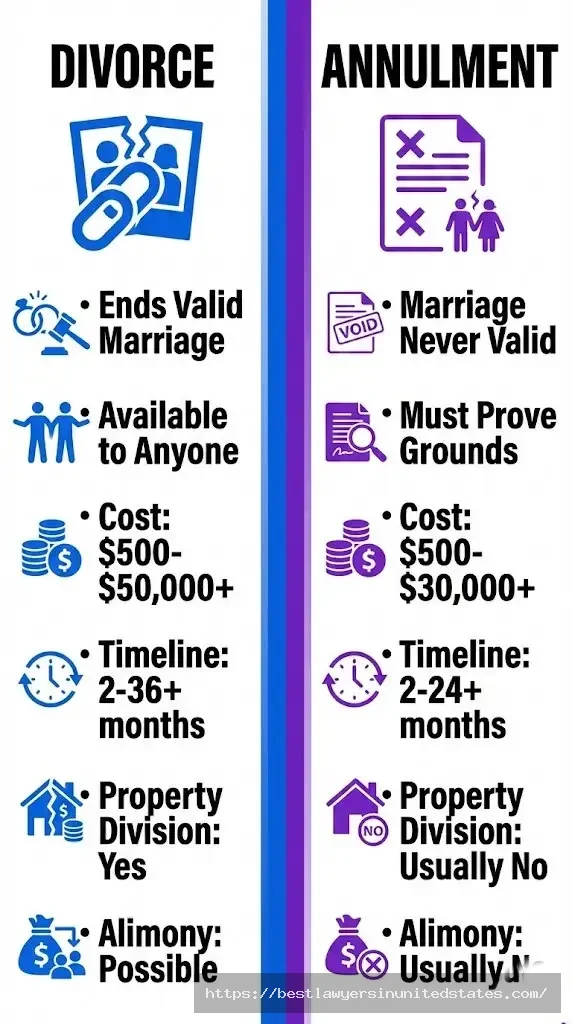
An annulment is a legal ruling that declares a marriage was never valid from the start. The court treats the marriage as if it never existed. Your marital status returns to “never married” instead of “divorced.”
Getting an annulment is much harder than getting a divorce. You must prove specific legal grounds existed at the time you married. Simply wanting to avoid “divorced” status isn’t enough.
Courts grant annulments rarely because the burden of proof is high. You need evidence showing why the marriage should be erased from legal records.
Void vs Voidable Marriages
Understanding the difference between void and voidable marriages matters for annulments:
Void marriages were never legal from the beginning. These include:
- Bigamy (one spouse was already married)
- Incest (spouses are close blood relatives)
- Marriages where one spouse couldn’t legally consent
Void marriages don’t require court action to invalidate, but most people still file for annulment to get official documentation.
Voidable marriages appear valid but can be annulled for specific reasons:
- Fraud or misrepresentation
- Mental incapacity at time of marriage
- Underage marriage without proper consent
- Duress or coercion
- Failure to consummate
- Concealment of important facts
Voidable marriages remain valid until a court grants an annulment. Time limits often apply.
| Marriage Type | Status | Court Action | Time Limits |
|---|---|---|---|
| Void | Invalid from start | Optional but recommended | Usually none |
| Voidable | Valid until annulled | Required | Varies by state and ground |
Key Differences Between Divorce and Annulment
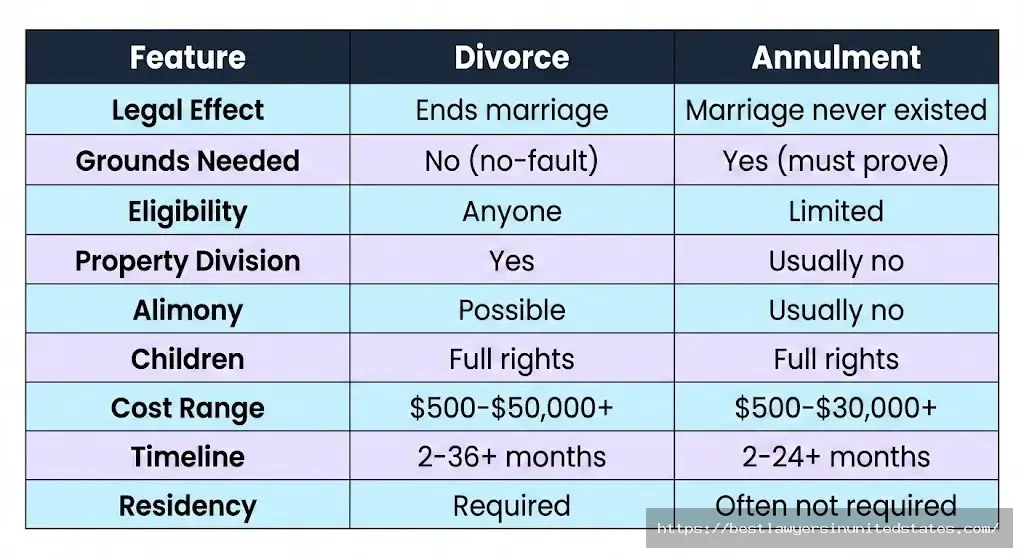
The legal differences between divorce and annulment affect your property, finances, and future. Understanding these distinctions helps you choose the right option.
Legal Effect on Marriage Status
Divorce ends a marriage that legally existed. Your marital status changes from “married” to “divorced.” Official records show you were married and later divorced.
Annulment erases the marriage entirely. Your marital status returns to “never married” or “single.” The law treats you as if the marriage never happened.
This distinction matters for:
- Future marriage licenses and applications
- Background checks and official documents
- Religious considerations
- Personal preference about marital history
Critical difference: Children born during an annulled marriage remain legitimate. The annulment doesn’t affect parental rights or children’s legal status.
Eligibility Requirements
Anyone can file for divorce. You only need to meet your state’s residency requirements, which typically range from 30 days to one year.
Annulment requires proving specific legal grounds existed when you married. You can’t get an annulment just because you want one. Courts deny annulments when proper grounds don’t exist.
| Option | Eligibility | Difficulty | Availability |
|---|---|---|---|
| Divorce | Residency requirement only | Easy to qualify | Universal |
| Annulment | Must prove specific grounds | Hard to qualify | Limited |
Property Division
Divorce involves dividing marital property according to state law. Courts use either community property rules (50/50 split) or equitable distribution (fair but not always equal).
Prenuptial agreements remain valid in divorce. The court enforces the terms you agreed to before marriage.
Annulment typically doesn’t involve property division. Each person keeps what they brought into the marriage. Property acquired during the marriage may return to the original purchaser.
Prenuptial agreements become void with annulment. Since the marriage never legally existed, contracts based on that marriage have no effect.
Important note: Some states allow limited property division in annulments despite the general rule. Check your state’s specific laws.
Spousal Support (Alimony)
Divorce allows courts to award spousal support or alimony. Alimony calculations consider factors like marriage length, income disparity, and each spouse’s needs.
Annulment usually bars spousal support entirely. Since the marriage was never valid, courts reason that no support obligation exists between the parties.
Exception: Some states allow limited support in annulment cases involving fraud or other special circumstances. These exceptions are rare and state-specific.
Effect on Children
Both divorce and annulment protect children’s rights equally. The type of proceeding doesn’t affect:
✅ Parental rights and responsibilities
✅ Child custody arrangements
✅ Child support obligations
✅ Children’s legitimacy
✅ Inheritance rights
Courts handle custody and support the same way whether parents divorce or annul their marriage. The focus stays on the children’s best interests regardless of how the marriage ends.
| Issue | Divorce | Annulment | Difference |
|---|---|---|---|
| Child Custody | Court decides | Court decides | None |
| Child Support | Required | Required | None |
| Legitimacy | Protected | Protected | None |
Timeline & Process
Divorce timeline depends on whether it’s contested and your state’s waiting period. Most divorces take 2-12 months for uncontested cases and 12-36 months for contested cases.
Annulment timeline varies widely:
- Uncontested with clear grounds: 2-6 months
- Contested with disputed facts: 6-24 months or longer
- Evidence gathering can add significant delays
Time sensitivity matters: Many states impose statutes of limitation on annulments. You might lose the right to annul if you wait too long after discovering the grounds.
Residency Requirements
Divorce requires state residency. Most states require you to live there for 30 days to one year before filing.
Annulment often has no residency requirement. Many states let you file where the marriage took place, regardless of where you currently live.
Strategic consideration: If you married in Nevada but live elsewhere, you might file for annulment in Nevada without establishing residency. This flexibility doesn’t apply to divorce.
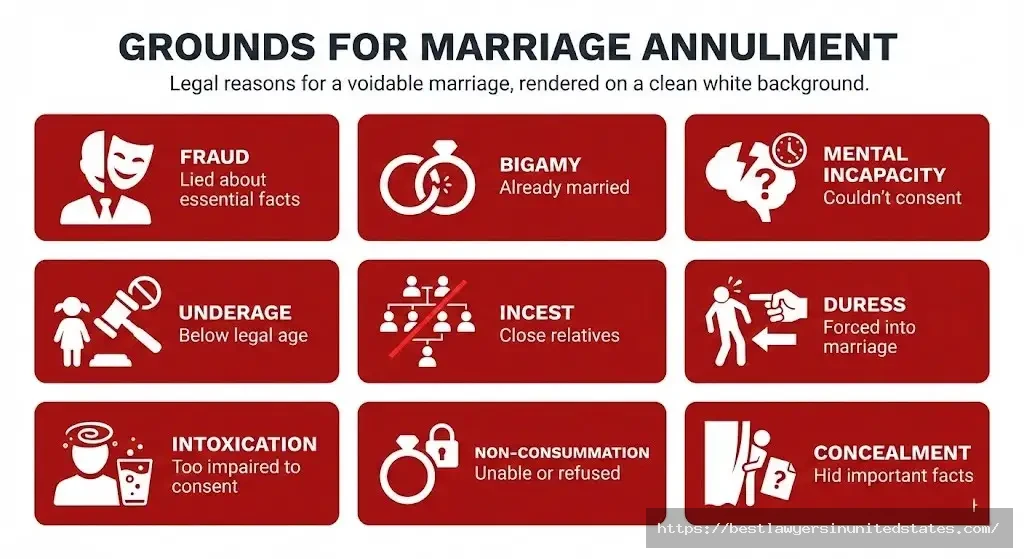
Grounds for Annulment
You must prove one of these specific grounds existed at the time you married. Simply regretting the marriage or wanting to avoid “divorced” status doesn’t qualify.
Fraud or Misrepresentation
Fraud occurs when one spouse lies about essential facts to get the other to marry them. The lie must be material to the decision to marry.
Examples of fraud grounds:
- Hiding a criminal conviction
- Lying about ability or desire to have children
- Concealing serious illness or addiction
- Misrepresenting financial status
- Lying about immigration intentions
Not fraud: Lying about loving the other person or exaggerating personal qualities. Courts require fraud about concrete facts, not feelings.
You must show the fraud induced you to marry. If you would have married anyway knowing the truth, courts may deny the annulment.
Bigamy
Bigamy means one spouse was already legally married when your marriage ceremony occurred. This makes your marriage void from the beginning.
Bigamy annulments face no time limits. You can file decades later because the marriage was never valid in the first place.
Proof required: Marriage certificate from the prior marriage and evidence it wasn’t dissolved before your ceremony.
Mental Incapacity
Mental incapacity means one spouse couldn’t understand what marriage means or couldn’t consent to the contract. This must have existed when you married.
Valid grounds include:
- Severe mental disability
- Temporary mental illness affecting judgment
- Mental condition preventing understanding of marriage commitment
Not valid: Mental health issues that develop after marriage. The incapacity must have existed during the ceremony.
Underage Marriage
Most states require both spouses to be 18 or older to marry. Marriages involving minors without proper consent may be annulled.
Rules vary by state:
- Some states allow 16-17 year olds to marry with parental consent
- A few states allow younger marriages with court approval
- Marriages below legal age without proper authorization can be annulled
Time limits apply: The underage spouse typically must file before turning 18 or within a short period after reaching legal age.
Incestuous Marriage
Marriages between close blood relatives violate state law. These relationships include:
- Parent and child
- Siblings (including half-siblings)
- Grandparent and grandchild
- Aunt/uncle and niece/nephew
State laws define which relationships qualify. First cousins can marry in some states but not others.
Incestuous marriages are void from the start. No time limit applies to annulments based on this ground.
Duress or Coercion
Duress means one spouse was forced to marry under threat or pressure. True duress involves serious threats that overcome free will.
Examples include:
- Physical threats or violence
- Threats to harm family members
- Immigration fraud schemes with coercion
- Severe emotional manipulation rising to compulsion
Not duress: Family pressure, cultural expectations, or pregnancy alone. Courts require proof of serious threats that eliminated choice.
Intoxication
One or both spouses were too intoxicated to consent to marriage. The intoxication must have been severe enough to prevent understanding what was happening.
Proof typically requires:
- Witness testimony about intoxication level
- Photos or videos from the ceremony
- Medical records if hospitalization occurred
- Documentation of substance abuse issues
Quick filing matters: You must file soon after sobering up. Living as a married couple after the ceremony may void this ground.
Failure to Consummate
Some states allow annulment when one spouse physically cannot or refuses to consummate the marriage. This ground has strict requirements:
- Physical inability or refusal must have existed before marriage
- Other spouse must not have known about the issue
- Attempt at consummation must have failed after marriage
- Filing must occur relatively soon after discovery
Not all states recognize this ground. Check your state’s specific laws.
Concealment
Concealment means hiding important facts that would have affected the decision to marry. This differs slightly from fraud because it involves omission rather than active lying.
Common concealment claims:
- Hidden children from prior relationships
- Undisclosed addiction or substance abuse
- Secret debt or bankruptcy
- Serious criminal history
- Inability or unwillingness to have children
The concealed fact must be material. Minor omissions don’t justify annulment.
Annulment vs Divorce: Cost Comparison
Both options involve court filing fees and potential attorney costs. Which costs less depends entirely on whether the case is contested.
Filing Fees
Court filing fees are similar for divorce and annulment in most states. You’ll pay between $100 and $500 to file your initial petition.
State-specific examples:
- California: $435-$450 (same for both)
- Texas: $250-$300 (same for both)
- New York: $335 (same for both)
- Florida: $408 (same for both)
Filing fees vary significantly by state and sometimes by county within each state.
| Cost Type | Divorce | Annulment | Notes |
|---|---|---|---|
| Filing Fee | $100-$500 | $100-$500 | Usually identical |
| Service Fee | $50-$200 | $50-$200 | Delivering papers to spouse |
| Motion Fees | $50-$100 | $50-$100 | Additional court filings |
Attorney Fees
Attorney costs vary dramatically based on complexity, not whether you file for divorce or annulment.
Uncontested cases (either divorce or annulment):
- Flat fee arrangements: $1,500-$3,000 total
- Some attorneys charge $500-$1,500 for simple cases
- DIY with forms only: $200-$500 in court fees
Contested cases can cost much more:
- Annulment with disputed grounds: $5,000-$30,000+
- Divorce with complex property: $15,000-$50,000+
- Cases requiring expert witnesses: add $2,000-$10,000
Key insight: Contested annulments often cost MORE than divorces because proving grounds requires extensive evidence, witness testimony, and potentially expert evaluations.
Total Cost Estimates
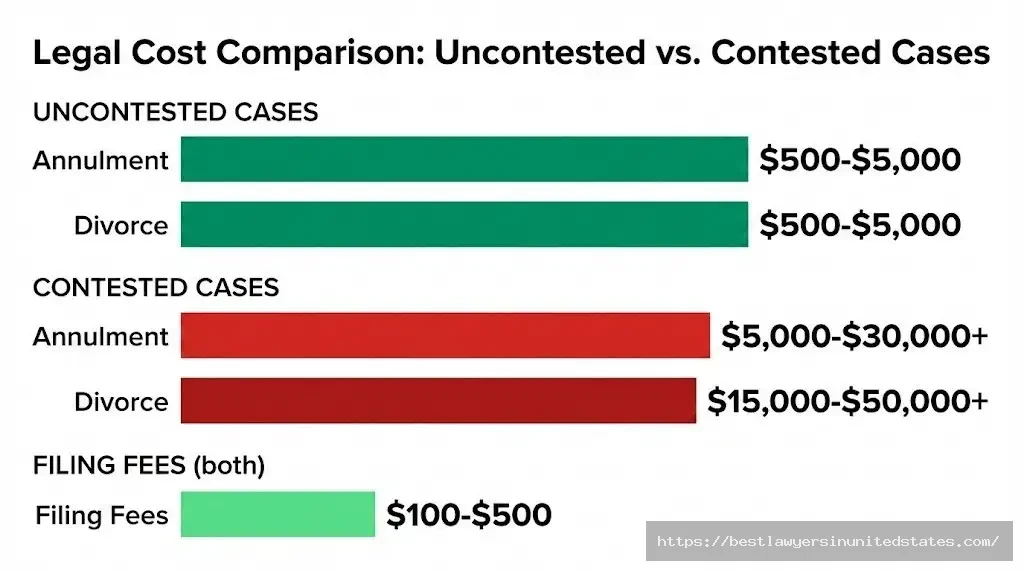
Here’s what you might spend on each option:
| Case Type | Uncontested | Contested |
|---|---|---|
| Simple Annulment | $500-$2,500 | $5,000-$30,000+ |
| Simple Divorce | $500-$2,500 | $15,000-$50,000+ |
| With Attorney | $2,000-$5,000 | $10,000-$100,000+ |
| DIY/Pro Se | $200-$500 | Not recommended |
Use our divorce cost calculator to estimate your total expenses based on your specific situation.
Divorce Cost Calculator
Get an estimated cost for your divorce based on your specific situation
Your Estimated Divorce Cost
Cost Breakdown
📧 Get a Personalized Consultation
Have questions about your specific situation? Contact our legal experts for guidance tailored to your needs.
Contact Us via EmailMoney-saving tip: If you qualify for annulment and both spouses agree, you might pay less overall. But contested annulments often exceed contested divorce costs because of the additional burden of proof.
Annulment vs Divorce Timeline
Time matters when ending your marriage. Understanding realistic timelines helps you plan accordingly.
Annulment Timeline
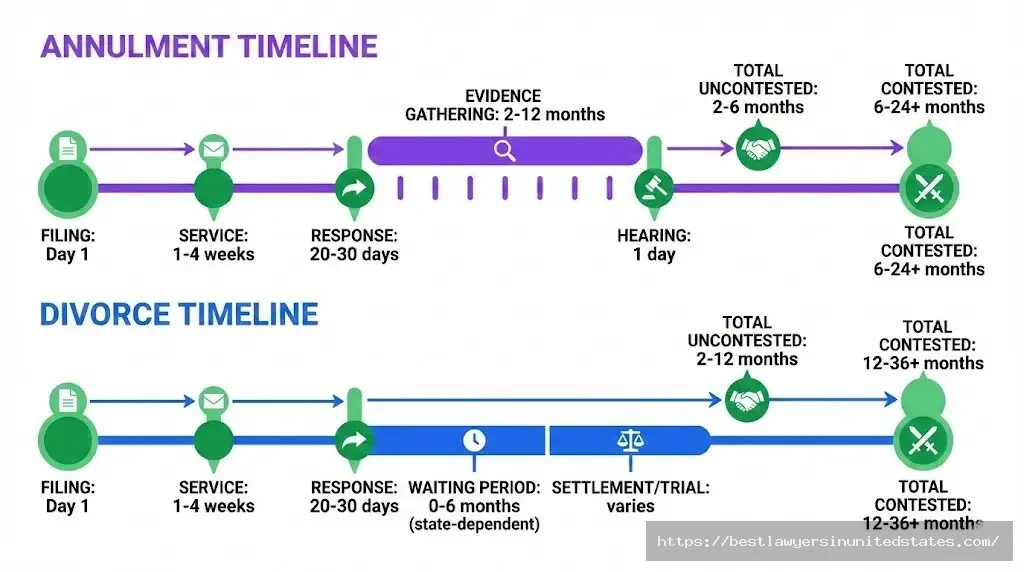
Uncontested annulments with clear grounds move quickly:
- Filing to final decree: 2-6 months
- Most time spent on evidence gathering
- Hearing usually takes one day
Contested annulments take much longer:
- Filing to final decree: 6-24 months or more
- Discovery process for evidence
- Multiple court hearings
- Expert witness evaluations possible
Critical factor: Proving grounds takes time. Fraud cases require extensive documentation. Mental incapacity may need medical experts. Bigamy requires tracking down marriage records.
Divorce Timeline
Divorce timelines vary by state waiting periods and case complexity.
State waiting periods range from:
- No waiting period: Alaska, Nevada, South Dakota, Washington
- 60-90 days: Most states
- 6 months: California
- 12 months: Arkansas, Mississippi (if contested)
Typical divorce timelines:
- Uncontested: 2-12 months including waiting period
- Contested: 12-36 months from filing to final decree
- Complex property cases: 24-48 months possible
Divorce timeline varies by state and complexity, but most uncontested cases finish within one year.
| Timeline Stage | Annulment | Divorce |
|---|---|---|
| Filing | Day 1 | Day 1 |
| Serving Spouse | 1-4 weeks | 1-4 weeks |
| Response Period | 20-30 days | 20-30 days |
| Evidence Gathering | 2-12 months | 1-6 months |
| Waiting Period | Usually none | 0-6 months (state-dependent) |
| Final Hearing | 1 day | 1 day (if needed) |
| Total Uncontested | 2-6 months | 2-12 months |
| Total Contested | 6-24+ months | 12-36+ months |
Statute of Limitations for Annulment
Many states impose time limits on filing for annulment based on the specific ground:
Fraud annulments:
- File within 1-4 years after discovering the fraud
- Clock starts when you learn the truth, not when you married
- Living together after discovery may bar the annulment
Underage marriages:
- Minor must file before turning 18 or within months after
- Time limits vary by state
- Some states allow parents/guardians to file
Bigamy and incest:
- Usually no time limit (void from start)
- Can file decades later if needed
Intoxication and duress:
- File within weeks or months of the ceremony
- Waiting too long suggests you consented to continue the marriage
Critical deadline: Check your state’s specific statute of limitations. Missing the deadline means you must divorce instead of annulling.
Religious Annulment vs Legal Annulment
Religious and legal annulments are completely separate processes. Getting one doesn’t automatically grant the other.
Catholic Church Annulment
The Catholic Church has its own annulment process separate from civil courts. A church annulment doesn’t affect your legal marital status.
Catholic annulment process:
- File petition with local diocese tribunal
- Provide testimony and evidence
- Tribunal investigates and interviews witnesses
- Formal decision issued (usually 12-18 months)
- Appeal possible if denied
Catholic annulment grounds differ from legal grounds:
- Lack of canonical form
- Lack of intent to be faithful, open to children, or permanent
- Mental reservations at time of marriage
- Psychological inability to fulfill marriage obligations
Cost: Most dioceses charge $200-$1,000 for processing fees. Fee waivers available for financial hardship.
Timeline: Catholic annulments typically take 12-18 months to complete.
Other Religious Considerations
Other faiths handle marriage dissolution differently:
Judaism:
- “Get” (religious divorce document) required
- Requires participation from both spouses
- Civil divorce doesn’t replace religious process
Islam:
- “Talaq” allows husband to divorce wife
- “Khul” allows wife to seek divorce
- Religious process separate from civil courts
Protestant denominations:
- Most recognize civil divorce
- Some require annulment for remarriage in church
- Policies vary by denomination and individual church
Religious Marital Status in Civil Courts
U.S. courts don’t enforce religious marriage rules. Your legal status depends only on civil court proceedings.
Key points:
- Catholic annulment doesn’t end civil marriage (need legal divorce)
- Civil annulment doesn’t satisfy Catholic requirements (need tribunal annulment)
- Can be legally divorced but still “married” in religious eyes
- Can have church annulment but be legally divorced (not annulled)
If religious status matters to you, pursue both processes separately.
Which Is Better: Annulment or Divorce?
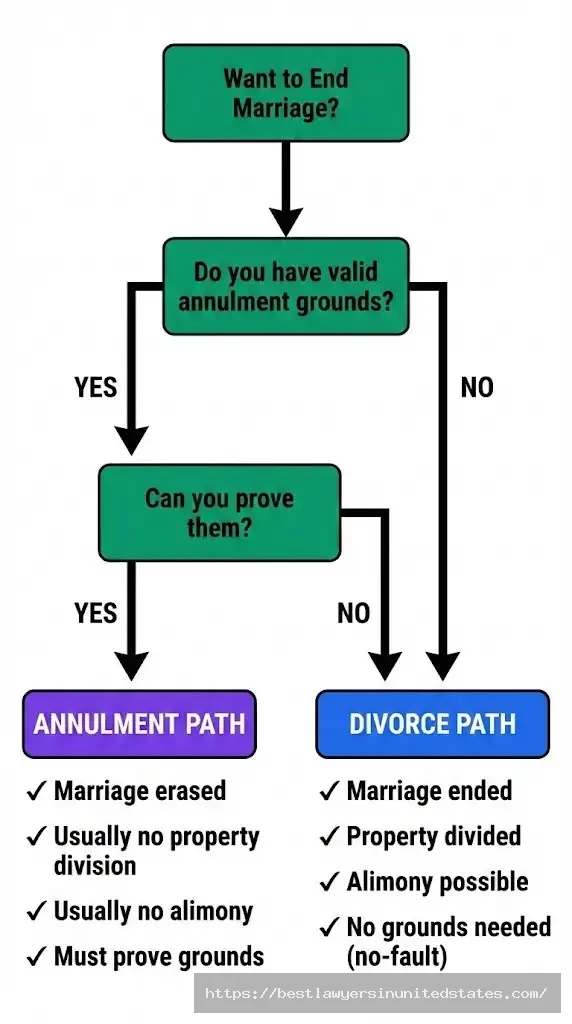
Neither option is inherently “better.” The right choice depends on your eligibility and circumstances.
When Annulment Makes Sense
Consider annulment if you meet ALL these conditions:
✅ Valid legal grounds exist (fraud, bigamy, etc.)
✅ You have strong evidence to prove grounds
✅ Marriage was relatively recent (evidence easier to gather)
✅ Religious reasons make “never married” status important
✅ You want prenuptial agreement invalidated
✅ Spouse agrees or won’t contest the grounds
Reality check: Most people don’t qualify for annulment. Courts deny petitions when proper grounds don’t exist.
When Divorce Is the Better Option
Choose divorce when:
✅ No valid annulment grounds exist
✅ Marriage lasted months or years
✅ You need property division and spousal support
✅ Simpler, more predictable legal process preferred
✅ State waiting period not a concern
✅ No-fault option available (all states)
Practical advice: If you’re unsure whether you qualify for annulment, consult a family law attorney before filing. Denied annulments waste time and money.
Factors to Consider
Weigh these factors when deciding:
Evidence strength: Can you actually prove annulment grounds? Fraud requires extensive documentation. Mental incapacity may need medical experts.
Cost-benefit analysis: Will annulment cost significantly less or more than divorce in your situation?
Timeline urgency: Do you need this resolved quickly? Contested annulments can take longer than uncontested divorces.
Children’s interests: Either process protects children equally, but which moves faster and causes less conflict?
Property complexity: Need formal property division? Divorce provides clearer rules than annulment.
Religious considerations: Does your faith require annulment for remarriage in the church?
| Factor | Choose Annulment | Choose Divorce |
|---|---|---|
| Valid grounds | Yes, provable | No grounds exist |
| Marriage duration | Short (under 1 year) | Any length |
| Evidence | Strong, documented | Not needed |
| Property | Simple, keep your own | Complex, need division |
| Cost priority | Uncontested, cheap | Varies |
| Speed priority | Quick if uncontested | Faster path available |
| Religious status | Matters greatly | Doesn’t matter |
How to File for Annulment vs Divorce
Both processes follow similar procedures but with different evidence requirements.
Annulment Filing Process
Filing for annulment requires proving your case:
Step 1: Determine eligibility and grounds
- Identify which ground applies to your situation
- Confirm statute of limitations hasn’t expired
- Assess strength of your evidence
Step 2: Gather evidence to prove grounds
- Collect documents, photos, records
- Identify potential witnesses
- Obtain expert evaluations if needed (mental health, medical)
- Organize timeline of events
Step 3: File petition in appropriate court
- Complete annulment petition forms
- Pay filing fee ($100-$500)
- File in county where you married or currently live
Step 4: Serve spouse with papers
- Have sheriff or process server deliver documents
- Spouse has 20-30 days to respond (varies by state)
- Proof of service filed with court
Step 5: Attend hearing to present evidence
- Present your case to the judge
- Testify about grounds for annulment
- Witness testimony if needed
- Submit documentary evidence
Step 6: Judge rules on validity
- Judge evaluates evidence and testimony
- Determines whether grounds proven
- Issues ruling granting or denying annulment
Step 7: Receive annulment decree if granted
- Court issues final decree
- Marriage declared void from beginning
- Decree used to update legal records
Divorce Filing Process
Filing for divorce follows a more straightforward path:
Step 1: Meet residency requirements
- Live in state for required period (30 days to 1 year)
- File in county where you or spouse resides
Step 2: Determine grounds
- No-fault (irreconcilable differences) – available everywhere
- Fault-based (adultery, cruelty, etc.) – optional in some states
Step 3: File divorce petition
- Complete petition for dissolution forms
- Pay filing fee ($100-$500)
- Submit to family court clerk
Step 4: Serve spouse
- Deliver papers through sheriff or process server
- Spouse has 20-30 days to respond
Step 5: Negotiate settlement or prepare for trial
- Exchange financial disclosures
- Discuss property division, custody, support
- Mediation may help reach agreement
- Trial needed if no settlement
Step 6: Complete waiting period
- State-mandated waiting period must pass
- Ranges from none to 6 months
Step 7: Receive final divorce decree
- Court issues final judgment
- Marriage legally terminated
- Decree enforces property, custody, support terms
Common Questions About Annulment vs Divorce
Can You Get an Annulment Without Your Spouse Knowing?
Quick Answer: No, you cannot get an annulment without notifying your spouse. Courts require proper service of legal papers.
Due process guarantees your spouse the right to respond to legal proceedings affecting them. You must serve your spouse with annulment papers unless they’re truly missing and you obtain a court order allowing alternative service.
Rare exceptions exist when a spouse cannot be located after diligent search efforts. You must prove to the court you made every reasonable effort to find them.
Can You Still Marry After Annulment?
Quick Answer: Yes, you can marry after an annulment. Your legal status returns to “never married.”
After an annulment, you’re legally single and free to remarry immediately. No waiting period applies like it might after divorce in some states.
You may need to provide your annulment decree when applying for a new marriage license. This proves your previous marriage was legally ended.
Does Annulment Erase the Marriage Completely?
Quick Answer: Yes, annulment legally treats the marriage as if it never existed.
From a legal standpoint, the marriage is erased from records. Your marital status returns to single or never married on official documents.
However, some records may still exist. Court files remain accessible unless sealed. Children born during the marriage remain legitimate and retain all legal rights.
What Happens If Your Annulment Is Denied?
Quick Answer: If the court denies your annulment, you must file for divorce instead to end the marriage.
Courts deny annulments when you fail to prove valid grounds existed. The marriage remains legally valid, so divorce becomes your only option.
You can appeal the denial, but appeals rarely succeed without new evidence. Most people proceed with divorce after annulment denial.
Evidence gathered for the annulment case may still be useful in divorce proceedings, especially if you pursue a fault-based divorce.
Is Cheating a Ground for Annulment?
Quick Answer: No, discovering infidelity after marriage typically doesn’t qualify as annulment grounds.
Adultery that occurs during the marriage isn’t fraud at the time of marriage. You cannot annul based on your spouse’s behavior after you married.
Exception: If your spouse married you while secretly planning to be unfaithful or misrepresented their intentions about fidelity before the wedding, some states might consider this fraud.
Infidelity is better addressed through fault-based divorce in states that recognize adultery as grounds for divorce.
Is a Sexless Marriage Grounds for Annulment?
Quick Answer: Only if one spouse was physically unable to consummate the marriage AND concealed this inability before the wedding.
Refusal to have sex after marriage doesn’t qualify. The inability or refusal must have existed before marriage and been hidden from the other spouse.
If your spouse could physically consummate but refuses, this doesn’t meet annulment requirements. Some states allow this as grounds for fault-based divorce instead.
Can You Get an Annulment Years After Marriage?
Quick Answer: It depends on the grounds and your state’s statute of limitations. Some grounds have no time limit while others expire within months or years.
No time limit for:
- Bigamy (marriage was void from start)
- Incest (prohibited relationship)
Time limits apply for:
- Fraud (1-4 years after discovering the fraud)
- Underage marriage (must file shortly after turning 18)
- Intoxication or duress (must file within weeks/months)
The longer you wait, the harder proving grounds becomes. Living together for years after the incident that allegedly justified annulment can bar you from getting one.
How Much Does an Annulment Cost Compared to Divorce?
Quick Answer: Annulments cost $500-$5,000 uncontested or $5,000-$30,000+ contested. Divorces cost similar amounts depending on complexity.
Uncontested cases (either annulment or divorce) typically cost $500-$2,500 if both spouses agree. Contested cases escalate quickly based on legal complexity, not the type of proceeding.
Contested annulments sometimes cost more than divorces because proving grounds requires extensive evidence, expert witnesses, and additional court time.
Can You Get Legal Separation Instead of Divorce or Annulment?
Quick Answer: Yes, legal separation allows you to live apart while remaining legally married.
Legal separation provides a middle ground. You remain married but have court-approved terms for property division, custody, and support.
Key differences:
- Separation: still married, living apart with legal agreement
- Divorce: marriage ended, legally divorced
- Annulment: marriage treated as never existing
Legal separation works well if religious beliefs prohibit divorce or if you’re unsure about permanently ending the marriage.
Do I Need a Lawyer for Annulment or Divorce?
Quick Answer: You don’t legally need a lawyer for either, but contested cases strongly benefit from legal representation.
DIY is possible when:
- Both spouses agree on terms
- No children involved
- Minimal property to divide
- Straightforward grounds for annulment (if applicable)
You should hire a lawyer when:
- Spouse contests the annulment or divorce
- Proving annulment grounds is complex
- Significant property or debt exists
- Children and custody are involved
- Domestic violence or abuse is present
Annulments especially benefit from legal help because proving grounds requires legal knowledge and strong evidence presentation.
How Long Does Each Process Take?
Quick Answer: Uncontested annulments take 2-6 months. Uncontested divorces take 2-12 months. Contested cases of either take 6 months to 2+ years.
The biggest time factors are:
- Whether spouses agree or contest
- Quality of evidence (for annulment)
- State waiting periods (for divorce)
- Court backlog in your county
- Complexity of property and custody issues
Neither process is consistently faster. Uncontested cases move quickly regardless of type.
Does an Annulment Affect Children Differently Than Divorce?
Quick Answer: No, children have the same rights and protections whether parents annul or divorce.
Federal and state laws protect children regardless of how the marriage ends. Both processes handle:
- Child custody the same way
- Child support calculations identically
- Children’s legitimacy and inheritance rights equally
The annulment doesn’t make children “illegitimate” or affect their legal status in any way.
Will I Have to Pay Alimony After Annulment?
Quick Answer: Usually no. Most states don’t award alimony in annulments because the marriage is deemed invalid.
Since annulment treats the marriage as never existing, courts generally don’t order spousal support. You can’t have support obligations from a marriage that legally didn’t happen.
Rare exceptions: A few states allow limited support in fraud cases or situations where denying support would be extremely unfair. These are uncommon.
Alimony in divorce cases is much more common because the marriage was valid and created support obligations.
Can You Convert an Annulment to a Divorce?
Quick Answer: If your annulment is denied, you simply file for divorce separately. There’s no “conversion” process.
The two processes are independent. If the court finds you don’t have valid annulment grounds, your marriage remains legally valid and you must divorce to end it.
Some attorneys file both petitions simultaneously to save time if the annulment fails. Check whether your state allows this strategy.
What Evidence Do You Need for Annulment?
Quick Answer: Evidence depends on your specific grounds but typically includes documents, witness testimony, and sometimes expert evaluations.
Common evidence types:
For fraud:
- Documents proving the deception
- Communications (texts, emails, letters)
- Witness testimony about the fraud
- Timeline showing when you discovered the truth
For bigamy:
- Marriage certificate from prior marriage
- Proof prior marriage wasn’t dissolved
- Public records searches
For mental incapacity:
- Medical records and evaluations
- Expert psychiatric testimony
- Evidence of condition at time of marriage
- Witness testimony about mental state
For underage marriage:
- Birth certificate proving age
- Marriage license without proper consent
- Records showing lack of parental/court approval
Strong evidence is critical. Courts deny annulments when proof is weak or missing.
Final Thoughts: Making the Right Choice
Choosing between divorce and annulment starts with eligibility. You can’t pick annulment unless you meet specific legal grounds and can prove them in court.
If you qualify for both options, consider these factors:
- Strength of evidence for annulment grounds
- Total costs including attorney fees and expert witnesses
- Timeline urgency and your state’s statutes of limitation
- Religious considerations and remarriage plans
- Property division needs and complexity
- Children’s best interests and minimizing conflict
Most people divorce because they don’t meet annulment requirements or because divorce offers a more predictable path. There’s no shame in divorce and it doesn’t carry the social stigma it once did.
Act promptly if considering annulment. Statutes of limitation expire quickly for many grounds. The longer you wait, the harder proving your case becomes.
Consult a family law attorney to evaluate your specific situation. They can assess whether you have valid annulment grounds, estimate costs for each option, and recommend the best path forward.
Questions about your situation? Speak with experienced divorce attorneys in your state for personalized guidance. Find divorce lawyers near you offering free consultations.
Email: [email protected]