
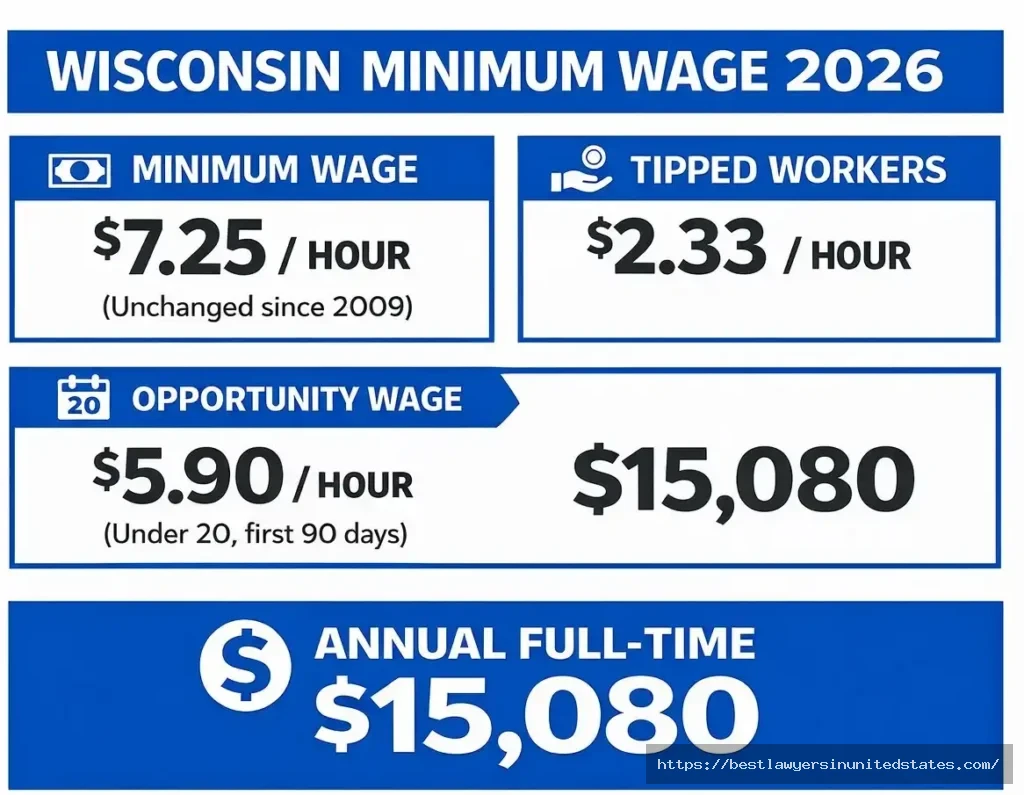
Wisconsin’s minimum wage remains $7.25 per hour in 2026, unchanged since July 24, 2009. Tipped workers earn a base rate of $2.33 per hour plus tips. Young workers under 20 can be paid $5.90 per hour for their first 90 days of employment.
This guide covers everything Wisconsin workers and employers need to know about wage laws in 2026. You’ll learn about tipped employee rules, overtime requirements, how to file wage theft complaints, and why Wisconsin cities cannot raise their local minimum wage. We’ve included free calculators to help you figure out your exact earnings and potential wage theft recovery.
Calculate Your Earnings in Wisconsin
Want to know exactly how much you’ll earn at Wisconsin’s $7.25 minimum wage? Use our free calculator to estimate your weekly, monthly, and annual income based on your hours worked.
💰 Minimum Wage Earnings Calculator
Calculate your weekly, monthly, and annual earnings with overtime and tax estimates
📊 Your Earnings Breakdown
💰 Gross Earnings
Calculator features:
- Automatic Wisconsin wage rates for 2026
- Weekly, monthly, and annual earnings
- Overtime calculations
- Tax withholding estimates
- Take-home pay breakdown
Full calculator with all features: Minimum Wage Calculator
Questions about your wages or need legal help?
Email: [email protected]
What Is the Minimum Wage in Wisconsin for 2026?
Wisconsin's minimum wage is $7.25 per hour as of 2026. This rate has not changed since July 24, 2009, when the federal minimum wage increased to $7.25. Wisconsin law ties the state minimum wage to the federal rate, so when federal law sets a higher minimum, Wisconsin follows it automatically.
The state has no scheduled increases for 2026 or 2027. While other states have raised their minimum wages significantly, Wisconsin remains at the federal floor of $7.25.
Regular Employees
All non-exempt employees in Wisconsin must receive at least $7.25 per hour. This applies to most hourly workers in retail, food service, hospitality, and other industries.
Annual earnings at $7.25/hour:
- Full-time (40 hours/week): $15,080 per year
- Part-time (25 hours/week): $9,425 per year
- Part-time (20 hours/week): $7,540 per year
Tipped Employees
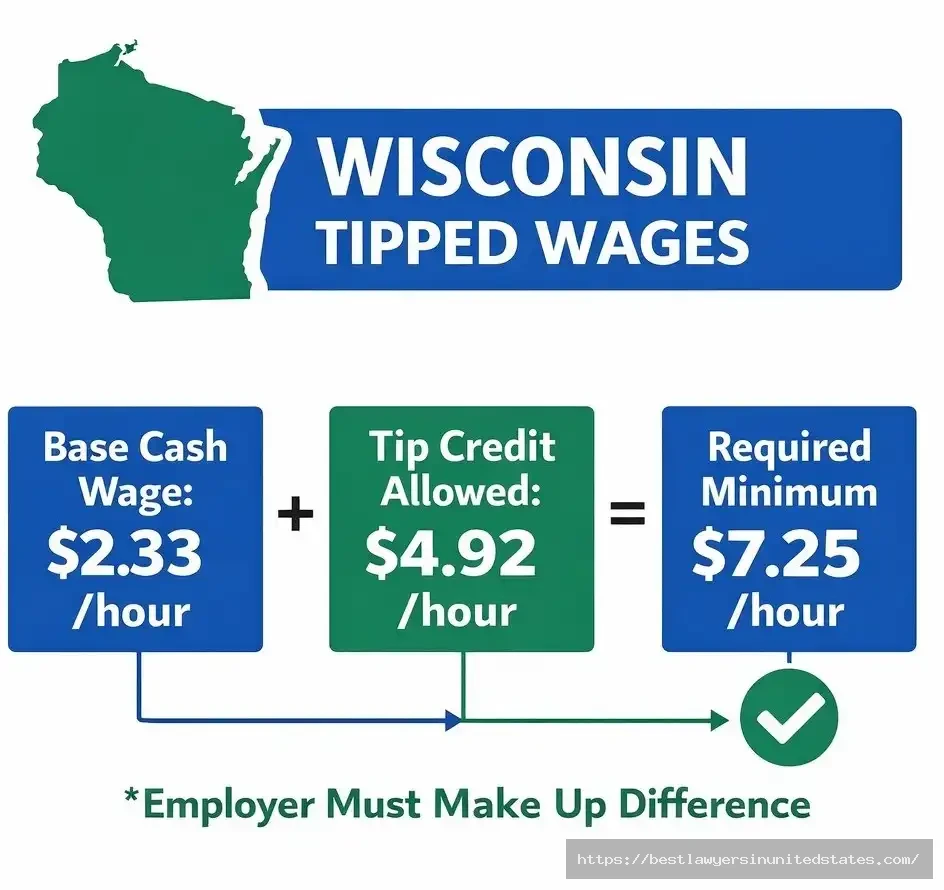
Wisconsin allows employers to pay tipped workers a lower base wage of $2.33 per hour. The employer can claim a "tip credit" of $4.92 per hour. However, if your tips plus the base wage don't add up to at least $7.25 per hour, your employer must make up the difference.
This cash wage of $2.33 is higher than the federal tipped minimum of $2.13, giving Wisconsin servers and bartenders slightly better baseline protection.
Opportunity Wage for Young Workers
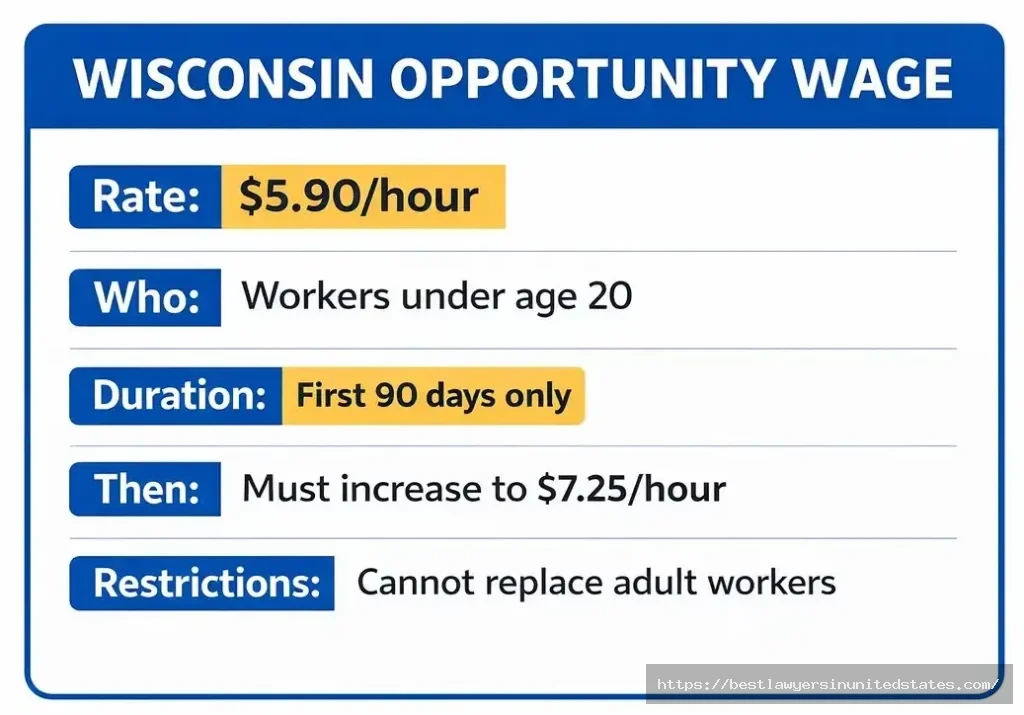
Employers can pay workers under age 20 an "opportunity wage" of $5.90 per hour for their first 90 consecutive calendar days of employment. After 90 days or when the employee turns 20, whichever comes first, the wage must increase to at least $7.25.
| Worker Type | Minimum Wage | Who Qualifies | Time Limit |
|---|---|---|---|
| Regular Adult | $7.25/hour | Age 20+ | No limit |
| Tipped Worker | $2.33/hour base | Service workers receiving tips | No limit |
| Opportunity Wage | $5.90/hour | Under age 20 | First 90 days only |
How Tipped Employees Get Paid in Wisconsin
Wisconsin uses a "tip credit" system that lets employers pay tipped workers less than the standard minimum wage. The employer pays $2.33 per hour as a base wage and counts your tips to make up the difference to $7.25.
How the Tip Credit Works
Your employer can take a credit of up to $4.92 per hour against the minimum wage if you receive tips. Here's how it breaks down:
Minimum wage obligation: $7.25 per hour
Base cash wage paid: $2.33 per hour
Tip credit allowed: $4.92 per hour
If your tips don't equal at least $4.92 per hour, your employer must pay you additional wages to reach $7.25 total.
Real Examples for Servers
Example 1: Good Tip Night
- Hours worked: 8 hours
- Base wage earned: $18.64 (8 × $2.33)
- Tips received: $120
- Tips per hour: $15
- Total hourly rate: $17.33 ($2.33 + $15)
- Result: You earned well above minimum wage
Example 2: Slow Shift
- Hours worked: 6 hours
- Base wage earned: $13.98 (6 × $2.33)
- Tips received: $18
- Tips per hour: $3
- Total hourly rate: $5.33 ($2.33 + $3)
- Employer owes you: $11.52 more to reach $7.25/hour minimum
- Your check should be: $25.50 ($13.98 + $11.52)
What Counts as Tips
Wisconsin law defines tips as money customers voluntarily leave for service. Your employer cannot count the following as tips toward the tip credit:
- Service charges added to bills
- Credit card processing fees (employer cannot deduct these from your tips)
- Mandatory gratuities
- Tips you share with managers or owners
Your rights:
- ✅ Keep 100% of your tips
- ✅ Participate in tip pools with other service staff
- ❌ Managers cannot take your tips
- ❌ Employers cannot deduct credit card fees from tips
Wisconsin vs Federal and Neighboring States
Wisconsin's $7.25 minimum wage matches the federal rate but lags far behind its neighboring states. This wage gap creates challenges for Wisconsin workers and employers competing for talent across state lines.
How Wisconsin Compares
| State | Minimum Wage | Higher Than WI | Effective Date |
|---|---|---|---|
| Wisconsin | $7.25 | Baseline | Since 2009 |
| Federal | $7.25 | Same | Since 2009 |
| Minnesota | $11.13 | +$3.88 (53%) | Jan 1, 2026 |
| Illinois | $15.00 | +$7.75 (107%) | Jan 1, 2026 |
| Michigan | $10.56 | +$3.31 (46%) | Jan 1, 2026 |
| Iowa | $7.25 | Same | Since 2008 |
Wisconsin workers in border cities face a tough choice. A minimum wage job in Illinois pays nearly double what the same job pays in Wisconsin. Someone working full-time in Illinois earns $31,200 annually, while the same worker in Wisconsin earns just $15,080.
The Border City Problem
Cities on Wisconsin's borders see workers cross state lines for better pay:
Beloit, WI vs Rockford, IL: Workers in Beloit earn $7.25 while crossing to Illinois gets them $15.00.
La Crosse, WI vs La Crescent, MN: The river separating these cities creates a $3.88/hour wage gap.
Superior, WI vs Duluth, MN: Minnesota workers earn $11.13 while Wisconsin workers across the bridge earn $7.25.
Many Wisconsin employers now pay $12-15 per hour anyway to compete with neighboring states. The labor shortage has pushed market wages above the legal minimum in many industries.
Why Can't Milwaukee or Madison Raise Their Minimum Wage?
Wisconsin law prohibits cities and counties from setting their own minimum wages. Unlike California where cities like San Francisco have $18+ minimum wages, Wisconsin municipalities have no local control over wage rates.
The State Preemption Law
Wisconsin Statutes § 104.001 gives the state legislature sole authority to set minimum wage rates. No city, county, or other local government can pass ordinances establishing different minimum wages within their boundaries.
This means Milwaukee, Madison, Green Bay, and every other Wisconsin city must follow the state's $7.25 minimum wage. Local officials cannot raise it even if voters support higher wages.
How Other States Handle Local Wages
Many states allow cities to set higher minimums:
Illinois: Chicago has a $16.20 minimum wage while the state minimum is $15.00.
Minnesota: Minneapolis and St. Paul have different minimums based on employer size ($15.57 for large employers).
California: San Francisco ($18.67), Los Angeles ($17.28), and dozens of cities exceed the state's $16.50 minimum.
Wisconsin's approach prevents this local flexibility. A Milwaukee worker earns $7.25 even though the city's cost of living far exceeds rural Wisconsin.
Political Gridlock
Wisconsin's minimum wage freeze stems from divided government. Democratic governors have proposed increases, but the Republican-controlled legislature has blocked every attempt since 2009. The state preemption law ensures cities cannot act on their own.
Key takeaway: Wisconsin cities cannot raise minimum wages no matter how high their cost of living gets. Only state legislation can change wage rates.
Opportunity Wage: What Young Workers Need to Know
Wisconsin allows employers to pay workers under age 20 a reduced "opportunity wage" of $5.90 per hour for their first 90 days. This training wage applies only during an employee's initial employment period.
Who Qualifies for Opportunity Wage
The opportunity wage applies to:
- Workers under age 20
- First 90 consecutive calendar days of employment
- Any industry or job type
Once you turn 20 or complete 90 days (whichever comes first), your wage must increase to at least $7.25 per hour.
How the 90-Day Clock Works
The 90-day period counts calendar days, not just days worked. If you start a summer job on June 1, your 90 days end on August 29 regardless of how many hours you worked.
Example: High school student hired June 1
- Opportunity wage period: June 1 - August 29
- Wage: $5.90/hour
- August 30 onward: Must earn $7.25/hour minimum
- If they turn 20 on July 15: Wage increases to $7.25 immediately
Restrictions on Opportunity Wage
Employers cannot abuse this lower wage to avoid paying standard minimum wage. Wisconsin law prohibits:
❌ Firing workers at day 89 to hire new opportunity wage workers
❌ Replacing adult workers with youth workers to pay less
❌ Using opportunity wage for workers age 20+
❌ Extending opportunity wage beyond 90 days
Summer jobs, part-time positions, and student employment commonly use the opportunity wage. Fast food restaurants, retail stores, and seasonal businesses often pay this rate to teen workers.
Calculate Your Overtime Pay in Wisconsin
Working more than 40 hours per week? Calculate your overtime earnings based on Wisconsin's overtime laws. This calculator accounts for Wisconsin's time-and-a-half overtime requirement after 40 hours.
⏰ Overtime Pay Calculator
Calculate your overtime earnings based on your state's specific labor laws
📍 Select Your State
💰 Your Hourly Wage
📊 Calculation Method
📅 Weekly Hours
💵 Your Weekly Overtime Pay
📊 Earnings Breakdown
📅 Pay Period Estimates
⚖️ State vs Federal Comparison
Calculator features:
- Wisconsin-specific overtime rules
- Daily and weekly overtime calculations
- Pay period breakdowns
- Comparison with federal law
- Estimated take-home pay
Full overtime calculator: Overtime Pay Calculator
Questions about your wages or need legal help?
Email: [email protected]
How Overtime Works in Wisconsin
Wisconsin follows federal overtime rules under the Fair Labor Standards Act (FLSA). Non-exempt employees must receive overtime pay at 1.5 times their regular rate for all hours worked over 40 in a workweek.
Overtime Rate Calculation
Regular minimum wage: $7.25 per hour
Overtime rate: $10.88 per hour (1.5 × $7.25)
If you earn more than minimum wage, calculate overtime at 1.5 times your actual hourly rate. A worker earning $12 per hour gets $18 per hour for overtime.
Who Gets Overtime Pay
Most hourly workers qualify for overtime. Non-exempt employees in these categories must receive overtime:
- Retail workers
- Restaurant employees
- Manufacturing workers
- Healthcare support staff
- Most hourly positions
Who Doesn't Get Overtime (Exempt Employees)
Wisconsin exempts certain employees from overtime requirements:
Executive employees: Managers with supervisory duties earning at least $844 per week ($43,888 annually)
Administrative employees: Office workers performing non-manual work earning at least $844 per week
Professional employees: Licensed professionals like doctors, lawyers, teachers
Outside sales: Salespeople working primarily outside the office
Computer professionals: Certain IT workers earning at least $844 per week or $27.63 per hour
| Worker Type | Overtime Required? | Calculation |
|---|---|---|
| Retail Cashier | ✅ Yes | 1.5× regular rate after 40 hours |
| Restaurant Server | ✅ Yes | 1.5× regular rate after 40 hours |
| Office Manager | ❌ No (if salaried) | Exempt if meets salary/duties test |
| Warehouse Worker | ✅ Yes | 1.5× regular rate after 40 hours |
Common Overtime Violations
Employers sometimes violate overtime laws:
❌ Requiring "off the clock" work
❌ Averaging hours across two weeks
❌ Paying straight time for overtime hours
❌ Misclassifying employees as exempt
❌ Not counting all hours worked
Wisconsin law requires employers to pay overtime for all hours worked over 40, even if not authorized in advance. You cannot waive your right to overtime pay.
Living Wage vs Minimum Wage: Can You Survive on $7.25?
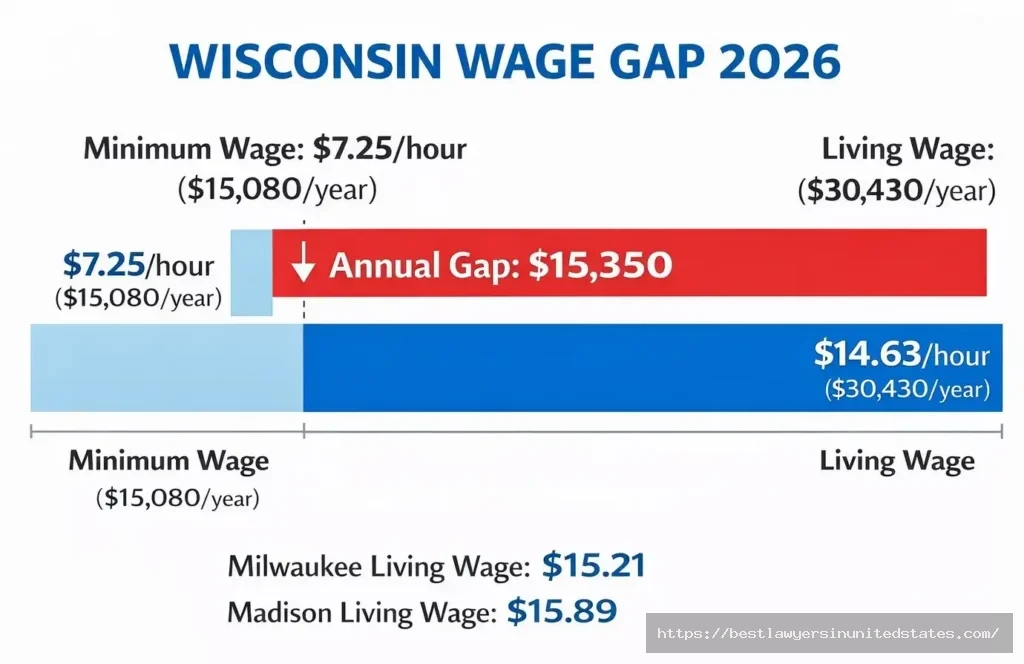
Wisconsin's $7.25 minimum wage falls far short of what economists call a "living wage." The MIT Living Wage Calculator estimates a single adult in Wisconsin needs $14.63 per hour to cover basic expenses. That's more than double the current minimum wage.
The Living Wage Gap
Wisconsin minimum wage: $7.25/hour
Wisconsin living wage (single adult): $14.63/hour
Shortfall: $7.38/hour
Annual income gap: $15,350 for full-time work
A single adult working 40 hours per week at minimum wage earns $15,080 annually before taxes. The living wage for the same person would be $30,430. That's a difference of more than $15,000 per year.
Cost of Living by Wisconsin City
Living costs vary across Wisconsin. Major cities require higher wages than rural areas:
| City | Living Wage (Single Adult) | Minimum Wage | Monthly Shortfall |
|---|---|---|---|
| Milwaukee | $15.21/hour | $7.25/hour | $1,380 |
| Madison | $15.89/hour | $7.25/hour | $1,498 |
| Green Bay | $14.12/hour | $7.25/hour | $1,193 |
| Rural Wisconsin | $13.85/hour | $7.25/hour | $1,144 |
What Living Wage Covers
The MIT Living Wage Calculator includes these basic expenses:
- Housing (rent/mortgage)
- Food
- Transportation
- Healthcare
- Childcare (if applicable)
- Taxes
- Other necessities (clothing, household items)
It does not include:
- Savings for retirement
- Emergency funds
- Entertainment or dining out
- Vacations
- College savings
Even meeting basic needs requires double Wisconsin's minimum wage in most areas.
Working Multiple Jobs
Many minimum wage workers in Wisconsin hold two or three jobs to make ends meet. A single parent needs approximately $31 per hour to support one child. That's 4.3 times the minimum wage.
The reality: You cannot live independently on $7.25/hour in Wisconsin. Most minimum wage workers rely on:
- Roommates or family housing
- Public assistance programs
- Multiple jobs
- Partner's income
Wisconsin Minimum Wage History: From Pioneer to Laggard
Wisconsin was an early leader in worker protections but now lags behind most states on minimum wage. The state passed its first minimum wage law in 1913, making it only the second state to protect workers this way.
Historical Wage Rates
| Year | Minimum Wage | Adjusted for 2026 Inflation | Purchasing Power vs Today |
|---|---|---|---|
| 1968 | $1.60 | $14.25 | 96% higher than 2026 |
| 1980 | $2.90 | $10.82 | 49% higher than 2026 |
| 1990 | $3.35 | $7.92 | 9% higher than 2026 |
| 2000 | $5.15 | $9.25 | 28% higher than 2026 |
| 2009 | $7.25 | $10.51 | 45% higher than 2026 |
| 2026 | $7.25 | $7.25 | Baseline |
Peak Purchasing Power: 1968
Wisconsin's minimum wage had its highest purchasing power in 1968 at $1.60 per hour. After adjusting for inflation, that equals $14.25 in 2026 dollars. Today's $7.25 minimum wage has 49% less buying power than the 1968 rate.
What you could buy in 1968 vs 2026:
- 1968: One hour of minimum wage work bought approximately 2.5 gallons of gas
- 2026: One hour of minimum wage work buys approximately 1.8 gallons of gas
17 Years Without an Increase
Wisconsin's minimum wage has been frozen at $7.25 since July 24, 2009. That's 17 years without any cost of living adjustment. During this time:
- Rent in Wisconsin increased by 35%
- Healthcare costs rose by 45%
- Food prices increased by 30%
- College tuition rose by 40%
Meanwhile, states like Tennessee and Alabama also remain at $7.25, showing how the federal minimum creates a floor many states never rise above.
Why Wisconsin Hasn't Increased Its Wage
Wisconsin Statutes § 104.035 automatically adopts any federal minimum wage increase. When the federal rate is higher than Wisconsin's statute, the higher rate applies. But Wisconsin law doesn't allow state wages to exceed federal minimums without legislative action.
Since the federal minimum hasn't increased since 2009, neither has Wisconsin's. The state legislature would need to pass new legislation to go above $7.25, and political divisions have prevented this for 17 years.
Will Wisconsin Raise the Minimum Wage in 2026?
No minimum wage increases are scheduled for Wisconsin in 2026 or 2027. The state's minimum wage will remain $7.25 per hour unless the legislature passes new laws or federal law changes.
Recent Legislative Attempts
Governor Tony Evers has proposed raising Wisconsin's minimum wage multiple times:
2019: Proposed $15 minimum wage by 2025
Result: Republican legislature blocked it
2021: Proposed gradual increases to $10.15
Result: No legislative action
2023: Proposed $10.00 minimum wage
Result: Blocked again
2024: Referendum efforts for $12 minimum wage
Result: Did not reach ballot
The pattern is clear: Democratic governors propose increases, and the Republican-controlled legislature rejects them. This political gridlock has kept wages frozen since 2009.
Why Minnesota Succeeded But Wisconsin Didn't
Minnesota passed legislation to increase its minimum wage to $11.13 while Wisconsin stayed at $7.25. The difference? Minnesota's legislature and governor agreed on wage increases. Wisconsin's divided government cannot reach consensus.
Minnesota's wage increases were phased in gradually:
- 2014: $8.00
- 2016: $9.50
- 2022: $10.33
- 2026: $11.13
Wisconsin has had none of these adjustments.
Federal Minimum Wage Prospects
The federal minimum wage has been $7.25 since 2009. Congressional proposals to raise it to $15 have failed repeatedly. Without federal action, Wisconsin's minimum wage will not increase automatically.
Realistic outlook for 2026-2027: No changes expected unless Wisconsin's political landscape shifts dramatically or federal law changes.
What Would a $15 Minimum Wage Mean?
If Wisconsin adopted a $15 minimum wage like Illinois:
Current: $7.25/hour = $15,080/year full-time
At $15: $15/hour = $31,200/year full-time
Difference: $16,120 more annually
This would bring minimum wage closer to living wage but still fall short in expensive cities like Madison.
Calculate Your Wage Theft Recovery in Wisconsin
Think your employer owes you money? Use our wage theft calculator to estimate how much you could recover, including unpaid wages, penalties, and interest under Wisconsin law.
Wage Theft Recovery Calculator
Estimate how much you can recover in unpaid wages, penalties, and damages based on your state's laws
💵 Estimated Total Recovery
💰 Unpaid Wages
⚖️ Penalties & Damages
📋 Total Summary
Calculator features:
- Multiple violation types (unpaid wages, overtime, tips)
- Wisconsin-specific penalties and damages
- Filing deadline tracker
- Total recovery estimate
- Next steps guidance
Full wage theft calculator: Wage Theft Calculator
Need help with unpaid wages? Contact Wisconsin Department of Workforce Development or consult with an employment attorney.
Email: [email protected]
What If You're Not Being Paid Properly?
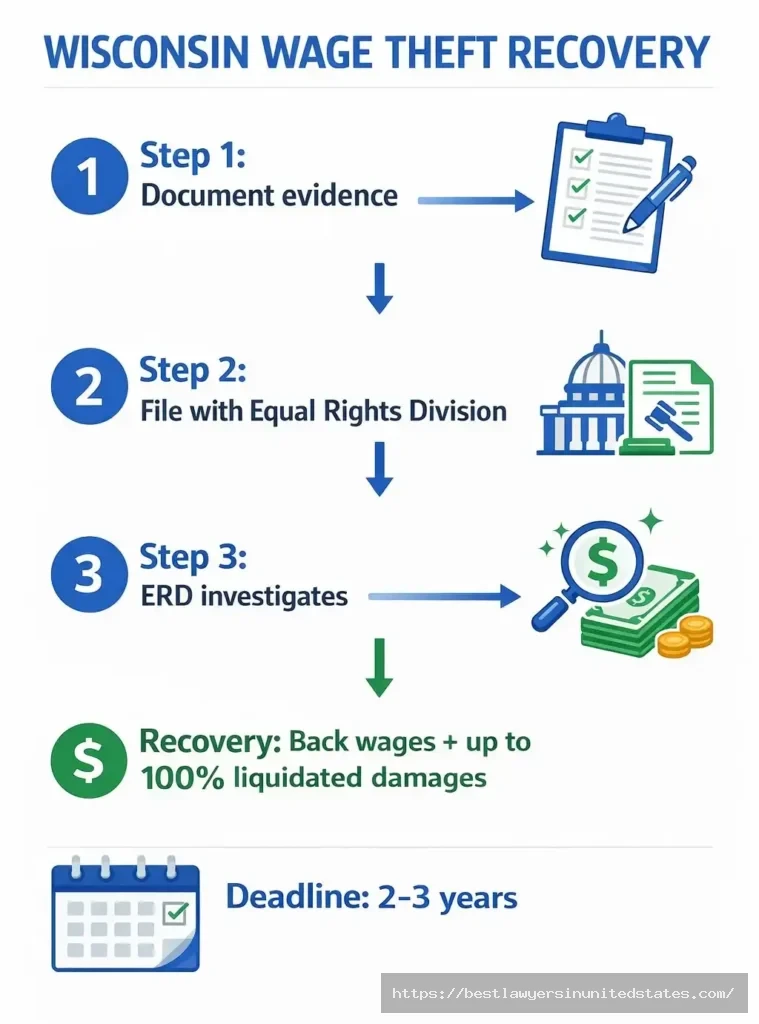
Wisconsin law protects your right to full payment of wages earned. If your employer violates wage laws, you can file a complaint with the Wisconsin Department of Workforce Development (DWD) Equal Rights Division (ERD).
Common Wage Violations
Watch for these illegal practices:
❌ Unpaid overtime: Not paying 1.5× for hours over 40
❌ Below minimum wage: Paying less than $7.25/hour
❌ Tip theft: Keeping tips meant for employees
❌ Off-the-clock work: Requiring work without pay
❌ Illegal deductions: Taking money from paychecks without authorization
❌ Final paycheck delay: Not paying final wages on time
How to File a Wage Claim in Wisconsin
Step 1: Document Everything Collect evidence before filing:
- Pay stubs from all pay periods
- Time sheets or work schedules
- Copies of your time clock records
- Text messages or emails about wages
- Written policies about pay
Step 2: Contact the Equal Rights Division
Wisconsin Equal Rights Division (ERD)
Address: 201 E. Washington Ave, Room A300, Madison, WI 53703
Phone: (608) 266-6860
Online: File complaint at dwd.wisconsin.gov
Step 3: File Your Complaint
You must file within the statute of limitations:
- 2 years for most wage claims
- 3 years if the violation was willful (intentional)
The ERD investigates your claim and may hold a hearing. You don't need a lawyer, but one can help.
Step 4: Potential Recovery
Wisconsin law allows you to recover:
Unpaid wages: Full amount owed
Liquidated damages: Up to double the unpaid amount (100% penalty)
Attorney fees: If you win
Interest: On unpaid amounts
| Violation Type | What You Can Recover | Penalty to Employer |
|---|---|---|
| Unpaid minimum wage | Back wages + damages | Up to 200% of wages |
| Unpaid overtime | Back wages + damages | Up to 200% of wages |
| Stolen tips | Full tips + damages | Up to 200% of tips |
| Late final paycheck | Wages + penalty | Continuing daily penalty |
Real Example of Wage Theft Recovery
Situation: Server worked 50 hours/week for 8 weeks but was paid straight time for all hours (no overtime).
What was owed:
- Regular pay: 40 hours × $7.25 × 8 weeks = $2,320
- Overtime pay: 10 hours × $10.88 × 8 weeks = $870.40
- Total owed: $3,190.40
What was paid:
- Actual payment: 50 hours × $7.25 × 8 weeks = $2,900
Unpaid wages: $290.40
Potential recovery with liquidated damages:
- Unpaid wages: $290.40
- Liquidated damages (100%): $290.40
- Total recovery: $580.80
Retaliation Is Illegal
Wisconsin law prohibits employers from retaliating against workers who file wage claims. Your employer cannot:
❌ Fire you for filing a complaint
❌ Cut your hours in retaliation
❌ Demote you
❌ Create a hostile work environment
❌ Threaten you
If retaliation occurs, file an additional complaint with ERD.
What Employers Must Do to Comply
Wisconsin employers must follow both state and federal wage laws. The Department of Workforce Development enforces these requirements and can penalize violations.
Required Wage Posters
Employers must display these posters where all employees can see them:
Wisconsin Minimum Wage Notice: Shows current rates
Federal FLSA Poster: Federal wage and hour requirements
Equal Rights Division Poster: How to file complaints
Posters must be in English and any other language spoken by employees.
Record-Keeping Requirements
Wisconsin employers must maintain records for at least 3 years:
- Employee names and addresses
- Hours worked each day and week
- Wage rate and total wages paid
- Pay period dates
- Date of payment
- Tip records for tipped employees
Failure to keep records can result in penalties and makes it harder for employers to defend against wage claims.
Payroll System Requirements
Your payroll must:
✅ Pay at least minimum wage for all hours worked
✅ Calculate overtime correctly at 1.5× regular rate
✅ Track tips for tipped employees
✅ Make up difference if tips don't reach minimum wage
✅ Transition opportunity wage workers to full minimum after 90 days
Common Employer Mistakes
These violations trigger complaints and penalties:
Averaging hours across weeks: You can't average 30 hours one week and 50 hours the next to avoid overtime.
Misclassifying employees: Calling someone a manager or independent contractor doesn't make them exempt from overtime.
Automatic meal break deductions: You can't automatically deduct 30 minutes if employees work through lunch.
Comp time instead of overtime: Private employers cannot offer time off instead of overtime pay.
Penalties for Violations
The Wisconsin DWD can impose:
- Back wages owed to employees
- Liquidated damages up to 100% of unpaid wages
- Civil penalties per violation
- Criminal charges for willful violations
- Business license suspension
Key takeaway: Following wage laws costs less than defending violations and paying penalties.
Special Worker Categories in Wisconsin
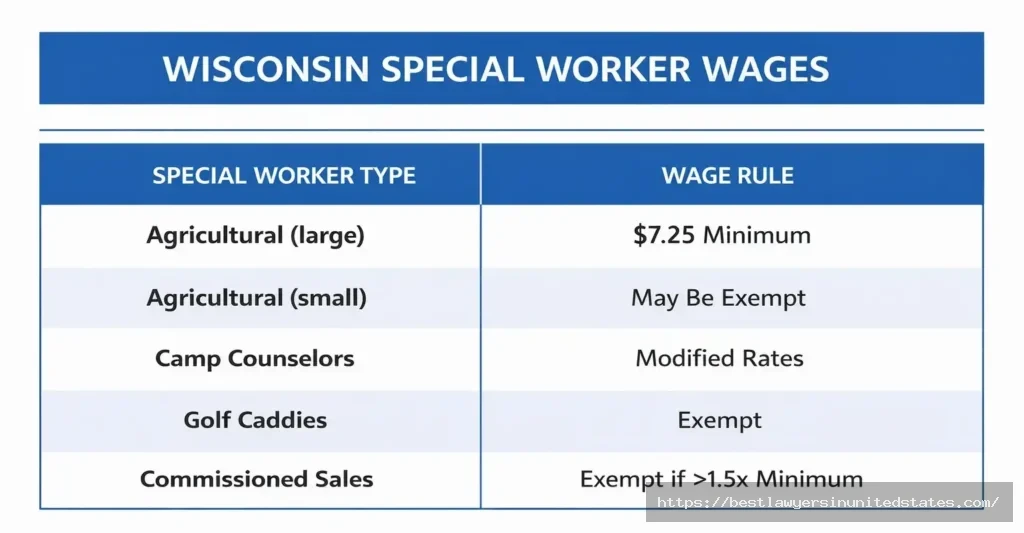
Wisconsin wage law treats some worker categories differently. Understanding these exceptions helps both employers and employees know their rights.
Agricultural Workers
Farm workers in Wisconsin have limited wage protections. Small farms may not need to pay minimum wage if they:
- Used fewer than 500 "man-days" of agricultural labor in any quarter of the previous year
- Employ immediate family members only
Large agricultural operations must pay minimum wage and overtime to non-family workers.
Camp Counselors and Seasonal Workers
Summer camp counselors may receive reduced wages if they:
- Work at organized camps
- Receive room and board
- Work seasonal positions
The employer can count lodging and meals toward minimum wage at their reasonable cost or fair value.
Golf Caddies
Golf caddies are exempt from minimum wage laws in Wisconsin. Courses can pay caddies any amount or use tips-only compensation.
Commissioned Salespeople
Retail sales workers paid entirely on commission may be exempt from minimum wage if they:
- Earn more than 1.5 times minimum wage when commissions are averaged
- Work primarily in sales
- Have commissions account for more than half their compensation
Professional Exemptions
Certain professionals don't receive overtime pay:
Lawyers: Licensed attorneys
Doctors: Licensed physicians
Teachers: Academic instructors
Accountants: Licensed CPAs
These exemptions require proper licensing and genuine professional duties.
| Worker Type | Minimum Wage Required? | Overtime Required? | Special Rules |
|---|---|---|---|
| Agricultural (large farms) | ✅ Yes | ✅ Yes | None |
| Agricultural (small farms) | ❌ Sometimes exempt | ❌ Sometimes exempt | Under 500 man-days |
| Camp Counselors | ⚠️ Modified | ⚠️ Modified | Room/board credits |
| Golf Caddies | ❌ Exempt | ❌ Exempt | Tips-based |
| Commissioned Sales | ⚠️ If >1.5× min wage | ❌ Exempt | Must average above minimum |
Milwaukee and Madison: City-Specific Considerations
Milwaukee and Madison face unique challenges with Wisconsin's frozen minimum wage. Both cities have significantly higher costs of living than rural areas but cannot raise local wages due to state preemption law.
Cost of Living Differences
Milwaukee:
- Living wage needed: $15.21/hour
- Actual minimum wage: $7.25/hour
- Housing costs: 40% above state average
Madison:
- Living wage needed: $15.89/hour
- Actual minimum wage: $7.25/hour
- Housing costs: 55% above state average
A Milwaukee worker earning $7.25/hour cannot afford rent on a one-bedroom apartment without spending more than 50% of their income on housing. The same is true in Madison.
How City Employers Respond
Many Milwaukee and Madison employers pay well above $7.25 to attract workers:
Target: Starting wage $15-17/hour
McDonald's: $12-14/hour average
Amazon warehouses: $15.50-18/hour
Retail stores: $11-15/hour typical
Market forces push wages higher even though the law doesn't require it. Employers competing with Minnesota and Illinois must offer competitive pay.
Political Efforts for Local Control
Milwaukee aldermen and Madison council members have proposed giving cities authority to set minimum wages. These efforts failed at the state legislature level due to the preemption law.
Key difference: Unlike cities in neighboring states, Wisconsin municipalities have zero flexibility on wage policy.
Frequently Asked Questions
What is Wisconsin's minimum wage for 2026?
Quick Answer: Wisconsin's minimum wage is $7.25 per hour in 2026, unchanged since 2009. Tipped workers earn $2.33 base wage plus tips.
This rate matches the federal minimum wage. Full-time workers (40 hours/week) earn $15,080 annually before taxes.
When will Wisconsin raise the minimum wage?
Quick Answer: Wisconsin has no scheduled minimum wage increases for 2026 or 2027. The rate will remain $7.25 unless the legislature passes new laws.
Governor Tony Evers has proposed increases multiple times, but the Republican legislature has blocked all attempts since 2009. Political gridlock prevents change.
Do waitresses in Wisconsin make minimum wage?
Quick Answer: Wisconsin waitresses and servers earn $2.33 per hour base wage plus tips. If tips don't bring total pay to $7.25/hour, employers must pay the difference.
This is called the "tip credit" system. Your employer can count up to $4.92 per hour in tips toward your minimum wage obligation.
How do I calculate my earnings at Wisconsin minimum wage?
Quick Answer: Use our free minimum wage calculator to estimate weekly, monthly, and annual earnings at $7.25/hour.
For manual calculation: Multiply your hours by $7.25. A 40-hour week pays $290. A full year (2,080 hours) pays $15,080.
What is the opportunity wage in Wisconsin?
Quick Answer: Wisconsin's opportunity wage is $5.90 per hour for workers under age 20 during their first 90 days of employment.
After 90 days or when you turn 20 (whichever comes first), your wage must increase to at least $7.25 per hour.
How much overtime pay am I entitled to in Wisconsin?
Quick Answer: Wisconsin workers earn 1.5 times their regular rate for hours over 40 per week. At $7.25/hour, overtime pays $10.88/hour.
Use our overtime calculator to estimate your overtime earnings based on hours worked.
Can Milwaukee or Madison set their own minimum wage?
Quick Answer: No. Wisconsin law prohibits cities from setting minimum wages higher than the state rate of $7.25.
This is different from states like California or Illinois where cities can establish higher local minimums. Wisconsin's preemption law gives only the state legislature authority over wages.
What states have $15 minimum wage?
Quick Answer: California, Connecticut, Massachusetts, New York, and Washington all have $15+ minimum wages. Illinois neighbors Wisconsin with a $15 minimum.
Wisconsin's $7.25 is less than half of these states' rates. Many Wisconsin workers cross the border to Illinois for better wages.
How do I file a wage theft complaint in Wisconsin?
Quick Answer: File with the Wisconsin Equal Rights Division (ERD) at (608) 266-6860 or online at dwd.wisconsin.gov within 2-3 years of the violation.
You'll need pay stubs, time records, and evidence of the violation. The ERD investigates and can award back wages plus liquidated damages.
How do I calculate wage theft recovery in Wisconsin?
Quick Answer: Use our wage theft calculator to estimate unpaid wages plus liquidated damages (up to double the amount).
Wisconsin law allows recovery of unpaid wages, penalties equal to 100% of unpaid amounts, interest, and attorney fees if you win.
What is a livable wage in Wisconsin?
Quick Answer: A single adult in Wisconsin needs approximately $14.63/hour to cover basic expenses, according to MIT's Living Wage Calculator.
This is twice Wisconsin's $7.25 minimum wage. In Milwaukee ($15.21) and Madison ($15.89), the living wage is even higher.
Can you live on minimum wage in Wisconsin?
Quick Answer: No. At $7.25/hour ($15,080/year full-time), you cannot afford basic living expenses as a single adult in Wisconsin.
Most minimum wage workers rely on roommates, family support, public assistance, or multiple jobs to make ends meet.
What was Wisconsin's minimum wage in 1990?
Quick Answer: Wisconsin's minimum wage was $3.35 per hour in 1990, which equals $7.92 in 2026 dollars when adjusted for inflation.
Today's $7.25 minimum has less purchasing power than the 1990 wage, showing how inflation has eroded the value.
How does Wisconsin overtime work?
Quick Answer: Wisconsin requires 1.5 times your regular rate for all hours over 40 in a workweek. At minimum wage, that's $10.88/hour for overtime.
Exempt employees (certain salaried managers and professionals) don't receive overtime pay regardless of hours worked.
Who is exempt from minimum wage in Wisconsin?
Quick Answer: Golf caddies, some small farm workers, certain commissioned salespeople, and immediate family members working in family businesses may be exempt.
Most hourly workers in retail, restaurants, manufacturing, and service industries must receive at least $7.25/hour.
Is Wisconsin raising minimum wage in 2026?
Quick Answer: No. Wisconsin has no scheduled minimum wage increases for 2026. The rate remains $7.25/hour.
Without new legislation or federal changes, Wisconsin's minimum wage will stay frozen at the 2009 level.
Know Your Rights, Use the Tools
Wisconsin's minimum wage has been stuck at $7.25 for 17 years while costs keep rising. Whether you're earning minimum wage, working for tips, or putting in overtime hours, you deserve fair pay under the law.
Our three calculators help you:
- Calculate exact earnings at Wisconsin's minimum wage
- Figure overtime pay for hours over 40 per week
- Estimate wage theft recovery if you're owed money
If your employer violates wage laws, contact the Wisconsin Equal Rights Division at (608) 266-6860. You have 2-3 years to file a claim and could recover double the unpaid amount.
Need legal help with wage issues?
Email: [email protected]
Compare Wisconsin to other states:
- Minnesota minimum wage ($11.13)
- Illinois minimum wage ($15.00)
- Michigan minimum wage ($10.56)
