
Quick Answer: A divorce waiting period is the mandatory time between filing for divorce and receiving your final decree. This period ranges from zero days in states like Alaska and Nevada to 6 months in California. Most states require 30 to 120 days.
The waiting period exists to give couples time to reconsider. Some states also use this time for required mediation or parenting classes. Understanding your state’s waiting period helps you plan your divorce timeline and budget accordingly.
This guide covers waiting periods in all 50 states, how to calculate your timeline, and whether you can speed up the process. We’ll also explain the difference between waiting periods and separation requirements, which many people confuse.
What Is a Divorce Waiting Period?
A divorce waiting period is the time you must wait after filing before your divorce becomes final. This period starts on different dates depending on your state—either when you file the petition or when your spouse receives the papers.
The three key divorce timelines are:
- Waiting Period: Time AFTER filing before divorce is final
- Separation Period: Time BEFORE filing (required in some states)
- Residency Requirement: How long you must live in a state before filing
Many people confuse waiting periods with separation requirements. North Carolina requires couples to live apart for one year before filing. California requires a six-month waiting period after filing. These are completely different requirements that serve different purposes.
Why States Have Waiting Periods
States created waiting periods for several reasons. The primary goal is reconciliation. Lawmakers believed that cooling-off periods might save marriages. Court systems also use this time to process paperwork and schedule hearings.
Some states require couples to attend mediation during the waiting period. Others mandate parenting classes for divorcing parents. These requirements aim to reduce conflict and protect children during the divorce process.
Common reasons for waiting periods:
✅ Allow time for reconciliation
✅ Process court paperwork
✅ Complete mandatory mediation
✅ Finish parenting classes
✅ Gather financial documents
✅ Negotiate settlement terms
Calculate Your Divorce Timeline
Planning your divorce? Use our free calculator to estimate when your divorce will be final based on your state’s waiting period requirements.
Divorce Cost Calculator
Get an estimated cost for your divorce based on your specific situation
Your Estimated Divorce Cost
Cost Breakdown
📧 Get a Personalized Consultation
Have questions about your specific situation? Contact our legal experts for guidance tailored to your needs.
Contact Us via EmailCalculator features:
- State-specific waiting period dates
- Filing vs. service date calculations
- Contested vs. uncontested timelines
- Remarriage eligibility dates
- Step-by-step process timeline
The calculator accounts for your state’s specific rules about when the waiting period starts. In Texas, the 60-day clock begins when your spouse is served. In California, it starts on your filing date.
Questions about your divorce timeline or need legal help?
Email: [email protected]
All 50 States: Waiting Period Comparison
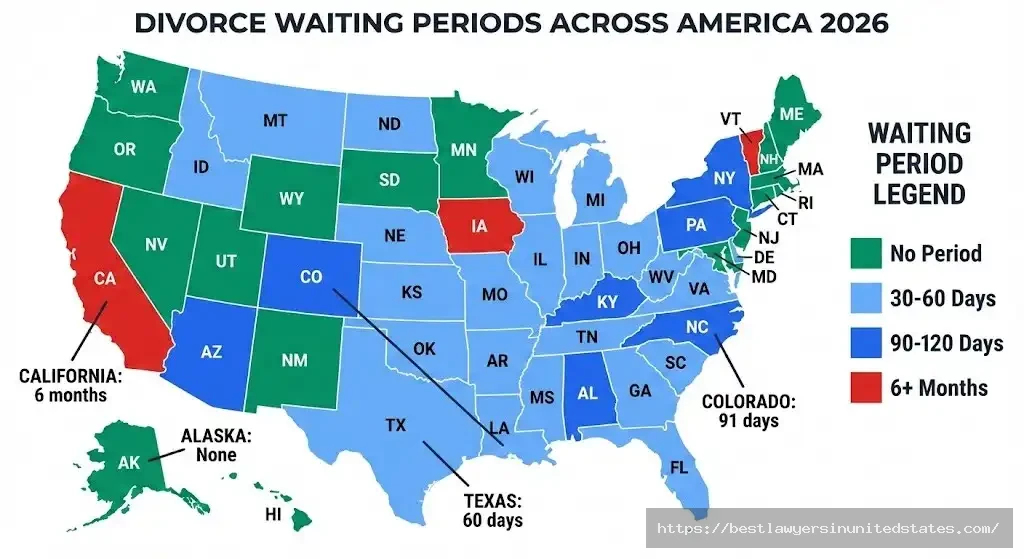
This table shows the waiting period requirements for every state. States with “None” still require time for service and court processing, but have no mandatory waiting period after filing.
| State | Waiting Period After Filing | Mandatory Separation Before Filing | Residency Requirement | Waiver Available? |
|---|---|---|---|---|
| Alabama | 30 days | No | 6 months | Rare |
| Alaska | None | No | 30 days (flexible) | N/A |
| Arizona | 60 days (from service) | No | 90 days | No |
| Arkansas | None | 18 months (contested) | 60 days | N/A |
| California | 6 months + 1 day | No | 6 months | Very rare |
| Colorado | 91 days (mandatory) | No | 91 days | No |
| Connecticut | 90 days | No | 12 months | Rare |
| Delaware | None | No | 6 months | N/A |
| Florida | 20 days (service only) | No | 6 months | No |
| Georgia | 31 days | No | 6 months | Rare |
| Hawaii | None | No | 6 months | N/A |
| Idaho | 20 days (service only) | No | 6 weeks | N/A |
| Illinois | None | No | 90 days | N/A |
| Indiana | 60 days | No | 6 months | Rare |
| Iowa | 90 days | No | 1 year | No |
| Kansas | 60 days | No | 60 days | Rare |
| Kentucky | 60 days | No | 180 days | No |
| Louisiana | None | No | 6 months | N/A |
| Maine | 60 days | No | 6 months | Rare |
| Maryland | 30-60 days (varies) | No | 6 months | Rare |
| Massachusetts | 120 days (nisi period) | No | 1 year | No |
| Michigan | 60-180 days | No | 180 days | No |
| Minnesota | None | No | 180 days | N/A |
| Mississippi | 60 days | No | 6 months | Rare |
| Missouri | 30 days | No | 90 days | Rare |
| Montana | None | No | 90 days | N/A |
| Nebraska | 60 days | No | 1 year | Rare |
| Nevada | None | No | 6 weeks | N/A |
| New Hampshire | None | No | 1 year | N/A |
| New Jersey | None | No | 1 year | N/A |
| New Mexico | 30 days | No | 6 months | Rare |
| New York | None | No | 1 year | N/A |
| North Carolina | None | 1 year separation | 6 months | No |
| North Dakota | 60 days | No | 6 months | Rare |
| Ohio | 30-90 days | No | 6 months | Rare |
| Oklahoma | 10-90 days | No | 6 months | Varies |
| Oregon | None | No | 6 months | N/A |
| Pennsylvania | 90 days | No | 6 months | No |
| Rhode Island | 60 days | No | 1 year | Rare |
| South Carolina | 90 days | No | 3 months | No |
| South Dakota | None | No | Varies | N/A |
| Tennessee | 60-90 days | No | 6 months | No |
| Texas | 60 days | No | 6 months | Rare |
| Utah | 30 days | No | 3 months | Rare |
| Vermont | 6 months | No | 6 months | No |
| Virginia | None | 6-12 months separation | 6 months | No |
| Washington | 90 days | No | Varies | No |
| West Virginia | None | No | 1 year | N/A |
| Wisconsin | 120 days | No | 6 months | No |
| Wyoming | None | No | 60 days | N/A |
Key findings from the data:
- 17 states have no mandatory waiting period after filing
- California has the longest waiting period at 6 months
- Wisconsin requires 120 days, one of the longest
- Texas, Arizona, Kansas require 60 days
- Colorado mandates 91 days with no exceptions
Understanding how divorce laws vary by state helps you plan accurately. Some states measure from filing, others from when your spouse is served.
States with No Divorce Waiting Period
Seventeen states allow divorces to be finalized without a mandatory waiting period. This doesn’t mean instant divorce. You still need time for service, court scheduling, and paperwork processing.
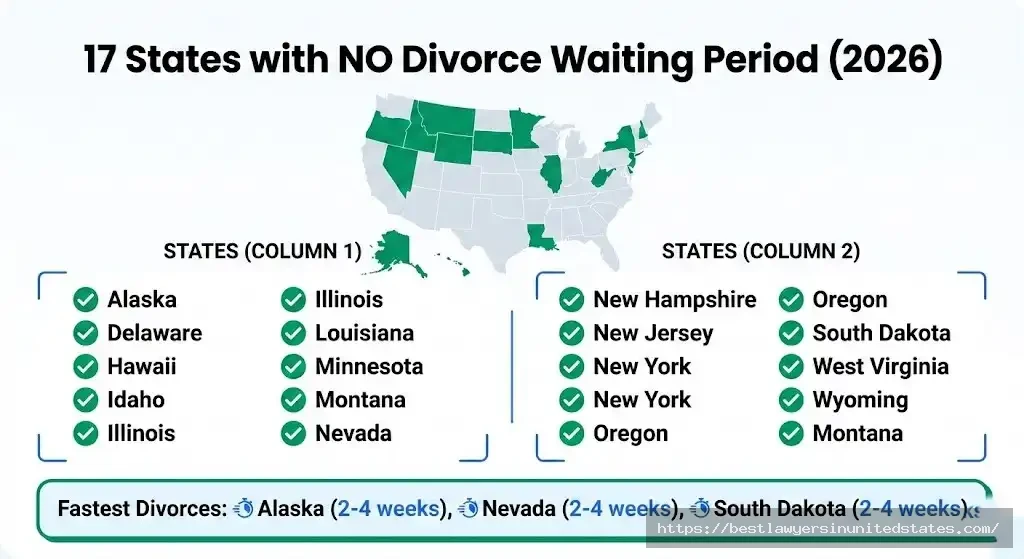
Fastest Divorce States
Alaska
No waiting period after filing. Requires 30 days of residency but courts apply this flexibly. Uncontested divorces can be final in 2-4 weeks if both parties agree on all terms.
Nevada
No waiting period if you’ve been a Nevada resident for 6 weeks. Popular for quick divorces. Some couples establish residency just to divorce faster.
South Dakota
No waiting period. Residency requirements vary based on grounds for divorce. Can be as short as the time you’ve lived there if filing on certain grounds.
Wyoming
No mandatory waiting period. Requires 20 days for service only. One of the fastest states if all agreements are ready.
Montana
No waiting period after filing. Requires 20 days for service. Can finalize in under a month for uncontested cases.
Other No-Waiting-Period States
The following states also have no mandatory waiting period:
✅ Delaware
✅ Hawaii
✅ Idaho (20-day service requirement)
✅ Illinois (but 90-day residency)
✅ Louisiana
✅ Minnesota
✅ New Hampshire
✅ New Jersey
✅ New York
✅ Oregon
✅ West Virginia
Timeline for fastest divorce:
If you meet residency requirements and have an uncontested divorce with all agreements ready, you could finalize in 2-4 weeks in Alaska or South Dakota. Nevada requires the 6-week residency first, then can process quickly.
Even without a waiting period, expect at least 2-3 weeks for:
- Filing and processing paperwork
- Serving your spouse
- Court scheduling
- Final decree preparation
Need help with a quick DIY divorce? Our state-by-state guide shows you how to file without an attorney in states with no waiting period.
Mandatory Separation States Explained
Four states require couples to live separately BEFORE filing for divorce. This is different from a waiting period. You must physically separate, wait the required time, then file your petition.
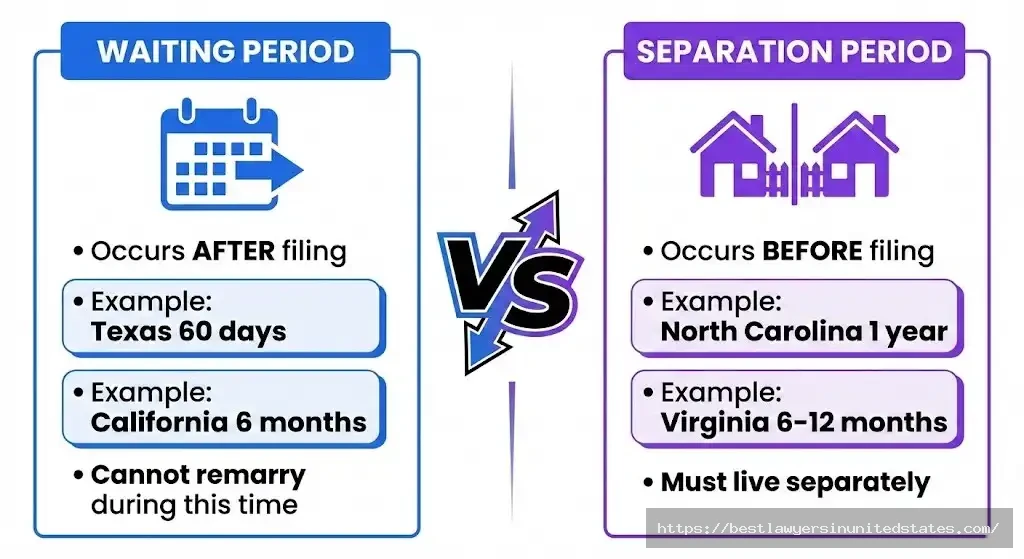
North Carolina: One-Year Separation
North Carolina requires couples to live apart for one full year before filing. This is the strictest separation requirement in the United States.
Timeline breakdown:
- Day 1: Spouses separate
- Month 12: One year of separation complete
- File divorce petition
- Final decree (same day if uncontested)
Total minimum timeline: 12-14 months
The separation must be continuous. Moving back in together resets the clock. North Carolina courts define separation as living in separate residences with intent to divorce.
North Carolina divorce costs average $8,000-$15,000 for uncontested cases when you factor in the year-long wait. Many couples use this time to negotiate settlements.
Virginia: Six to Twelve Months Separation
Virginia requires separation before filing. The duration depends on your situation:
6 months: If you have no children and a signed separation agreement
12 months: If you have children or no separation agreement
Timeline for 6-month separation:
- Create and sign separation agreement
- Live apart for 6 months
- File divorce petition
- Final decree
Total timeline: 7-8 months
Virginia divorce costs range from $7,000-$20,000 depending on whether you use the 6-month or 12-month track.
Arkansas: Eighteen-Month Separation
Arkansas requires an 18-month separation for contested divorces. Uncontested divorces can proceed without separation if both parties agree.
Two paths:
- Contested: 18 months separation required
- Uncontested: Can file immediately if both agree
This makes Arkansas unique. The separation requirement only applies when spouses disagree. If you both want the divorce and agree on terms, no separation is needed.
Maryland: One-Year Separation Option
Maryland offers two paths to no-fault divorce:
- Mutual consent: No separation required (both parties agree)
- One-year separation: Required if filing without mutual consent
Most Maryland couples use the mutual consent option to avoid the wait. This requires a signed settlement agreement covering all issues.
When Does the Divorce Waiting Period Start?
The start date for your waiting period depends on your state’s law. This affects when your divorce can be final and when you can remarry.
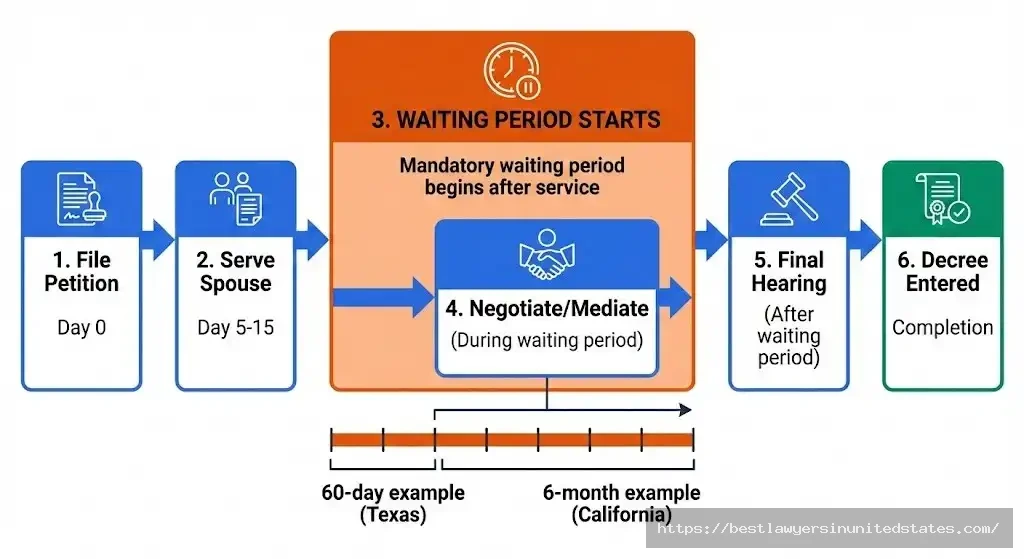
States Where Waiting Period Starts on Filing Date
California measures its 6-month waiting period from the date you file your petition. Your divorce cannot be final until 6 months and 1 day after filing, regardless of when your spouse receives the papers.
Example timeline:
- File petition: January 1, 2026
- Spouse served: January 20, 2026
- 6-month waiting period ends: July 1, 2026
- Earliest finalization: July 2, 2026
California divorce costs typically run $15,000-$30,000 for contested cases. The 6-month waiting period often works in your favor, giving time to negotiate without rushing.
Other states that count from filing:
✅ Vermont (6 months)
✅ Massachusetts (120 days)
✅ Pennsylvania (90 days)
States Where Waiting Period Starts on Service Date
Most states start the waiting period when your spouse is served with divorce papers. This can add weeks to your timeline if service is delayed.
Texas requires 60 days from the date your spouse is served, not from when you file.
Example timeline:
- File petition: January 1, 2026
- Spouse served: January 15, 2026
- 60-day waiting period starts: January 15, 2026
- Earliest finalization: March 16, 2026
Texas divorce costs range from $15,000-$23,000 for contested cases. Understanding the 60-day rule from service helps you plan court dates.
Other states that count from service:
✅ Arizona (60 days from service)
✅ Kansas (60 days from service)
✅ Indiana (60 days from service)
✅ Kentucky (60 days from service)
Why This Matters
Knowing when your waiting period starts affects several decisions:
Court scheduling: You can’t schedule your final hearing until the waiting period ends
Settlement negotiations: You know your deadline for reaching agreements
Remarriage planning: You can calculate when you’ll be legally single
Financial planning: You can project when divorce costs will be final
The distinction between filing date and service date can add 2-4 weeks to your timeline. Service typically takes 1-3 weeks depending on whether your spouse cooperates.
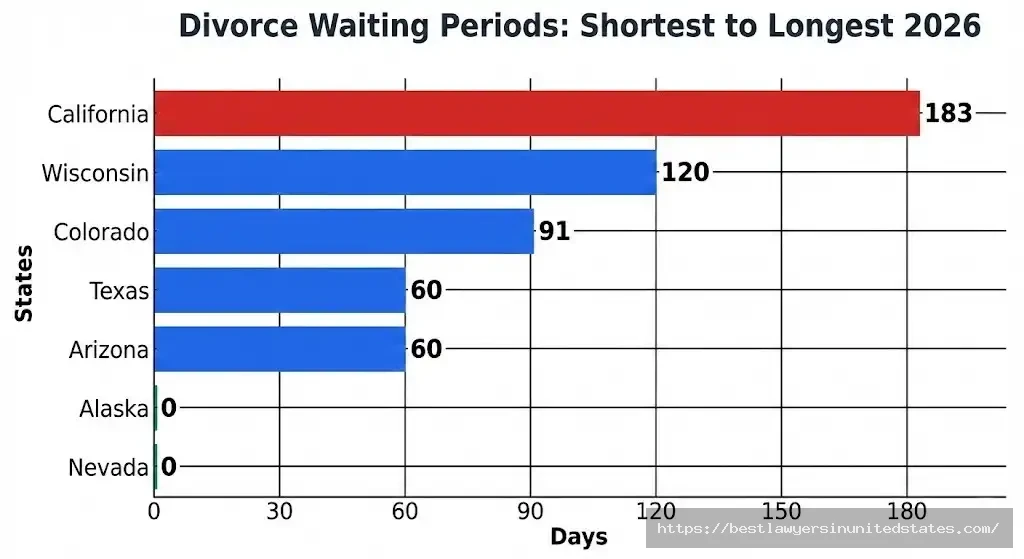
How Long Is the Waiting Period by State?
Waiting periods fall into four categories based on length. Knowing your state’s category helps you plan your divorce timeline.
Short Waiting Periods (20-60 Days)
Texas: 60 days from service
Texas Family Code § 6.702 mandates a 60-day waiting period. This starts when your spouse receives the divorce papers. Courts cannot grant a final decree before the 60 days end.
Arizona: 60 days from service
Arizona requires 60 days from the date of service. Arizona divorce costs average $12,000-$20,000 for contested cases.
Kansas: 60 days from service
Kansas Statutes § 23-2707 sets a 60-day minimum. This period cannot be waived even if both parties agree.
Alabama: 30 days from filing
One of the shortest waiting periods. Allows divorces to finalize quickly in uncontested cases.
Florida: 20 days (service only)
Florida has no true waiting period. The 20 days is just the time allowed for the respondent to answer. Florida divorce costs are among the lowest for uncontested cases.
Standard Waiting Periods (90-120 Days)
Colorado: 91 days (mandatory)
Colorado Revised Statutes § 14-10-107 requires exactly 91 days. This cannot be waived under any circumstances. Colorado divorce costs range from $8,000-$18,000.
Wisconsin: 120 days
Wisconsin Statutes § 767.335 mandates 120 days. This is one of the longest waiting periods and cannot be shortened.
Connecticut: 90 days
Standard 90-day waiting period for all divorces.
Iowa: 90 days minimum
Can extend to 180 days or more for contested cases at court’s discretion.
Pennsylvania: 90 days
Cannot be waived even with mutual consent. Pennsylvania divorce costs average $10,000-$15,000.
Long Waiting Periods (6+ Months)
California: 6 months + 1 day
California Family Code § 2339 sets the longest waiting period. The divorce cannot be final until at least 6 months and 1 day after filing. Courts very rarely grant waivers.
Vermont: 6 months
Another long waiting period with no waiver options.
Massachusetts: 120 days (nisi period)
Called a “nisi period” rather than a waiting period. Serves the same function. Massachusetts divorce costs can be high due to attorney fees in the state.
Divorce Waiting Periods by Region
| State | Waiting Period | Starts From | Can Waive? |
|---|---|---|---|
| Northeast | |||
| Connecticut | 90 days | Filing | Rare |
| Maine | 60 days | Filing | Rare |
| Massachusetts | 120 days | Filing | No |
| New Hampshire | None | N/A | N/A |
| New Jersey | None | N/A | N/A |
| New York | None | N/A | N/A |
| Pennsylvania | 90 days | Filing | No |
| Rhode Island | 60 days | Filing | Rare |
| Vermont | 6 months | Filing | No |
| Southeast | |||
| Alabama | 30 days | Filing | Rare |
| Florida | 20 days | Service | No |
| Georgia | 31 days | Filing | Rare |
| Kentucky | 60 days | Service | No |
| Maryland | 30-60 days | Varies | Rare |
| North Carolina | None | N/A (1-yr separation) | No |
| South Carolina | 90 days | Filing | No |
| Tennessee | 60-90 days | Filing | No |
| Virginia | None | N/A (6-12 mo separation) | No |
| West Virginia | None | N/A | N/A |
| Midwest | |||
| Illinois | None | N/A | N/A |
| Indiana | 60 days | Service | Rare |
| Iowa | 90 days | Filing | No |
| Kansas | 60 days | Service | Rare |
| Michigan | 60-180 days | Filing | No |
| Minnesota | None | N/A | N/A |
| Missouri | 30 days | Filing | Rare |
| Nebraska | 60 days | Filing | Rare |
| North Dakota | 60 days | Filing | Rare |
| Ohio | 30-90 days | Filing | Rare |
| South Dakota | None | N/A | N/A |
| Wisconsin | 120 days | Filing | No |
| Southwest | |||
| Arizona | 60 days | Service | No |
| New Mexico | 30 days | Filing | Rare |
| Oklahoma | 10-90 days | Filing | Varies |
| Texas | 60 days | Service | Rare |
| West | |||
| Alaska | None | N/A | N/A |
| California | 6 months + 1 day | Filing | Very rare |
| Colorado | 91 days | Filing | No |
| Hawaii | None | N/A | N/A |
| Idaho | 20 days | Service | N/A |
| Montana | None | N/A | N/A |
| Nevada | None | N/A | N/A |
| Oregon | None | N/A | N/A |
| Utah | 30 days | Filing | Rare |
| Washington | 90 days | Filing | No |
| Wyoming | None | N/A | N/A |
How to Waive the Divorce Waiting Period
Some states allow courts to waive or shorten the waiting period under specific circumstances. Other states have mandatory periods that cannot be changed.
States That Allow Waivers
Texas allows waivers in limited situations. Both parties must file a joint waiver affidavit stating they want to waive the 60-day period. The judge has discretion to approve or deny.
Grounds for waiver in Texas:
✅ Both parties agree in writing
✅ Domestic violence with protective order
✅ Military deployment pending
✅ Compelling financial hardship
Even with a waiver, judges rarely approve them. Most Texas divorces still take the full 60 days.
California grants waivers only in extreme cases. Documented domestic violence is the primary reason. Even then, courts are reluctant to waive the 6-month period.
Florida has no true waiting period to waive. Courts may expedite hearings for good cause.
Filing a Motion to Waive
The process varies by state but generally follows these steps:
1. File a formal motion
Submit a written request to the court explaining why you need the waiver
2. Provide evidence
Include documentation such as:
- Domestic violence police reports
- Restraining orders
- Military deployment orders
- Medical emergencies
- Financial hardship proof
3. Both parties consent (if required)
Some states require both spouses to agree to the waiver
4. Attend a hearing
The judge reviews your motion and makes a decision
5. Receive ruling
If approved, your divorce can proceed immediately
States That Prohibit Waivers
These states have mandatory waiting periods that cannot be shortened:
Colorado: 91-day period is absolute. Colorado Revised Statutes § 14-10-107 contains no waiver provisions. No exceptions exist for any reason.
Wisconsin: 120-day waiting period cannot be waived. Wisconsin Statutes § 767.335 makes no provisions for early finalization.
Pennsylvania: 90-day period is mandatory with no exceptions.
Iowa: 90-day minimum cannot be reduced.
Massachusetts: 120-day nisi period has no waiver option.
Remarriage Waiting Periods After Divorce
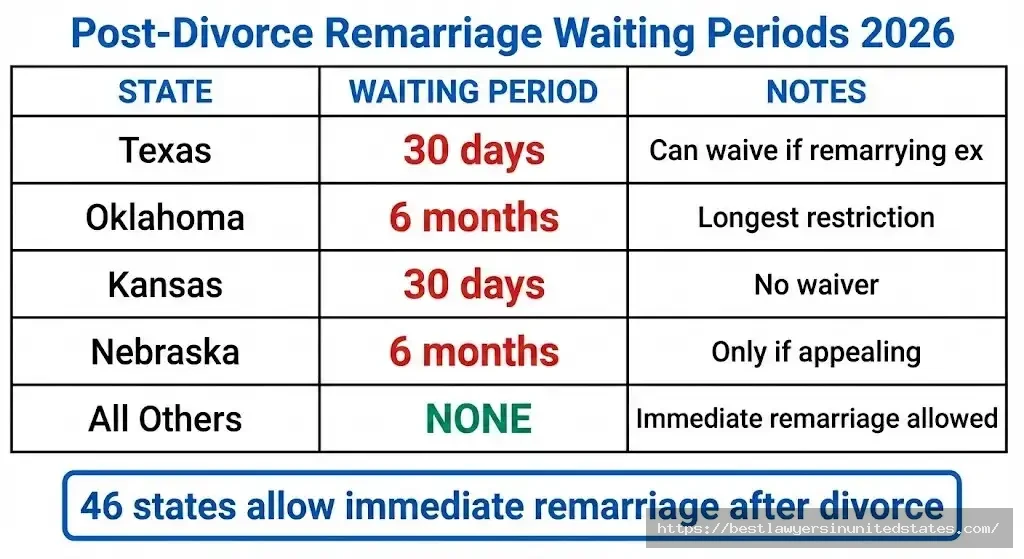
Four states restrict how quickly you can remarry after your divorce is final. This is separate from the divorce waiting period.
States with Remarriage Waiting Periods
| State | Remarriage Waiting Period | Can Be Waived? | Notes |
|---|---|---|---|
| Texas | 30 days after decree | Yes | Waived if marrying same ex-spouse |
| Oklahoma | 6 months after decree | No | Longest remarriage restriction |
| Kansas | 30 days after decree | No | Applies to both parties |
| Nebraska | 6 months | Yes | Only if appeal is filed |
Texas example:
If your Texas divorce is final on March 1, 2026, you cannot remarry until April 1, 2026. The 30-day remarriage waiting period can be waived if you’re remarrying your ex-spouse.
Total timeline to remarry in Texas:
- File petition: January 1
- Serve spouse: January 15
- 60-day divorce waiting period ends: March 16
- Divorce decree entered: March 16
- 30-day remarriage period ends: April 15
- Earliest remarriage: April 15 (104 days from filing)
Oklahoma’s 6-month rule:
Oklahoma has the longest remarriage waiting period at 6 months. If your divorce is final on January 1, you cannot remarry until July 1.
This affects estate planning and benefits. If you need to add a new spouse to health insurance or update beneficiaries, you must wait the full 6 months.
States with No Remarriage Waiting Period
Most states allow immediate remarriage once your divorce is final:
✅ California
✅ Florida
✅ New York
✅ Illinois
✅ Georgia
✅ North Carolina
✅ Virginia
✅ Arizona
✅ Washington
✅ All other states not listed above
What Happens During the Divorce Waiting Period?
The waiting period doesn’t mean you sit idle. Courts expect you to make progress on your divorce settlement during this time.
What You Can Do
Financial matters you can handle:
✅ Calculate and agree on child support payments
✅ Determine alimony amounts and duration
✅ Divide property and assets
✅ Close joint bank accounts
✅ Refinance or sell marital home
✅ Update beneficiaries on retirement accounts
Legal steps to take:
✅ Gather financial documents
✅ Complete required parenting classes
✅ Attend court-ordered mediation
✅ Negotiate custody arrangements
✅ Draft settlement agreement
✅ File additional motions if needed
Calculate your costs: Use our divorce cost calculator to estimate your total expenses including attorney fees, filing costs, and mediation.
Questions about finances during separation?
Email: [email protected]
What You Cannot Do
Legal restrictions during waiting period:
❌ Cannot remarry (bigamy)
❌ Cannot finalize divorce early (except with waiver)
❌ Cannot move children out of state without agreement
❌ Cannot hide or dispose of assets
Actions that may affect your case:
⚠️ Dating may impact alimony in fault states
⚠️ Moving affects jurisdiction and custody
⚠️ Large purchases may be questioned
⚠️ Taking children on extended trips requires notice
Can You Date During the Waiting Period?
Technically yes, but it can affect your divorce in several ways:
In fault states: Dating before divorce is final may be considered adultery. This can impact:
- Alimony awards
- Property division
- Custody decisions (if dating affects children)
In no-fault states: Dating is generally not a factor unless it affects the children or finances.
Most divorce attorneys advise clients to avoid dating until the divorce is final. The potential impact on your case usually outweighs any benefits.
Using the Waiting Period Productively
For uncontested divorces:
The waiting period gives you time to work through details without pressure. Use this time to:
- Finalize your marital settlement agreement
- Complete required paperwork
- Organize financial records
- Plan your post-divorce budget
- Consider tax implications
For contested divorces:
The waiting period often leads to settlement. As the deadline approaches, parties become more willing to negotiate. Use this time to:
- Participate in mediation sessions
- Exchange financial discovery
- Evaluate settlement offers
- Prepare for trial if necessary
Understanding how long divorce takes in your state helps you plan realistic timelines.
Calculate Your Divorce Costs
Planning your divorce budget? Our calculator estimates your total costs based on your state’s requirements and your case complexity.
Features:
- State-specific filing fees
- Attorney cost estimates
- Contested vs. uncontested comparison
- Mediation cost projections
- Total expense breakdown
The calculator factors in your state’s waiting period when estimating timeline-related costs like temporary support and attorney time.
Need help budgeting for your divorce?
Email: [email protected]
Frequently Asked Questions
What is the shortest divorce waiting period?
Quick Answer: Alaska, Nevada, and South Dakota have no mandatory waiting period after filing, making them the fastest states for divorce finalization.
Even without a waiting period, expect 2-4 weeks minimum for filing, service, and court processing. An uncontested divorce with all agreements ready can be final in under a month in these states.
What is the longest divorce waiting period?
Quick Answer: California has the longest waiting period at 6 months plus 1 day from the filing date, as required by California Family Code § 2339.
North Carolina requires 1 year of physical separation before you can even file. This makes the total timeline 12-14 months minimum. But this is a separation requirement, not a waiting period after filing.
Can I waive the divorce waiting period?
Quick Answer: It depends on your state. Colorado, Wisconsin, and Pennsylvania have mandatory periods that cannot be waived. Texas, California, and Florida allow waivers in limited circumstances.
Grounds for waiver typically include domestic violence, military deployment, or mutual agreement. Even in states that allow waivers, courts rarely grant them. Filing a motion to waive requires evidence and often a court hearing.
When does the divorce waiting period start?
Quick Answer: In most states, the waiting period starts when your spouse is served with divorce papers. California, Massachusetts, and Vermont count from the filing date instead.
This distinction can add 2-4 weeks to your timeline. Service typically takes 1-3 weeks depending on your spouse’s cooperation. Knowing when your clock starts helps you schedule your final hearing accurately.
Why is there a 60-day waiting period for divorce?
Quick Answer: States created 60-day waiting periods to allow time for reconciliation, complete required mediation or parenting classes, and process court paperwork.
Texas, Arizona, Kansas, and other states use 60 days as a cooling-off period. The idea is that some couples might reconsider during this time. Courts also use the period for administrative processing and mandatory programs.
Why is there a 6-month waiting period for divorce in California?
Quick Answer: California’s 6-month waiting period exists to encourage reconciliation and give courts time to handle complex property division cases in a community property state.
California Family Code § 2339 established this period decades ago when divorces were more difficult to obtain. The law remains in place despite modern no-fault divorce. The 6-month period also helps couples organize finances in a state where all marital assets are split 50/50.
Can I get divorced immediately?
Quick Answer: No state allows completely immediate divorce, but Alaska, Nevada, and Wyoming can finalize uncontested divorces in 2-4 weeks if all requirements are met.
Even the fastest divorces require time for filing paperwork, serving your spouse, and court processing. If you meet residency requirements and have an uncontested divorce with complete agreements, these states offer the quickest path.
What states have no divorce waiting period?
Quick Answer: Seventeen states have no mandatory waiting period: Alaska, Delaware, Hawaii, Idaho, Illinois, Louisiana, Minnesota, Montana, Nevada, New Hampshire, New Jersey, New York, Oregon, South Dakota, West Virginia, and Wyoming.
These states still require time for service and court processing. Illinois requires 90 days of residency before filing. Nevada requires 6 weeks of residency. Having no waiting period doesn’t mean instant divorce.
How do I calculate my divorce waiting period?
Quick Answer: Use our divorce waiting period calculator above, or count the days from either your filing date or service date depending on your state’s law.
States that count from filing: California, Massachusetts, Vermont, Pennsylvania. States that count from service: Texas, Arizona, Kansas, Indiana, Kentucky. Check your state’s specific statute to confirm when your clock starts.
Can I remarry during the divorce waiting period?
Quick Answer: No. Remarrying before your divorce is final is bigamy, a criminal offense in all states.
You must wait until you receive your final divorce decree. Even then, Texas, Oklahoma, Kansas, and Nebraska have additional remarriage waiting periods of 30 days to 6 months after the decree.
How long does it take to get divorced in [my state]?
Quick Answer: Timeline varies by state and case type. Check the comparison table above for your state’s waiting period, then add time for filing, service, and court scheduling.
Contested divorces take 6-18 months even in fast states. Uncontested divorces can be final in 1-3 months in states with no waiting period. Your total timeline = residency requirement + filing/service time + waiting period + court processing.
Do all states have divorce waiting periods?
Quick Answer: No. Seventeen states have no mandatory waiting period after filing for divorce.
However, even states without waiting periods have time requirements for service and court processing. Some states like North Carolina and Virginia require separation before filing instead of waiting after filing.
What’s the difference between a waiting period and a separation period?
Quick Answer: A waiting period occurs AFTER filing and before finalization. A separation period is required BEFORE you can file for divorce.
Waiting period example: Texas requires 60 days after filing before divorce is final.
Separation period example: North Carolina requires 1 year of living apart before you can file.
These are completely different requirements. North Carolina couples must separate first, wait a year, then file. Their total timeline is longer than states with just a waiting period.
Can domestic violence shorten the waiting period?
Quick Answer: Yes, in some states. California, Texas, and Florida may waive or shorten waiting periods in documented domestic violence cases.
You typically need a restraining order, police reports, or other evidence. File a motion to waive the waiting period explaining the safety concerns. Courts review these requests seriously but still approve them rarely.
Does the waiting period apply to legal separation?
Quick Answer: Most states have no waiting period for legal separation, only for divorce.
Legal separation can begin immediately in most jurisdictions. The waiting period applies when you want to convert the separation to a divorce or file for divorce directly. Check your state’s specific requirements for both processes.
Next Steps: Planning Your Divorce Timeline
Now that you understand waiting periods, take these steps to move forward:
During your research phase:
- Verify your state’s exact waiting period statute
- Calculate your estimated finalization date
- Budget for divorce costs using our calculator
- Understand your state’s divorce process
- Learn about grounds for divorce in your state
Before filing:
- Meet residency requirements
- Gather financial documents
- Research divorce filing fees in your county
- Decide between contested and uncontested
- Consider DIY divorce if appropriate
During the waiting period:
- Complete required parenting classes
- Attend mediation sessions
- Calculate child support if needed
- Determine alimony amounts
- Draft your settlement agreement
- Prepare for final hearing
After the waiting period:
- File for final hearing date
- Submit final divorce papers
- Attend hearing if required
- Receive divorce decree
- Update legal documents
- File for name change if desired
Understanding your state’s waiting period is just one part of the divorce process. The better prepared you are, the smoother your case will proceed. Use the resources and calculators on this page to plan your timeline and budget accurately.
Questions about your divorce timeline or need legal help?
Email: [email protected]