
Getting divorced when you have kids adds layers of complexity that childless couples never face. You need to deal with custody arrangements, child support calculations, parenting plans, and protecting your children’s emotional well-being. The average divorce with children costs between $3,000 and $50,000+ depending on whether you agree on custody and support.
This guide covers everything you need to know about divorcing when you have minor children. You’ll learn about custody types, filing requirements, cost breakdowns, and how to help your kids cope during this difficult time.
What Gets Decided in a Divorce with Children?
When you file for divorce with minor children, courts must resolve several issues beyond ending your marriage. The judge determines custody arrangements, child support payments, parenting time schedules, property division, and who carries health insurance for the kids.
Legal Custody vs Physical Custody
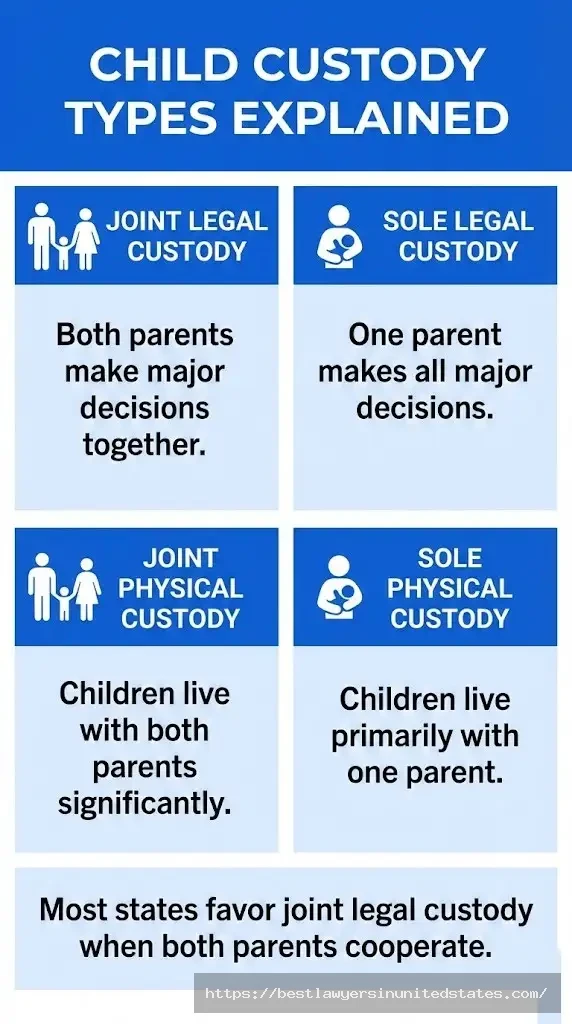
Legal custody means who makes major decisions about education, healthcare, and religious upbringing. Physical custody determines where children live day-to-day. Both types can be joint (shared between parents) or sole (one parent only).
| Custody Type | What It Means | Decision-Making |
|---|---|---|
| Joint Legal Custody | Both parents share major decisions | Both parents must agree |
| Sole Legal Custody | One parent makes all major decisions | One parent decides alone |
| Joint Physical Custody | Children live with both parents for significant time | Split living arrangement |
| Sole Physical Custody | Children live primarily with one parent | One primary residence |
Most states favor joint legal custody when both parents can cooperate. Physical custody depends on work schedules, school locations, and what serves the children’s best interests.
Child Support and Parenting Plans
Courts order the non-custodial parent to pay child support that covers living expenses, healthcare, education, and extracurricular activities. Every state uses different formulas based on parental income and custody time.
You must also submit a detailed parenting plan outlining holidays, weekends, school breaks, and summer vacation schedules. The court reviews your plan to verify it serves your children’s needs.
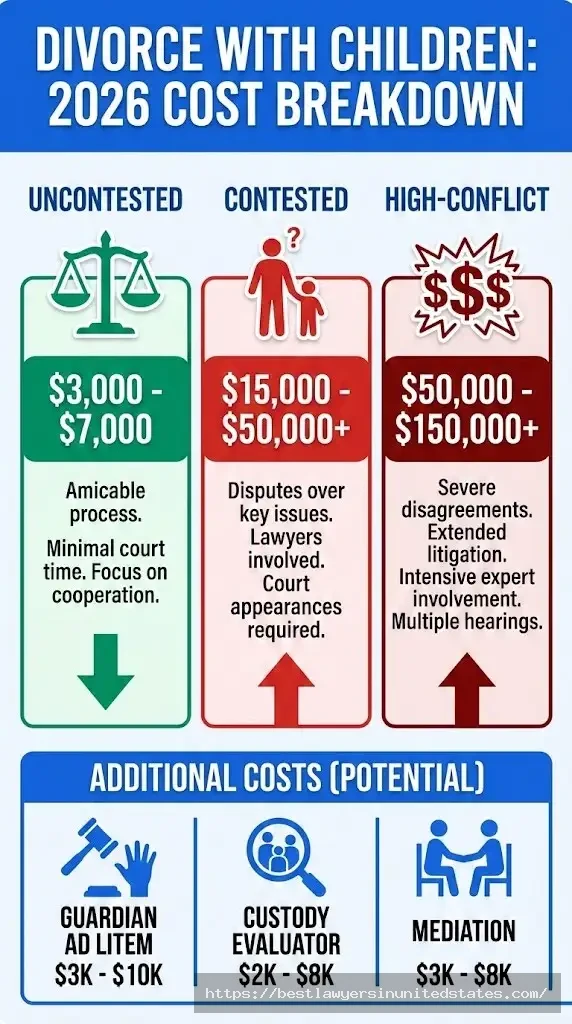
How Much Does Divorce with Children Cost?
Quick Answer: Uncontested divorce with children costs $3,000 to $7,000 on average. Contested divorce with custody disputes costs $15,000 to $50,000+. High-conflict custody battles can exceed $100,000.
The total depends on your state’s filing fees, whether you hire an attorney, custody complexity, and how much you disagree with your spouse.
Uncontested Divorce with Children Costs
When both parents agree on custody, parenting time, and child support, costs stay relatively low. You can use our divorce cost calculator to estimate expenses for your specific situation.
| Cost Type | Average Cost | Range | Notes |
|---|---|---|---|
| Filing Fees | $200-$435 | Varies by state | One-time court fee |
| Attorney Fees | $1,500-$3,000 | Flat fee typical | Optional for uncontested |
| Mediation | $100-$300/hr | 2-5 sessions | Helps create parenting plan |
| Parenting Classes | $25-$100 | Per parent | Mandatory in most states |
| Total Uncontested | $3,000-$7,000 | DIY to full attorney | Average with agreement |
You can reduce costs by handling paperwork yourself using state-provided forms. Many states offer DIY divorce guides with step-by-step instructions for parents who agree on all terms.
Contested Divorce with Children Costs
When you disagree about custody or support, costs skyrocket due to court hearings, attorney time, and expert evaluations.
Contested divorce expenses:
✅ Filing fees: $200-$435 depending on state
✅ Attorney retainer: $5,000-$10,000 upfront
✅ Hourly attorney rates: $250-$500/hour
✅ Guardian ad litem: $3,000-$10,000 for custody investigation
✅ Custody evaluator: $2,000-$8,000 for psychological assessment
✅ Court costs: $500-$2,000 for hearings and motions
✅ Expert witnesses: $2,000-$5,000 per expert
Key cost driver: The more you fight over custody and support, the higher your legal bills climb. Most divorce attorney fees range from $15,000 to $30,000 for contested cases with children.
Ways to Reduce Divorce Costs
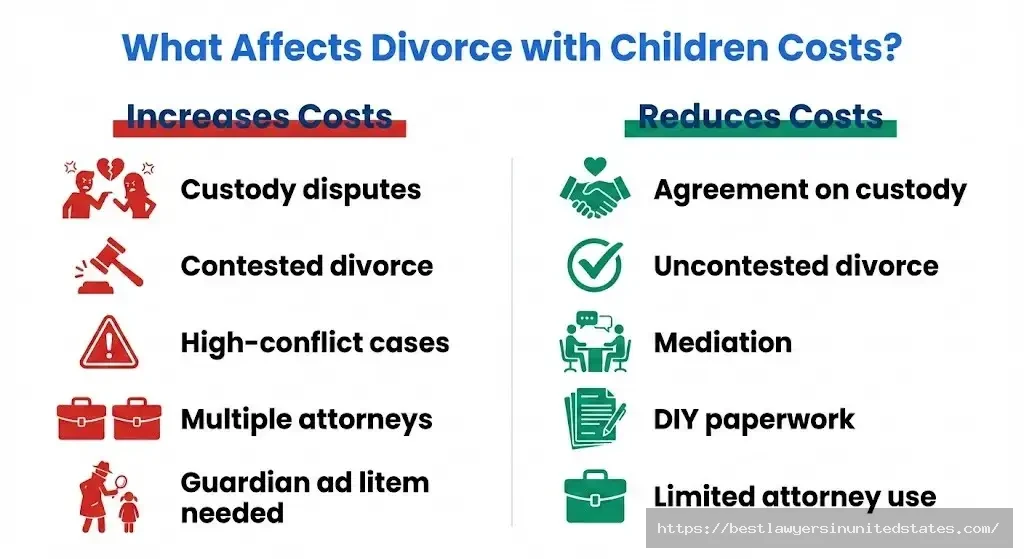
Consider divorce mediation: Hiring a neutral mediator costs $3,000-$8,000 total, far less than litigation. Both parents work together to create custody and support agreements. Check divorce mediation costs for detailed pricing.
File fee waivers: If you earn below certain income thresholds, you can request the court waive divorce filing fees. Most states require proof of income and expenses.
Limited scope representation: Hire an attorney for specific tasks like reviewing documents or attending one hearing. This costs much less than full representation.
Calculate Your Divorce Costs
Planning a divorce? Use our free calculator to estimate total costs based on your state’s filing fees, typical attorney rates, and whether your divorce is contested or uncontested.
Divorce Cost Calculator
Get an estimated cost for your divorce based on your specific situation
Your Estimated Divorce Cost
Cost Breakdown
📧 Get a Personalized Consultation
Have questions about your specific situation? Contact our legal experts for guidance tailored to your needs.
Contact Us via EmailCalculator features:
- State-specific filing fees
- Attorney cost estimates by complexity
- Contested vs uncontested comparison
- Total cost breakdown
- Money-saving tips for your situation
Questions about your divorce or need legal help? Find divorce lawyers near you for free consultation.
Email: [email protected]
Types of Divorce When You Have Children
Choosing the right divorce type affects your timeline, costs, and stress level. The main options are uncontested, contested, and mediated divorces.
Uncontested Divorce with Children
Uncontested divorce means you and your spouse agree on custody, parenting time, child support, and property division. You submit a signed agreement to the court.
Benefits: Faster timeline (2-6 months), lower costs ($3,000-$7,000), less stress for children, more control over outcomes.
Requirements: Both parents must cooperate, sign all paperwork, and agree on all major issues before filing.
Contested Divorce with Children
Contested divorce happens when you disagree about custody, support, or other terms. The judge makes final decisions after reviewing evidence and testimony.
Challenges: Longer timeline (12-24+ months), higher costs ($15,000-$50,000+), more stress for children, unpredictable outcomes.
When necessary: Domestic violence concerns, one parent unfit, major disagreements about custody or support.
Divorce Mediation with Children
Both parents work with a neutral mediator to negotiate custody, support, and property division outside court. The mediator helps you reach agreements but doesn’t make decisions.
Cost savings: $3,000-$8,000 total vs $15,000+ for contested litigation.
Best for: Parents who can communicate civilly but need help structuring agreements.
Child Custody Explained
Courts decide custody based on what serves the children’s best interests. Understanding custody types helps you plan for negotiations or court hearings.
Joint Custody vs Sole Custody
Joint legal custody means both parents share decision-making authority for education, healthcare, and religion. This is the default in most states when both parents are fit.
Sole legal custody gives one parent full decision-making power. Courts only grant this when the other parent is unfit due to abuse, addiction, or abandonment.
Joint physical custody means children spend significant time living with each parent. The exact split varies but often ranges from 60/40 to 50/50.
Sole physical custody means children live primarily with one parent while the other gets visitation rights.
Best Interests of the Child Factors
Courts use specific factors to determine what custody arrangement serves children’s needs:
✅ Child’s age and developmental needs
✅ Each parent’s ability to provide stable housing
✅ Child’s relationship with each parent
✅ Parents’ mental and physical health
✅ History of domestic violence or abuse
✅ Child’s preference (if age-appropriate)
✅ Each parent’s work schedule and availability
✅ Siblings’ custody arrangements
Key point: Courts prioritize stability and continuity in children’s lives over parents’ preferences.
Who Gets the House in Divorce with Children?
Courts often award the family home to the parent with primary physical custody. This lets children stay in familiar schools and neighborhoods.
The non-custodial parent may receive other assets to balance the property division. In community property states, you might need to refinance or sell the house to split equity fairly.
How to File for Divorce with Children
Filing for divorce with children requires additional paperwork beyond standard divorce forms. The process varies by state but follows similar steps.
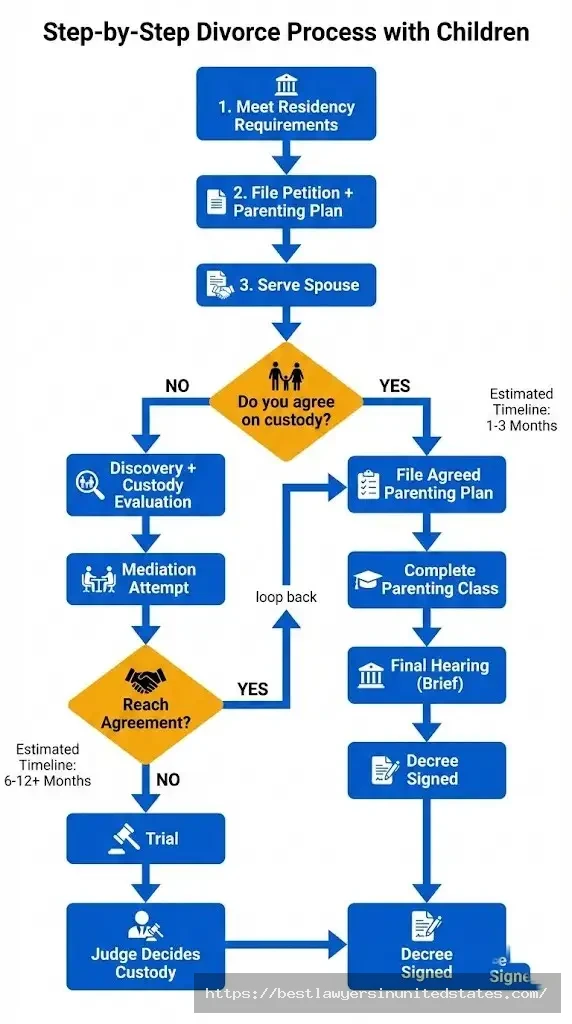
Step 1: Meet Residency Requirements
Most states require you or your spouse to live in the state for 6 months to 1 year before filing. You must also live in your county for 30-90 days.
Examples: Texas requires 6 months in state and 90 days in county. California requires 6 months in state. Nebraska requires 1 year.
Step 2: Gather Required Documents
Divorce petition documents:
✅ Petition for dissolution of marriage
✅ Summons for your spouse
✅ Proposed parenting plan
✅ Financial affidavit showing income and expenses
✅ Child support calculation worksheet
✅ Certificate of completion for parenting class
Most states provide free forms on family court websites. You can also use online divorce services that complete paperwork for you.
Step 3: File Petition and Pay Fees
Submit your petition to the family court clerk in your county. You must pay filing fees ranging from $150 to $435 depending on your state.
Cannot afford fees? Request a fee waiver by submitting proof of low income. Courts waive fees for people below certain income thresholds.
Step 4: Serve Your Spouse
You must officially notify your spouse about the divorce by delivering copies of all filed documents. Options include:
- Personal service by sheriff or process server ($50-$150)
- Certified mail with return receipt ($10-$20)
- Voluntary appearance form signed by spouse (free)
Your spouse has 20-30 days to file a response depending on your state.
Step 5: Complete Parenting Education Class
Most states require both parents to attend a parenting class focused on helping children through divorce. Classes cost $25-$100 per person and take 4-6 hours.
You receive a certificate of completion that must be filed before finalizing your divorce.
Step 6: Attend Hearings and Finalize
Uncontested cases: You may attend one brief hearing where the judge reviews your agreement and signs the final decree.
Contested cases: You attend multiple hearings for temporary orders, discovery disputes, and trial. The judge makes final custody and support decisions.
Understanding how long divorce takes helps you plan for the months ahead while managing your children’s expectations.
Child Support: What You Need to Know
Every state requires the non-custodial parent to pay child support that helps cover the children’s basic needs. Payment amounts follow state guidelines based on both parents’ incomes.
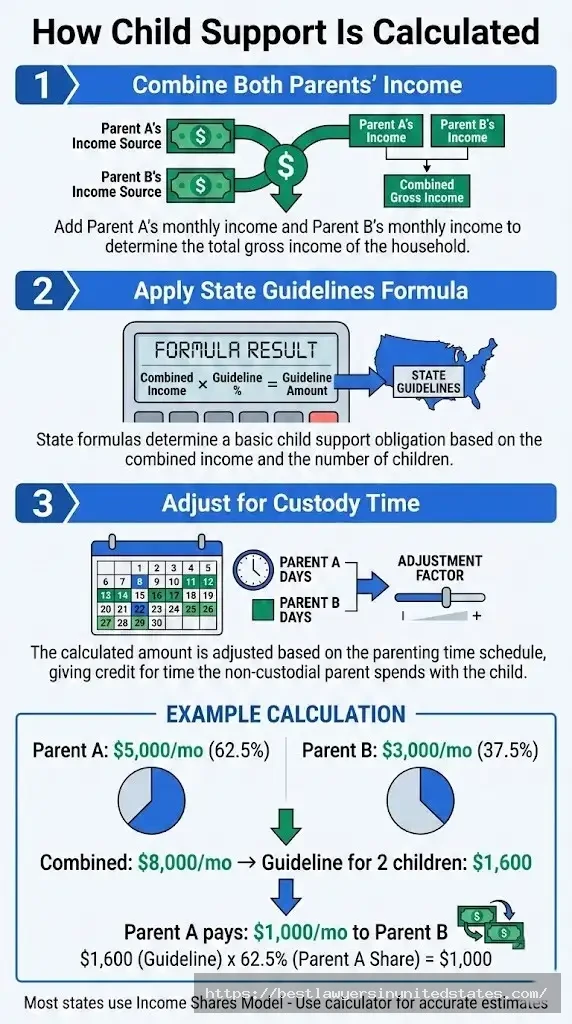
How Child Support Is Calculated
Most states use an income shares model that considers both parents’ gross income and the number of children. The formula calculates how much two-parent households typically spend on children, then splits that amount based on each parent’s income percentage.
Example calculation:
- Combined parental income: $8,000/month
- Parent A earns $5,000 (62.5%)
- Parent B earns $3,000 (37.5%)
- Guideline amount for 2 children: $1,600/month
- Parent A’s obligation: $1,000/month (62.5% of $1,600)
- Parent B’s obligation: $600/month (37.5% of $1,600)
If Parent B has primary custody, Parent A pays $1,000/month. The $600 Parent B would owe is considered paid through daily caregiving.
Adjustments for custody time: If you have joint physical custody with significant parenting time, your child support may be reduced to reflect shared expenses.
Calculate Child Support
Have children? Our calculator estimates child support payments based on state-specific guidelines, both parents’ incomes, and custody arrangements.
Calculator features:
- State-specific child support formulas
- Income shares model calculations
- Custody time adjustments
- Additional expense estimates
Questions about child support or need legal help? Find family law attorneys for free consultation.
Email: [email protected]
What Child Support Covers
Basic child support covers:
✅ Food, clothing, and shelter
✅ School supplies and fees
✅ Basic healthcare costs
✅ Transportation expenses
✅ Childcare while parents work
Additional expenses split separately:
✅ Uninsured medical and dental bills
✅ Extracurricular activities
✅ Private school tuition
✅ College expenses (in some states)
The court order specifies which parent pays each additional expense or sets a percentage split.
Modifying Child Support
You can request modification when circumstances change significantly. Valid reasons include job loss, major income changes, children’s increased needs, or custody changes.
Most states require at least 15-20% income change before modifying support. You must file a motion with the court and prove changed circumstances.
Property Division When You Have Children
Dividing assets and debts becomes more complex when children are involved. Courts consider children’s housing stability and educational needs.
Who Gets the Family Home?
The parent with primary physical custody often receives the family home. This lets children stay in familiar schools and neighborhoods.
Options for splitting home equity:
✅ Buy out spouse’s share through refinancing
✅ Offset home equity with retirement accounts or other assets
✅ Delay sale until children graduate high school
✅ Sell immediately and split proceeds
Courts also consider each parent’s ability to afford mortgage payments and maintenance costs.
Dividing Other Assets and Debts
Community property states (CA, TX, AZ, NV, WA, ID, LA, NM, WI) split marital assets 50/50 regardless of who earned more.
Equitable distribution states split assets fairly but not necessarily equally. Courts consider marriage length, each spouse’s income, and contributions to marital property.
Check state-specific divorce laws through our divorce laws by state guide for detailed property division rules.
College Savings and Education Accounts
Courts decide who controls 529 plans and how to split balances. Some states require parents to contribute to college costs while others do not.
You can negotiate college funding as part of your marital settlement agreement even if not legally required.
How Long Does Divorce with Children Take?
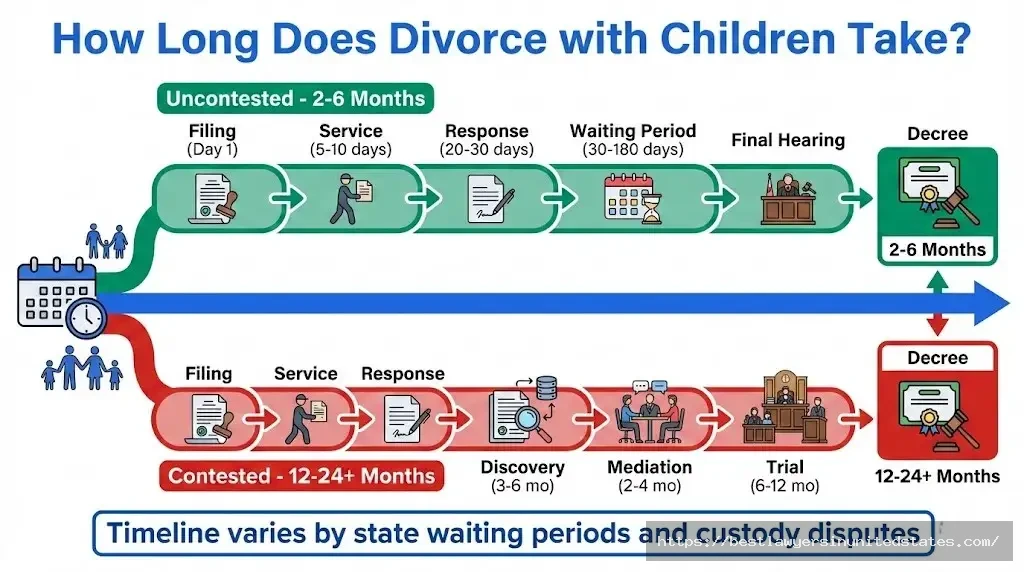
Quick Answer: Uncontested divorce with children takes 2-6 months. Contested divorce with custody disputes takes 12-24+ months.
Timeline depends on your state’s waiting period, court backlog, and whether you agree on custody and support.
Divorce Timeline by Type
| Stage | Uncontested | Contested | Notes |
|---|---|---|---|
| Filing | Day 1 | Day 1 | Submit petition to court |
| Service | 5-10 days | 5-10 days | Deliver papers to spouse |
| Response | 20-30 days | 20-30 days | Spouse files answer |
| Waiting Period | 30-180 days | 30-180 days | State-mandated minimum |
| Discovery | N/A | 3-6 months | Exchange financial info |
| Mediation | 1-2 months | 2-4 months | Negotiate agreements |
| Trial | N/A | 6-12 months | If no settlement |
| Total | 2-6 months | 12-24+ months | Average timeline |
States like California require 6-month waiting periods before finalizing divorce. Texas requires 60 days. Some states have no waiting period for uncontested cases.
Factors That Delay Divorce
Common delays:
✅ Spouse avoiding service or not responding
✅ Disagreements over custody and support
✅ Complex property division issues
✅ Court backlog and scheduling conflicts
✅ Need for custody evaluations or investigations
✅ One parent relocating with children
You can speed up the process by agreeing to terms outside court, responding to all requests promptly, and keeping communications focused on children’s needs.
Is It Better to Stay Together for the Kids or Divorce?
Quick Answer: Research shows children do better after divorce than staying in high-conflict marriages. Kids in low-conflict marriages benefit when parents stay together.
The decision depends on your specific situation and whether staying married causes more harm than divorcing.
When Divorce Is the Healthier Choice
Children suffer when exposed to constant fighting, tension, and hostility between parents. Studies show these effects:
Staying in high-conflict marriage:
✅ Higher anxiety and depression in children
✅ Poor academic performance
✅ Difficulty forming healthy relationships as adults
✅ Increased behavioral problems
Divorcing from high-conflict marriage:
✅ Reduced exposure to parental conflict
✅ More stability with clear custody schedule
✅ Better mental health outcomes long-term
✅ Modeling healthy boundaries for children
Key factor: How you handle the divorce matters more than the divorce itself. Children thrive when parents cooperate and avoid putting kids in the middle.
When Staying Together Makes Sense
If your marriage has fixable problems and you can co-parent effectively, staying together may benefit children. Consider couples therapy before deciding to divorce.
Low-conflict marriages provide children with stability, two-parent household benefits, and modeling of working through difficulties.
How to Tell Your Children About Divorce
Telling children about divorce ranks among parents’ hardest conversations. Preparation and honesty help children process the news.
Plan the Conversation
Best practices:
✅ Tell children together with your spouse if possible
✅ Choose a calm time with no distractions
✅ Keep explanations simple and age-appropriate
✅ Avoid blaming the other parent
✅ Reassure children they did nothing wrong
✅ Let them know both parents still love them
What to say: “Mom and Dad have decided we’ll be happier living in separate homes. This is a decision between adults and has nothing to do with you. We both love you very much and will always be your parents.”
What Not to Say
Avoid these mistakes:
✅ Sharing adult details about why you’re divorcing
✅ Blaming your spouse or discussing their faults
✅ Making children pick sides or choose favorites
✅ Asking children to keep secrets from the other parent
✅ Using children as messengers between parents
✅ Making promises you cannot keep
Age-Appropriate Conversations
Young children (3-5): Keep explanations very simple. “Mommy and Daddy will live in different houses but we both love you.”
School-age (6-12): Provide more details about living arrangements and schedules. Answer questions honestly but age-appropriately.
Teenagers (13+): They can handle more information but still need reassurance. Respect their feelings even if they seem angry or withdrawn.
Helping Children Cope with Divorce
Most children experience sadness, anger, confusion, and anxiety during divorce. Your support helps them adapt to changes.
Normal Reactions by Age
Preschoolers (3-5):
- Regression (bedwetting, thumb-sucking)
- Increased clinginess or separation anxiety
- Tantrums and behavioral outbursts
School-age (6-12):
- Sadness and crying
- Anger at one or both parents
- Declining grades or school problems
- Withdrawal from friends
Teenagers (13-18):
- Depression or anxiety
- Acting out or risky behaviors
- Taking sides with one parent
- Mature too quickly by parenting younger siblings
These reactions typically improve within 6-12 months as children adjust to new routines.
Signs Your Child Needs Professional Help
Red flags requiring therapy:
✅ Depression lasting more than 2-3 months
✅ Severe anxiety or panic attacks
✅ Sudden drop in school performance
✅ Substance use or self-harm behaviors
✅ Eating disorder symptoms
✅ Complete withdrawal from activities and friends
✅ Aggressive or violent behavior
Contact your pediatrician for mental health referrals. Many children benefit from therapy during major life transitions.
Maintaining Stability and Routines
Help children adjust by:
✅ Keeping consistent bedtimes and meal schedules
✅ Maintaining the same school and activities
✅ Following similar rules at both households
✅ Creating new family traditions
✅ Regular communication between parents about children’s needs
Children feel more secure when daily life remains predictable despite the family structure changing.
Common Mistakes Parents Make
Avoiding these errors protects your children and keeps divorce costs down.
Using Children as Messengers
Never ask children to deliver messages like “Tell your dad he needs to pay child support.” This puts kids in uncomfortable positions and damages their relationship with both parents.
Solution: Communicate directly through text, email, or co-parenting apps. Keep children completely out of adult discussions.
Bad-Mouthing the Other Parent
Speaking negatively about your ex in front of children forces them to choose sides. It damages their relationship with the other parent and creates loyalty conflicts.
Solution: Process anger and frustration with a therapist or trusted friend. Show children you respect their relationship with the other parent.
Making Children Choose Sides
Asking “Do you want to live with me or Dad?” or “Who do you like better?” puts impossible pressure on children. They love both parents and should not feel forced to pick favorites.
Solution: Let the court and professionals determine custody based on children’s needs, not their stated preferences.
Not Getting Legal Help When Needed
Some parents try handling complex custody disputes alone to save money. This often backfires when you miss important deadlines or agree to unfavorable terms.
When you need an attorney:
✅ Spouse hired a lawyer
✅ Disagreements over custody or support
✅ Domestic violence or safety concerns
✅ Complex property or business assets
✅ Spouse hiding income or assets
Check divorce attorney fees to understand typical costs in your area.
Special Situations in Divorce with Children
Certain circumstances require extra legal considerations beyond standard divorce procedures.
Divorce When Pregnant
Most states prohibit finalizing divorce while the wife is pregnant. Courts require waiting until the baby is born to establish paternity and include the child in custody orders.
Exceptions: A few states allow divorce during pregnancy if paternity is already established or the husband is not the biological father.
You can still file for divorce while pregnant. The case simply cannot be finalized until after birth.
Same-Sex Marriage with Children
Same-sex couples face unique challenges when one spouse gave birth during marriage. Some states do not automatically recognize the non-biological parent’s rights without adoption.
Protect parental rights by:
✅ Filing second-parent adoption if not done during marriage
✅ Getting court orders establishing both parents’ legal rights
✅ Working with attorneys experienced in LGBTQ+ family law
Military Divorce with Children
Military families have special protections under the Servicemembers Civil Relief Act (SCRA). Courts may delay proceedings if the service member is deployed.
Additional considerations:
✅ BAH (housing allowance) affects child support calculations
✅ Military pension division requires special orders
✅ Frequent relocations complicate custody arrangements
Learn more about military divorce requirements and protections.
Domestic Violence and Protective Orders
If you or your children face abuse, file for a protective order before or during divorce. Courts take domestic violence seriously when determining custody.
Evidence of abuse affects:
✅ Which parent gets custody
✅ Whether visitation is supervised
✅ Which parent stays in the family home
✅ How quickly the divorce proceeds
Many states offer free legal help for domestic violence victims through legal aid organizations.
Frequently Asked Questions
Can You Do Uncontested Divorce with Children?
Quick Answer: Yes, uncontested divorce with children is possible when both parents agree on custody, parenting time, and child support.
You must still file parenting plans and child support calculations even when you agree. Courts review agreements to confirm they serve children’s best interests before approving.
Who Usually Wins Child Custody?
Quick Answer: About 80% of custody cases result in mothers getting primary physical custody. However, fathers who actively pursue custody increasingly win joint or primary arrangements.
Courts decide based on children’s best interests, not gender. Fathers who show active involvement in children’s lives and can provide stable homes have strong custody cases.
At What Age Does Divorce Affect a Child the Most?
Quick Answer: Children aged 6-12 often struggle most with divorce as they understand what’s happening but lack coping skills that teens develop.
Preschoolers adapt more easily with consistent routines. Teenagers may act out but generally have better emotional tools. Every child responds differently regardless of age.
What Is the Biggest Mistake During a Divorce?
Quick Answer: Using children as messengers or weapons against your ex is the most damaging mistake.
This forces children to choose sides and damages relationships with both parents. Keep children completely out of adult conflicts and disagreements.
Who Gets the House in Divorce with Children?
Quick Answer: The parent with primary physical custody typically gets the family home so children can stay in familiar schools and neighborhoods.
The other parent may receive offsetting assets like retirement accounts. Some couples sell the house and split proceeds if neither can afford to keep it.
How Much Does Divorce with Children Cost?
Quick Answer: Uncontested divorce with children costs $3,000-$7,000 average. Contested divorce with custody disputes costs $15,000-$50,000+.
Costs depend on your state’s filing fees, whether you hire an attorney, and how much you fight over custody and support. Use our divorce cost calculator for personalized estimates.
Can I File for Divorce If Pregnant?
Quick Answer: Yes, you can file for divorce while pregnant, but most states prohibit finalizing it until after the baby is born.
Courts need to establish paternity and include the newborn in custody and support orders before issuing final decrees.
What If My Spouse Won’t Sign Divorce Papers?
Quick Answer: You can still get divorced if your spouse refuses to cooperate through divorce without spouse signature.
After properly serving your spouse, you wait for their response deadline to pass. Then you request a default judgment where the judge grants divorce based on your proposed terms.
How Long Does Divorce with Children Take?
Quick Answer: Uncontested divorce with children takes 2-6 months on average. Contested divorce with custody battles takes 12-24+ months.
Timeline depends on your state’s waiting period requirements and whether you agree on custody and support terms.
Do I Need a Lawyer for Divorce with Children?
Quick Answer: You don’t legally need a lawyer, but hiring one is wise for any contested custody issues or complex assets.
You can handle simple uncontested divorces yourself using state forms. Consider hiring an attorney if your spouse has a lawyer or you disagree about custody.
How Is Child Support Calculated?
Quick Answer: Most states use income shares models that calculate child support based on both parents’ gross income and number of children.
The formula determines how much two-parent households typically spend on children, then splits that amount based on each parent’s income percentage. Use our calculator for state-specific estimates.
Can Child Support Be Modified?
Quick Answer: Yes, you can request modification when income changes significantly (usually 15-20%+) or children’s needs change.
You must file a motion with the court proving changed circumstances. The judge reviews current finances and decides whether modification is appropriate.
What Are Grounds for Divorce?
Quick Answer: All states now offer no-fault divorce based on irreconcilable differences, meaning you don’t need to prove wrongdoing.
Some states still allow fault-based grounds like adultery, abuse, or abandonment. However, no-fault divorces are faster and less expensive.
How Do I Find Divorce Records?
Quick Answer: Contact the clerk’s office in the county where the divorce was filed to request copies of divorce decrees and related documents.
Most states charge $10-$50 for certified copies. Some counties offer online access to recent divorce records.
Protecting Your Children Through Divorce
Divorce changes your family structure but doesn’t have to harm your children long-term. Research shows kids thrive after divorce when parents cooperate and prioritize their needs above conflict.
Key actions that help children:
✅ Maintain consistent routines between households
✅ Keep children completely out of adult conflicts
✅ Never bad-mouth the other parent
✅ Support children’s relationship with both parents
✅ Seek professional help if children show signs of distress
✅ Communicate directly with your ex about parenting issues
Most children adjust within 6-12 months when parents handle divorce responsibly. Focus on co-parenting effectively and your children will adapt to the new family structure.
If you’re ready to file for divorce or need help understanding the divorce process, consult with a family law attorney who can explain your state’s specific requirements and protect your parental rights.
Use our calculators to estimate divorce costs, child support, and other financial impacts. Understanding the numbers helps you plan for your family’s financial future after divorce.
For personalized legal advice, contact experienced family law attorneys through our divorce lawyer directory. Many offer free initial consultations to discuss your situation and options.
Email: [email protected]